

Income Tax Return Filing 2026: Step-by-Step Guide for Salaried Employees, Freelancers & Business Owners
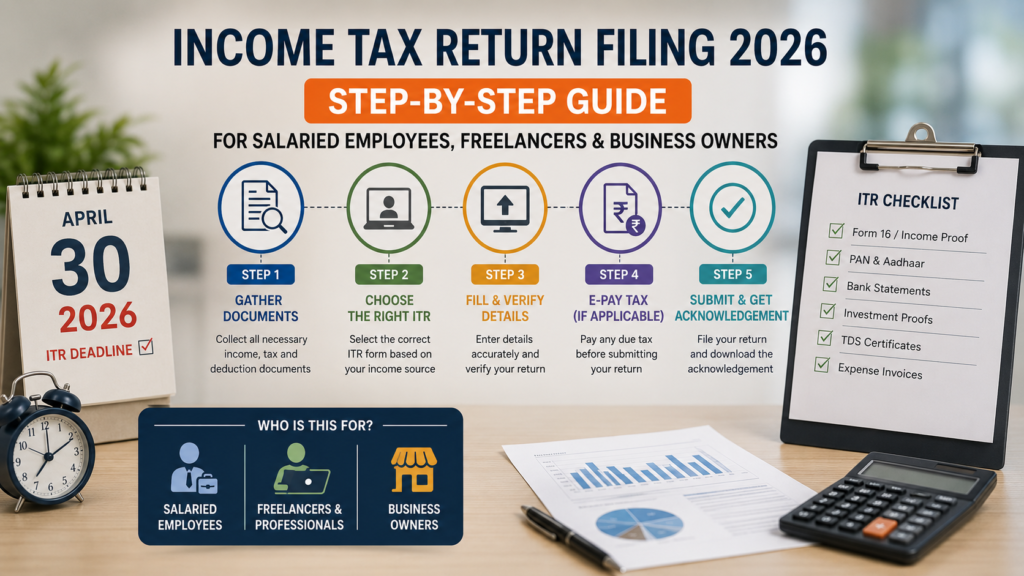
TL;DR Income Tax Return (ITR) filing is an essential annual compliance requirement for eligible taxpayers in India. Whether you’re a salaried employee, freelancer, professional, startup founder, or business owner, filing your return accurately and on time helps avoid penalties, claim refunds, maintain financial credibility, and ensure compliance with tax laws. This guide walks you through the complete ITR filing process for 2026. Understanding Income Tax Return Filing Every financial year, eligible taxpayers are required to report their income, deductions, taxes paid, and other financial details to the Income Tax Department by filing an Income Tax Return (ITR). An ITR is more than just a tax compliance document—it serves as proof of income and financial responsibility. It is often required when applying for loans, visas, government tenders, credit facilities, and various financial transactions. With increasing digital integration through the Income Tax e-Filing Portal, AIS, Form 26AS, and pre-filled returns, accurate filing has become easier—but also demands careful verification of financial information. Who Should File an Income Tax Return? Filing an Income Tax Return may be mandatory or beneficial depending on your income, business activities, and financial transactions. The following categories generally need to file ITR: Salaried Employees Individuals earning salary income above the applicable exemption limits or meeting prescribed filing conditions should file an Income Tax Return. Freelancers & Consultants Professionals providing services independently are required to report their business or professional income and comply with tax provisions applicable to them. Business Owners Proprietorships, partnership firms, LLPs, and companies must comply with applicable income tax filing requirements based on their business structure and legal obligations. Self-Employed Professionals Doctors, architects, lawyers, chartered accountants, designers, and other professionals should report their professional income through the appropriate ITR forms. Investors Individuals earning income from capital gains, dividends, interest, rental income, or foreign assets may also need to file returns depending on applicable provisions. Why Filing Your ITR Is Important Many taxpayers believe ITR filing is necessary only when tax is payable. In reality, timely filing offers several important benefits. Legal Compliance Filing your return helps you comply with the provisions of the Income-tax Act and reduces the likelihood of penalties or notices. Easier Loan Approvals Banks and financial institutions often ask for ITR acknowledgements while processing home loans, personal loans, education loans, or business finance. Faster Refund Processing If excess tax has been deducted through TDS or advance tax, filing your return is essential to claim the refund. Proof of Income ITRs serve as an accepted proof of income for visa applications, government tenders, and financial transactions. Carry Forward of Eligible Losses Timely filing may allow eligible business or capital losses to be carried forward in accordance with tax provisions. Improved Financial Credibility Regular tax compliance demonstrates financial discipline and enhances credibility with lenders, investors, and business partners. Documents Required for Income Tax Return Filing Keeping all documents ready before filing helps avoid delays and errors. Commonly required documents include: PAN Card Aadhaar Card Form 16 (for salaried employees) Form 26AS Annual Information Statement (AIS) Taxpayer Information Summary (TIS) Salary slips Bank statements Interest certificates Investment proofs Home loan certificate Capital gains statements Rental income records Business financial statements GST records (where applicable) TDS certificates Previous year’s ITR Choosing the Correct ITR Form Selecting the right ITR form is one of the most important steps in the filing process. The applicable form depends on factors such as: Nature of income Employment status Business or professional income Capital gains Foreign assets Agricultural income Presumptive taxation eligibility Using an incorrect ITR form may result in defective return notices or processing delays. Step-by-Step Income Tax Return Filing Process Step 1: Collect Financial Documents Gather all income, investment, and tax-related documents before starting the filing process. Step 2: Verify Form 26AS, AIS & TIS Cross-check the tax deducted, financial transactions, and reported income to ensure consistency with your records. Step 3: Calculate Total Income Include income from all applicable sources, such as salary, business or profession, house property, capital gains, and other sources. Step 4: Claim Eligible Deductions Review deductions available under the applicable tax regime and ensure all eligible claims are supported by proper documentation. Step 5: Select the Correct ITR Form Choose the appropriate return form based on your income profile and filing requirements. Step 6: Complete the Return Enter accurate personal details, income information, deductions, taxes paid, and bank account details. Step 7: Verify Tax Liability Check whether any additional tax is payable or whether a refund is due before submitting the return. Step 8: Submit and E-Verify the Return Complete the filing process by electronically verifying your return through the approved verification methods. Common Mistakes During ITR Filing Even small errors can delay processing or trigger notices. Avoid mistakes such as: Selecting the wrong ITR form. Ignoring AIS or Form 26AS mismatches. Omitting income from bank interest or capital gains. Claiming unsupported deductions. Providing incorrect bank account details. Failing to e-verify the return after submission. Waiting until the last date to file. Accurate preparation and careful review help ensure smooth processing. Why Hire a Chartered Accountant for Income Tax Return Filing? Although the Income Tax e-Filing Portal has made online filing more convenient, preparing an accurate Income Tax Return requires much more than simply filling out an online form. Every taxpayer’s financial situation is unique, and even small mistakes can lead to delayed refunds, notices from the Income Tax Department, or additional tax liabilities. A qualified Chartered Accountant helps ensure that your return is accurate, compliant, and optimized within the framework of applicable tax laws. A Chartered Accountant Can Help You: Select the correct ITR form. Verify Form 26AS, AIS, and TIS. Calculate taxable income accurately. Identify eligible deductions and exemptions. Report capital gains correctly. Handle business and professional income. Prepare depreciation schedules. Calculate advance tax liabilities. File revised or updated returns when necessary. Respond to Income Tax notices. Provide tax planning strategies for future financial years. Professional guidance is particularly valuable for freelancers, consultants, startups, companies, and individuals with multiple income
Internal Audit vs Statutory Audit: Which One Does Your Business Need?
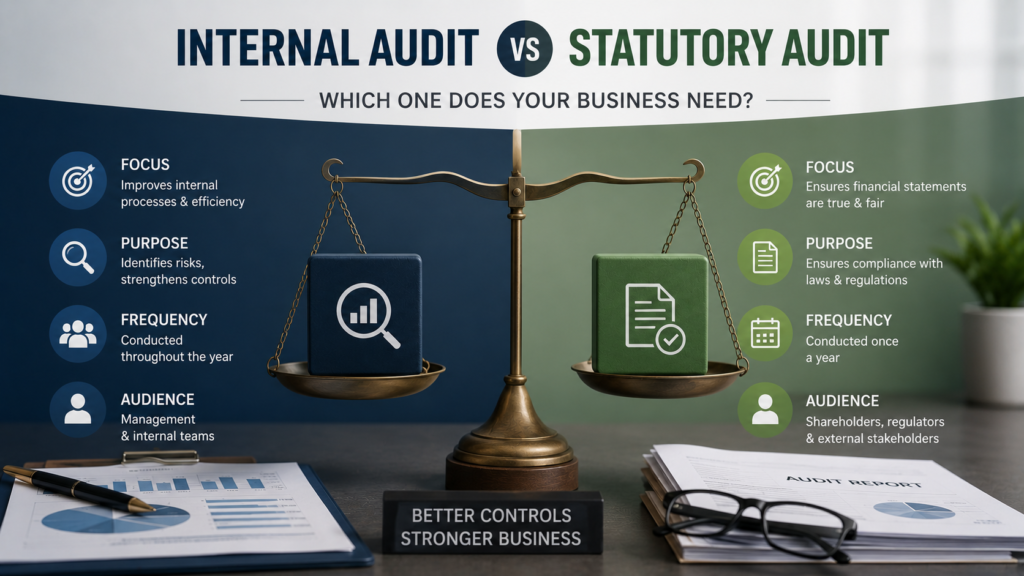
TL;DR Internal audits help businesses improve operations, strengthen internal controls, and identify risks before they become costly problems. Statutory audits are legally mandated for eligible entities to ensure financial statements present a true and fair view. While internal audits focus on improving business performance, statutory audits focus on regulatory compliance and financial reporting. Many growing businesses benefit from both. Understanding Business Audits As businesses expand, financial transactions become more complex, compliance obligations increase, and operational risks multiply. Conducting regular audits is one of the most effective ways to maintain financial discipline, improve transparency, and build stakeholder confidence. However, many entrepreneurs confuse internal audits with statutory audits, assuming they serve the same purpose. Although both involve examining financial records and business processes, their objectives, scope, frequency, and legal requirements differ significantly. Understanding these differences enables business owners to select the right audit approach and strengthen their overall financial governance. What is an Internal Audit? An internal audit is an independent evaluation of a company’s internal controls, financial processes, operational efficiency, and risk management systems. Unlike statutory audits, internal audits are primarily conducted for management. Their objective is not merely to verify financial statements but to identify weaknesses, improve efficiency, and recommend corrective actions. Internal audits typically evaluate: Accounting systems Internal financial controls Operational procedures Inventory management Procurement processes Revenue recognition Expense controls Payroll systems IT security controls Regulatory compliance Fraud prevention mechanisms Risk management practices Internal audits provide management with practical recommendations that enhance profitability and reduce business risks. What is a Statutory Audit? A statutory audit is an audit mandated by law under applicable legislation such as the Companies Act, Income Tax Act, or other regulatory frameworks. Its primary objective is to determine whether a company’s financial statements accurately reflect its financial position and comply with applicable accounting standards and legal requirements. Statutory audits are conducted by independent Chartered Accountants appointed according to statutory provisions. The audit report is typically submitted to: Shareholders Banks Investors Government authorities Regulatory agencies Financial institutions A statutory audit enhances credibility and assures stakeholders that the financial statements are reliable. Internal Audit vs Statutory Audit: Key Differences Parameter Internal Audit Statutory Audit Purpose Improve operations and controls Verify financial statements Mandatory Depends on applicable laws and business needs Mandatory for eligible entities under law Conducted By Internal audit team or external professionals Independent Chartered Accountant Primary Users Management Shareholders, regulators, lenders Frequency Monthly, quarterly, half-yearly, or annual Generally annual Focus Processes, risks, controls, efficiency Financial statements and compliance Reporting Management reports Statutory audit report Value Addition Operational improvement Regulatory compliance and financial credibility Benefits of Internal Audit An effective internal audit contributes significantly to operational excellence. Better Risk Management Internal audits identify potential financial, operational, and compliance risks before they escalate. Stronger Internal Controls Reviewing approval workflows, payment systems, inventory controls, and financial processes reduces opportunities for errors and fraud. Fraud Detection Regular audits help uncover irregular transactions, unauthorized activities, and control weaknesses at an early stage. Improved Operational Efficiency Businesses often discover redundant processes, unnecessary costs, and workflow inefficiencies that can be optimized. Enhanced Compliance Internal audits ensure adherence to GST, Income Tax, Companies Act provisions, labor laws, and internal company policies. Better Decision-Making Management receives detailed reports with actionable recommendations supported by accurate financial and operational data. Benefits of Statutory Audit Statutory audits provide assurance to stakeholders and strengthen the company’s reputation. Increased Financial Credibility Audited financial statements inspire confidence among banks, investors, suppliers, and customers. Legal Compliance Statutory audits help businesses fulfill mandatory obligations under applicable laws and avoid penalties for non-compliance. Easier Access to Finance Financial institutions often require audited statements when evaluating loan applications or credit facilities. Greater Investor Confidence Investors prefer businesses with independently audited financial statements, as they indicate transparency and sound governance. Accurate Financial Reporting Statutory audits help detect material misstatements and improve the reliability of financial information. Which Businesses Need Internal Audit? Internal audits are particularly valuable for organizations with growing operations or increasing complexity. Businesses that commonly benefit include: Growing startups Manufacturing companies Trading businesses Retail chains Construction companies Healthcare organizations Educational institutions Logistics companies IT and software firms Companies with multiple branches Businesses handling large inventories Organizations seeking operational efficiency Even where not legally required, internal audits can significantly improve governance and reduce long-term risks. Which Audit Is Right for Your Business? Choosing between an internal audit and a statutory audit depends on your business size, legal obligations, industry, and long-term objectives. While many companies assume they only need the audit mandated by law, proactive businesses often benefit from both. Here’s a simple comparison: Business Situation Internal Audit Statutory Audit Startup looking to improve financial processes ✅ Recommended ❌ Not always mandatory SME wanting stronger internal controls ✅ Highly Recommended Depends on turnover and legal requirements Company requiring statutory compliance Optional ✅ Mandatory Business preparing for funding or investors ✅ Strongly Recommended Usually Required Company facing rapid expansion ✅ Essential Depends on legal thresholds Government contract bidding Recommended Often Mandatory Manufacturing business with inventory risks ✅ Highly Beneficial Mandatory if applicable Family-owned business seeking fraud prevention ✅ Recommended Limited fraud detection scope Can a Business Conduct Both Internal and Statutory Audits? Absolutely. Many successful businesses conduct both because they serve completely different purposes. The internal audit helps management continuously improve business performance throughout the year, while the statutory audit independently verifies financial statements at the end of the financial year. Using both provides several advantages: Better compliance management Reduced financial risks Faster audit completion Higher investor confidence Improved corporate governance Stronger fraud prevention Better tax planning Increased operational efficiency Common Audit Mistakes Businesses Should Avoid Businesses often create unnecessary financial and compliance risks by making avoidable mistakes. Some of the most common include: Waiting until the financial year-end to prepare records Maintaining incomplete accounting books Ignoring GST reconciliation Delaying TDS payments Poor inventory documentation Lack of supporting invoices Weak approval systems Mixing personal and business expensesa Ignoring internal financial controls Not consulting experienced Chartered Accountants before audits Avoiding these mistakes can significantly reduce
GST Registration in Bhopal: Eligibility, Required Documents, Process, and Benefits
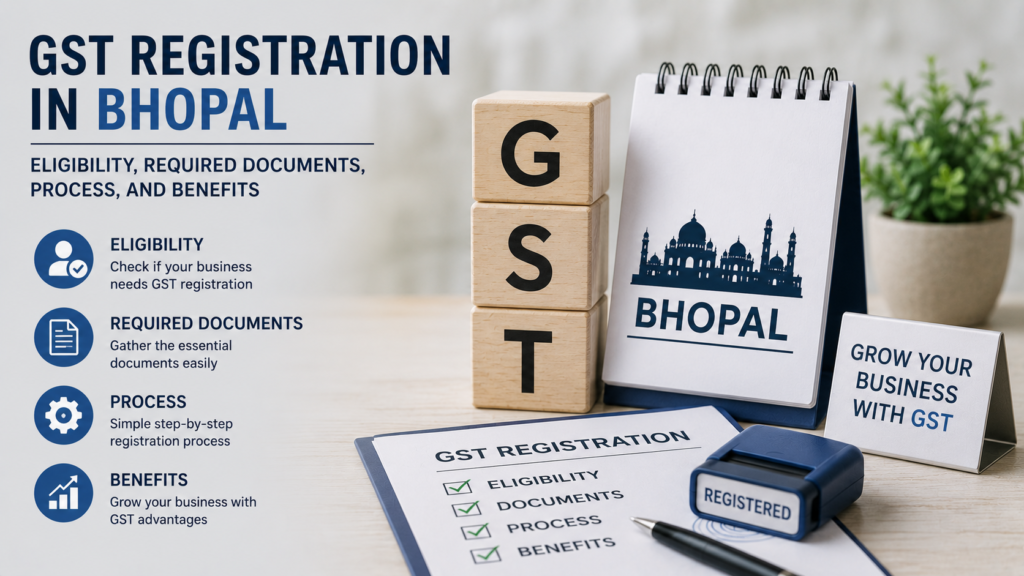
TL;DR GST Registration is one of the first compliance requirements for many businesses operating in India. Whether you’re a startup, retailer, manufacturer, service provider, freelancer, or e-commerce seller in Bhopal, obtaining GST registration helps your business remain legally compliant, claim input tax credit, and build credibility. This guide explains who should register, required documents, registration steps, benefits, and why professional assistance can simplify the process. What is GST Registration? Goods and Services Tax (GST) Registration is the process through which a business obtains a unique Goods and Services Tax Identification Number (GSTIN) from the Government of India. Once registered, a business becomes legally authorized to: Collect GST from customers Claim Input Tax Credit (ITC) Issue GST-compliant tax invoices File GST Returns Conduct interstate business legally Supply products through e-commerce marketplaces GST registration is a legal requirement for many businesses depending on their turnover, business activities, and nature of supplies. Why is GST Registration Important? GST Registration is more than a compliance formality. It provides several business advantages: Legal recognition Better business credibility Input Tax Credit benefits Easier loan approvals Improved vendor trust Eligibility for government tenders Smooth interstate trade Expansion through online marketplaces Many corporate clients also prefer working only with GST-registered suppliers. Who Needs GST Registration? GST Registration becomes mandatory in several situations. Businesses that generally require GST Registration include: Businesses Crossing Prescribed Turnover Limits If annual turnover exceeds the applicable threshold under GST law, registration becomes mandatory. Interstate Suppliers Businesses supplying goods or services across state borders may need GST registration depending on applicable provisions. E-commerce Sellers Selling through online platforms generally requires GST registration. Examples include: Amazon Flipkart Meesho IndiaMART JioMart Input Service Distributors Businesses distributing Input Tax Credit among branches require GST registration. Casual Taxable Persons Temporary businesses participating in exhibitions, trade fairs, or seasonal operations may also require GST registration. Non-Resident Taxable Persons Foreign businesses supplying goods or services in India need GST registration under applicable provisions. Agents of Registered Businesses Certain agents acting on behalf of GST-registered businesses must obtain registration. Reverse Charge Mechanism Cases Some businesses liable to pay tax under the Reverse Charge Mechanism may need registration. Eligibility for GST Registration A business should evaluate registration based on: Annual turnover Nature of goods supplied Nature of services provided Interstate transactions E-commerce operations Tax liability under GST law Even if registration is not mandatory, businesses may voluntarily register to enjoy various commercial benefits. Documents Required for GST Registration Preparing accurate documents helps avoid application rejection. Commonly required documents include: Identity Proof PAN Card Aadhaar Card Passport (where applicable) Business Registration Documents Depending on business type: Partnership Deed Certificate of Incorporation LLP Agreement Shop Establishment Certificate MSME Registration (if available) Address Proof Electricity Bill Property Tax Receipt Municipal Tax Receipt Rent Agreement NOC from Property Owner Bank Account Details Cancelled Cheque Bank Statement Passbook Copy Business Photographs Recent passport-size photographs of: Proprietor Partners Directors Authorized Signatory Digital Signature (Where Applicable) Certain business entities may require Digital Signature Certificates for application submission. Step-by-Step GST Registration Process Step 1 Collect all business documents. Step 2 Prepare identity and address proofs. Step 3 Complete the online GST registration application. Step 4 Upload supporting documents. Step 5 Verify the application using OTP or Digital Signature. Step 6 Application is processed by GST authorities. Step 7 Receive GSTIN and GST Registration Certificate after approval. Benefits of GST Registration A GST registration offers several long-term advantages for growing businesses. Claim Input Tax Credit (ITC) Registered businesses can claim credit for GST paid on eligible business purchases, reducing the overall tax burden. Enhanced Business Credibility Many corporate clients, government departments, and larger organizations prefer dealing with GST-registered businesses, improving trust and business opportunities. Easier Interstate Trade GST registration enables businesses to expand operations across different states while remaining compliant with tax regulations. Eligibility for E-commerce Platforms Most online marketplaces require sellers to have a valid GSTIN before listing products or services. Improved Access to Business Loans Financial institutions often view GST registration as a sign of formal business operations, which can support loan and credit applications. Better Compliance and Growth Maintaining GST compliance helps businesses avoid penalties and creates a strong foundation for future expansion. Common Mistakes to Avoid During GST Registration Many GST registration applications are delayed or rejected because of avoidable errors. Paying attention to details during the application process can save valuable time and prevent compliance issues. Some of the most common mistakes include: Entering incorrect PAN, Aadhaar, or business details. Using an address that does not match supporting documents. Uploading unclear or expired documents. Selecting the wrong business constitution. Choosing incorrect HSN or SAC codes. Mentioning inaccurate bank account information. Ignoring GST notices requesting additional clarification. Applying under the wrong state jurisdiction. Not updating mobile number or email for OTP verification. Delaying registration even after crossing the mandatory turnover threshold. Working with an experienced Chartered Accountant helps ensure your application is accurate, complete, and approved without unnecessary delays. GST Registration Fees in Bhopal The cost of GST registration depends on your business structure, documentation readiness, and whether additional registrations are required. Typical professional fees may vary based on: Service Estimated Professional Fee* Basic GST Registration ₹1,000 – ₹3,000 GST Registration with Business Consultation ₹3,000 – ₹7,000 GST Registration + MSME + PAN/TAN Assistance ₹5,000 – ₹10,000+ Actual fees may differ depending on business complexity and additional compliance requirements. Why Hire a Chartered Accountant for GST Registration? Although GST registration can be completed online, many businesses benefit from professional assistance to avoid costly mistakes. A Chartered Accountant can help you: Determine whether GST registration is mandatory or voluntary. Select the correct business category. Prepare accurate documentation. Respond to GST department queries. Obtain GSTIN faster. Ensure future GST compliance. Assist with GST return filing and tax planning. Reduce the risk of penalties due to incorrect registration. Instead of viewing GST registration as a one-time formality, businesses should consider it the first step toward long-term tax compliance. Why Businesses in Bhopal Trust Junaid Khan & Co. Whether you are
How to Respond to an Income Tax Notice Without Facing Penalties
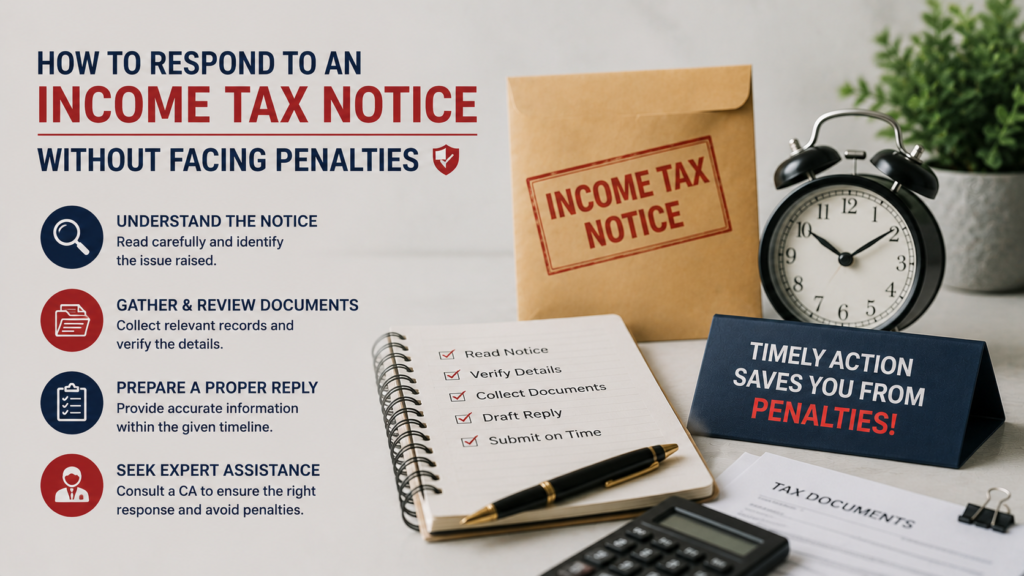
TL;DR Receiving an Income Tax Notice does not necessarily mean you’ve committed tax fraud. Many notices are issued for routine verification, mismatched information, missing documents, or clarification requests. The key is responding accurately and within the prescribed deadline. Working with an experienced Chartered Accountant can significantly reduce the risk of penalties and ensure smooth compliance. Receiving an Income Tax Notice Isn’t the End—But Ignoring It Can Be Few things create panic for taxpayers like opening an email from the Income Tax Department. Whether you’re a salaried employee, freelancer, startup founder, or business owner, receiving an Income Tax Notice can be stressful. However, it’s important to understand that most notices are not punishments—they’re requests for clarification or verification. The Income Tax Department increasingly relies on technology, AI-based data matching, and analytics to identify discrepancies between your Income Tax Return (ITR), GST filings, TDS records, Annual Information Statement (AIS), and financial transactions. If any mismatch is detected, a notice may be issued. Responding correctly—and on time—is the difference between resolving the issue smoothly and facing unnecessary penalties. Why Does the Income Tax Department Send Notices? Common reasons include: Income mismatch High-value transactions Incorrect deductions claimed Missing income disclosure TDS mismatch AIS mismatch Bank transaction discrepancies Capital gains not reported Late filing Defective ITR Tax audit selection Random scrutiny assessments Receiving a notice doesn’t automatically mean you’ve done something wrong. Common Types of Income Tax Notices Notice Type Purpose Defective Return Errors in ITR filing Scrutiny Notice Detailed examination of return Demand Notice Additional tax payable Reassessment Notice Previously undisclosed income Information Request Clarification regarding transactions Notice for Non-Filing Return not filed despite eligibility Each notice has different timelines and documentation requirements. Step 1: Stay Calm and Read the Notice Carefully Avoid reacting emotionally. Instead: Read every page. Check the section under which the notice is issued. Verify the Assessment Year. Note the response deadline. Understand exactly what information is requested. Many taxpayers respond incorrectly simply because they misunderstand the purpose of the notice. Step 2: Verify the Authenticity Before responding: Log into the Income Tax e-Filing Portal. Check whether the notice appears under your account. Match the Document Identification Number (DIN). Confirm the issuing officer’s details. Never respond to suspicious emails without verification. Step 3: Identify the Reason for the Notice The reason determines your response. Examples include: Income mismatch Perhaps your employer reported different salary figures. TDS mismatch Tax deducted may not reflect correctly. AIS mismatch Banks, mutual funds, brokers, or employers may have reported transactions differently. High-value transactions Examples: Property purchase Luxury vehicle purchase Large cash deposits Foreign travel Credit card spending The department simply seeks clarification. Step 4: Gather Supporting Documents Prepare all relevant records before submitting your response. These may include: PAN Aadhaar Income Tax Returns Form 16 Form 26AS Annual Information Statement (AIS) Bank Statements Investment Proofs Capital Gain Statements GST Returns Purchase Invoices Sale Bills Audit Reports Loan Documents Business Books of Accounts Organized documentation leads to faster resolution. Step 5: Draft a Clear and Accurate Response Your response should: Answer every query. Attach supporting documents. Be factual. Avoid assumptions. Avoid emotional explanations. Reference supporting evidence. A professional, structured reply significantly improves credibility. Step 6: Submit Before the Deadline Late responses often lead to: Penalties Interest Best judgment assessment Additional notices Prosecution in severe cases Always submit well before the due date to avoid technical issues. Step 7: Track the Status After submission: Save the acknowledgement. Monitor the Income Tax Portal. Respond quickly if additional clarification is requested. Tax proceedings may involve multiple rounds of communication. Common Mistakes That Can Lead to Penalties Many penalties arise not because of tax evasion, but because of avoidable errors such as: Ignoring the notice. Missing response deadlines. Uploading incomplete documents. Providing inaccurate information. Contradicting previously filed returns. Failing to reconcile AIS or Form 26AS data. Responding without professional review. A careful, evidence-based reply can prevent unnecessary complications and improve the chances of a quick resolution. Step 8: Seek Professional Assistance When Required While some basic notices can be handled independently, complex notices involving scrutiny, reassessment, high-value transactions, or tax demands require expert guidance. A qualified Chartered Accountant can: Interpret the legal provisions mentioned in the notice. Review your Income Tax Return for inconsistencies. Reconcile data with Form 26AS, AIS, and TIS. Prepare a legally sound response. Represent you before the Income Tax Department when required. Help minimize additional tax liabilities, interest, or penalties. Professional assistance not only saves time but also reduces the risk of making errors that could escalate the matter. Can a Chartered Accountant Respond to an Income Tax Notice on Your Behalf? Yes. A Chartered Accountant can represent taxpayers in many tax-related matters, depending on the nature of the notice and the applicable provisions under the Income-tax Act. A CA can assist with: Drafting detailed responses. Preparing supporting documentation. Reconciling tax records. Filing revised or updated returns, where applicable. Representing the taxpayer during assessments. Communicating with the Income Tax Department. For businesses and professionals with complex financial transactions, having expert representation often leads to a smoother resolution. How to Avoid Penalties After Receiving an Income Tax Notice The best way to avoid penalties is to respond proactively and accurately. Follow these best practices: ✔ Reply Before the Deadline Never wait until the last day. Early responses leave time to address any technical issues or additional requests. ✔ Submit Complete Information Incomplete responses often result in follow-up notices and prolonged assessments. ✔ Match All Financial Records Ensure consistency between: Income Tax Return (ITR) Form 26AS Annual Information Statement (AIS) Taxpayer Information Summary (TIS) GST Returns (if applicable) Bank statements Books of accounts ✔ Keep Supporting Documents Ready Maintain organized records for at least the prescribed retention period to respond quickly if questioned. ✔ Be Honest and Transparent If an error was made, acknowledge it and provide the correct information. Intentional concealment can attract more severe consequences than an honest mistake. ✔ Consult a Chartered Accountant Professional review helps identify risks before submitting your reply and ensures
Why Every Startup Needs a Chartered Accountant Before Raising Funds
TL;DR A great business idea alone is rarely enough to secure funding. Investors expect startups to demonstrate financial discipline, legal compliance, accurate reporting, and realistic growth projections. A Chartered Accountant (CA) plays a crucial role in preparing your startup for fundraising by ensuring your financial records are investor-ready, identifying compliance gaps, assisting with valuation, and supporting due diligence. Engaging a CA before approaching investors can significantly improve your chances of raising capital while avoiding costly mistakes. Why Raising Funds Is More Than Just Pitching an Idea Many founders believe that a compelling pitch deck and an innovative product are enough to attract investors. While these elements are important, experienced investors place equal—if not greater—importance on a startup’s financial health and operational readiness. Whether you’re approaching angel investors, venture capital firms, banks, or government funding programs, you’ll be expected to provide accurate financial information and demonstrate that your business is built on a strong financial foundation. Investors are not simply investing in an idea—they are investing in a business that can manage capital responsibly and deliver sustainable returns. This is where the expertise of a Chartered Accountant becomes invaluable. What Investors Expect Before Funding Before committing capital, investors conduct detailed evaluations to assess both the opportunities and risks associated with your startup. 1. Accurate Financial Statements Investors want confidence that your reported numbers reflect the true financial position of your business. Typically requested documents include: Profit & Loss Statement Balance Sheet Cash Flow Statement Revenue reports Expense analysis Bank reconciliations Financial ratios Poorly maintained accounts immediately raise concerns about governance and operational discipline. 2. Complete Regulatory Compliance Investors carefully examine whether the startup complies with applicable legal and tax requirements. Common areas reviewed include: Income Tax filings GST compliance TDS compliance ROC filings (where applicable) Accounting records Payroll compliance Statutory registrations Even minor compliance lapses can delay or jeopardize funding discussions. 3. Reliable Financial Forecasts Funding decisions are based largely on future growth potential rather than past performance. Investors expect realistic projections covering: Revenue growth Operating expenses Cash burn Customer acquisition costs Gross margins Profitability timelines Capital utilization A Chartered Accountant helps develop forecasts based on realistic assumptions rather than optimistic estimates. 4. Transparent Business Operations Transparency builds investor confidence. Founders should be prepared to explain: Revenue model Cost structure Pricing strategy Outstanding liabilities Existing debt Related-party transactions Capital structure Well-organized documentation reflects professionalism and reduces perceived investment risk. How a Chartered Accountant Helps Before Fundraising A Chartered Accountant contributes far beyond tax filing. They act as a strategic financial advisor throughout the fundraising journey. 1. Preparing Investor-Ready Financial Statements One of the first tasks of a CA is organizing the startup’s financial records into professional, accurate reports. This includes: Cleaning bookkeeping records Reconciling bank accounts Verifying assets and liabilities Preparing audited or reviewed statements (where applicable) Standardizing accounting practices Clear financial statements improve credibility during investor meetings. 2. Ensuring Tax Compliance Tax-related issues are among the most common reasons investors request additional clarification during due diligence. A CA ensures: GST returns are filed correctly Income Tax returns are updated TDS obligations are fulfilled Advance tax liabilities are addressed Tax notices are resolved proactively Strong tax compliance demonstrates financial discipline and minimizes legal risks. 3. Assisting with Startup Valuation Valuation determines how much equity founders may need to dilute in exchange for investment. A Chartered Accountant supports valuation by analyzing: Revenue performance Profitability trends Cash flows Comparable businesses Industry benchmarks Asset values Growth projections Accurate valuation helps founders negotiate confidently and avoid unnecessary dilution. 4. Preparing for Financial Due Diligence Due diligence is a detailed examination of every significant financial and legal aspect of the startup. A CA helps organize: Financial statements Tax filings Shareholding records Compliance certificates Loan agreements Vendor contracts Customer agreements Statutory registers Being due diligence-ready shortens fundraising timelines and builds investor trust. 5. Building Realistic Financial Projections One of the biggest mistakes founders make is presenting unrealistic revenue forecasts. A Chartered Accountant prepares evidence-based projections using: Historical financial data Industry growth trends Market assumptions Cost estimates Pricing models Cash flow planning Break-even analysis Credible financial projections reassure investors that management understands the economics of the business. 6. 10 Ways a Chartered Accountant Increases Your Startup’s Funding Success A Chartered Accountant does much more than prepare tax returns. They become a strategic financial partner who helps startups present a strong investment case. 1. Builds Investor Confidence Investors trust startups with organized financial records, transparent accounting practices, and complete statutory compliance. Professionally maintained books indicate that the founders are capable of managing investment responsibly. 2. Improves Financial Reporting A CA ensures your financial reports are accurate, timely, and aligned with accepted accounting standards. This includes: Profit & Loss Statements Balance Sheets Cash Flow Statements Management reports Monthly financial dashboards Clear reporting makes investor discussions smoother. 3. Reduces Compliance Risks Non-compliance with GST, Income Tax, TDS, or ROC requirements can become major red flags during due diligence. A Chartered Accountant helps eliminate these risks before investors discover them. 4. Assists in Business Valuation Incorrect valuation can either discourage investors or cause founders to dilute excessive equity. A CA helps determine a fair valuation using: Financial performance Comparable companies Future revenue projections Industry benchmarks Growth potential 5. Optimizes Cash Flow Management Investors closely evaluate whether startups can efficiently manage cash. A Chartered Accountant helps: Monitor cash burn Improve working capital Control unnecessary expenses Forecast funding requirements Plan future capital allocation 6. Strengthens Internal Controls Good internal controls reduce financial fraud and operational risks. Examples include: Approval systems Expense policies Vendor verification Financial documentation Audit trails 7. Supports Better Tax Planning Effective tax planning improves profitability and investor returns without violating tax regulations. A CA identifies: Eligible deductions Tax-saving opportunities Incentives available for startups Efficient business structures 8. Prepares a Due Diligence Data Room Professional investors expect a well-organized virtual data room containing all essential documents. A Chartered Accountant helps prepare: Financial statements Tax returns Compliance certificates Shareholding records Contracts Licenses Payroll records 9. Helps Negotiate Investor Discussions Financial negotiations
LLP Registration vs Sole Proprietorship: Which Business Structure Saves More Tax?
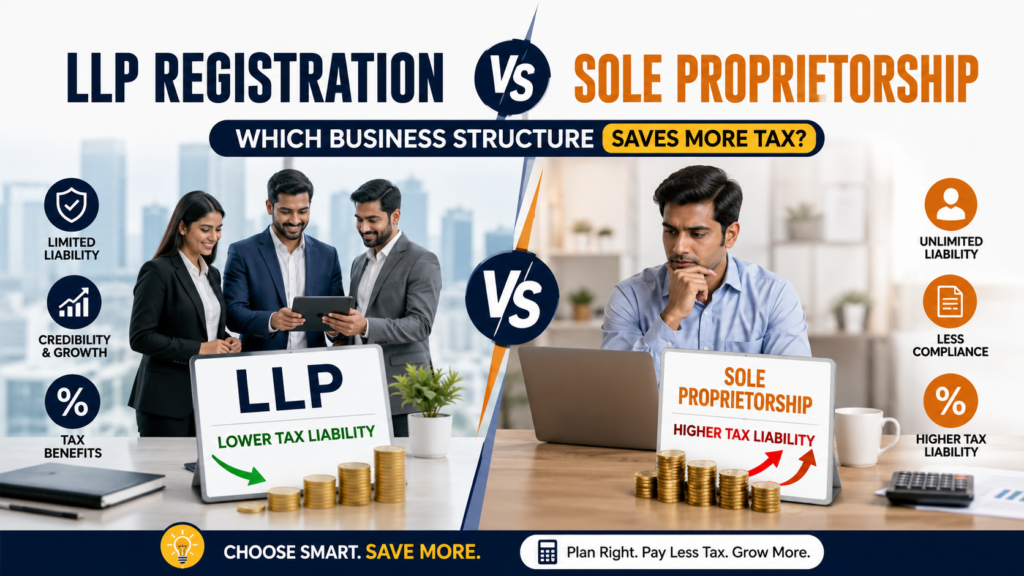
TL;DR If you’re starting a business in India, choosing between an LLP and a Sole Proprietorship can significantly impact your taxes, legal liability, compliance burden, and future growth. While a Sole Proprietorship offers simplicity and lower compliance, an LLP provides limited liability, greater credibility, and better scalability. The right choice depends on your business goals, expected profits, and expansion plans. Why Choosing the Right Business Structure Matters One of the biggest mistakes new entrepreneurs make is selecting a business structure based solely on registration cost or convenience. However, the legal structure of your business affects nearly every aspect of operations—from taxation and compliance to fundraising and risk management. A business that starts as a small proprietorship may later require conversion into an LLP or company due to growth, increasing compliance requirements, or investor expectations. Making the right decision early can save both money and administrative effort. Before registering your business, evaluate factors such as annual turnover, projected profits, number of owners, funding requirements, liability exposure, and long-term business plans. Understanding Sole Proprietorship A Sole Proprietorship is the simplest and most common business structure in India. It is owned and managed by a single individual, and there is no legal distinction between the owner and the business. Key Features Single owner Easy to start Minimal legal formalities Low compliance burden Complete control over business decisions Advantages Low setup cost Simple tax filing Quick business commencement Full control over profits Minimal regulatory requirements Disadvantages Unlimited personal liability Difficult to raise investment Limited business credibility Business ends with the owner Personal assets remain exposed to business risks Understanding LLP Registration A Limited Liability Partnership (LLP) combines the operational flexibility of a partnership with the legal protection of a corporate entity. Unlike a Sole Proprietorship, an LLP is a separate legal entity, meaning the partners’ personal assets are generally protected from business liabilities. Key Features Separate legal identity Minimum two designated partners Limited liability protection Perpetual succession Recognized under the LLP Act Advantages Better business credibility Easier access to funding Legal protection for partners Structured ownership Suitable for growing businesses Disadvantages Annual compliance requirements Mandatory statutory filings Slightly higher registration costs Requires at least two partners LLP Registration vs Sole Proprietorship: Complete Comparison Feature Sole Proprietorship LLP Legal Status Owner and business are the same Separate legal entity Owners One Minimum two partners Liability Unlimited Limited Registration Relatively simple Mandatory LLP registration Taxation Individual tax slab LLP taxation provisions Compliance Low Moderate Fundraising Difficult Easier Business Continuity Depends on owner Perpetual succession Brand Credibility Moderate High Expansion Limited Excellent Tax Comparison Between LLP and Sole Proprietorship Taxation is one of the most important considerations when choosing a business structure. Sole Proprietorship Business income is treated as the owner’s personal income and taxed according to the applicable individual income tax slab. As profits increase, the effective tax burden may also increase depending on the owner’s total taxable income. Suitable for: Freelancers Small traders Local businesses Consultants with modest profits LLP An LLP is taxed under the Income Tax Act as a separate entity. It offers opportunities for structured financial planning and may be more suitable for businesses with consistent profits, multiple partners, or expansion plans. Suitable for: Professional firms Agencies Manufacturers Service companies Growing startups Compliance Comparison Compliance obligations are another important factor when deciding between an LLP and a Sole Proprietorship. While many entrepreneurs focus on tax savings, ongoing regulatory responsibilities can significantly affect operating costs and administrative workload. Compliance Area Sole Proprietorship LLP Income Tax Return Mandatory Mandatory GST Returns (if applicable) Mandatory Mandatory Annual MCA Filing Not Applicable Mandatory Statutory Records Minimal Mandatory Audit Requirement Based on applicable tax/GST provisions Based on applicable legal provisions Separate PAN Uses proprietor’s PAN Separate PAN for LLP Bank Account In proprietor’s name/business name Separate LLP bank account Sole Proprietorship Compliance Compliance is relatively simple and usually includes: Income Tax Return filing GST return filing (if registered) TDS compliance (if applicable) Maintaining basic books of accounts Renewal of local business registrations, where applicable This makes it suitable for businesses with straightforward operations and limited transactions. LLP Compliance An LLP requires more structured compliance, including: Annual Return filing Statement of Accounts and Solvency Income Tax Return GST compliance (where applicable) TDS compliance Maintenance of statutory books and records Partner-related documentation and resolutions Although compliance costs are higher, they improve transparency, governance, and business credibility. Registration Cost Comparison Registration expenses should not be the only deciding factor. Instead, evaluate the total long-term value offered by each business structure. Expense Sole Proprietorship LLP Registration Cost Lower Moderate Annual Compliance Cost Lower Higher Accounting Cost Lower Moderate Legal Protection Limited High Growth Potential Moderate High Many businesses initially choose a proprietorship because of lower costs but later incur additional expenses when converting to an LLP after business growth. Planning ahead can reduce unnecessary restructuring costs. Which Business Structure Is Best for Different Businesses? Choose a Sole Proprietorship if you are: A freelancer A consultant working independently A small retail shop owner Running a home-based business Testing a new business idea Operating with limited investment Choose an LLP if you are: Starting a business with one or more partners Expecting rapid business growth Providing professional services Planning to apply for larger business loans Looking for better credibility with clients Seeking long-term expansion opportunities When Should You Convert a Sole Proprietorship into an LLP? Many successful businesses begin as proprietorships and later convert into LLPs. Consider conversion when: Business turnover increases significantly You add business partners Personal liability becomes a concern Banks require a more formal business structure Clients prefer working with registered entities You plan to expand into multiple cities You want stronger legal protection for personal assets Early planning with a Chartered Accountant ensures the transition is smooth and compliant. Common Mistakes to Avoid Entrepreneurs often make costly decisions by overlooking the broader implications of business structure selection. Avoid these mistakes: Choosing solely based on registration cost Ignoring future tax implications Underestimating compliance requirements Failing to consider liability protection
Income Tax Return Filing Mistakes That Can Trigger an Income Tax Notice
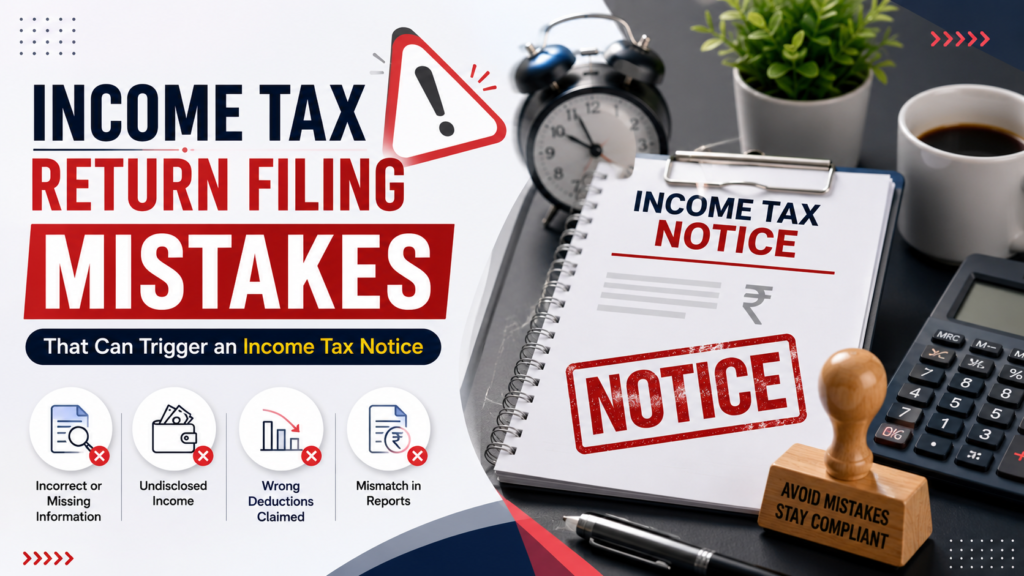
TL;DR A single mistake in your Income Tax Return (ITR)—such as underreporting income, claiming incorrect deductions, or mismatching information with AIS or Form 26AS—can result in an Income Tax notice. This guide explains the most common filing errors, how to avoid them, and why working with an experienced Chartered Accountant can help individuals and businesses stay compliant and reduce tax-related risks. Introduction Income Tax Return filing has become significantly more data-driven in recent years. The Income Tax Department now cross-verifies information from multiple sources, including bank transactions, TDS records, Annual Information Statement (AIS), Taxpayer Information Summary (TIS), GST filings, mutual fund transactions, and property registrations. This advanced digital verification system means even small inconsistencies can attract scrutiny. While receiving an Income Tax notice does not automatically imply wrongdoing, responding to notices can be time-consuming, stressful, and expensive if proper documentation is unavailable. Whether you are a salaried employee, freelancer, business owner, contractor, or startup founder, understanding the most common Income Tax Return filing mistakes can help you avoid unnecessary notices and maintain complete tax compliance. Why Income Tax Notices Are Increasing The Income Tax Department now relies heavily on technology and data analytics rather than random assessments. Modern systems compare information from various financial databases to identify discrepancies. Some commonly matched data sources include: Annual Information Statement (AIS) Form 26AS Taxpayer Information Summary (TIS) GST returns PAN-linked banking transactions Property purchase and sale records Securities transactions Mutual fund investments Foreign remittances Credit card spending Because of this integrated approach, omissions that may have gone unnoticed in the past are now detected much more efficiently. How the Income Tax Department Detects Errors The Department compares information reported by taxpayers with data received from banks, employers, financial institutions, registrars, and other reporting entities. Important verification tools include: Annual Information Statement (AIS) Contains details of: Salary Interest income Dividend income Mutual fund investments Share transactions Property transactions Foreign remittances Form 26AS Shows: TDS deducted Advance tax Self-assessment tax Tax collected at source (TCS) GST Records Business turnover declared under GST is often compared with turnover declared in Income Tax Returns. PAN-Based Reporting Every significant financial transaction linked to PAN becomes part of the taxpayer’s financial profile. 15 Income Tax Return Filing Mistakes That Can Trigger an Income Tax Notice 1. Not Reporting All Sources of Income Many taxpayers report only salary income while forgetting: Savings account interest Fixed deposit interest Rental income Dividend income Freelancing income Commission Side business income Even small amounts reflected in AIS should be disclosed appropriately. 2. Mismatch Between AIS and ITR One of the most common reasons for notices is inconsistency between: AIS Form 26AS Filed ITR Before filing, carefully verify every reported transaction. 3. Selecting the Wrong ITR Form Using an incorrect ITR form may result in: Defective return notices Delayed processing Requirement to file again Always choose the return form applicable to your income category. 4. Incorrect Bank Account Details Incorrect account information may delay: Refund processing Verification Communication from the department Ensure all active bank accounts are correctly reported. 5. Claiming Deductions Without Supporting Documents Improper claims under sections such as: 80C 80D Home loan deductions Donations without valid documentation can trigger verification. Maintain: Premium receipts Investment proofs Donation certificates Loan statements 6. Ignoring Capital Gains Many taxpayers mistakenly assume that if no money is withdrawn, taxes do not apply. Capital gains may arise from: Shares Mutual funds Property sales Gold Digital assets These transactions should be reported accurately, even if tax liability is minimal. 7. Incorrect HRA Claims Claiming House Rent Allowance without: Paying rent Rent receipts PAN of landlord (where applicable) can lead to scrutiny. 8. Not Reporting Foreign Assets or Overseas Income Residents holding: Foreign bank accounts Overseas investments Foreign shares Foreign property must disclose these appropriately under applicable schedules. Failure to report can attract significant penalties. 9. Cash Deposit Mismatch Large cash deposits that do not align with declared income often invite queries. Maintain documentation explaining: Business receipts Sale proceeds Agricultural income Gifts (where applicable) 10. Claiming Excessive Business Expenses Businesses sometimes classify personal expenses as business expenses. Common examples include: Personal travel Family expenses Personal vehicle costs Non-business purchases Keep proper invoices and maintain separate personal and business accounts. 11. GST Turnover Does Not Match Income Tax Return Businesses registered under GST should ensure consistency between: GST returns Books of accounts Profit & Loss statement Income Tax Return Large variations frequently trigger scrutiny. 12. Claiming Wrong TDS Credit Never claim TDS that does not appear in: Form 26AS AIS Incorrect TDS claims often delay refunds and may result in notices. 13. Filing Return After Due Date Late filing may result in: Interest Late fees Loss of certain benefits Higher scrutiny in some cases Timely filing demonstrates better compliance. 14. Submitting Fake Investment Proofs Submitting fabricated deductions or manipulated documents is a serious compliance violation and may attract penalties and prosecution under applicable tax laws. Always maintain genuine documentation. 15. Ignoring Mistakes Instead of Filing a Revised Return If you discover an error after filing: Do not wait for a notice. File a revised return within the permitted timeline. Voluntary correction is generally preferable to departmental detection. Quick Checklist Before Filing Your ITR ✔ Verify AIS thoroughly ✔ Match Form 26AS ✔ Reconcile TDS ✔ Report every source of income ✔ Verify bank details ✔ Review capital gains ✔ Check GST turnover (for businesses) ✔ Maintain deduction proofs ✔ Use the correct ITR form ✔ Get professional review before submission Why Businesses Should Hire a Chartered Accountant Income tax laws continue to evolve, making professional guidance increasingly valuable. An experienced Chartered Accountant can help you: Select the correct ITR form Reconcile AIS and Form 26AS Identify eligible deductions Minimize tax liability legally Ensure GST and Income Tax consistency Handle notices and scrutiny professionally Maintain proper financial records Plan taxes proactively instead of reactively Professional tax advice reduces compliance risks while saving valuable time. How Junaid Khan & Co. Helps At Junaid Khan & Co., Chartered Accountants in Bhopal, we assist
How to Choose the Best Chartered Accountant in Bhopal for Your Business and Tax Needs
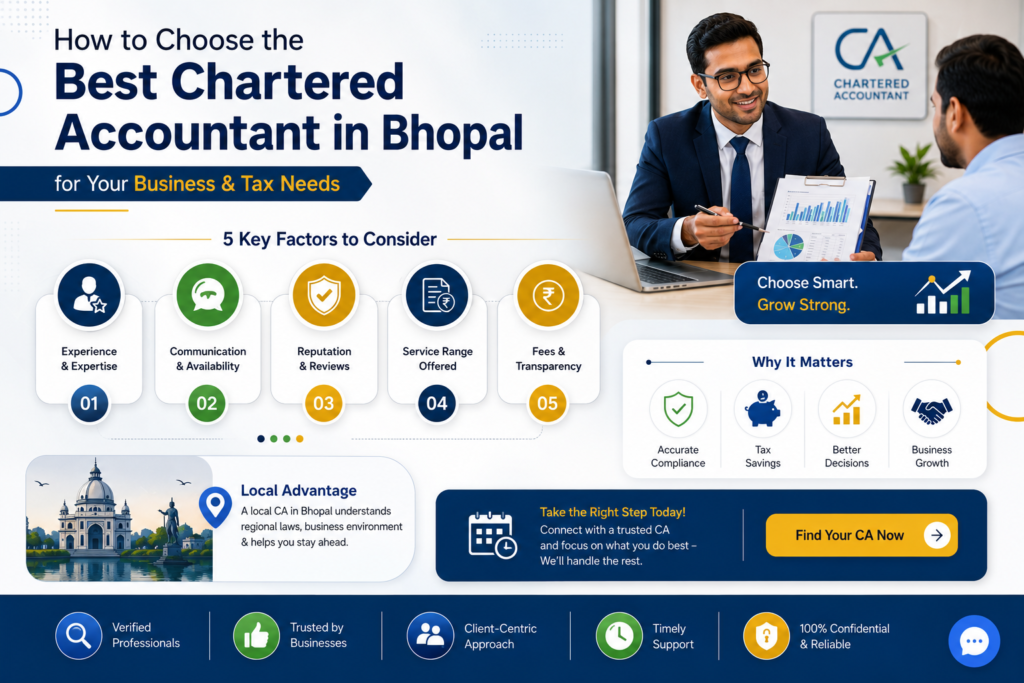
TL;DR Choosing the best Chartered Accountant in Bhopal is one of the most important decisions for your business or personal finances. A qualified CA can help you save taxes legally, ensure timely compliance, avoid penalties, improve profitability, and guide your business through every stage of growth. This guide explains exactly what to look for before hiring a Chartered Accountant and how to make the right choice. Why Choosing the Right Chartered Accountant Matters Many business owners think a Chartered Accountant’s role is limited to filing income tax returns. In reality, a professional CA acts as your financial advisor, compliance expert, and strategic business partner. Whether you run a startup, retail shop, manufacturing unit, consultancy, or service business, financial decisions directly impact profitability and long-term growth. The right CA helps you: Reduce tax liability legally Maintain accurate books of accounts Ensure GST compliance Avoid penalties Prepare for audits Improve cash flow Assist with funding and loans Support business expansion Hiring an experienced Chartered Accountant early can save your business significant time, money, and compliance risks. What Does a Chartered Accountant Actually Do? A modern Chartered Accountant provides much more than tax filing. Tax Planning Tax planning is about minimizing your tax burden while remaining fully compliant with Indian tax laws. Professional tax planning includes: Income tax planning Advance tax calculation Capital gains planning Tax-saving investment guidance Business expense optimization Tax notice assistance GST Compliance GST regulations continue to evolve, making professional guidance essential. A CA assists with: GST registration GST return filing Input Tax Credit reconciliation GST audits GST notices GST advisory Accounting Services Proper accounting helps businesses make informed financial decisions. Services include: Bookkeeping Bank reconciliation Financial statements MIS reporting Cash flow analysis Payroll accounting Audit Services Businesses often require professional audit support for statutory and regulatory compliance. Common audit services include: Statutory Audit Tax Audit Internal Audit Stock Audit Due Diligence Compliance Audit Business Registration Launching a business involves multiple legal formalities. A Chartered Accountant can assist with: Private Limited Company Registration LLP Registration Partnership Firm Registration MSME Registration Startup India Registration PAN & TAN GST Registration Financial Advisory Beyond compliance, experienced CAs provide strategic financial guidance. Examples include: Business restructuring Profitability analysis Budget planning Financial forecasting Investment planning Loan documentation Working capital management 10 Factors to Consider Before Hiring a Chartered Accountant 1. Industry Experience Every industry has unique financial and tax requirements. For example: Manufacturing businesses face inventory valuation challenges. Healthcare professionals require specialized tax planning. E-commerce companies manage multi-state GST compliance. Startups need funding support and investor-ready financial statements. Choose a CA who understands your industry rather than one offering only generic accounting services. 2. Complete Range of Services Hiring separate professionals for accounting, GST, taxation, audits, and registrations often increases costs and creates coordination issues. Instead, look for a CA firm offering comprehensive services such as: Accounting Income Tax GST Audit Company Registration ROC Compliance Payroll Financial Advisory Business Consulting A single point of contact simplifies financial management and ensures consistent compliance. 3. Strong Knowledge of Changing Tax Laws Indian tax regulations are updated frequently. A reliable Chartered Accountant should stay current with: Income Tax amendments GST notifications MCA compliance ROC regulations TDS provisions Startup incentives MSME benefits Proactive advice helps businesses adapt quickly and avoid costly mistakes. 4. Technology and Automation Modern accounting is increasingly digital. A capable CA should leverage cloud-based accounting software, secure document sharing, automated compliance reminders, and real-time financial reporting to improve efficiency and accuracy. Businesses benefit from faster reporting, better collaboration, and reduced paperwork when their CA embraces technology rather than relying solely on manual processes. 5. Communication and Responsiveness Financial matters often require timely decisions. Your Chartered Accountant should respond promptly to queries, explain complex concepts in simple language, and keep you informed about important deadlines and regulatory changes. Poor communication can lead to missed compliance dates and unnecessary penalties. 6. Reputation and Client Reviews Before finalizing a Chartered Accountant, research their reputation thoroughly. Consider: Google reviews and ratings Client testimonials Years of experience Industry recognition Case studies Referral recommendations Consistent positive feedback often reflects professionalism, reliability, and long-term client satisfaction. 7. Transparent Pricing The cheapest CA is not always the best choice. Instead, look for: Clearly defined service packages Transparent fee structure No hidden charges Defined scope of work Annual compliance plans Ongoing advisory support Choosing based on overall value rather than price alone usually delivers better long-term results. 8. Personalized Business Advice Every business has unique financial goals and compliance requirements. A good Chartered Accountant should: Understand your business model Identify potential risks Recommend tax-saving opportunities Improve financial processes Support business expansion Offer proactive advice throughout the year Avoid professionals who only become available during tax season. 9. Scalability of Services As your business grows, your compliance and financial needs become more complex. Choose a CA firm that can support: Company incorporation Multi-state GST Payroll management Internal audits Investor reporting Funding assistance Business valuation Expansion planning Working with a scalable firm eliminates the need to switch advisors as your business evolves. 10. Long-Term Partnership Approach The best Chartered Accountant is more than a compliance expert—they become a strategic business advisor. A long-term relationship enables your CA to: Understand your financial history Anticipate future challenges Recommend growth strategies Improve profitability Ensure ongoing compliance Provide timely financial insights This continuity leads to better financial planning and stronger business outcomes. Questions You Must Ask Before Hiring a Chartered Accountant Before making your decision, ask: How many years of experience do you have? Do you work with businesses in my industry? Which accounting software do you use? What services are included in your engagement? How frequently will we communicate? Who will be my primary point of contact? How do you handle tax notices or assessments? What is your typical turnaround time? How are your fees structured? Can you support future business expansion? These questions help you assess expertise, communication style, and long-term compatibility. Red Flags to Avoid Be cautious if a CA: Promises unrealistic tax savings Lacks transparency in
GST Registration vs Composition Scheme: Which Is Better for Small Businesses in Bhopal?
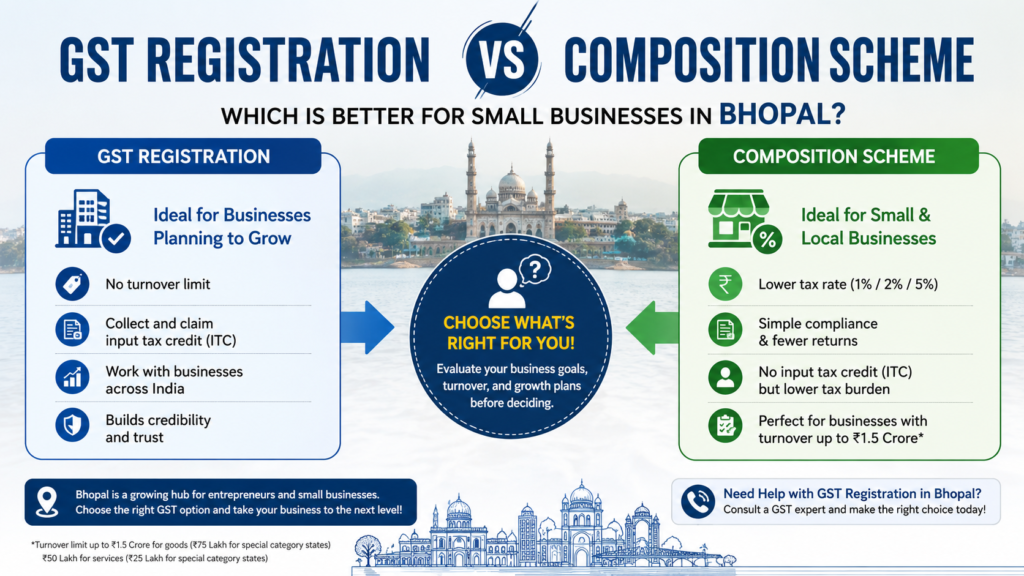
TL;DR If your business has growth ambitions, works with corporate clients, wants Input Tax Credit benefits, or operates across multiple states, Regular GST Registration is usually the better option. If your business is small, locally focused, has limited compliance capacity, and wants simplified taxation, the Composition Scheme may be suitable. The right choice depends on: ✔ Annual turnover ✔ Customer type ✔ Profit margins ✔ Growth plans ✔ Compliance capability ✔ GST Input Tax Credit requirements This guide explains both options in detail to help Bhopal business owners make an informed decision. Why This Decision Matters More Than Ever For many small businesses in Bhopal, GST compliance is no longer just a legal requirement—it directly affects profitability, cash flow, pricing strategy, and business growth. One of the most common questions business owners ask is: “Should I register under the normal GST scheme or opt for the Composition Scheme?” Choosing the wrong option can lead to: Higher tax costs Reduced competitiveness Limited growth opportunities Compliance challenges Cash flow issues On the other hand, selecting the right scheme can simplify operations and improve profitability. Let’s break down both options. Understanding Regular GST Registration Regular GST Registration is the standard GST framework under which businesses collect GST from customers and remit it to the government. Businesses registered under the regular scheme can: Charge GST on invoices Claim Input Tax Credit (ITC) Conduct interstate business Sell through e-commerce platforms Supply goods and services to corporate clients Participate in government tenders This scheme is generally designed for businesses that expect growth and need operational flexibility. Key Features of Regular GST Registration Input Tax Credit Available One of the biggest advantages is the ability to claim GST paid on purchases. For example: If a trader purchases inventory worth ₹10 lakh and pays GST on those purchases, the GST amount can be claimed as Input Tax Credit. This significantly reduces the final tax burden. Interstate Business Allowed Businesses can freely sell products and services across India. This is particularly beneficial for: Online sellers Manufacturers Service providers Export-oriented businesses Better Business Credibility Corporate clients often prefer dealing with GST-registered suppliers who can issue tax invoices and provide Input Tax Credit benefits. This can directly impact business opportunities. Understanding the GST Composition Scheme The Composition Scheme was introduced to reduce the compliance burden for small taxpayers. Instead of following regular GST procedures, eligible businesses can pay tax at a fixed lower rate based on turnover. The scheme is primarily designed for: Small traders Local retailers Small restaurants Certain service providers Key Features of Composition Scheme Simplified Compliance Businesses generally face: Reduced recordkeeping requirements Simpler return filing Less administrative burden This is attractive for small businesses with limited accounting resources. Lower Tax Rates Composition taxpayers typically pay tax at prescribed composition rates rather than normal GST rates. However, lower tax rates do not always mean lower overall tax costs. The impact depends on Input Tax Credit eligibility and business model. No Input Tax Credit This is the biggest limitation. Composition dealers: Cannot claim Input Tax Credit Cannot pass ITC benefits to customers For many businesses, this can significantly affect competitiveness. GST Registration vs Composition Scheme: Detailed Comparison Factor Regular GST Registration Composition Scheme Input Tax Credit Available Not Available Interstate Sales Allowed Restricted in many cases E-commerce Selling Allowed Limited GST Invoice Allowed Not Allowed as Tax Invoice Compliance Higher Lower Growth Flexibility High Limited Corporate Clients Preferred Less Preferred Tax Administration Detailed Simplified Who Should Choose Regular GST Registration? Regular GST registration is usually ideal for businesses that: Plan to Grow Aggressively If you expect turnover growth over the next few years, switching later may create operational disruptions. Starting with regular registration can be more practical. Sell to Businesses B2B customers prefer vendors who can provide Input Tax Credit benefits. Without ITC benefits, customers may prefer competitors. Operate Online Businesses selling through: Amazon Flipkart Meesho Other marketplaces typically require regular GST registration. Have Significant Purchase Costs When businesses purchase inventory, machinery, or raw materials regularly, Input Tax Credit becomes highly valuable. This often outweighs the compliance burden. Who Should Choose the Composition Scheme? The composition scheme may work well for: Local Retail Shops Businesses serving local consumers often find compliance simplicity attractive. Examples: Grocery stores Gift shops Local traders Small retail outlets Businesses with Minimal Input Tax Credit Requirements If purchase-related GST is relatively low, losing ITC may have limited impact. Owners Seeking Simpler Compliance For business owners who prefer a straightforward taxation framework, composition can reduce administrative workload. Real-Life Bhopal Business Examples Example 1: Local Grocery Store Annual Turnover: ₹60 lakh Customer Base: Local consumers Interstate Sales: None ITC Requirement: Low Recommended Option: Composition Scheme Reason: Compliance simplicity may outweigh ITC benefits. Example 2: Manufacturing Unit Annual Turnover: ₹1.2 crore Raw Material Purchases: High B2B Customers: Yes Recommended Option: Regular GST Registration Reason: Input Tax Credit benefits can significantly reduce tax costs. Example 3: Digital Marketing Agency Annual Turnover: ₹45 lakh Clients Across India Growing Business Recommended Option: Regular GST Registration Reason: Interstate services and future growth make regular registration more suitable. Example 4: Restaurant Business Annual Turnover: ₹75 lakh Local Customer Base Limited Expansion Plans Recommended Option: Depends on cost structure and tax planning analysis. Professional evaluation is recommended. Common Mistakes Businesses Make Choosing Based Only on Tax Rate Many business owners focus only on lower composition rates and ignore ITC losses. Ignoring Growth Plans A scheme suitable today may become restrictive within a year. Not Evaluating Customer Type B2B and B2C businesses often require different GST strategies. Poor Record Keeping Regardless of the chosen scheme, proper documentation remains essential. How to Switch Between Schemes Businesses may switch between schemes if eligibility conditions are met. Before switching: Review turnover projections Analyze customer profile Estimate ITC benefits Evaluate compliance costs Consult a GST professional A structured analysis prevents costly mistakes. Expert Recommendation from Chartered Accountants In our experience advising businesses across Bhopal, most growth-oriented businesses benefit more from Regular GST Registration. While the Composition Scheme provides simplicity,
Startup Compliance Checklist for New Businesses in Bhopal: A CA’s Complete Guide
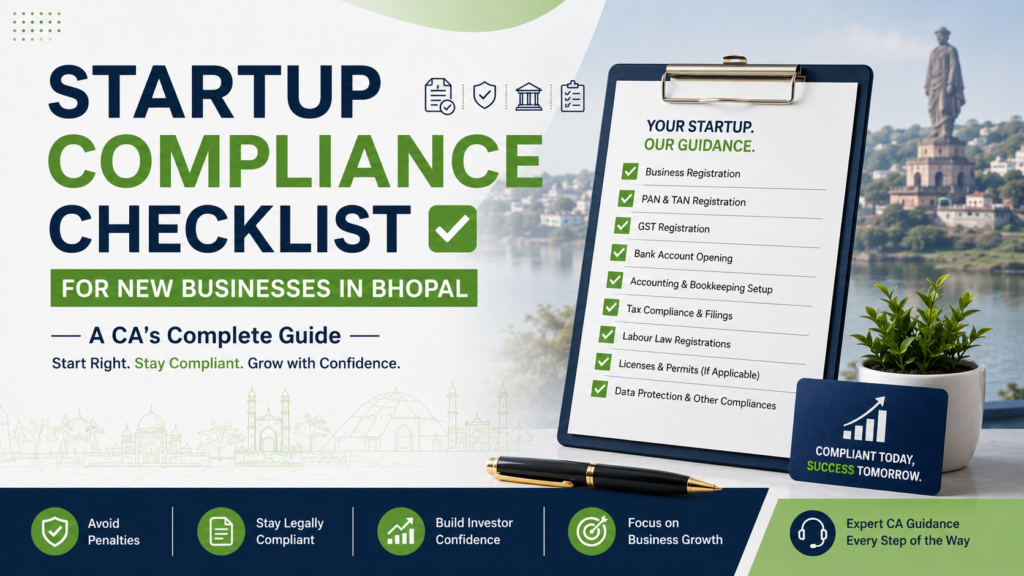
TL;DR Starting a business involves much more than registering a company and opening a bank account. Every startup must comply with multiple legal, tax, accounting, and regulatory requirements to avoid penalties and build a sustainable business. Essential Startup Compliance Checklist ✔ Business Registration ✔ PAN & TAN Registration ✔ GST Registration (if applicable) ✔ MSME/Udyam Registration ✔ Professional Accounting System ✔ Bookkeeping & Record Maintenance ✔ Income Tax Compliance ✔ TDS Compliance ✔ Labour Law Compliance ✔ Annual Filings & Regulatory Reporting Businesses that establish compliance systems from day one are better positioned for growth, funding, and long-term success. Why Startup Compliance Matters Many entrepreneurs focus entirely on product development, customer acquisition, and revenue generation during the initial stages of business. While these activities are important, ignoring compliance can become one of the costliest mistakes a startup makes. Poor compliance can lead to: Government penalties Tax notices GST disputes Loss of input tax credits Regulatory action Difficulty obtaining funding Banking and loan challenges Reputational risks On the other hand, businesses with strong compliance frameworks gain greater credibility with investors, banks, customers, and government agencies. Compliance is not merely a legal obligation—it is a business growth strategy. Startup Compliance Checklist Overview The startup compliance process can be divided into five major categories: Compliance Area Importance Business Registration Legal identity Tax Compliance Avoid penalties Accounting Compliance Financial transparency Labour Compliance Employee protection Annual Filings Regulatory compliance Let’s examine each area in detail. 1. Business Registration Requirements Choosing the right business structure is the first compliance decision every entrepreneur must make. Common business structures include: Sole Proprietorship Suitable for: Small businesses Freelancers Consultants Advantages: Easy setup Lower compliance burden Limitations: Unlimited liability Partnership Firm Suitable for: Family businesses Professional firms Joint ventures Advantages: Shared ownership Flexible management Limitations: Partner liability exposure LLP (Limited Liability Partnership) Suitable for: Professional service firms Growing startups Advantages: Limited liability Simplified compliance Private Limited Company Suitable for: Fundraising startups High-growth businesses Technology ventures Advantages: Investor-friendly structure Limited liability Greater credibility Essential Registration Documents Regardless of business structure, startups generally require: PAN Aadhaar Address proof Bank account Business address documentation Identity proof of promoters Proper documentation ensures smoother registration and future compliance. 2. PAN and TAN Registration PAN (Permanent Account Number) PAN serves as the primary tax identification number for businesses. It is required for: Opening business bank accounts Filing tax returns Financial transactions Regulatory compliance TAN (Tax Deduction and Collection Account Number) Businesses responsible for deducting tax at source must obtain TAN. TAN becomes necessary when: Salaries are paid Contractors are engaged Professional fees are paid Certain specified payments are made Failure to comply with TDS regulations can attract penalties and interest. 3. GST Registration Requirements One of the most important startup compliance requirements involves GST. GST Registration May Be Required For: Businesses crossing prescribed turnover thresholds Interstate suppliers E-commerce sellers Certain service providers Businesses voluntarily opting into GST Benefits of GST Registration Legal compliance Input Tax Credit eligibility Improved credibility Business expansion opportunities Common GST Compliance Requirements GST registration Tax invoice generation Return filing Input tax credit reconciliation Record maintenance Many startups underestimate GST compliance complexity and face avoidable issues later. 4. MSME/Udyam Registration Many entrepreneurs overlook one of the most beneficial registrations available to small businesses. Benefits of Udyam Registration Easier loan approvals Government scheme eligibility Subsidies and incentives Reduced compliance burden in certain areas Protection against delayed payments For eligible businesses, Udyam registration should be completed early. 5. Startup Accounting and Bookkeeping Compliance Accounting is one of the most neglected compliance areas among new businesses. Unfortunately, poor accounting often creates: Tax issues GST mismatches Cash flow problems Funding challenges Essential Accounting Requirements Maintain records of: Sales invoices Purchase invoices Expenses Bank transactions Payroll records GST records Asset registers Best Practice Implement accounting software from day one rather than attempting to reconstruct records later. Why Proper Bookkeeping Matters Accurate bookkeeping helps startups: Monitor profitability Manage cash flow Prepare tax returns Secure investments Support audits Improve decision-making Investors and lenders often review financial records before approving funding. Poor bookkeeping can negatively affect business valuation and credibility. 6. Income Tax Compliance Every business must understand its income tax obligations. Key requirements include: Income Tax Return Filing Businesses must file tax returns within applicable deadlines. Advance Tax Certain businesses may need to pay taxes periodically throughout the year. Tax Planning Proper tax planning helps: Reduce tax liability legally Improve cash flow Avoid year-end surprises Startups that ignore tax planning often pay more tax than necessary. 7. TDS Compliance Many startups are unaware of Tax Deducted at Source (TDS) obligations. TDS may apply when making payments such as: Salaries Contractor payments Professional fees Rent Commission Compliance generally includes: Deduction of tax Deposit of deducted tax Filing TDS returns Issuing certificates TDS defaults can result in penalties and compliance notices. 8. Labour Law Compliance Businesses employing staff must also address labour-related obligations. Depending on employee strength and business activities, requirements may include: Employment contracts Payroll records Employee benefits Statutory registrations Labour law reporting Maintaining proper HR documentation protects both employers and employees. 9. Annual Compliance Requirements Compliance does not end after registration. Businesses must continue meeting ongoing obligations. Common Annual Requirements Income tax return filing Financial statement preparation GST filings TDS filings Regulatory filings Accounting reviews Audit requirements (where applicable) Missing deadlines can result in penalties and legal complications. Common Startup Compliance Mistakes Many startups make avoidable compliance mistakes during their first few years. Mistake 1 Delaying GST registration. Mistake 2 Not maintaining accounting records. Mistake 3 Missing tax filing deadlines. Mistake 4 Mixing personal and business finances. Mistake 5 Ignoring TDS obligations. Mistake 6 Choosing the wrong business structure. Mistake 7 Trying to manage compliance without professional guidance. These mistakes often become expensive as the business grows. How a Chartered Accountant Can Help Startup founders already manage multiple responsibilities. A Chartered Accountant helps ensure compliance remains under control. Professional support typically includes: Business registration guidance GST registration and compliance Tax planning Accounting setup Bookkeeping support Financial reporting Regulatory compliance