

Common Accounting Mistakes That Cost Small Businesses Thousands in Taxes
TL;DR Many small businesses lose significant amounts of money every year—not because of poor sales, but because of poor accounting. The most expensive accounting mistakes include: ✔ Mixing personal and business finances ✔ Missing deductible expenses ✔ Poor bookkeeping ✔ Incorrect GST records ✔ Delayed financial reporting ✔ Poor cash flow monitoring ✔ Weak tax planning ✔ Lack of professional accounting oversight Avoiding these mistakes can improve profitability, reduce tax liability, and strengthen long-term business growth. Why Accounting Matters More Than Most Business Owners Realize Many entrepreneurs focus heavily on sales, marketing, and operations. However, accounting is often the foundation that determines whether a business grows profitably or struggles financially. Good accounting helps business owners: Understand profitability Manage taxes efficiently Monitor cash flow Make informed decisions Avoid penalties Secure loans and investments Scale operations confidently Unfortunately, many small businesses treat accounting as a year-end activity rather than an ongoing business function. This mistake can be extremely costly. The Hidden Cost of Poor Accounting Accounting errors rarely create immediate problems. Instead, they gradually affect: Tax liability Business profitability Compliance status Cash flow Financial planning For example, a business that fails to record deductible expenses throughout the year may pay significantly more tax than necessary. Similarly, inaccurate financial records can trigger GST mismatches, compliance notices, and unnecessary scrutiny. The true cost often extends far beyond accounting fees. 1. Mixing Personal and Business Finances This is one of the most common mistakes among small business owners. Many entrepreneurs use the same bank account for: Business purchases Personal expenses Family spending Vendor payments This creates confusion and makes accurate accounting nearly impossible. Consequences Inaccurate financial statements Lost deductible expenses Tax filing complications Audit risks Best Practice Maintain separate: Bank accounts Credit cards Expense records for business and personal use. 2. Ignoring Regular Bookkeeping Many businesses postpone bookkeeping until tax season. Unfortunately, delayed bookkeeping often results in: Missing transactions Incorrect records Forgotten expenses Financial confusion Example A retailer with hundreds of monthly transactions may struggle to reconstruct records months later. The result is inaccurate reporting and lost tax deductions. Best Practice Update accounting records weekly or monthly. Consistent bookkeeping improves financial accuracy and decision-making. 3. Failing to Record Business Expenses Properly Every legitimate business expense should be documented appropriately. Commonly missed expenses include: Travel costs Professional subscriptions Office supplies Software expenses Communication costs Business meals Training expenses Impact When expenses are not recorded properly: Taxable income appears higher Tax liability increases Profit figures become misleading This is one of the easiest ways businesses unintentionally overpay taxes. 4. Poor GST Record Management GST compliance depends heavily on accurate accounting records. Many businesses make mistakes involving: Tax invoices GST classifications Input tax records Filing reconciliations Consequences Poor GST accounting can lead to: Input Tax Credit losses Compliance notices Interest liabilities Penalties Best Practice Reconcile GST records regularly and maintain accurate supporting documentation. 5. Not Reconciling Bank Accounts Bank reconciliation ensures accounting records match actual bank transactions. Without reconciliation: Duplicate entries go unnoticed Missing transactions remain hidden Fraud risks increase Cash balances become unreliable Recommended Frequency Monthly reconciliation is generally considered a minimum best practice. 6. Delaying Accounting Entries Many business owners record transactions weeks or months after they occur. Delayed accounting creates: Inaccurate reports Decision-making problems Tax planning difficulties Compliance risks Real-time accounting provides a far clearer picture of business performance. 7. Ignoring Cash Flow Management Profitability and cash flow are not the same thing. A business may appear profitable on paper while struggling to pay suppliers and employees. Common Cash Flow Mistakes Excessive credit sales Delayed collections Poor inventory management Lack of forecasting Best Practice Monitor: Incoming cash Outgoing cash Outstanding receivables Upcoming liabilities on a regular basis. 8. Poor Tax Planning Throughout the Year Many businesses only think about taxes when filing returns. This reactive approach limits tax-saving opportunities. Effective tax planning should occur throughout the financial year. Benefits Lower tax liability Better cash flow management Improved compliance Reduced year-end stress Tax planning is most effective when integrated into routine financial management. 9. Inaccurate Inventory Accounting For businesses dealing with physical products, inventory accounting directly affects profitability and taxation. Common mistakes include: Incorrect stock counts Outdated inventory records Inventory valuation errors Unrecorded losses Impact Inventory errors can distort: Profit calculations Taxable income Financial statements Accurate inventory controls are essential. 10. Trying to Manage Everything Without Professional Support Many business owners attempt to handle accounting themselves despite limited expertise. While this may appear cost-effective initially, it often becomes expensive later. Professional accountants can help identify: Tax-saving opportunities Compliance risks Financial inefficiencies Reporting errors Their expertise often saves businesses significantly more than the cost of professional services. How Accounting Errors Increase Tax Liability Many accounting mistakes directly affect tax outcomes. Accounting Error Potential Impact Missing expenses Higher taxable income Poor bookkeeping Incorrect tax reporting GST errors Penalties and interest Inventory mistakes Misstated profits Delayed accounting Missed tax planning opportunities Incomplete records Lost deductions The cumulative financial impact can be substantial over time. How to Build an Error-Free Accounting System Business owners can reduce accounting risks by implementing a structured process. Step 1 Maintain separate financial accounts. Step 2 Use accounting software. Step 3 Update records consistently. Step 4 Perform monthly reconciliations. Step 5 Track expenses systematically. Step 6 Review GST compliance regularly. Step 7 Conduct quarterly financial reviews. Step 8 Work with qualified accounting professionals. These steps create stronger financial controls and better decision-making capabilities. Benefits of Professional Accounting Services Professional accounting support provides advantages beyond compliance. Better Tax Efficiency Proper accounting helps identify legitimate deductions and planning opportunities. Improved Cash Flow Accurate financial information supports better operational decisions. Stronger Compliance Professional oversight reduces the risk of notices and penalties. Better Business Growth Reliable financial data enables confident expansion and investment decisions. Reduced Stress Business owners can focus on growth while professionals manage financial compliance. Conclusion Accounting mistakes are not merely administrative errors—they can directly affect profitability, tax liability, compliance, and long-term business success. Small businesses that neglect bookkeeping, fail to track expenses, ignore reconciliations, or
Expert Insights: Tax Planning Strategies Every Bhopal Business Owner Should Know in 2026

TL;DR If you’re running a business in Bhopal, tax planning should not be a year-end activity. The most successful businesses plan taxes throughout the financial year. In 2026, rising compliance requirements, stricter GST monitoring, and increased data matching between government systems make proactive tax planning more important than ever. Key strategies include: ✔ Choosing the correct business structure ✔ Maximizing deductible business expenses ✔ Managing GST Input Tax Credit efficiently ✔ Planning advance tax payments ✔ Using depreciation benefits strategically ✔ Conducting quarterly tax reviews ✔ Maintaining proper documentation ✔ Working with an experienced Chartered Accountant Businesses that implement these strategies can improve profitability, reduce tax liabilities legally, and minimize compliance risks. Why Tax Planning Matters More Than Ever in 2026 Business taxation in India continues to evolve. Authorities now have access to more integrated financial data than ever before. GST filings, TDS returns, bank transactions, annual returns, and income tax filings are increasingly interconnected. For business owners in Bhopal, this means two things: Non-compliance is easier to detect. Proper tax planning creates larger financial advantages. Many entrepreneurs still confuse tax planning with last-minute tax saving. However, effective tax planning is a year-round financial strategy designed to: Reduce tax liability legally Improve cash flow Enhance profitability Prevent penalties Support business growth Businesses that plan proactively often retain more capital for expansion, hiring, technology upgrades, and working capital needs. Tax Planning vs Tax Evasion: Understanding the Difference Before discussing strategies, it is important to understand the distinction. Tax Planning Tax Evasion Legal Illegal Uses available provisions under law Conceals income Supported by documentation Misrepresents transactions Reduces risk Increases legal exposure Long-term benefit Short-term risk Professional tax planning focuses entirely on legal methods permitted under Indian tax laws. The objective is not avoiding tax—it is paying only what is legally required. Common Tax Mistakes Bhopal Businesses Still Make Despite increasing awareness, many businesses continue to make costly mistakes. Delaying Tax Planning Until March Waiting until the financial year-end limits available options. Missing Eligible Deductions Numerous businesses fail to claim legitimate expenses due to poor recordkeeping. Improper GST Reconciliation Unmatched GST data often leads to denied Input Tax Credits. Inadequate Documentation Lack of supporting documents can result in rejected claims during assessments. Incorrect Business Structure Many growing businesses continue operating under structures that are no longer tax efficient. Avoiding these mistakes can significantly improve financial outcomes. 10 Tax Planning Strategies Every Business Owner Should Implement 1. Choose the Right Business Structure The structure of your business directly impacts taxation. Common structures include: Proprietorship Partnership Firm LLP Private Limited Company As businesses grow, their original structure may become less tax efficient. For example, a rapidly expanding proprietorship may benefit from restructuring into an LLP or Private Limited Company. Regular evaluation ensures your structure aligns with current business objectives and tax requirements. 2. Track Every Eligible Business Expense One of the easiest ways to reduce taxable income is by properly recording legitimate business expenses. Common deductible expenses include: Office rent Salaries and wages Internet and communication expenses Professional fees Marketing costs Travel expenses Business software subscriptions Insurance premiums Many businesses unknowingly overpay taxes simply because expenses are poorly documented. A robust accounting system ensures every eligible deduction is captured. 3. Optimize Depreciation Benefits Depreciation remains one of the most valuable tax planning tools available. Assets such as: Machinery Computers Office equipment Furniture Vehicles can generate significant tax benefits over their useful life. Strategic timing of asset purchases can help businesses maximize depreciation claims while improving operational efficiency. For manufacturing and trading businesses in Bhopal, this strategy can create substantial tax savings. 4. Improve GST Input Tax Credit Management GST Input Tax Credit (ITC) continues to be one of the most underutilized tax-saving opportunities. To maximize ITC: Verify supplier compliance Match invoices regularly Conduct monthly reconciliations Monitor GSTR filings Resolve mismatches immediately Failure to manage ITC properly can increase tax costs unnecessarily. Businesses that actively monitor GST records often discover recoverable credits that improve cash flow. 5. Plan Advance Tax Payments Carefully Advance tax is not merely a compliance requirement. It is also a financial planning tool. Benefits include: Better cash flow management Reduced interest liability Improved forecasting Avoidance of penalties Instead of reacting to tax obligations, successful businesses forecast taxable income throughout the year and plan accordingly. 6. Maximize Available Deductions Many businesses fail to utilize deductions available under various provisions of tax law. Potential opportunities may include: Employee benefit contributions Research and development expenses Startup incentives Business loan interest Professional development costs Each business has unique eligibility criteria. Regular consultation with a Chartered Accountant helps identify opportunities specific to your industry. 7. Maintain Proper Documentation Documentation is the foundation of successful tax planning. Maintain records for: Invoices Contracts Bank statements GST returns Payroll records Asset registers Expense vouchers Strong documentation not only supports deductions but also simplifies audits and assessments. Think of documentation as your first line of defense against compliance issues. 8. Leverage Technology and Accounting Automation Manual bookkeeping increases the risk of errors. Modern accounting solutions provide: Real-time reporting Automated GST calculations Expense tracking Tax forecasting Compliance alerts Technology enables business owners to identify tax-saving opportunities earlier and make informed financial decisions. Automation also improves accuracy and operational efficiency. 9. Review Related Party Transactions Businesses frequently engage in transactions involving: Family-owned entities Sister concerns Group companies Improper structuring can attract scrutiny. Ensure: Transactions occur at reasonable values Agreements are documented Supporting evidence is maintained Proper planning reduces compliance risk while maintaining operational flexibility. 10. Conduct Quarterly Tax Health Checks The best businesses do not wait until year-end. They review their tax position every quarter. Quarterly reviews help identify: Tax-saving opportunities Compliance gaps Cash flow concerns GST mismatches Documentation deficiencies A proactive review process prevents surprises and supports better decision-making. Industry-Specific Tax Planning Tips Manufacturers Focus on: Depreciation planning Inventory valuation Input tax credit optimization Capital expenditure timing Retail Businesses Prioritize: GST reconciliation Inventory management Cash flow forecasting Expense tracking Service Providers Pay close attention to: Professional income reporting Advance tax calculations
The Real Cost of Running a Business in India: Registration, GST, Tax, Accounting & Hidden Expenses
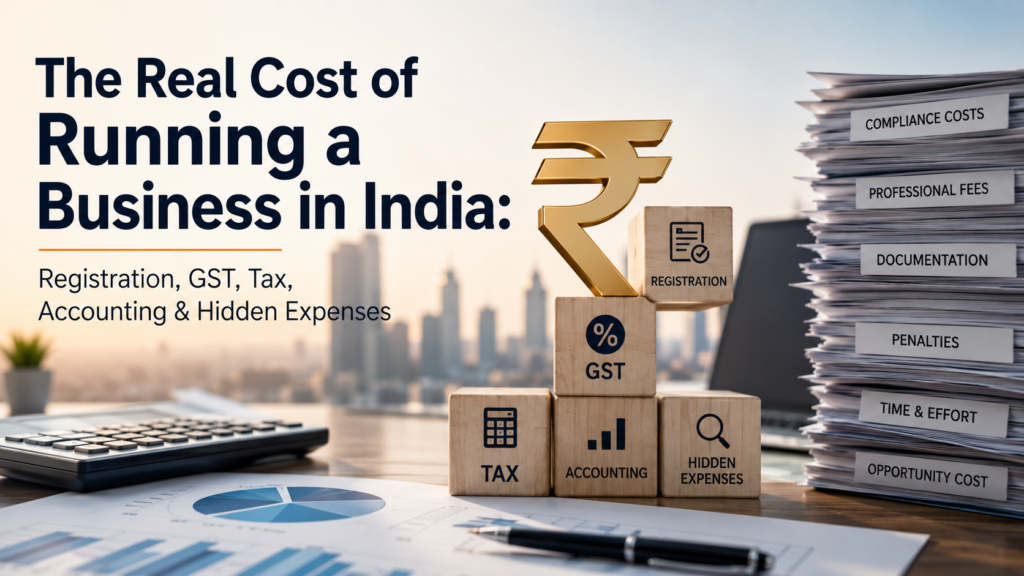
TL;DR Many businesses in India face financial challenges not because of insufficient revenue, but because key costs are underestimated during planning and growth stages. Key cost drivers include: Business registration and entity structure decisions GST and tax compliance obligations Accounting and bookkeeping systems Operational overheads and administrative expenses Hidden financial inefficiencies and cash flow gaps Understanding the complete cost structure of a business is essential for sustainable growth and long-term stability. Why Business Costs Are Often Miscalculated Many entrepreneurs focus heavily on revenue opportunities while underestimating the financial commitments required to operate and grow a business. A business may appear profitable on paper but still experience financial pressure due to: Delayed receivables Compliance-related obligations Limited financial visibility Untracked operational expenses Inefficient cash flow management One common challenge businesses face is inadequate visibility into spending patterns and financial obligations. The Core Cost Components of Running a Business in India 1. Business Registration Costs and Structural Setup Every business begins with registration, but the chosen business structure can influence long-term compliance requirements, taxation, and operational flexibility. Key elements influencing cost structure include: Entity type selection Documentation and registration requirements Legal and regulatory formalities Initial compliance setup Common business structures include: Proprietorship (simplified structure for small businesses) Partnership Firm (shared ownership model) Limited Liability Partnership (LLP) Private Limited Company Selecting an unsuitable business structure may result in: Additional compliance requirements Increased administrative effort Operational limitations as the business grows 2. GST & Tax Compliance Costs Tax compliance and related obligations are often overlooked during business planning. Key components may include: GST registration and return filing Input tax credit reconciliation TDS compliance and reporting Advance tax planning Annual income tax filings Business Impact Areas Working capital management Cash flow timing Administrative workload Compliance-related risks The complexity of GST compliance may increase for businesses involved in: Multi-state operations Ecommerce activities High transaction volumes Multiple business verticals 3. Accounting & Bookkeeping Systems Accounting serves as the financial foundation of a business and supports informed decision-making. Core elements include: Transaction recording systems Expense classification and tracking Invoice management Bank reconciliations Periodic financial reporting Without structured accounting processes: Expense visibility may be reduced Profitability analysis becomes difficult Financial decision-making may become reactive Well-maintained accounting records can help improve financial clarity, compliance readiness, and operational control. 4. Legal & Statutory Compliance Businesses operate within various regulatory frameworks that require periodic compliance. Examples include: ROC filings for companies and LLPs Annual returns Labor law compliance requirements Industry-specific registrations and licenses Audit-related documentation Failure to comply with applicable regulations may result in: Administrative challenges Regulatory notices Operational disruptions 5. Operational Overheads Operational expenses extend beyond direct revenue-generating activities. Common overhead costs include: Employee-related expenses Office and infrastructure costs Software and technology subscriptions Vendor and service provider payments Logistics and distribution expenses These costs often evolve as the business expands and therefore require regular monitoring. Hidden Costs Most Founders Miss Many business owners focus on visible expenses while overlooking indirect costs that can affect profitability. Common Hidden Cost Categories Inefficient vendor agreements Delayed receivables Manual processing errors Duplicate operational activities Poor inventory control Limited tax planning Rework caused by inaccurate records Although these costs may not always appear as direct expenses, they can influence overall financial performance. Monthly vs Annual Financial Burden Breakdown Category Frequency Impact Area Tax filings Monthly / Quarterly Compliance management Accounting updates Monthly Financial reporting GST reconciliation Monthly Cash flow accuracy ROC compliance Annual Regulatory requirements Operational expenses Ongoing Profitability and growth Why Businesses Experience Cash Flow Pressure Cash flow challenges are often linked to financial structure and timing rather than profitability alone. Common reasons include: Delayed customer payments Tax payment schedules Untracked expenses Inventory holding costs Inadequate forecasting Even profitable businesses may experience liquidity constraints when cash inflows and outflows are not properly aligned. Financial Planning Mistakes in Early-Stage Businesses Some common financial planning challenges include: Lack of cost forecasting Ignoring compliance timelines Mixing personal and business finances Irregular financial reviews Absence of accounting discipline These issues may accumulate over time and become more visible as the business scales. How Accounting Systems Reduce Cost Leakage Structured accounting systems support stronger financial management by: Recording transactions accurately Improving expense visibility Supporting tax compliance Enhancing cash flow planning Strengthening internal controls Greater financial clarity can contribute to better business decisions and improved resource allocation. Realistic Cost Structure Framework for SMEs A stable business typically allocates resources across: Compliance and regulatory obligations Accounting and financial management systems Operational infrastructure Taxation responsibilities Growth and expansion initiatives The objective is not to eliminate costs entirely but to optimize resources through effective planning and monitoring. Conclusion The cost of running a business in India extends beyond registration expenses. It involves ongoing compliance obligations, taxation requirements, accounting systems, operational overheads, and financial management processes. Businesses that do not establish structured financial systems at an early stage may encounter: Cash flow challenges Compliance-related pressure Growth constraints Limited financial visibility A well-organized financial framework can help businesses improve clarity, stability, and long-term scalability. Frequently Asked Questions 1. What is the real cost of running a business in India? The overall cost includes registration expenses, taxation compliance, accounting systems, operational overheads, technology costs, and various administrative requirements. 2. What are hidden business expenses? Hidden expenses may include delayed receivables, inefficient processes, bookkeeping errors, compliance lapses, and untracked operational costs. 3. Why do businesses underestimate costs? Many businesses focus primarily on revenue opportunities and may not fully account for compliance obligations, operational overheads, and financial management requirements. 4. Is GST a major cost for small businesses? GST itself is a tax mechanism, but compliance requirements associated with GST can influence administrative workload, cash flow planning, and financial processes. 5. What is the biggest expense in running a business? Major expenses vary by industry and business model. However, operational, employee-related, compliance, and infrastructure costs often represent significant ongoing expenditures. 6. How can businesses reduce financial pressure? Businesses can improve financial control through structured accounting systems, regular financial reviews, effective compliance management, and proper cash flow planning. 7. Do
Best Chartered Accountant in Bhopal? 11 Questions Every Business Owner Should Ask Before Hiring a CA
TL;DR Selecting the right Chartered Accountant in Bhopal is a strategic business decision, not just a professional appointment. The right CA ensures compliance accuracy, financial clarity, and scalable business operations. This guide provides: 11 critical evaluation questions Key red flags to avoid Practical selection framework for founders Compliance-focused decision structure Why Choosing the Right CA Matters for Business Survival In today’s regulatory environment, businesses operate under continuous compliance requirements including GST, TDS, ROC filings, and structured accounting. A mismatch in financial advisory support often leads to: Compliance delays Tax inconsistencies Poor financial visibility Operational confusion Cash flow mismanagement For growing businesses, the right financial expert becomes part of the operational backbone. The Role of a Chartered Accountant in Business Growth A Chartered Accountant is not limited to filing returns or maintaining records. A structured financial expert contributes to: Tax planning and compliance management Business structuring decisions Financial reporting accuracy Risk identification Audit readiness Cash flow clarity Strong financial advisory support improves decision-making quality across all business functions. 11 Questions to Ask Before Hiring a CA 1. What experience do you have with business compliance? Experience determines accuracy in handling GST, TDS, ROC, and audit requirements. 2. Do you understand my industry structure? Different industries require different compliance handling, especially in ecommerce, services, and manufacturing sectors. 3. How do you manage GST and taxation workflows? GST compliance requires structured reconciliation, reporting cycles, and documentation discipline. 4. What accounting systems do you work with? Modern businesses require cloud-based accounting systems for accuracy and scalability. 5. How will financial reporting be shared? Clear reporting structures improve decision-making and transparency in business operations. 6. How do you handle compliance deadlines? A disciplined compliance system reduces risk of penalties and operational disruptions. 7. Do you use digital accounting tools? Digital tools improve accuracy, reduce manual errors, and enhance financial visibility. 8. How do you support business decision-making? Financial advisory should support planning, forecasting, and strategic decisions. 9. How do you manage audit and risk situations? Audit readiness ensures smooth regulatory interaction and financial transparency. 10. How quickly do you respond to queries? Responsiveness is critical in financial decision-making scenarios. 11. Can your support scale as the business grows? Scalability ensures continuity during expansion, funding, and operational growth. Red Flags to Watch While Evaluating a CA Business owners should carefully observe: Lack of structured reporting systems Delayed communication patterns Poor documentation discipline Absence of digital tools Reactive instead of proactive advisory approach Financial clarity depends heavily on structured systems. How a Strong CA Impacts Business Growth A well-structured financial advisory relationship helps businesses: Maintain compliance consistency Improve financial visibility Reduce operational risks Strengthen decision-making Build investor confidence Financial discipline directly supports scalability. Structured Evaluation Checklist Area Evaluation Focus Compliance Handling Accuracy & timeliness Reporting System Clarity & consistency Digital Tools Automation capability Advisory Role Strategic input quality Responsiveness Communication speed Conclusion Selecting the best Chartered Accountant in Bhopal is not about availability—it is about capability, structure, and long-term alignment with business growth. A strong financial advisor strengthens compliance systems, improves clarity, and supports sustainable scaling. Businesses that evaluate carefully before selection build stronger financial foundations for the future. 6. FAQ SECTION 1. How do I choose the best Chartered Accountant in Bhopal? Evaluate experience, compliance handling systems, reporting structure, and ability to support business growth. 2. What questions should I ask before hiring a CA? Ask about compliance experience, reporting systems, digital tools, and communication structure. 3. Why is a CA important for businesses? A CA ensures compliance accuracy, financial clarity, and structured tax management. 4. What makes a good Chartered Accountant? Strong technical knowledge, structured systems, responsiveness, and advisory capability. 5. Can a CA help in business growth? Yes, financial clarity and compliance systems directly support scalable business operations. 6. What is the biggest mistake while hiring a CA? Choosing without evaluating systems, experience, and communication quality. 7. Do startups need a CA from day one? Yes, early financial structure prevents compliance and reporting issues later. BLOG BY: JUNAID KHAN & CO.
Monthly vs Quarterly GST Filing: Which Option Is Better for Small Businesses in 2026?
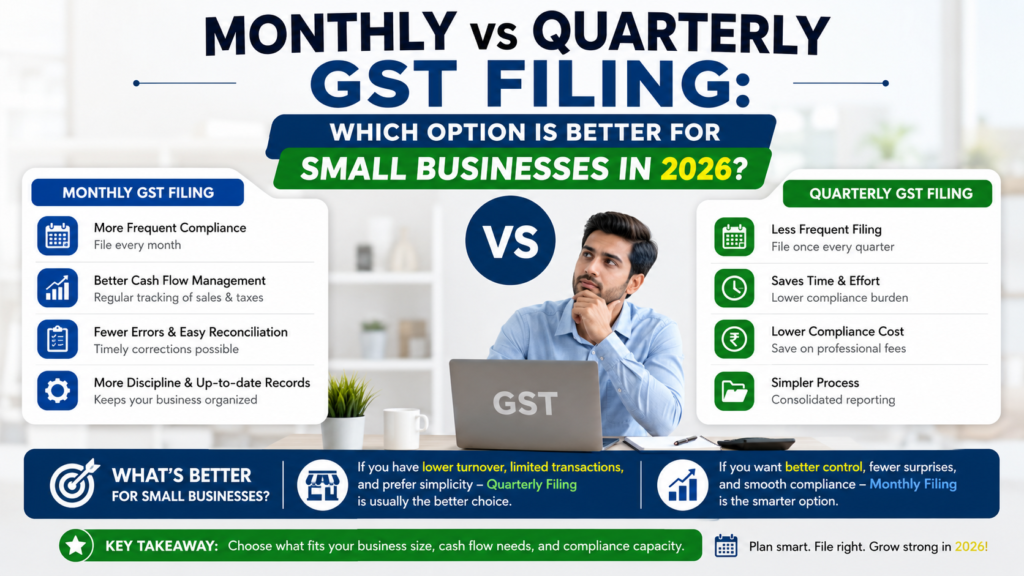
TL;DR GST filing frequency is one of the most important compliance decisions for small businesses in India. Choosing between monthly and quarterly GST filing affects bookkeeping, cash flow visibility, reconciliation, and overall financial management.GST filing frequency directly influences compliance workload, financial visibility, and operational efficiency. Small businesses often struggle to decide between monthly and quarterly GST filing due to unclear rules and operational constraints. The right choice depends on: Business size Transaction volume Cash flow stability Accounting systems Growth stage A structured approach to GST filing reduces compliance errors and improves financial planning. Understanding GST Filing Frequency in India GST return filing is a structured compliance system that requires businesses to report transactions periodically. Two commonly used filing patterns include: Monthly GST filing cycle Quarterly GST filing cycle Each structure affects: Reporting workload Cash flow visibility Tax reconciliation process Operational discipline The selection is not arbitrary; it depends on turnover patterns and compliance eligibility. How GST Filing Cycles Work in Practice GST filing is designed to ensure transparency in: Sales reporting Input tax credit claims Tax liability calculations Vendor reconciliation Businesses must align internal accounting systems with filing cycles to avoid: Mismatch errors Delayed submissions Compliance inconsistencies Monthly GST Filing Explained Monthly GST filing follows a structured reporting cycle where transactions are recorded and submitted every month. This system is generally aligned with: Higher transaction volumes Frequent sales activity Detailed reconciliation requirements Operational Characteristics Continuous bookkeeping required Frequent invoice reconciliation Monthly reporting discipline Real-time financial tracking needed Quarterly GST Filing Explained Quarterly GST filing consolidates transactions into a three-month reporting cycle. This structure is generally suited for: Lower transaction volumes Stable business operations Simplified compliance workflows Operational Characteristics Less frequent reporting Consolidated reconciliation process Reduced administrative workload Delayed financial visibility compared to monthly cycle Key Factors That Influence GST Filing Choice 1. Business Size Smaller businesses with limited transactions often manage quarterly cycles effectively, while high-volume businesses require monthly reporting accuracy. 2. Cash Flow Stability Frequent filing improves financial visibility, which helps in monitoring inflows and outflows more closely. 3. Transaction Volume Higher transaction frequency requires structured monthly reconciliation to maintain accuracy. 4. Compliance Capacity Businesses with limited accounting systems often find quarterly cycles easier to manage initially. Impact of GST Filing Frequency on Business Operations GST filing structure directly impacts: Accounting workload Invoice management systems Tax reconciliation accuracy Financial reporting cycles Decision-making speed Businesses with structured accounting systems handle frequent filings more efficiently due to real-time data availability. Common Mistakes in GST Filing Selection Several operational errors occur when businesses choose filing cycles without evaluating internal systems: Selecting filing frequency without accounting setup Ignoring transaction complexity Missing reconciliation timelines Poor invoice tracking systems Lack of compliance calendar discipline These issues often lead to reporting inconsistencies and financial mismanagement. How Filing Frequency Affects Financial Planning GST filing cycles influence how financial data is interpreted. Monthly systems allow: Faster decision cycles Real-time financial monitoring Improved forecasting accuracy Quarterly systems provide: Consolidated reporting views Reduced administrative load Delayed financial insights Both systems require strong bookkeeping discipline to maintain accuracy. Choosing the Right GST Structure for Growth Stage Business evolution often requires reassessment of filing strategy: Early stage: simplified reporting may suffice Growth stage: structured monthly systems become necessary Scaling stage: automation and integrated accounting become critical The decision should align with operational maturity rather than convenience alone. Transitioning Between Filing Frequencies Businesses often shift between filing structures as operations evolve. Key triggers include: Increase in transaction volume Expansion into new markets Hiring of finance teams Integration of accounting systems Smooth transitions require: Updated bookkeeping systems Clean financial records Consistent invoice management Final Decision Framework A structured decision approach includes evaluating: Transaction volume consistency Internal accounting readiness Cash flow tracking needs Compliance discipline capability Growth trajectory Businesses that align filing frequency with operational structure experience fewer compliance disruptions. Conclusion GST filing frequency is not merely a compliance requirement—it directly impacts financial discipline and operational efficiency. The choice between monthly and quarterly filing depends on business maturity, accounting systems, and transaction behavior. Structured financial systems ensure smoother compliance, accurate reporting, and better decision-making across all stages of business growth. 6. FAQ SECTION 1. Is monthly GST filing mandatory for all businesses? Not all businesses require monthly filing; eligibility depends on turnover and compliance category. 2. Who can file GST quarterly in India? Businesses with specific turnover thresholds and eligible schemes can opt for quarterly filing. 3. Which GST filing method is easier for small businesses? Quarterly filing may reduce administrative frequency, but suitability depends on transaction complexity. 4. Does GST filing frequency affect cash flow? Yes, filing cycles influence financial tracking and reporting visibility. 5. Can businesses switch filing frequency later? Yes, filing structure can be adjusted based on operational requirements and eligibility. 6. What happens if GST returns are delayed? Delays may result in compliance notices and financial penalties. 7. Which filing method is better for growing businesses? Growing businesses often require structured monthly reporting for better financial control. BLOG BY: JUNAID KHAN & CO.
Expert Insights: Why Most New Businesses Fail During Registration & Compliance Stage
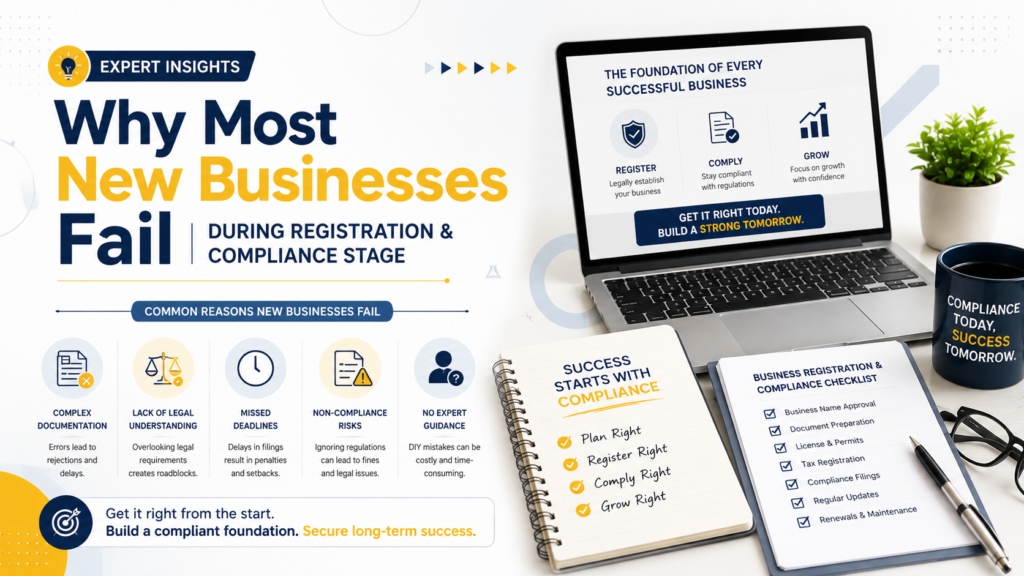
TL;DR Many startups and new businesses fail before scaling because they underestimate the importance of registration, compliance, taxation, and financial structuring. The most common reasons include: Choosing the wrong business structure Missing compliance deadlines GST and tax filing errors Poor bookkeeping systems Inadequate legal documentation Lack of professional advisory support Businesses that establish proper compliance systems early improve operational stability, investor confidence, and long-term scalability. Why the Registration & Compliance Stage Is Critical Most entrepreneurs focus heavily on branding, product development, and customer acquisition during the early stages of business. However, many ignore the legal and compliance foundation that supports sustainable growth. A business may generate revenue initially, but weak compliance systems eventually create operational roadblocks such as: Government notices Banking restrictions Funding difficulties Vendor trust issues Tax penalties Legal complications The registration and compliance stage determines whether a business is structurally prepared for long-term operations. Businesses that neglect this phase often struggle within the first few years. The Hidden Risks New Businesses Ignore New founders frequently assume that registration is simply paperwork. In reality, incorporation is the beginning of ongoing legal, tax, and financial responsibilities. Hidden Risks Include: Incorrect tax classification Improper GST registration Delayed ROC filings Unstructured accounting Lack of statutory records Incomplete shareholder agreements Regulatory non-compliance These issues compound over time and become expensive operational problems later. Most Common Registration Mistakes Founders Make 1. Choosing the Wrong Business Structure One of the earliest and most damaging mistakes is selecting an unsuitable business structure. Many founders register without understanding the long-term impact of: Taxation Compliance obligations Liability protection Funding capability Scalability Common Structures in India Structure Suitable For Sole Proprietorship Freelancers & small local businesses Partnership Firm Small jointly operated businesses LLP Professional services & SMEs Private Limited Company Scalable startups seeking investment Choosing the wrong structure can create: Tax inefficiencies Limited funding opportunities Operational restrictions Compliance confusion 2. Incomplete Documentation During Registration Documentation errors delay approvals and create legal inconsistencies. Common documentation mistakes include: Incorrect address proofs Mismatched PAN details Improper MOA/AOA drafting Missing digital signatures Director KYC issues Poor documentation can delay: Bank account opening GST registration Vendor onboarding Funding processes Founders should maintain organized documentation from day one. 3. Ignoring Industry-Specific Licenses Many businesses assume incorporation alone is sufficient. However, depending on the business type, additional licenses may be required. Examples include: GST registration Shops & Establishment License Import Export Code (IEC) FSSAI registration Professional Tax registration MSME/Udyam registration Operating without required approvals increases compliance risk significantly. 4. Poor Financial Planning Before Launch Many startups begin operations without: Accounting systems Cash flow forecasting Expense categorization Tax planning Compliance budgeting This creates immediate operational instability. According to startup ecosystem reports, cash flow mismanagement remains one of the top reasons early-stage businesses fail. Financial discipline should begin before the first sale. Major Compliance Mistakes That Hurt Startups 1. GST Compliance Errors GST remains one of the biggest compliance challenges for new businesses. Common mistakes include: Delayed GST registration Incorrect invoice formatting ITC mismatches Late filing Vendor reconciliation failures Consequences may include: Interest liabilities Penalties Notice issuance Working capital disruption Businesses should implement structured GST tracking systems early. 2. Ignoring TDS & Payroll Compliance Businesses hiring employees or contractors must understand TDS obligations. Common issues include: Incorrect deductions Delayed deposits Filing errors Missing payroll documentation This creates unnecessary scrutiny and financial exposure. Payroll compliance becomes increasingly important as businesses scale. 3. Delayed ROC Filings Private Limited Companies and LLPs have ongoing filing obligations. Missed ROC deadlines affect: Company status Director compliance records Future fundraising Corporate credibility Founders often ignore ROC obligations until notices arrive. Compliance calendars help avoid this problem. 4. Weak Accounting & Bookkeeping Systems Many startups operate for months without organized accounting. Common issues: Untracked expenses Mixed personal and business transactions No receivable tracking Missing invoices Cash flow confusion Weak bookkeeping creates inaccurate financial reporting. This affects: Tax filings Investor due diligence Loan eligibility Business valuation Why Founders Underestimate Compliance Many entrepreneurs view compliance as a secondary administrative activity. In reality, compliance directly impacts: Business continuity Funding readiness Operational stability Legal protection Financial transparency Startups with poor compliance often appear risky to: Investors Banks Strategic partners Enterprise clients Compliance is not merely about avoiding penalties—it builds business credibility. Registration vs Operational Readiness Registration alone does not make a business operationally ready. A scalable business also requires: Accounting systems Financial controls Vendor contracts Tax tracking Payroll workflows Documentation management Founders should think beyond incorporation certificates. Operational readiness determines whether a company can grow sustainably. Essential Compliance Systems Every Startup Needs 1. Compliance Calendar Track: GST filings ROC filings TDS due dates Payroll compliance Annual returns 2. Cloud Accounting System Use structured accounting platforms for: Invoicing Reconciliation Reporting Expense tracking 3. Document Management System Maintain: Tax filings Registration certificates Agreements Financial records 4. Internal Financial Controls Create approval systems for: Expenses Vendor payments Payroll Reimbursements Startup Compliance Checklist Area Key Requirement Business Registration Proper structure selection GST Timely registration & filing Accounting Organized bookkeeping ROC Filings Annual compliance Payroll TDS & statutory deductions Documentation Digital records management Banking Separate business accounts How Professional Guidance Reduces Risk Professional advisory support helps founders: Choose the right structure Avoid legal mistakes Maintain tax compliance Build scalable accounting systems Improve operational readiness Experienced chartered accountants and compliance advisors can identify risks before they become expensive business problems. For many startups, professional guidance during the initial stage prevents years of compliance complications later. Conclusion Most new businesses do not fail because their ideas are weak. They fail because operational foundations are poorly structured from the beginning. Registration and compliance are not merely formalities—they establish the legal, financial, and operational backbone of a company. Founders who prioritize: Correct registration Strong accounting systems Timely compliance Structured documentation Professional guidance position their businesses for sustainable growth and long-term stability. Businesses seeking structured registration, compliance management, accounting support, and startup advisory can benefit from expert guidance from firms like Junaid Khan & Co to build a stronger operational foundation from the beginning. 6. FAQ SECTION 1.
Accounting & Bookkeeping for Growing Businesses: Systems Every Founder Should Set Up Early
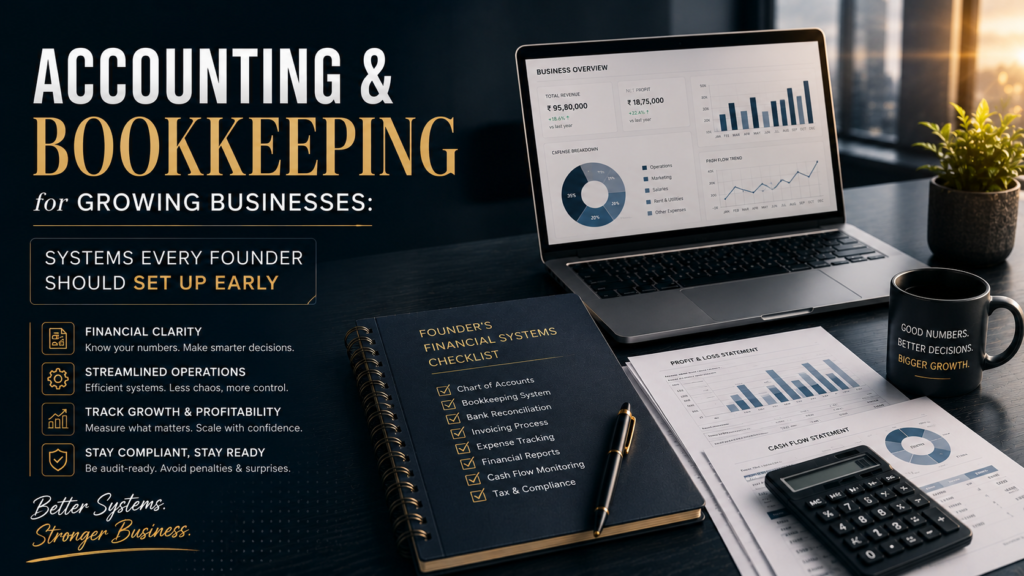
TL;DR Growing businesses often fail financially not because of poor sales, but because of weak accounting systems. Founders who establish proper bookkeeping workflows early gain better cash flow visibility, easier tax compliance, stronger investor confidence, and scalable operations. This guide explains: The accounting systems every growing business needs Common bookkeeping mistakes to avoid Financial reports founders should monitor How automation improves accuracy and efficiency When outsourcing accounting becomes necessary Why Early Accounting Systems Matter Most founders focus heavily on sales, hiring, and operations during the growth phase. Accounting becomes an afterthought until problems start appearing: GST mismatches Cash flow shortages Vendor disputes Missed tax deadlines Unclear profitability Investor due diligence issues Without structured bookkeeping systems, financial data becomes unreliable. That directly impacts strategic decisions. According to multiple SME finance studies, businesses with organized financial reporting are significantly more likely to maintain healthy cash flow and secure external funding. Strong accounting systems help businesses: Track profitability accurately Maintain compliance Forecast growth Improve operational efficiency Build lender and investor trust The Real Cost of Poor Bookkeeping Poor bookkeeping creates hidden financial risks that compound over time. Problem Business Impact Missing expense records Incorrect profit calculation Delayed invoicing Slower cash inflow GST reconciliation errors Notices and penalties No receivable tracking Bad debts Weak payroll records Compliance disputes Manual spreadsheets Human errors and duplication Founders often underestimate how quickly financial disorganization affects business growth. A business can grow revenue while simultaneously losing financial control. Core Accounting Systems Every Founder Needs 1. Separate Business and Personal Finances One of the earliest systems founders should establish is complete separation between business and personal transactions. This includes: Dedicated business bank accounts Separate credit/debit cards Structured reimbursement policies Clear owner withdrawal tracking Mixing personal and business expenses creates: Tax complications Audit risks Reporting inaccuracies Cash flow confusion Clean financial separation improves bookkeeping accuracy immediately. 2. Implement Cloud Accounting Software Early Manual bookkeeping becomes unsustainable once transaction volume increases. Cloud accounting software helps automate: Invoicing Expense categorization Bank reconciliation Financial reporting GST calculations Benefits include: Real-time financial visibility Reduced human errors Faster reporting Easier collaboration with accountants Secure cloud backups Founders should prioritize systems that integrate with: Banking GST filing Payroll Ecommerce platforms CRM tools 3. Build an Expense Management Workflow Uncontrolled expense tracking is one of the most common operational weaknesses in growing businesses. An effective workflow should include: Digital expense submissions Approval hierarchy Receipt storage Vendor categorization Monthly reconciliation Recommended categories: Marketing Salaries Travel Software subscriptions Vendor payments Operational expenses This improves budgeting accuracy and tax documentation readiness. 4. Set Up Invoice & Receivable Tracking Revenue means little if collections are delayed. Many businesses struggle because they track sales but fail to monitor receivables properly. Every founder should implement: Standardized invoicing Payment due-date tracking Automated reminders Customer ledger reconciliation Ageing analysis reports Aging reports help identify: Chronic late payers Cash flow risks Collection inefficiencies Strong receivable management improves liquidity significantly. 5. Create GST & Tax Compliance Tracking Systems Compliance becomes more complex as businesses scale. Growing businesses must track: GST input/output reconciliation TDS deductions Vendor compliance Filing deadlines Advance tax obligations Missing compliance deadlines can result in: Notices Interest liabilities Penalties ITC mismatches A structured compliance calendar reduces these risks. 6. Establish Payroll & Employee Payment Systems Payroll errors damage employee trust and create compliance exposure. Founders should implement: Salary processing workflows Leave tracking PF/ESI calculations Reimbursement systems Payroll documentation As teams grow, payroll complexity increases rapidly. Automated payroll systems improve: Accuracy Timeliness Statutory compliance Record maintenance 7. Review Monthly Financial Reports Many founders only review finances during tax season. That creates delayed decision-making. Businesses should review monthly: Report Why It Matters Profit & Loss Statement Tracks profitability Cash Flow Statement Monitors liquidity Balance Sheet Evaluates financial position Receivables Report Tracks collections Expense Summary Controls spending Monthly reviews help founders: Detect financial leaks Improve forecasting Optimize margins Make data-driven decisions 8. Maintain a Proper Document Management System Financial documentation becomes critical during: Tax assessments Funding rounds Audits Vendor disputes Due diligence Businesses should maintain: Digital invoices Contracts Tax filings Payroll records Bank statements Cloud storage with organized folders improves accessibility and audit readiness. Essential Financial Reports Founders Should Review Founders do not need to become accountants, but they must understand core business metrics. Key Metrics to Monitor Gross profit margin Net profit margin Burn rate Cash runway Accounts receivable turnover Operating expenses ratio These indicators reveal operational efficiency and growth sustainability. Common Bookkeeping Mistakes Growing Businesses Make Delaying Accounting Until Year-End This causes: Backlogs Errors Tax stress Inaccurate reports Over-Reliance on Excel Sheets Spreadsheets become risky during scaling due to: Manual errors Version conflicts Lack of automation Ignoring Cash Flow Profitability does not guarantee healthy cash flow. Many businesses fail because: Collections are delayed Expenses rise too quickly Inventory locks working capital Poor Vendor Documentation Missing invoices and contracts create: GST input issues Audit risks Payment disputes Automation vs Manual Accounting Automation significantly improves operational efficiency. Manual Systems Best for: Very early-stage businesses Minimal transactions Automated Systems Best for: Scaling companies Multi-location operations Ecommerce businesses Service firms with recurring invoicing Automation improves: Accuracy Speed Compliance tracking Reporting consistency However, automation still requires professional oversight. When to Outsource Accounting & Bookkeeping Many founders attempt to manage bookkeeping internally for too long. Outsourcing becomes beneficial when: Transaction volume increases Compliance complexity rises Financial reporting becomes inconsistent Internal teams lack expertise Professional accounting support helps businesses: Improve compliance Maintain accurate books Generate strategic reports Prepare for audits and funding How Proper Financial Systems Help Businesses Scale Businesses with structured accounting systems scale faster because they can: Access financing more easily Forecast accurately Reduce operational inefficiencies Improve profitability analysis Build investor confidence Financial discipline creates operational stability. As businesses expand into new markets, hire larger teams, or increase transaction volume, accounting systems become a strategic growth asset—not just a compliance function. Conclusion Accounting and bookkeeping are not merely administrative tasks. They form the operational backbone of a scalable business. Founders who establish structured financial systems early gain: Better visibility Stronger
TDS & TCS Compliance Guide 2026: Mistakes That Trigger Notices and How to Avoid Them
TL;DR TDS and TCS compliance has become heavily data-driven in FY 2026. The Income Tax Department now uses automated reconciliation systems to detect mismatches, delayed deposits, incorrect PAN entries, and return filing errors. Even small compliance gaps can trigger notices, interest liabilities, or scrutiny. This guide explains: Common TDS/TCS mistakes Reasons businesses receive notices Filing and reconciliation best practices Internal compliance controls businesses should adopt Preventive strategies for FY 2026 Understanding TDS & TCS in Simple Terms Tax Deducted at Source (TDS) and Tax Collected at Source (TCS) are mechanisms used by the government to collect taxes during transactions rather than waiting until year-end tax filing. TDS Applies When: A business deducts tax before making payments such as: Salaries Contractor payments Professional fees Rent Interest Commission TCS Applies When: A seller collects tax while selling specified goods or services such as: Scrap Minerals Motor vehicles Overseas tour packages E-commerce transactions under applicable provisions In 2026, tax authorities are increasingly relying on AI-driven data matching between: GST returns Income tax returns TDS returns AIS/TIS data Bank transactions MCA filings This means even minor inconsistencies can now trigger automated notices. Why TDS & TCS Notices Are Increasing in 2026 Businesses today operate in a highly digitized compliance environment. The Income Tax Department cross-verifies multiple data sources automatically. Major Reasons Notices Are Increasing Automated reconciliation systems Higher reporting transparency Real-time PAN validation GST and TDS data integration AI-based anomaly detection Increased compliance scrutiny for MSMEs and startups Many businesses still rely on outdated manual accounting systems, creating frequent mismatches and filing errors. Common TDS Compliance Mistakes Businesses Make 1. Deducting TDS Under the Wrong Section Using the wrong TDS section is one of the most common compliance errors. For example: Professional fees wrongly booked as contractor payments Rent categorized incorrectly Technical services misclassified This can result in: Short deduction notices Interest liability Reassessment risk Prevention Tip Create a vendor classification matrix based on payment nature. 2. Delayed TDS Deduction Many businesses deduct TDS only at the time of payment instead of at the earlier of: Expense booking, or Actual payment This creates compliance gaps and interest exposure. Common Scenario A company records consultancy expenses in March but deducts TDS in May during payment processing. Result: Late deduction liability Interest implications Notice risk 3. Late Deposit of TDS Even when TDS is correctly deducted, delayed deposit remains a major issue. Consequences Interest liability Penalty exposure Disallowance of expenses Increased scrutiny risk Businesses often face delays because: Finance approvals are pending Cash flow planning is weak Compliance calendars are not maintained 4. PAN Errors and Vendor Mismatches Incorrect PAN details create immediate reconciliation failures. Common Problems Invalid PAN Vendor PAN mismatch Name mismatch Inactive PAN status This can: Increase TDS rates automatically Cause Form 26AS mismatches Trigger vendor disputes Prevention Tip Verify PAN details before onboarding vendors. 5. Incorrect TDS Return Filing Errors in quarterly returns are a major source of notices. Common Filing Errors Wrong challan mapping Incorrect deductee details Duplicate entries Missing transactions Invalid section codes Businesses often fail to reconcile: Books of accounts Challans Return data Form 26AS before submission. Common TCS Compliance Errors TCS compliance is becoming increasingly important for: E-commerce sellers Automobile dealers Exporters Traders dealing in notified goods Frequent TCS Mistakes Failure to identify applicable transactions Incorrect collection rates Delayed TCS deposits Missing TCS returns Non-reconciliation with sales records Businesses frequently misunderstand threshold applicability, especially in high-volume sectors. Major TDS & TCS Notice Triggers in FY 2026 1. Mismatch Between GST & TDS Data Authorities compare: Vendor payments GST outward supplies Expense reporting If numbers do not align, scrutiny may begin. 2. High-Value Transactions Without TDS Large payments without applicable TDS deduction create automatic risk flags. 3. Frequent Revised Returns Multiple revisions indicate weak internal controls. This often increases: Compliance scrutiny Audit probability 4. Short Deduction Cases Deducting lower tax than applicable is a common issue in: Professional services Contractual work Technical consultancy 5. Non-Filing or Nil Filing Patterns Businesses with: High turnover Vendor-heavy operations Salary expenses but nil TDS filing often attract notices. TDS & TCS Compliance Checklist for Businesses Compliance Area Action Required Vendor Onboarding Verify PAN & compliance status Expense Booking Apply correct TDS section Monthly Review Reconcile ledgers and challans Return Filing Validate deductee data GST Matching Compare vendor invoices Documentation Maintain agreements and invoices Compliance Calendar Track all due dates Due Dates Businesses Should Never Ignore Critical Compliance Activities TDS deduction TDS deposit Quarterly TDS return filing TCS collection TCS return filing PAN validation Reconciliation reviews Missing timelines significantly increases notice risk. Best Practices to Avoid TDS & TCS Notices Automate Compliance Processes Modern accounting software reduces: Manual entry errors Calculation mismatches Filing delays Conduct Monthly Reconciliation Reconcile: Books Challans GST data Vendor ledgers Form 26AS every month rather than waiting until quarter-end. Maintain Vendor Documentation Keep: PAN copies Agreements Invoices Declarations GST registrations organized and updated. Train Finance Teams Regularly Tax provisions change frequently. Businesses should conduct periodic compliance training for accounting staff. Seek Professional Review Before Filing A professional compliance review helps identify: Section errors Missing deductions Mismatches Reporting gaps before filing returns. How Professional CA Support Reduces Compliance Risks Businesses often focus only on filing returns but ignore preventive compliance systems. Professional CA firms help by: Conducting TDS/TCS health checks Setting internal SOPs Improving reconciliation systems Handling notice responses Monitoring compliance calendars Reducing operational tax risks For growing businesses, startups, and MSMEs, proactive compliance support is often more valuable than reactive notice handling. Conclusion TDS & TCS compliance in FY 2026 is no longer a routine accounting formality. It has become a critical risk-management function for businesses of all sizes. Most notices today are not caused by tax evasion — they result from: Reconciliation failures Incorrect reporting Delayed filings Weak internal systems Businesses that implement structured compliance workflows, conduct periodic reviews, and maintain accurate records can significantly reduce scrutiny and operational stress. Junaid Khan & Co helps businesses streamline tax compliance, strengthen reporting accuracy, and reduce regulatory exposure through practical
Business Funding Readiness: Financial Documents Investors & Banks Expect Before Approval

TL;DR Securing business funding in 2026 requires more than a good business idea. Banks, NBFCs, investors, and venture capital firms increasingly evaluate: financial discipline, compliance history, cash flow consistency, documentation quality, and operational transparency. Before approving funding, lenders and investors typically review: financial statements, GST records, income tax filings, bank statements, projections, compliance records, and business performance indicators. Businesses with organized documentation and strong financial systems significantly improve their chances of approval. This guide explains the exact financial documents and readiness factors investors and banks expect before approving business funding. Why Funding Readiness Matters More in 2026 Funding evaluation processes have become significantly more data-driven. Today, lenders and investors use: AI-assisted risk analysis, automated financial verification, GST and tax reconciliation systems, digital transaction reviews, and compliance scoring models. This means businesses are evaluated not only on growth potential but also on: financial consistency, transparency, and compliance behavior. Even profitable businesses may struggle to secure funding if documentation is incomplete or poorly maintained. What Banks & Investors Actually Evaluate Contrary to popular belief, funding approval is not based only on revenue. Financial institutions evaluate: business sustainability, repayment capability, compliance history, operational efficiency, and risk exposure. Key Areas Evaluated Evaluation Area Why It Matters Financial Statements Measures profitability & stability Cash Flow Indicates repayment capability GST & Tax Compliance Reflects financial discipline Bank Statements Shows transaction consistency Business Projections Demonstrates growth planning Existing Liabilities Evaluates financial risk Accounting Quality Indicates operational maturity Founder Credibility Builds investor confidence Essential Financial Documents Every Business Needs Proper documentation is the foundation of funding readiness. 1. Profit & Loss Statement This helps investors understand: revenue trends, profitability, expense management, and business efficiency. A poorly maintained P&L statement immediately raises concerns. 2. Balance Sheet The balance sheet reflects: assets, liabilities, capital structure, and overall financial position. Banks use it to evaluate financial strength and stability. 3. Cash Flow Statement Cash flow is often more important than revenue. Even profitable businesses can face rejection if: cash flow management is weak, receivables are poorly controlled, or operational liquidity is unstable. 4. Bank Statements Lenders review banking behavior carefully. They evaluate: transaction consistency, cash deposits, EMI history, cheque returns, and operational discipline. 5. GST Returns & Compliance Records GST filings help institutions verify: actual business turnover, transaction consistency, vendor activity, and compliance discipline. Mismatch between GST records and financial statements creates red flags. 6. Income Tax Returns ITRs establish: declared income credibility, tax discipline, and financial consistency. Businesses with irregular tax filing histories often face higher scrutiny. 7. Business Registration Documents Investors generally review: incorporation certificates, partnership deeds, LLP agreements, licenses, and regulatory registrations. Proper legal structure improves credibility. Importance of Financial Statements Many businesses focus only on revenue growth. However, investors prioritize: margin quality, cash generation, sustainability, and scalability. Financial Statements Help Evaluate: operational efficiency, debt exposure, growth patterns, and financial governance. Professionally maintained statements create stronger trust. Business Projections & Forecasting Funding institutions want visibility into future performance. Common Forecasting Documents revenue projections, cash flow forecasts, expansion plans, break-even analysis, and operational estimates. Realistic projections are critical. Overly aggressive forecasts often damage credibility. Compliance Documents Investors Review Compliance history plays a major role in risk evaluation. Commonly Reviewed Compliance Areas GST filing consistency Income tax filing history ROC compliance TDS compliance Payroll records Vendor documentation Accounting reconciliation Strong compliance systems reduce perceived risk. GST, Tax & Regulatory Readiness Funding institutions increasingly cross-check: GST turnover, tax declarations, banking activity, and reported income. Common Red Flags Frequent GST delays Tax mismatches Incomplete bookkeeping Unexplained cash transactions Non-compliant vendors Missing financial records Businesses should regularly conduct compliance reviews before applying for funding. Common Reasons Businesses Get Rejected Many businesses assume rejection occurs due to low turnover alone. In reality, documentation and compliance weaknesses are major factors. Common Rejection Reasons Poor bookkeeping Inconsistent cash flow Weak financial projections GST mismatches Irregular tax filing Incomplete documentation Excessive liabilities Lack of business transparency How Poor Bookkeeping Affects Funding Poor accounting systems create multiple problems. Consequences Include inaccurate financial statements, unreliable projections, reconciliation errors, compliance inconsistencies, and lower investor confidence. Businesses with organized accounting systems appear: more stable, scalable, and professionally managed. Due Diligence Preparation for Startups Startups often underestimate investor due diligence. Modern due diligence includes: financial verification, founder background review, compliance checks, legal verification, operational analysis, and scalability evaluation. Startup Readiness Best Practices Maintain updated books Organize compliance records Separate personal and business finances Document major agreements Monitor cash flow regularly Maintain investor-ready reporting Funding Readiness Checklist Area Recommended Action Financial Statements Update regularly GST Compliance Monthly reconciliation Tax Filing Timely submissions Bank Records Organized transaction history Cash Flow Monitoring Monthly review Accounting System Use structured software Business Projections Maintain realistic forecasts Compliance Documentation Keep digitally organized How Junaid Khan & Co Helps Businesses Prepare Junaid Khan & Co supports businesses with: financial statement preparation, GST reconciliation, startup compliance, funding documentation, bookkeeping support, tax compliance, audit preparedness, and business financial advisory. The firm assists: startups, MSMEs, growing businesses, and service companies preparing for funding opportunities. Conclusion Funding readiness is no longer optional for growing businesses. Banks and investors expect: accurate financial reporting, strong compliance systems, organized documentation, and operational transparency. Businesses that proactively improve financial discipline and documentation quality significantly increase their chances of: loan approval, investor confidence, and sustainable growth. A well-prepared business not only secures funding faster but also builds long-term credibility in the market. 6. FAQ SECTION 1. What financial documents do banks require before approving loans? Banks usually review financial statements, GST returns, bank statements, tax filings, and compliance records. 2. Why do investors check GST and tax filings? GST and tax records help verify turnover consistency and compliance discipline. 3. What is investor due diligence? Investor due diligence is a detailed review of a business’s financial, legal, and operational condition before funding. 4. How important is bookkeeping for funding approval? Strong bookkeeping improves transparency, reporting accuracy, and investor confidence. 5. Can startups secure funding without financial projections? Most investors expect realistic business projections and future planning analysis.
Audit Requirements in India Explained: Does Your Business Actually Need an Audit?
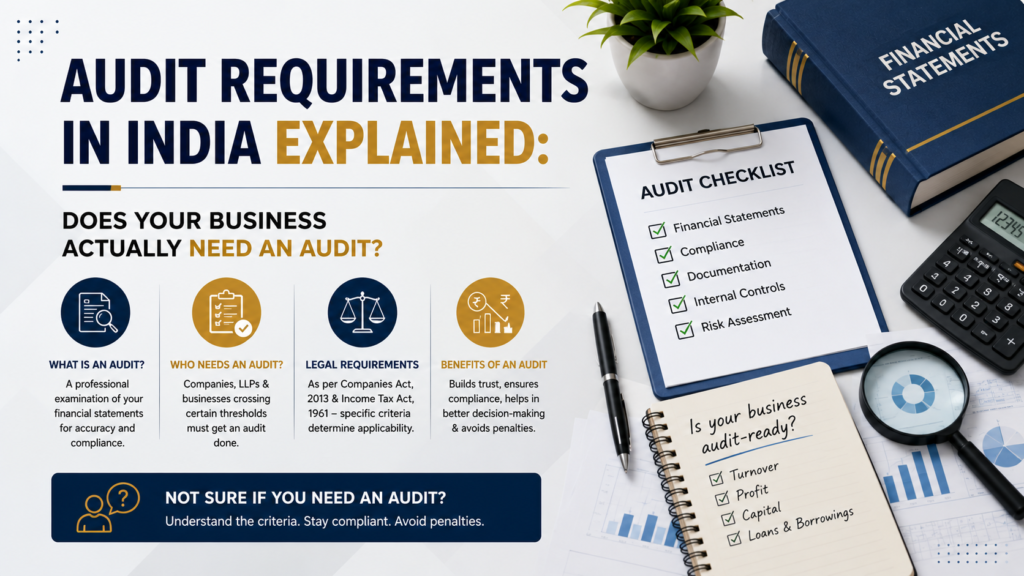
TL;DR Not every business in India requires the same type of audit. However, depending on: Business structure Turnover Profit declaration Tax regime Compliance category your business may require: Statutory audit Tax audit Internal audit GST-related compliance review Many startups and small businesses misunderstand audit applicability and either: Ignore mandatory compliance, or Spend unnecessarily on audits they may not require This guide explains: Which audits apply to which businesses Important turnover thresholds Common misconceptions Practical audit preparedness strategies for FY 2026–27 Why Audit Compliance Matters in India Audits are not just regulatory formalities. They help: Improve financial transparency Strengthen credibility Detect accounting inconsistencies Reduce compliance risks Support funding and banking processes Today, tax departments and regulatory authorities increasingly rely on: digital reconciliation, data analytics, AI-based scrutiny systems, and automated mismatch detection. As a result, proper audit compliance has become essential for businesses of all sizes. Types of Audits Businesses Should Know Many business owners use the term “audit” broadly, but different audits serve different purposes. Major Audit Categories in India Audit Type Purpose Statutory Audit Mandatory under company law Tax Audit Required under Income Tax Act Internal Audit Operational and risk review GST Compliance Review GST reconciliation and compliance analysis Stock Audit Inventory verification Forensic Audit Fraud investigation Understanding which audit applies to your business is critical. What Is a Statutory Audit? A statutory audit is mandated under the Companies Act. Usually Applicable To: Private Limited Companies Public Limited Companies Certain LLPs Regulated entities The purpose is to verify: financial statements, accounting records, and regulatory compliance. Key Objective To ensure that the financial statements present a true and fair view of the business. Even startups with minimal transactions may require statutory audit if incorporated as companies. What Is a Tax Audit? A tax audit is governed under the Income Tax Act. It evaluates whether: books of accounts are properly maintained, income is correctly reported, and tax compliance requirements are fulfilled. Businesses Typically Trigger Tax Audit Based On: turnover, gross receipts, or profit declaration criteria. Tax audit applicability can also change under presumptive taxation schemes. Audit Requirements for Different Business Structures Different entity types have different compliance obligations. Sole Proprietorship Audit applicability depends mainly on: turnover, profit reporting, and taxation scheme. Many small proprietors assume audits never apply to them, which is incorrect. Partnership Firms Partnerships may require: tax audit, accounting compliance, and financial reporting obligations depending on turnover and taxation structure. LLP (Limited Liability Partnership) LLPs may require audit depending on: turnover levels, contribution thresholds, and statutory obligations. LLPs are often preferred for flexibility, but compliance requirements still apply. Private Limited Companies Private limited companies generally require: statutory audit, annual ROC compliance, financial statement reporting, and structured accounting documentation. This applies even if the company is newly incorporated. Turnover Limits & Audit Applicability Turnover thresholds are among the most misunderstood compliance areas. Businesses should evaluate: total sales, digital transaction percentage, presumptive taxation eligibility, and declared profits. Common Mistakes Businesses Make Assuming GST turnover equals tax audit turnover Ignoring digital transaction provisions Mixing personal and business accounts Underreporting receipts Not maintaining proper books Regular professional review helps businesses avoid incorrect assumptions. Tax Audit for Professionals & Consultants Doctors, architects, consultants, freelancers, and other professionals may also face audit applicability. Common Professional Categories Medical practitioners Legal consultants IT consultants Marketing agencies Financial advisors Architects Designers Professionals using presumptive taxation must carefully evaluate: declared profit percentages, receipts, and compliance conditions. Is GST Audit Mandatory? Many businesses still believe GST audit is compulsory for all taxpayers. However, GST regulations have evolved significantly. Today, businesses mainly need: accurate GST reconciliation, return consistency, invoice matching, and documentation readiness. Authorities increasingly focus on: ITC mismatches, fake invoicing, e-invoice inconsistencies, and vendor compliance. Therefore, GST compliance reviews remain extremely important even when formal GST audit applicability differs. Common Audit Myths Businesses Believe Myth 1: Small Businesses Never Need Audit Incorrect. Many small businesses cross compliance thresholds without realizing it. Myth 2: Digital Payments Eliminate Audit Requirements Digital transactions may affect thresholds but do not automatically remove compliance obligations. Myth 3: Startups Can Ignore Audit in Initial Years Private limited companies generally require statutory audit regardless of early-stage activity. Myth 4: Freelancers Never Require Audit Professionals and freelancers may require audit depending on receipts and tax structure. Consequences of Ignoring Audit Compliance Ignoring audit obligations can create serious issues. Possible Risks Income tax notices Penalties Disallowance of expenses Increased scrutiny Delayed funding approvals Banking complications Compliance litigation Loss of financial credibility Businesses with poor accounting systems often struggle most during scrutiny. How Proper Accounting Reduces Audit Risk Strong accounting systems simplify compliance significantly. Best Practices Maintain organized books Separate personal and business expenses Use accounting software Reconcile GST regularly Track vendor documentation Preserve invoices digitally Review compliance monthly Businesses with structured bookkeeping experience: fewer notices, smoother audits, and stronger financial control. Audit Readiness Checklist for Businesses Compliance Area Recommended Action Books of Accounts Maintain updated records GST Reconciliation Monthly review Invoice Management Proper documentation Expense Tracking Categorize correctly Bank Reconciliation Monthly matching Financial Statements Prepare periodically Vendor Verification Maintain compliance records Tax Filing Timely submissions How Junaid Khan & Co Helps Businesses Stay Compliant Junaid Khan & Co assists businesses with: statutory audit support, tax audit compliance, GST reconciliation, accounting advisory, ROC compliance, startup compliance guidance, bookkeeping support, and financial reporting assistance. The firm works with: startups, MSMEs, LLPs, private limited companies, professionals, and growing businesses across India. Conclusion Audit compliance in India is more nuanced than many businesses realize. Not every business requires every type of audit. However, ignoring applicability rules can create: financial risk, penalties, scrutiny, and operational complications. Businesses should regularly review: turnover, business structure, taxation method, and compliance obligations. A proactive compliance strategy not only reduces audit risk but also improves: credibility, investor confidence, financial discipline, and long-term business stability. 6. FAQ SECTION 1. Is audit mandatory for every business in India? No. Audit applicability depends on business structure, turnover, receipts, and tax provisions. 2. What is the difference between statutory audit and tax audit?