

Advance Tax Payment Guide 2026: Due Dates, Calculation & Penalties for Late Payment
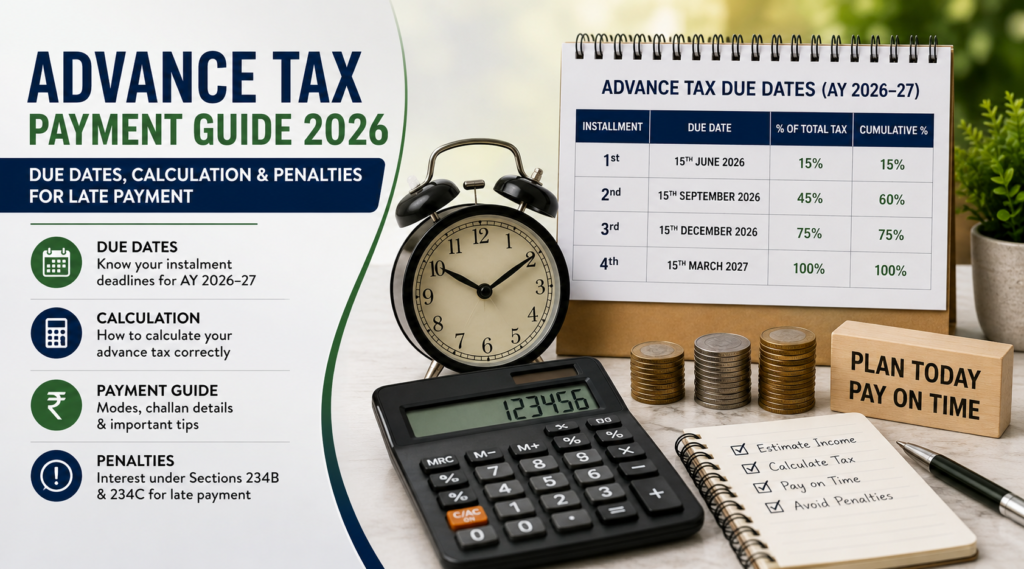
TL;DR Advance tax is a system under which eligible taxpayers pay their estimated income tax during the financial year instead of waiting until the year ends. For FY 2026–27 (AY 2027–28), taxpayers liable to pay advance tax generally make payments in instalments during the financial year. For most taxpayers, the statutory schedule is: Due Date Cumulative Advance Tax Payable 15 June 2026 15% 15 September 2026 45% 15 December 2026 75% 15 March 2027 100% For taxpayers covered by the presumptive taxation provisions under Sections 44AD or 44ADA, the applicable advance tax payment is generally 100% by 15 March. Missing or underpaying advance tax can result in interest under Sections 234B and 234C, subject to the conditions prescribed under the Income Tax Act. What Is Advance Tax? Advance tax is income tax paid during the financial year on income that is expected to be earned during that same year. It is commonly described as a “pay-as-you-earn” tax system. Instead of waiting until the end of the financial year to calculate and pay the entire tax liability, eligible taxpayers estimate their annual tax and pay it in instalments. For example, a freelancer expects to earn substantial professional income throughout FY 2026–27. Rather than waiting until March 2027, the taxpayer estimates the annual taxable income and pays the required tax progressively during the year. This helps both taxpayers and the tax administration manage tax liabilities more systematically. Who Is Required to Pay Advance Tax? Under Section 208, advance tax generally applies when the estimated tax liability for the financial year is ₹10,000 or more, subject to the conditions and exemptions provided by law. Advance tax can therefore apply to taxpayers such as: Business owners Freelancers Consultants Doctors Lawyers Chartered professionals Landlords Traders Investors with taxable income Salaried individuals with substantial additional income Companies and other taxpayers Senior Citizen Exception A resident individual who: is 60 years of age or more, and does not have income from a business or profession, is generally not liable to pay advance tax. This exception should be checked against the taxpayer’s actual circumstances and the applicable provisions. Advance Tax Due Dates for FY 2026–27 For taxpayers following the regular advance-tax schedule, the payment structure is cumulative. Instalment Due Date Minimum Cumulative Payment 1st 15 June 2026 15% 2nd 15 September 2026 45% 3rd 15 December 2026 75% 4th 15 March 2027 100% Example Suppose your estimated advance tax liability for FY 2026–27 is: ₹2,00,000 Your cumulative target would approximately be: By 15 June: ₹30,000 By 15 September: ₹90,000 By 15 December: ₹1,50,000 By 15 March: ₹2,00,000 These percentages are cumulative, not additional amounts payable at each date. So, if you have already paid ₹30,000 in June, you do not pay another ₹90,000 in September. You need to bring your cumulative payment up to ₹90,000. How Is Advance Tax Calculated? Advance tax should not be calculated simply by applying the tax slab to gross income. A proper calculation generally follows this sequence: Step 1: Estimate Total Income Consider expected income from all relevant sources, including: Salary Business income Professional income Rental income Interest Dividends Capital gains Other taxable income Step 2: Estimate Eligible Deductions Depending on the applicable tax regime and taxpayer category, consider eligible deductions. Step 3: Calculate Tax Calculate tax using the applicable provisions and tax regime. Step 4: Consider Rebate Apply any eligible rebate available under the applicable provisions. Step 5: Add Applicable Surcharge and Cess Where applicable, consider: Surcharge Health and Education Cess Other applicable components Step 6: Reduce TDS/TCS This is critical. Advance tax is generally calculated after considering taxes already expected to be deducted or collected and available for credit. Basic Formula Estimated Tax Liability − TDS/TCS Credits = Estimated Advance Tax Liability The resulting amount should then be considered against the applicable ₹10,000 threshold and instalment requirements. Example of Advance Tax Calculation Suppose a freelancer estimates the following income for FY 2026–27: Particular Amount Professional income ₹14,00,000 Interest income ₹50,000 Gross income ₹14,50,000 Eligible adjustments/deductions As applicable Estimated final tax liability ₹1,20,000 Expected TDS ₹30,000 Advance tax to be paid ₹90,000 The taxpayer should then distribute the ₹90,000 estimated advance-tax liability according to the applicable instalment schedule. This is only an illustrative example. The actual liability depends on the taxpayer’s income, tax regime, deductions, special-rate income and applicable provisions. Advance Tax for Salaried Employees Many salaried employees assume advance tax never applies to them. That is not always correct. If your employer deducts sufficient TDS from your salary, you may not need to separately pay advance tax. However, advance tax can become relevant if you earn significant additional income such as: Rental income Interest income Capital gains Freelance income Consultancy income Dividend income Other taxable receipts Example Suppose your employer deducts ₹1,50,000 as TDS. You later earn ₹2,00,000 in taxable capital gains and ₹80,000 in interest income. Your total final tax liability may exceed the tax already covered through TDS. The resulting shortfall may need to be addressed through advance tax to avoid interest exposure, subject to the applicable provisions. Advance Tax for Freelancers and Professionals Advance tax is particularly important for self-employed professionals because income is not necessarily accompanied by regular monthly TDS. Professionals such as: Consultants Doctors Lawyers Designers Architects Software professionals Marketing consultants Independent advisors may have substantial tax liabilities even after considering TDS deducted by clients. A good practice is to estimate income quarter by quarter rather than making a single annual guess. This is particularly useful when professional receipts fluctuate. Advance Tax for Businesses Business owners should integrate advance-tax planning with monthly or quarterly accounting. A business may experience: Seasonal sales Variable margins Large expenses New contracts Inventory changes Asset purchases Sudden revenue increases Therefore, advance tax should ideally be reviewed as financial results become clearer. Recommended Approach Monthly bookkeeping → Profit estimation → Tax projection → TDS/TCS reconciliation → Advance-tax planning This approach reduces the risk of reaching March with an unexpectedly large tax liability. Advance Tax on Capital Gains Capital gains can make
New Tax Regime vs Old Tax Regime FY 2026–27: Which One Can Save You More Tax?
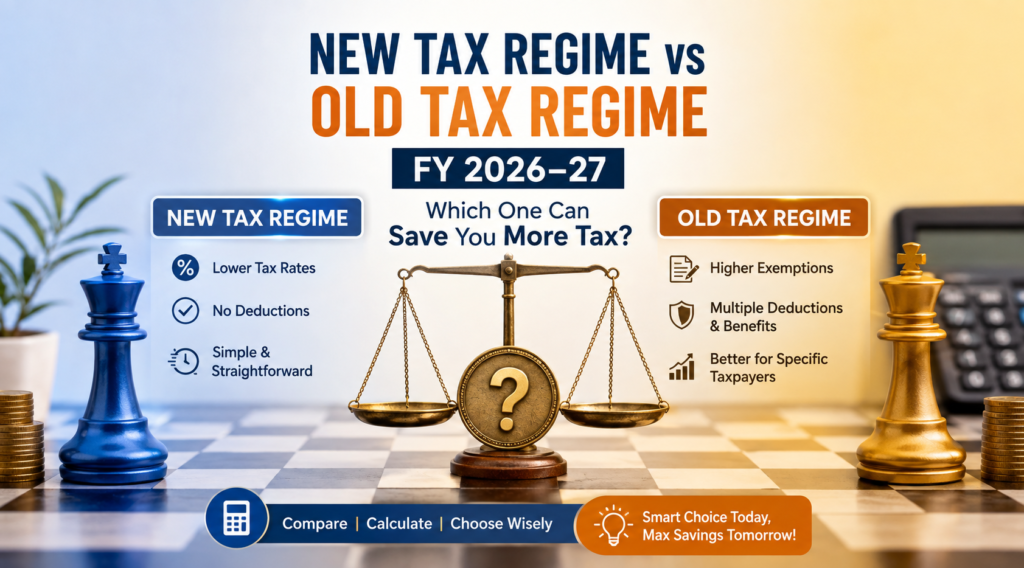
TL;DR The new tax regime is the default tax regime for eligible individual taxpayers, but the old regime continues to be available to eligible taxpayers who choose to opt out. The Income Tax Department specifically advises taxpayers to compare their tax liability under both regimes before making a choice. For FY 2026–27 (AY 2027–28), the new regime generally offers lower rates across more income slabs and permits fewer deductions and exemptions. The old regime has higher slab rates but allows a wider range of deductions and exemptions. The important question is therefore not simply “Which regime has lower tax rates?” It is: Which regime produces the lower final tax liability after considering your income, deductions, exemptions, investments and other eligible tax benefits? Introduction Choosing between the new tax regime and old tax regime can have a significant impact on your annual tax liability. Two taxpayers earning the same salary may end up paying different amounts of tax because their deductions, exemptions, investments, home-loan interest and other eligible benefits may be completely different. For FY 2026–27, the new regime continues to be the default regime for eligible taxpayers. However, taxpayers can opt for the old regime if it is more beneficial for their circumstances. This makes tax planning more important than simply following whichever regime appears popular. What Changed for FY 2026–27? The new regime continues to have a wider range of income slabs and comparatively lower rates. For individuals below 60 years of age, the official Income Tax Department’s AY 2026–27 guidance lists the following new-regime structure: Taxable Income New Regime Rate Up to ₹4 lakh Nil ₹4 lakh–₹8 lakh 5% ₹8 lakh–₹12 lakh 10% ₹12 lakh–₹16 lakh 15% ₹16 lakh–₹20 lakh 20% ₹20 lakh–₹24 lakh 25% Above ₹24 lakh 30% The Department also states that the Section 87A rebate under the new regime was increased to ₹60,000 for total income up to ₹12 lakh, applicable from AY 2026–27. Important: FY 2026–27 corresponds to AY 2027–28. Taxpayers should always verify the provisions applicable to the relevant assessment year before filing. New Tax Regime Slabs for FY 2026–27 For an individual below 60 years of age, the new regime provides: Income Slab Tax Rate Up to ₹4,00,000 0% ₹4,00,001–₹8,00,000 5% ₹8,00,001–₹12,00,000 10% ₹12,00,001–₹16,00,000 15% ₹16,00,001–₹20,00,000 20% ₹20,00,001–₹24,00,000 25% Above ₹24,00,000 30% These are the official slabs published by the Income Tax Department for AY 2026–27. Taxpayers should also consider applicable rebate, surcharge, marginal relief and 4% Health and Education Cess while calculating the final liability. Old Tax Regime Slabs for FY 2026–27 For individuals below 60 years, the traditional regime continues to use the following basic slabs: Income Slab Tax Rate Up to ₹2,50,000 0% ₹2,50,001–₹5,00,000 5% ₹5,00,001–₹10,00,000 20% Above ₹10,00,000 30% The old regime may nevertheless become attractive for taxpayers who have substantial eligible deductions and exemptions. New Tax Regime vs Old Tax Regime: Key Differences Feature New Tax Regime Old Tax Regime Default regime Yes No Tax rates Generally lower Generally higher Number of slabs More Fewer 80C deduction Generally not available Available, subject to conditions 80D deduction Generally restricted/not available Available, subject to conditions HRA exemption Generally not available Available, subject to conditions Standard deduction for salaried taxpayers Available Available Tax planning complexity Lower Higher Suitable for Taxpayers with fewer deductions Taxpayers with substantial eligible deductions The Income Tax Department describes the core distinction clearly: the new regime offers lower rates with fewer deductions and exemptions, while the old regime permits various deductions and exemptions. What Deductions Are Available Under Each Regime? This is where many taxpayers make the wrong decision. The old regime can be beneficial when a taxpayer has significant eligible deductions and exemptions. Common Old-Regime Tax Benefits Depending on eligibility and applicable conditions, these can include: Section 80C investments Section 80D medical insurance Section 80CCD(1B) additional NPS contribution HRA exemption Home-loan interest under applicable provisions Certain education-loan interest deductions Certain disability-related deductions Other deductions permitted under the Income Tax Act The exact availability depends on the taxpayer’s circumstances and the relevant provision. Is Section 80C Available Under the New Tax Regime? Generally, the popular Section 80C deduction is not available under the new regime, except for specific deductions that remain permitted under the applicable provisions. This is an important distinction for taxpayers who regularly claim deductions for: PPF ELSS Life insurance premiums Eligible tuition fees Certain principal repayments Other qualifying Section 80C investments/payments A taxpayer who has historically relied heavily on 80C should therefore calculate the tax under both regimes before deciding. Standard Deduction Under the Two Regimes For salaried taxpayers, standard deduction remains an important component of the comparison. The new regime provides a higher standard deduction for eligible salaried/pension income compared with the old regime under the current rules. This means taxpayers should compare taxable income after the applicable standard deduction, rather than comparing gross salary directly with the tax slabs. For example: Gross Salary → Applicable Standard Deduction → Taxable Salary → Other eligible adjustments → Tax Calculation This distinction becomes particularly important when comparing salaries around ₹10 lakh, ₹12 lakh, ₹15 lakh and ₹20 lakh. Section 87A Rebate Under the New Regime The Section 87A rebate is one of the most important features of the current new regime. For AY 2026–27, the Income Tax Department states that the rebate was increased from ₹25,000 to ₹60,000 for eligible resident individuals with total income up to ₹12 lakh. This significantly changes the tax calculation for taxpayers around the ₹12 lakh income level. However, taxpayers should not interpret this as meaning that every person earning exactly ₹12 lakh or less automatically has zero tax in every situation. Eligibility conditions and the nature of income must be considered. Which Tax Regime Is Better? There is no single answer that works for every taxpayer. The Income Tax Department itself states that the better option varies from person to person and recommends comparing the tax liability under both regimes before selecting one. The New Regime May Be More Attractive If: You have relatively few deductions. You
Income Tax Notice in 2026: Common Reasons, Types & How to Respond Online
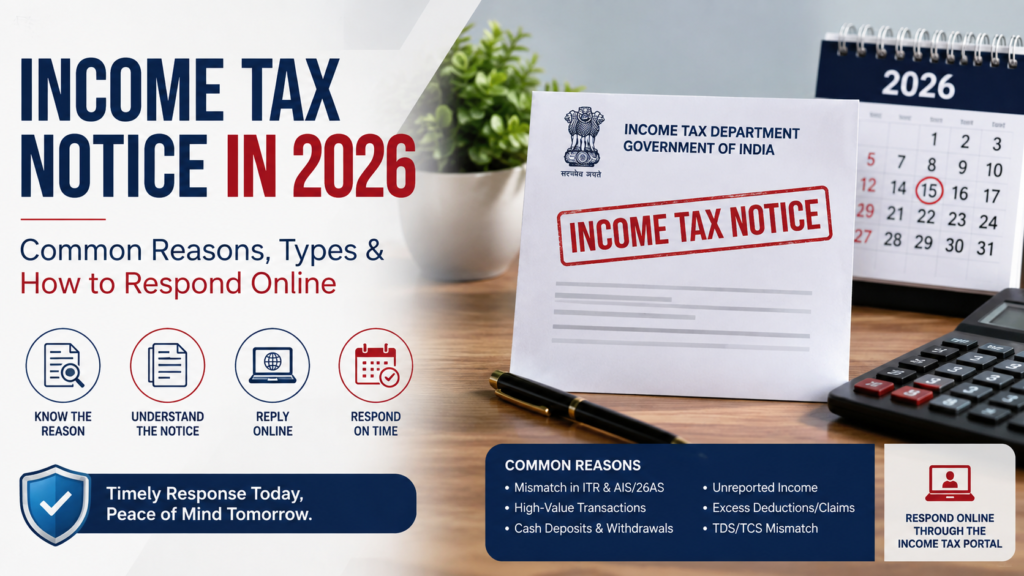
TL;DR Receiving an Income Tax Notice does not automatically mean that you have committed tax evasion or owe a penalty. A communication may be issued because the Income Tax Department requires clarification, detects a mismatch, processes an adjustment, finds the return defective, initiates scrutiny, or identifies a potential tax demand. The most important steps are to verify the communication, understand the applicable section, check the response deadline, reconcile the information with your ITR, AIS and Form 26AS, gather supporting documents, and submit an accurate response through the appropriate facility on the Income Tax e-Filing portal. The Income Tax Department’s e-Proceedings facility allows registered taxpayers or their authorized representatives to view and respond electronically to notices, intimations and letters. What Is an Income Tax Notice? An Income Tax notice is an official communication issued by the Income Tax Department concerning a taxpayer’s return, reported income, deductions, taxes, financial transactions, assessment or another compliance matter. Not every communication means additional tax is payable. Depending on its nature, the Department may simply be: Processing your return. Requesting additional information. Asking you to correct a defective return. Proposing an adjustment. Seeking clarification about a transaction. Conducting scrutiny. Communicating an outstanding demand. Therefore, the first step should never be panic or immediate payment. It should be understanding exactly what the communication says and what action it requires. Why Did You Receive an Income Tax Notice? Modern tax administration increasingly relies on information reported by employers, banks, financial institutions, GST systems and other reporting entities. This makes accurate reconciliation before ITR filing extremely important. Here are some common situations that can lead to a notice or further verification. 1. AIS or Form 26AS Does Not Match Your ITR A mismatch between information available with the Department and the information reported in your Income Tax Return can attract attention. For example, AIS or Form 26AS may contain: Salary information. Interest income. Dividend income. Securities transactions. TDS/TCS information. Other reportable financial transactions. If your ITR does not correctly account for relevant income or tax information, clarification or correction may be required. Mismatches between ITR data and AIS/Form 26AS are among the commonly cited reasons for tax communications. Practical Tip Always reconcile your Form 16, Form 16A, AIS, TIS and Form 26AS with your own financial records before submitting your return. 2. Income From One or More Sources Was Not Reported A taxpayer may correctly report salary or business income but accidentally forget another income source. Examples can include: Savings or fixed-deposit interest. Rental income. Capital gains. Dividend income. Freelance income. Professional receipts. Income from investments. The possibility of mismatches increases when taxpayers rely entirely on one document rather than reviewing their complete financial information. 3. Incorrect or Unsubstantiated Deduction Claims Deductions and exemptions should be claimed only when the taxpayer meets the applicable legal conditions and can maintain appropriate supporting documentation. Unusual or incorrect claims may require clarification. Maintain records supporting significant claims rather than trying to reconstruct them only after receiving a notice. 4. High-Value Transactions Require Reconciliation Certain transactions reported through the financial system may need to be properly reflected in your tax position. Examples can include: Purchase or sale of property. Large investments. Significant securities transactions. High-value deposits or receipts. A high-value transaction does not by itself establish wrongdoing. The key issue is whether the transaction and its tax implications have been correctly reported where required. 5. GST Turnover and Income Tax Records Do Not Match For business taxpayers, consistency between financial statements, GST records and Income Tax reporting is important. For example, a substantial difference between turnover reflected through GST-related records and the figures reported for Income Tax purposes may require reconciliation or explanation. GST/ITR turnover differences are also among the circumstances commonly discussed in relation to scrutiny. 6. Your Return Contains Errors or Is Incomplete Incorrect or incomplete information can result in a defective return communication. Possible issues include: Missing mandatory information. Incomplete schedules. Incorrect tax details. Income information not properly reported. Other inconsistencies affecting the validity of the return. A defective return notice should be addressed within the deadline specified in the communication. 7. TDS Information Does Not Match TDS-related mismatches can arise because of: Incorrect PAN. Incorrect TDS amount. Deductor reporting errors. Incorrect challan information. Delayed TDS deposit or reporting. Such mismatches can affect return processing and tax credit claims. Common Types of Income Tax Notices You Should Understand Different communications serve different purposes. Identifying the applicable provision is therefore essential before preparing your response. Section 139(9) – Defective Return A communication under Section 139(9) may be issued when the return is considered defective because required information is missing or contains specified deficiencies. What Should You Do? Review the defect mentioned in the notice, compare it with the filed ITR, correct the relevant information, and submit the response within the prescribed time. Section 143(1) – Intimation After Processing An intimation under Section 143(1) is associated with processing of the Income Tax Return. Processing may result in: No additional amount payable. Refund determination. Adjustment or tax demand. Taxpayers should compare the figures in the intimation with the original return before taking further action. Section 143(2) – Scrutiny Notice A scrutiny notice requires considerably more attention. Scrutiny can involve examination of matters such as reported income, deductions, losses, financial transactions or other information relevant to the assessment. Illustrative situations associated with scrutiny can include significant AIS/Form 26AS mismatches, undisclosed high-value transactions and differences between GST-related turnover and tax records. What Should You Do? Do not send a rushed explanation. Review the issue carefully and organize documentary evidence supporting the figures reported in the return. Section 142(1) – Inquiry Before Assessment A notice under Section 142(1) may seek information, accounts or documents required for assessment-related purposes. Depending on the circumstances, taxpayers may be asked to provide financial information or explanations concerning specific transactions. Section 148 – Income Escaping Assessment A notice relating to reassessment requires careful professional review because it can involve income that the Department believes may not have been appropriately assessed
How to Start a Business in India in 2026: Registration, GST, PAN & Compliance Checklist

TL;DR Starting a business in India involves more than developing a great idea. Entrepreneurs must choose an appropriate business structure, complete legal registrations, obtain PAN and GST registration where applicable, maintain proper accounting records, and comply with tax and regulatory requirements. Careful planning from the beginning helps businesses avoid compliance issues and build a strong foundation for long-term growth. Introduction India continues to be one of the world’s fastest-growing startup ecosystems, creating significant opportunities for entrepreneurs across manufacturing, technology, professional services, retail, healthcare, education, and e-commerce. However, starting a business requires much more than securing customers or arranging capital. Every business must satisfy various legal, financial, and tax-related obligations before commencing operations. Choosing the wrong business structure or overlooking mandatory registrations can create avoidable compliance issues later. This guide explains the key steps involved in setting up a business in India and highlights the registrations and compliance requirements every entrepreneur should understand. Step 1: Choose the Right Business Structure Selecting an appropriate legal structure is one of the most important decisions for any entrepreneur because it affects taxation, compliance obligations, ownership, fundraising, and business expansion. Common business structures include: Sole Proprietorship Suitable for individual entrepreneurs operating relatively small businesses with straightforward ownership. Advantages include: Easy to start. Lower compliance requirements. Complete owner control. Simple decision-making. Partnership Firm A partnership involves two or more persons carrying on a business together under a partnership agreement. Suitable for: Family businesses. Professional firms. Trading businesses. Service businesses. Limited Liability Partnership (LLP) LLPs combine operational flexibility with limited liability protection for partners. Suitable for: Professional firms. Consulting businesses. Service providers. Growing startups. Private Limited Company Private Limited Companies are generally preferred by startups planning rapid growth, external investment, or structured corporate governance. Key advantages include: Separate legal identity. Limited liability. Better investor confidence. Easier fundraising opportunities. Greater business credibility. One Person Company (OPC) An OPC allows a single entrepreneur to operate through a corporate structure while retaining limited liability. Step 2: Register Your Business The registration process varies depending on the business structure selected. Generally, registration involves: Selecting a suitable business name. Preparing constitutional documents. Completing required applications. Obtaining registration certificates from the appropriate authorities. Maintaining statutory records after incorporation. Professional assistance helps ensure that documents are prepared correctly and registrations are completed efficiently. Step 3: Apply for PAN & TAN Permanent Account Number (PAN) is an essential tax identification number required for most businesses. Tax Deduction and Collection Account Number (TAN) may also be required where tax deduction obligations apply. These registrations support: Income Tax compliance. Banking requirements. Financial transactions. Return filing. TDS compliance. Step 4: GST Registration GST registration may be mandatory depending on turnover thresholds, business activities, or other criteria prescribed under GST law. Businesses should carefully evaluate whether registration is mandatory or beneficial based on their operations. GST registration enables businesses to: Obtain a GST Identification Number (GSTIN). Issue GST-compliant invoices. Collect GST where applicable. Claim eligible Input Tax Credit, subject to conditions. Meet statutory compliance obligations. Step 5: Open a Business Bank Account Maintaining separate business and personal finances improves accounting accuracy and supports better financial management. A dedicated business account helps with: Recording business transactions. GST compliance. Loan applications. Financial reporting. Audit readiness. Step 6: Obtain Necessary Licenses Depending on the industry and business activities, additional registrations or licenses may be required. Examples include: Shop & Establishment Registration. Professional Tax Registration (where applicable). Trade License. Import Export Code (IEC). FSSAI Registration for food businesses. MSME/Udyam Registration. Industry-specific approvals. Entrepreneurs should identify applicable registrations before commencing operations. Step 7: Business Compliance Checklist After registration, businesses must continue meeting ongoing compliance obligations. Important compliance activities include: Maintaining books of accounts. Filing Income Tax Returns. Filing GST returns (where applicable). Deducting and depositing TDS, if required. Preparing financial statements. Conducting audits where applicable. Preserving statutory records. Complying with labour and other regulatory requirements. Common Mistakes New Businesses Make Many startups face avoidable compliance issues because of poor planning during the initial stages. Common mistakes include: Choosing an unsuitable business structure. Delaying GST registration where required. Mixing personal and business finances. Ignoring bookkeeping. Missing statutory filing deadlines. Poor documentation. Not seeking professional advice. Inadequate tax planning. Why Hiring a Chartered Accountant Is Important for New Businesses Starting a business involves legal registrations, taxation, accounting, and ongoing compliance. While many registration processes can be completed online, choosing the correct structure and ensuring ongoing compliance often requires professional expertise. A Chartered Accountant can help entrepreneurs: Select the most suitable business structure. Complete company, LLP, or proprietorship registration. Obtain PAN, TAN, and GST registration where applicable. Set up accounting and bookkeeping systems. Maintain statutory compliance. File Income Tax and GST returns. Assist with payroll and TDS compliance. Prepare financial statements. Provide business tax planning. Offer financial advisory for business growth. Professional guidance during the initial stages helps reduce compliance risks and allows entrepreneurs to focus on building their business. Startup Compliance Checklist Once your business is operational, maintaining regular compliance is essential to avoid penalties and ensure smooth operations. Business Registration ✔ Complete registration under the appropriate business structure. PAN & TAN ✔ Obtain PAN for the business. ✔ Apply for TAN if tax deduction obligations apply. GST Registration ✔ Register under GST if required under applicable provisions. ✔ Maintain GST-compliant invoices and records. Business Bank Account ✔ Open a dedicated current account for business transactions. Accounting & Bookkeeping ✔ Record all financial transactions accurately. ✔ Maintain purchase, sales, and expense registers. Income Tax Compliance ✔ File Income Tax Returns within the prescribed timelines. ✔ Pay advance tax where applicable. GST Compliance ✔ File GST returns on time. ✔ Reconcile GST records regularly. ✔ Monitor Input Tax Credit eligibility. TDS Compliance ✔ Deduct TDS wherever applicable. ✔ Deposit TDS within prescribed timelines. ✔ File TDS returns accurately. Statutory Records ✔ Preserve invoices, bank statements, contracts, payroll records, and statutory registers. Business Licenses ✔ Renew licenses and registrations before their expiry, wherever required. Annual Financial Statements ✔ Prepare Profit & Loss Account, Balance Sheet, and other
Top 20 Income Tax Deductions You Should Not Miss While Filing ITR in 2026

TL;DR Claiming eligible income tax deductions can significantly reduce your taxable income and improve your overall tax efficiency. Whether you’re a salaried employee, freelancer, professional, or business owner, understanding available deductions under the Income-tax Act helps you file an accurate Income Tax Return (ITR) while making the most of legitimate tax-saving opportunities. Proper documentation and timely tax planning are key to maximizing these benefits. Introduction Many taxpayers focus only on filing their Income Tax Return before the deadline but overlook one of the most important aspects of tax planning—claiming eligible deductions. Missing even a few legitimate deductions may result in paying more tax than required. India’s Income-tax Act provides several deductions that encourage savings, investments, insurance coverage, retirement planning, education, healthcare, and charitable giving. Understanding these provisions allows taxpayers to reduce their taxable income while remaining fully compliant with tax laws. This guide explains twenty of the most commonly claimed deductions that taxpayers should review before filing their ITR in 2026. Why Income Tax Deductions Matter Income tax deductions reduce the amount of income on which tax is calculated. By lowering taxable income, they can help individuals reduce their overall tax liability while encouraging long-term financial planning. Effective tax planning can help you: Reduce taxable income. Improve long-term savings. Build retirement wealth. Protect your family through insurance. Support higher education. Manage healthcare expenses. Encourage disciplined investments. Avoid last-minute tax planning. Top 20 Income Tax Deductions 1. Section 80C One of the most widely used tax-saving provisions, Section 80C covers eligible investments and specified expenditures up to the applicable statutory limit under the Income-tax Act. Common eligible investments include: Public Provident Fund (PPF) Employees’ Provident Fund (EPF) Equity Linked Savings Scheme (ELSS) National Savings Certificate (NSC) Tax-saving Fixed Deposits Sukanya Samriddhi Yojana Life Insurance Premiums Principal repayment of eligible home loans Children’s tuition fees (subject to conditions) 2. Section 80CCD(1B) This deduction is available for eligible contributions to the National Pension System (NPS), over and above certain other eligible deductions, subject to applicable limits. 3. Section 80D Taxpayers may claim deductions for eligible health insurance premiums paid for themselves and specified family members, subject to the limits prescribed under the Income-tax Act. 4. Section 80DD This provision provides deductions for eligible expenditure incurred towards the maintenance and care of specified dependents with disabilities, subject to prescribed conditions. 5. Section 80DDB Eligible taxpayers may claim deductions for specified medical treatment expenses for certain notified diseases, subject to documentation and applicable conditions. 6. Section 80E Individuals may claim deductions for eligible interest paid on education loans taken for higher education, as per applicable provisions. 7. Section 80EE Eligible taxpayers may claim deductions on interest paid for qualifying home loans, subject to specified conditions. 8. Section 80EEA This section provides additional deductions on eligible home loan interest for qualifying residential property purchases, where applicable. 9. Section 80EEB Tax benefits may be available on eligible loans taken for the purchase of qualifying electric vehicles, subject to statutory conditions. 10. Section 80G Donations made to eligible charitable institutions and approved funds may qualify for deductions under Section 80G, depending on the nature of the donation and eligibility requirements. 11. Section 80GG Individuals who do not receive House Rent Allowance (HRA) may be eligible to claim deductions for rent paid, subject to prescribed conditions. 12. Section 80GGA Certain eligible donations made for approved scientific research or rural development programs may qualify for deductions under this section. 13. Section 80GGC Eligible contributions made to registered political parties or approved electoral trusts may qualify for deductions, subject to applicable provisions. 14. Home Loan Interest Interest paid on eligible housing loans may qualify for deductions under relevant provisions of the Income-tax Act, subject to prescribed conditions. 15. House Rent Allowance (HRA) Eligible salaried employees receiving House Rent Allowance may claim exemptions based on applicable rules and supporting documentation. 16. Leave Travel Allowance (LTA) Eligible travel expenses within India may qualify for exemption under Leave Travel Allowance provisions, subject to prescribed conditions. 17. Standard Deduction Eligible salaried employees and pensioners may claim the standard deduction as permitted under the prevailing provisions of the Income-tax Act. 18. Interest on Savings Account Interest earned on eligible savings accounts may qualify for deductions under applicable sections, subject to statutory limits. 19. Interest on Fixed Deposits for Senior Citizens Eligible senior citizens may claim deductions on qualifying interest income as permitted under the Income-tax Act. 20. Business-Related Deductions Professionals, freelancers, and business owners may claim eligible business expenses that are wholly and exclusively incurred for business purposes, subject to proper documentation and applicable tax provisions. Examples include: Office rent Salaries and wages Professional fees Internet and communication expenses Software subscriptions Business travel Marketing expenses Depreciation on eligible assets Utility expenses Common Mistakes Taxpayers Make While Claiming Deductions Many taxpayers miss legitimate tax-saving opportunities or face issues during return processing because of avoidable mistakes. Filing an accurate Income Tax Return requires proper planning, documentation, and verification of every deduction claimed. Some common mistakes include: Claiming deductions without valid supporting documents. Selecting deductions that are not applicable under the chosen tax regime. Claiming the same deduction twice. Forgetting to verify Form 16, AIS, and Form 26AS before filing. Entering incorrect investment or insurance details. Ignoring interest income while calculating taxable income. Missing the prescribed conditions for specific deductions. Waiting until the last minute to plan tax-saving investments. Filing an incorrect ITR form. Not reconciling income reported by different sources. Carefully reviewing your financial records before filing your return helps reduce errors and improves the chances of faster return processing. Documents Required to Claim Income Tax Deductions Maintaining organized records is essential for claiming eligible deductions and responding to any future verification requirements. Common documents include: Form 16 Form 26AS Annual Information Statement (AIS) Salary slips Investment proofs Life insurance premium receipts Health insurance premium receipts Home loan interest certificate Home loan principal repayment certificate Education loan interest certificate Rent receipts (where applicable) Donation receipts Bank statements National Pension System (NPS) contribution statements Fixed Deposit certificates Business
GST Registration vs GST Composition Scheme: Which Is Better for Small Businesses?
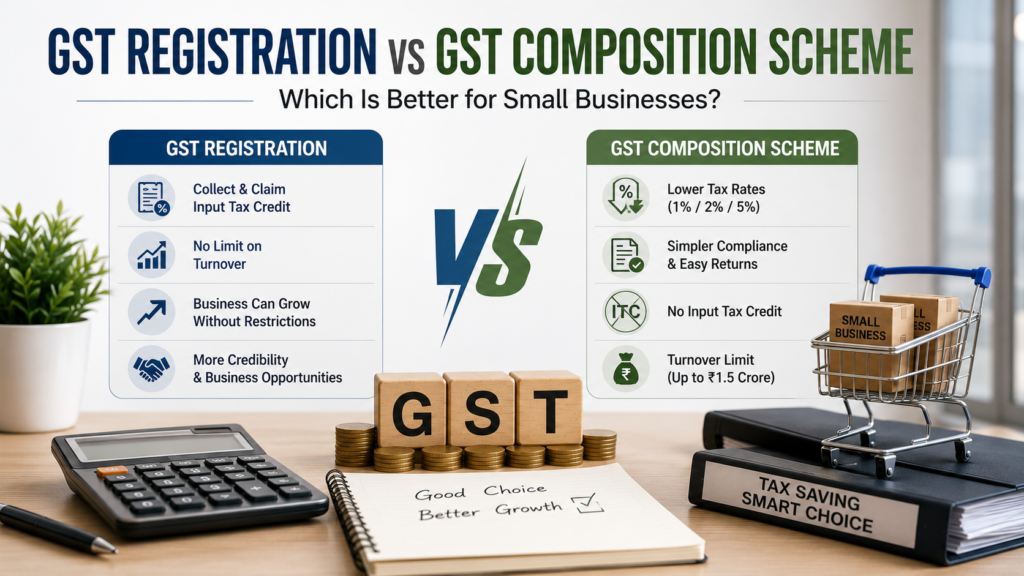
TL;DR Choosing between Regular GST Registration and the GST Composition Scheme is an important decision for every small business. While the Composition Scheme offers simplified compliance and reduced administrative burden for eligible taxpayers, Regular GST Registration provides broader business opportunities, Input Tax Credit (ITC) benefits, and greater flexibility for growing enterprises. The right choice depends on your business model, turnover, customers, and long-term growth plans. Introduction For many entrepreneurs, one of the earliest tax decisions is choosing the appropriate GST framework for their business. This decision influences not only day-to-day compliance but also cash flow, pricing strategy, customer relationships, and future expansion. Many small business owners assume that the Composition Scheme is always the better option because of its simpler compliance requirements. Others immediately choose Regular GST Registration without fully understanding the obligations involved. In reality, both options have distinct advantages and limitations. Selecting the right one requires a careful assessment of your business operations, expected turnover, customer profile, and future plans. This guide explains the key differences between the two so you can make an informed decision. What Is Regular GST Registration? Regular GST Registration is the standard GST framework under which eligible businesses collect GST from customers, file prescribed returns, maintain detailed records, and comply with applicable GST provisions. Businesses registered under the regular scheme generally have broader operational flexibility and can participate in a wider range of commercial activities. Some key features include: Collection of GST from customers. Eligibility to claim Input Tax Credit (subject to applicable conditions). Issuance of tax invoices. Participation in B2B transactions. Ability to deal with customers requiring GST-compliant invoices. Greater suitability for expanding businesses. What Is the GST Composition Scheme? The GST Composition Scheme is a simplified compliance mechanism available to eligible small taxpayers subject to prescribed turnover limits and other conditions under GST law. Instead of following the full compliance framework applicable to regular taxpayers, eligible businesses under the Composition Scheme generally benefit from simplified tax payment procedures and reduced return filing obligations. The scheme is primarily designed to reduce the compliance burden on small businesses with relatively straightforward operations. Key Differences Between Regular GST Registration and the Composition Scheme Feature Regular GST Registration GST Composition Scheme GST Collection GST collected from customers Composition taxpayers generally cannot collect GST separately from customers Input Tax Credit Eligible to claim ITC subject to conditions ITC generally not available Tax Invoice Can issue tax invoices Cannot issue standard GST tax invoices in the same manner as regular taxpayers Compliance Detailed compliance and return filing Simplified compliance for eligible taxpayers Business Expansion Suitable for growing businesses Best suited for smaller businesses meeting eligibility conditions Business Flexibility Greater operational flexibility Certain restrictions apply under the scheme Advantages of Regular GST Registration Many growing businesses choose Regular GST Registration because it offers long-term operational advantages. Input Tax Credit (ITC) Eligible businesses can claim Input Tax Credit on qualifying business purchases, helping reduce the overall tax cost and improve cash flow. Better Business Credibility Large organizations and corporate customers often prefer dealing with regular GST-registered businesses that issue compliant tax invoices. Supports Business Growth Regular registration is generally more suitable for businesses planning expansion, increasing turnover, or serving a broader customer base. Wider Commercial Opportunities Businesses under the regular scheme are better positioned to participate in commercial transactions that require full GST compliance. Better Financial Reporting Detailed accounting and GST compliance encourage stronger financial discipline and more accurate business reporting. Advantages of the GST Composition Scheme For eligible businesses with relatively simple operations, the Composition Scheme offers several practical benefits. Simplified Compliance The scheme reduces the administrative burden associated with GST compliance compared to the regular framework. Lower Compliance Costs Businesses may spend less time and fewer resources on maintaining detailed GST records and filing requirements. Easier Accounting Accounting procedures are generally simpler, making compliance more manageable for smaller enterprises. Suitable for Local Businesses Retail shops, small traders, and local businesses with straightforward operations may find the Composition Scheme beneficial, provided they satisfy all eligibility conditions. Reduced Administrative Burden Owners can devote more attention to running and growing their business rather than managing extensive GST compliance. Which Businesses Should Choose Regular GST Registration? Regular GST Registration is generally more suitable for businesses that: Plan rapid growth. Deal primarily with other businesses (B2B). Wish to claim eligible Input Tax Credit. Require tax invoices for commercial transactions. Have complex business operations. Anticipate expansion into new markets. Need stronger credibility with corporate customers. Which Businesses May Benefit from the Composition Scheme? Subject to eligibility under GST law, the Composition Scheme may be appropriate for businesses that: Operate on a relatively small scale. Primarily serve end consumers. Prefer simplified compliance. Have straightforward business operations. Do not require Input Tax Credit for their business model. Want to reduce administrative responsibilities. Common Mistakes Businesses Make While Choosing a GST Scheme Selecting the wrong GST option can increase compliance costs, affect profitability, and create operational challenges. Many businesses choose a scheme without considering their long-term goals, customer base, or tax implications. Some common mistakes include: Choosing the Composition Scheme only because compliance appears simpler. Ignoring eligibility conditions before opting for the scheme. Not evaluating future business expansion plans. Overlooking the importance of Input Tax Credit (ITC). Failing to understand customer expectations for GST tax invoices. Not reviewing turnover trends regularly. Assuming the same GST option suits every type of business. Taking GST-related decisions without professional advice. A careful evaluation before registration helps businesses avoid unnecessary complications and supports sustainable growth. Can You Switch Between Regular GST Registration and the Composition Scheme? Yes. Subject to the provisions of GST law and applicable eligibility conditions, businesses may move between the Regular GST Scheme and the Composition Scheme. A switch may be appropriate when: Business turnover changes significantly. The nature of business operations evolves. The customer profile shifts from B2C to B2B. Expansion plans require greater operational flexibility. The business becomes eligible or ineligible for the Composition Scheme. Before making any change, businesses should carefully evaluate the
How to Reduce Business Taxes Legally Before the End of FY 2026–27
TL;DR Effective tax planning before the close of FY 2026–27 can significantly reduce a business’s tax liability while ensuring compliance with Indian tax laws. By reviewing expenses, claiming eligible deductions, maintaining proper documentation, planning investments, and working with a qualified Chartered Accountant, businesses can improve cash flow and avoid last-minute tax-related challenges. Why Year-End Tax Planning Is Important Many businesses begin thinking about taxes only when the return filing deadline approaches. Unfortunately, by that stage, many legitimate tax-saving opportunities may no longer be available. Year-end tax planning allows business owners to review their financial position before the financial year closes and make informed decisions that can legally reduce taxable income. Proper planning also helps businesses: Improve cash flow. Avoid unnecessary tax payments. Maintain better financial records. Reduce compliance risks. Prepare for audits. Make informed investment decisions. Tax planning is not about avoiding taxes—it is about paying the correct amount of tax by making full use of available legal provisions. Benefits of Early Tax Planning Businesses that review their finances well before the financial year ends often gain significant advantages over those that wait until the last moment. Better Cash Flow Management Knowing your expected tax liability in advance allows better budgeting and prevents sudden cash flow pressures. More Time to Organize Financial Records Accurate bookkeeping throughout the year makes it easier to identify deductible expenses, reconcile accounts, and prepare financial statements. Reduced Risk of Errors Rushed year-end tax preparation often leads to incorrect reporting, missing documents, or overlooked deductions. Stronger Compliance Early planning ensures timely compliance with Income Tax, GST, TDS, and other statutory obligations. Improved Business Decision-Making Understanding your financial position before year-end supports smarter investment and expansion decisions. Legal Strategies to Reduce Business Taxes The following approaches can help businesses optimize their tax position while remaining fully compliant with applicable laws. 1. Maintain Accurate Books of Accounts Well-maintained accounting records are the foundation of effective tax planning. Accurate bookkeeping helps identify deductible business expenses, reconcile financial transactions, and prepare reliable financial statements. Businesses should regularly update: Sales records Purchase registers Expense records Bank statements GST records Payroll information Fixed asset registers 2. Review All Business Expenses Many businesses fail to claim legitimate expenses simply because they lack proper documentation or overlook eligible costs. Review expenses related to: Office rent Employee salaries Professional fees Internet and communication Business travel Marketing expenses Software subscriptions Insurance premiums Utilities Maintenance expenses Proper invoices and supporting documents should always be retained. 3. Plan Capital Expenditure Carefully Business investments in eligible assets may provide tax benefits through depreciation, subject to applicable tax provisions. Planning capital purchases before the financial year closes can help businesses manage taxable income more effectively while supporting operational growth. 4. Monitor Depreciation Claims Depreciation on eligible business assets is an important tax planning tool. Businesses should ensure: Asset registers are updated. Purchase dates are correctly recorded. Depreciation is calculated accurately. Supporting invoices are available. 5. Optimize Working Capital Efficient management of receivables, payables, inventory, and cash flow can strengthen the financial position of the business before year-end. Proper working capital planning also supports smoother tax payments and reduces financing costs. 6. Complete GST Reconciliation Reconciling GST returns with books of accounts before the financial year ends helps identify discrepancies, verify Input Tax Credit eligibility, and improve overall compliance. Businesses should reconcile: Purchase records. Sales registers. GST returns. E-invoices (where applicable). Vendor invoices. 7. Verify TDS Compliance Businesses responsible for deducting Tax Deducted at Source (TDS) should ensure deductions, deposits, and returns have been completed accurately and within prescribed timelines. Incomplete TDS compliance may affect deductions and lead to interest or penalties. 8. Review Outstanding Receivables and Payables Year-end is an ideal time to evaluate outstanding customer payments and supplier liabilities. A review of receivables and payables helps: Improve cash flow forecasting. Strengthen financial reporting. Identify doubtful debts. Plan collections more efficiently. 9. Evaluate Business Structure As businesses grow, their existing legal structure may no longer be the most suitable from an operational or tax perspective. Periodic review of the business structure can support long-term efficiency, provided any restructuring is based on commercial and legal considerations rather than solely tax outcomes. 10. Consult a Chartered Accountant Before Year-End Professional tax planning is one of the most effective ways to identify legitimate opportunities for reducing tax liability while remaining compliant. An experienced Chartered Accountant can review financial statements, identify potential risks, ensure proper documentation, and recommend strategies tailored to your business. Blog By : CA Junaid khan
AI in Accounting: How Chartered Accountants Are Transforming Business Finance in 2026

TL;DR Artificial Intelligence (AI) is reshaping the accounting profession by automating repetitive tasks, improving financial accuracy, enhancing compliance, and providing real-time business insights. Rather than replacing Chartered Accountants, AI is enabling them to focus on strategic advisory, tax planning, risk management, and business growth. Businesses that combine modern accounting technology with professional expertise are better positioned to improve efficiency, reduce costs, and make smarter financial decisions. Introduction The accounting profession is undergoing one of its biggest transformations in decades. Businesses are rapidly embracing Artificial Intelligence (AI), cloud accounting platforms, automation tools, and advanced analytics to simplify financial management. From automated bookkeeping and GST reconciliation to intelligent financial forecasting and fraud detection, AI is changing how organizations manage their finances. However, one common misconception remains: Will AI replace Chartered Accountants? The answer is no. Instead, AI is transforming the role of Chartered Accountants from traditional bookkeepers into strategic financial advisors who help businesses interpret data, ensure compliance, manage risks, and drive sustainable growth. For startups, MSMEs, and growing enterprises across India, understanding how AI and professional accounting work together is becoming essential for long-term success. What is AI in Accounting? Artificial Intelligence in accounting refers to the use of intelligent software and machine learning technologies to automate financial processes, analyze large volumes of data, identify anomalies, and support faster business decisions. Unlike traditional accounting software that relies on manual inputs, AI-powered systems continuously learn from historical financial data and improve their performance over time. Today, AI can assist with: Invoice processing Expense categorization Bank reconciliation GST calculations Tax data analysis Payroll automation Cash flow forecasting Financial reporting Risk identification Fraud detection This allows finance teams to spend less time on repetitive tasks and more time on strategic planning. Why AI is Revolutionizing Business Finance Modern businesses generate enormous amounts of financial data every day. Processing this information manually is time-consuming and increases the risk of human error. AI helps organizations by: Automating repetitive accounting work. Improving financial accuracy. Accelerating reporting timelines. Providing real-time dashboards. Enhancing compliance monitoring. Supporting better forecasting. Reducing operational costs. Identifying unusual transactions quickly. Instead of waiting until the end of the month for financial reports, businesses can access real-time insights that support faster decision-making. Top Applications of AI in Accounting 1. Automated Bookkeeping AI-powered accounting software automatically records transactions, categorizes expenses, and reconciles bank accounts with minimal manual intervention. Benefits include: Faster bookkeeping Fewer manual errors Better financial accuracy Time savings Improved productivity 2. Intelligent Invoice Processing Manual invoice entry consumes significant administrative time. AI can: Read invoices automatically. Extract supplier details. Verify invoice accuracy. Match purchase orders. Detect duplicate invoices. Process approvals faster. This significantly improves accounts payable efficiency. 3. GST Compliance Automation GST compliance involves multiple calculations, reconciliations, and return filings. AI assists by: Matching invoices automatically. Reconciling GST data. Identifying discrepancies. Monitoring Input Tax Credit. Reducing filing errors. Improving compliance accuracy. Businesses can reduce the likelihood of notices while simplifying GST management. 4. Financial Reporting Traditional reporting often takes days or weeks to prepare. AI-powered systems generate: Profit & Loss Statements Balance Sheets Cash Flow Statements Financial Ratios Business Dashboards Budget Reports within minutes using live financial data. 5. Fraud Detection One of AI’s strongest capabilities is identifying unusual financial behavior. AI can detect: Duplicate payments. Suspicious transactions. Unauthorized access. Abnormal expense patterns. Vendor fraud indicators. Unusual banking activities. Early detection helps businesses reduce financial losses and strengthen internal controls. 6. Cash Flow Forecasting Cash flow is one of the most important indicators of business health. AI analyzes: Historical transactions Customer payment behavior Seasonal trends Revenue patterns Expenses Outstanding receivables to generate more accurate cash flow forecasts and support better financial planning. 7. Tax Planning Assistance AI tools can organize financial information, identify eligible deductions, and highlight tax-saving opportunities based on available data. However, interpreting tax laws and applying them correctly still requires professional judgment from experienced Chartered Accountants. How Chartered Accountants Are Using AI Modern Chartered Accountants are embracing AI as a productivity tool rather than viewing it as competition. Today, CAs use AI to: Automate bookkeeping processes. Review financial transactions. Analyze business performance. Improve GST reconciliation. Monitor tax compliance. Generate management reports. Perform risk assessments. Support audit procedures. Enhance advisory services. Deliver faster client solutions. AI allows accountants to focus on strategic consulting while routine tasks are completed more efficiently. AI vs Human Chartered Accountants: Who Wins? One of the biggest questions businesses ask today is whether Artificial Intelligence can replace Chartered Accountants. While AI is highly effective at processing large volumes of financial data and automating repetitive tasks, it cannot replicate professional judgment, regulatory interpretation, ethical decision-making, or strategic business advice. AI Chartered Accountant Automates repetitive accounting tasks Provides professional judgment and expertise Processes large volumes of financial data quickly Interprets complex tax laws and regulations Identifies patterns and anomalies Advises on business strategy and financial planning Generates reports and dashboards Represents clients before tax authorities Performs data reconciliation Handles audits, litigation, and compliance matters Works based on historical data and algorithms Applies experience to unique business situations The future of accounting is not AI versus Chartered Accountants—it is AI working alongside Chartered Accountants to deliver faster, more accurate, and more valuable financial services. Benefits of AI in Accounting for Businesses Businesses that integrate AI with professional accounting support can experience significant operational and financial improvements. Improved Accuracy AI reduces manual data entry and minimizes calculation errors, resulting in more reliable financial records. Faster Decision-Making Real-time dashboards and financial reports provide management with timely information for strategic planning and operational decisions. Cost Efficiency Automation reduces repetitive administrative work, allowing accounting teams to focus on higher-value activities while improving productivity. Better Compliance AI assists with GST reconciliations, transaction monitoring, and financial record management, helping businesses strengthen tax compliance. Enhanced Fraud Prevention AI continuously monitors financial transactions and highlights unusual patterns that may indicate errors or fraudulent activities. Better Cash Flow Management Predictive analytics help businesses forecast cash inflows and outflows, improving budgeting and financial stability. Scalable Financial Operations As businesses grow,
AI in Accounting: How Chartered Accountants Are Transforming Business Finance in 2026
TL;DR Artificial Intelligence (AI) is reshaping the accounting profession by automating repetitive tasks, improving financial accuracy, enhancing compliance, and providing real-time business insights. Rather than replacing Chartered Accountants, AI is enabling them to focus on strategic advisory, tax planning, risk management, and business growth. Businesses that combine modern accounting technology with professional expertise are better positioned to improve efficiency, reduce costs, and make smarter financial decisions. Introduction The accounting profession is undergoing one of its biggest transformations in decades. Businesses are rapidly embracing Artificial Intelligence (AI), cloud accounting platforms, automation tools, and advanced analytics to simplify financial management. From automated bookkeeping and GST reconciliation to intelligent financial forecasting and fraud detection, AI is changing how organizations manage their finances. However, one common misconception remains: Will AI replace Chartered Accountants? The answer is no. Instead, AI is transforming the role of Chartered Accountants from traditional bookkeepers into strategic financial advisors who help businesses interpret data, ensure compliance, manage risks, and drive sustainable growth. For startups, MSMEs, and growing enterprises across India, understanding how AI and professional accounting work together is becoming essential for long-term success. What is AI in Accounting? Artificial Intelligence in accounting refers to the use of intelligent software and machine learning technologies to automate financial processes, analyze large volumes of data, identify anomalies, and support faster business decisions. Unlike traditional accounting software that relies on manual inputs, AI-powered systems continuously learn from historical financial data and improve their performance over time. Today, AI can assist with: Invoice processing Expense categorization Bank reconciliation GST calculations Tax data analysis Payroll automation Cash flow forecasting Financial reporting Risk identification Fraud detection This allows finance teams to spend less time on repetitive tasks and more time on strategic planning. Why AI is Revolutionizing Business Finance Modern businesses generate enormous amounts of financial data every day. Processing this information manually is time-consuming and increases the risk of human error. AI helps organizations by: Automating repetitive accounting work. Improving financial accuracy. Accelerating reporting timelines. Providing real-time dashboards. Enhancing compliance monitoring. Supporting better forecasting. Reducing operational costs. Identifying unusual transactions quickly. Instead of waiting until the end of the month for financial reports, businesses can access real-time insights that support faster decision-making. Top Applications of AI in Accounting 1. Automated Bookkeeping AI-powered accounting software automatically records transactions, categorizes expenses, and reconciles bank accounts with minimal manual intervention. Benefits include: Faster bookkeeping Fewer manual errors Better financial accuracy Time savings Improved productivity 2. Intelligent Invoice Processing Manual invoice entry consumes significant administrative time. AI can: Read invoices automatically. Extract supplier details. Verify invoice accuracy. Match purchase orders. Detect duplicate invoices. Process approvals faster. This significantly improves accounts payable efficiency. 3. GST Compliance Automation GST compliance involves multiple calculations, reconciliations, and return filings. AI assists by: Matching invoices automatically. Reconciling GST data. Identifying discrepancies. Monitoring Input Tax Credit. Reducing filing errors. Improving compliance accuracy. Businesses can reduce the likelihood of notices while simplifying GST management. 4. Financial Reporting Traditional reporting often takes days or weeks to prepare. AI-powered systems generate: Profit & Loss Statements Balance Sheets Cash Flow Statements Financial Ratios Business Dashboards Budget Reports within minutes using live financial data. 5. Fraud Detection One of AI’s strongest capabilities is identifying unusual financial behavior. AI can detect: Duplicate payments. Suspicious transactions. Unauthorized access. Abnormal expense patterns. Vendor fraud indicators. Unusual banking activities. Early detection helps businesses reduce financial losses and strengthen internal controls. 6. Cash Flow Forecasting Cash flow is one of the most important indicators of business health. AI analyzes: Historical transactions Customer payment behavior Seasonal trends Revenue patterns Expenses Outstanding receivables to generate more accurate cash flow forecasts and support better financial planning. 7. Tax Planning Assistance AI tools can organize financial information, identify eligible deductions, and highlight tax-saving opportunities based on available data. However, interpreting tax laws and applying them correctly still requires professional judgment from experienced Chartered Accountants. How Chartered Accountants Are Using AI Modern Chartered Accountants are embracing AI as a productivity tool rather than viewing it as competition. Today, CAs use AI to: Automate bookkeeping processes. Review financial transactions. Analyze business performance. Improve GST reconciliation. Monitor tax compliance. Generate management reports. Perform risk assessments. Support audit procedures. Enhance advisory services. Deliver faster client solutions. AI allows accountants to focus on strategic consulting while routine tasks are completed more efficiently. AI vs Human Chartered Accountants: Who Wins? One of the biggest questions businesses ask today is whether Artificial Intelligence can replace Chartered Accountants. While AI is highly effective at processing large volumes of financial data and automating repetitive tasks, it cannot replicate professional judgment, regulatory interpretation, ethical decision-making, or strategic business advice. AI Chartered Accountant Automates repetitive accounting tasks Provides professional judgment and expertise Processes large volumes of financial data quickly Interprets complex tax laws and regulations Identifies patterns and anomalies Advises on business strategy and financial planning Generates reports and dashboards Represents clients before tax authorities Performs data reconciliation Handles audits, litigation, and compliance matters Works based on historical data and algorithms Applies experience to unique business situations The future of accounting is not AI versus Chartered Accountants—it is AI working alongside Chartered Accountants to deliver faster, more accurate, and more valuable financial services. Benefits of AI in Accounting for Businesses Businesses that integrate AI with professional accounting support can experience significant operational and financial improvements. Improved Accuracy AI reduces manual data entry and minimizes calculation errors, resulting in more reliable financial records. Faster Decision-Making Real-time dashboards and financial reports provide management with timely information for strategic planning and operational decisions. Cost Efficiency Automation reduces repetitive administrative work, allowing accounting teams to focus on higher-value activities while improving productivity. Better Compliance AI assists with GST reconciliations, transaction monitoring, and financial record management, helping businesses strengthen tax compliance. Enhanced Fraud Prevention AI continuously monitors financial transactions and highlights unusual patterns that may indicate errors or fraudulent activities. Better Cash Flow Management Predictive analytics help businesses forecast cash inflows and outflows, improving budgeting and financial stability. Scalable Financial Operations As businesses grow,
New GST Rules 2026: Latest Compliance Updates Every Business Must Know
TL;DR GST compliance continues to evolve as tax administration becomes more digital and data-driven. Businesses should stay updated with applicable GST provisions, maintain accurate documentation, reconcile returns regularly, and strengthen internal controls to minimize compliance risks. This guide highlights the key compliance areas businesses should monitor in 2026 and explains how proactive GST management supports long-term business growth. Why Keeping Up with GST Rules Matters The Goods and Services Tax (GST) has transformed indirect taxation in India by creating a unified tax system across goods and services. As the business environment evolves, compliance requirements continue to be refined through amendments, notifications, procedural improvements, and increased use of technology. Today’s GST ecosystem relies heavily on digital reporting, automated reconciliations, analytics, and data matching. Businesses that fail to keep their records updated may face delayed Input Tax Credit (ITC), notices, interest, penalties, or unnecessary compliance challenges. Rather than viewing GST as a routine filing obligation, businesses should consider it an essential part of sound financial governance. Why Businesses Should Monitor GST Updates Regularly GST rules may change over time due to: Government notifications CBIC circulars Judicial decisions Process improvements Technology enhancements Return filing updates Compliance simplification initiatives Keeping track of these developments helps businesses remain compliant and avoid operational disruptions. Key GST Compliance Areas Businesses Should Focus on in 2026 Instead of reacting to notices after they arrive, businesses should strengthen the following compliance practices throughout the year. Accurate GST Registration Information Businesses should periodically review their GST registration details to ensure information such as business address, bank account, contact details, and authorized signatory remains accurate and updated. Failure to maintain current information may create difficulties during departmental verification or communication. Timely GST Return Filing One of the most important compliance responsibilities is filing GST returns within the prescribed due dates. Timely filing helps businesses: Avoid late fees. Reduce interest liabilities. Maintain compliance ratings. Facilitate smoother Input Tax Credit claims. Build credibility with customers and vendors. Maintaining a compliance calendar can significantly reduce the risk of missed deadlines. Regular Reconciliation of GST Records Businesses should frequently reconcile: Sales registers Purchase registers GST returns E-invoices (where applicable) Books of accounts Vendor invoices Regular reconciliation helps identify discrepancies early and minimizes future compliance issues. Proper Input Tax Credit (ITC) Management Input Tax Credit is one of the most valuable benefits available under GST. To maximize eligible ITC, businesses should: Maintain valid tax invoices. Verify supplier compliance. Match purchase records. Monitor vendor return filings. Maintain complete documentation. Effective ITC management improves working capital and reduces tax costs. Strong Invoice Management Invoices remain the foundation of GST compliance. Businesses should ensure that invoices contain all mandatory particulars and are issued accurately and on time. Maintaining organized digital records also supports smoother audits and reconciliations. Digital Record Keeping As tax administration becomes increasingly technology-driven, maintaining digital accounting records has become essential. Businesses should preserve: Purchase invoices Sales invoices Debit notes Credit notes E-way bills Bank statements GST returns Payment records Vendor contracts Cloud-based accounting systems can improve record management while simplifying future audits. Vendor Compliance Monitoring A business’s GST compliance is influenced not only by its own practices but also by the compliance behavior of its suppliers. Regularly reviewing vendor GST status, return filing history, and invoice accuracy helps reduce Input Tax Credit disputes and strengthens overall compliance. How New GST Compliance Practices Impact Small Businesses Small businesses often have limited accounting resources, making proactive compliance even more important. Improved GST management can help businesses: Reduce avoidable penalties. Improve cash flow through timely ITC. Build stronger relationships with vendors. Increase confidence during bank loan applications. Prepare for departmental audits. Improve financial reporting. Rather than viewing GST as a burden, businesses should integrate compliance into their everyday accounting processes. Best Practices for GST Compliance in 2026 To remain compliant and avoid unnecessary complications, businesses should adopt the following practices: Maintain updated books of accounts. Reconcile GST records every month. File returns within due dates. Preserve supporting documentation. Verify supplier GST compliance. Review Input Tax Credit eligibility regularly. Conduct periodic internal compliance reviews. Stay informed about official GST notifications. Seek professional advice whenever complex issues arise. Following these practices creates a strong compliance framework and reduces long-term business risks. Common GST Compliance Mistakes Businesses Should Avoid Even businesses with experienced accounting teams can make GST compliance mistakes that lead to notices, blocked Input Tax Credit (ITC), interest liabilities, or penalties. Identifying these issues early can save both time and money. Some of the most common mistakes include: Filing GST returns after the due date. Claiming ineligible Input Tax Credit. Failing to reconcile books of accounts with GST returns. Incorrect GST classification or tax rates. Issuing invoices with missing or inaccurate details. Ignoring vendor compliance before claiming ITC. Delayed payment of GST liability. Not maintaining proper accounting records and supporting documents. Failing to update GST registration details after business changes. Overlooking departmental notices or communications. Regular internal reviews and professional guidance help businesses minimize these risks and maintain smooth compliance. How a Chartered Accountant Can Help with GST Compliance GST regulations continue to evolve, making professional support increasingly valuable for businesses of every size. A Chartered Accountant not only ensures compliance but also helps improve tax efficiency and reduce operational risks. A professional CA can assist with: GST Registration and amendments. GST Return Filing. Input Tax Credit reconciliation. GST compliance reviews. GST audit preparation. E-invoicing guidance. E-way bill compliance. GST litigation support. Departmental notice responses. Monthly GST reconciliation. Business advisory on indirect taxation. Compliance planning for business expansion. Professional assistance allows business owners to focus on growth while ensuring that GST obligations are managed accurately and on time. Why Choose Junaid Khan & Co., Chartered Accountants in Bhopal? Managing GST compliance requires technical expertise, timely reporting, and continuous monitoring of regulatory developments. Businesses benefit from working with professionals who understand both the legal framework and the practical challenges of day-to-day operations. Junaid Khan & Co., Chartered Accountants in Bhopal offers end-to-end GST advisory and compliance solutions tailored to startups,