

TL;DR
Choosing between an LLP and a Private Limited Company is one of the most important decisions for startups, consultants, agencies, and growing businesses in India.
The right structure impacts:
- Tax efficiency
- Compliance burden
- Investor readiness
- Business scalability
- Legal protection
- Long-term growth opportunities
In 2026, the choice is no longer just about registration simplicity. Businesses must evaluate future expansion, taxation strategy, startup funding goals, and operational flexibility before selecting a structure.
This guide explains the practical differences between LLP and Private Limited Company structures and helps businesses determine which option may be more tax-efficient and growth-friendly.
Why Choosing the Right Business Structure Matters
Many businesses select a structure based only on:
- Initial setup convenience
- Advice from friends
- Short-term tax assumptions
This often creates long-term issues such as:
- High compliance costs
- Investor rejection
- Tax inefficiency
- Operational limitations
- Difficulty raising capital
The correct structure should align with:
- Revenue model
- Growth plans
- Funding goals
- Compliance capability
- Ownership strategy
Understanding LLP Structure
A Limited Liability Partnership (LLP) combines elements of:
- Partnership flexibility
- Limited liability protection
LLPs are commonly preferred by:
- Consultants
- Professional firms
- Agencies
- Small service businesses
- Family-run businesses
Core Features of LLP
- Separate legal entity
- Limited liability protection
- Flexible internal management
- Lower regulatory complexity compared to companies
- Partner-based ownership structure
Understanding Private Limited Company Structure
A Private Limited Company is a separate legal entity governed under the Companies Act.
It is commonly chosen by:
- Startups
- Fundraising-focused businesses
- Tech companies
- Scalable ventures
- Ecommerce brands
Core Features of Private Limited Company
- Shareholder ownership structure
- Strong investor preference
- Better scalability
- Easier equity dilution
- Higher compliance requirements
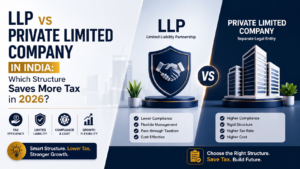
LLP vs Private Limited Company: Key Differences
| Feature | LLP | Private Limited Company |
|---|---|---|
| Ownership | Partners | Shareholders |
| Management | Flexible | Structured |
| Compliance Level | Moderate | Higher |
| Investor Preference | Limited | Strong |
| Equity Funding | Restricted | Easier |
| Governance | Flexible | Formal |
| Transferability | More restricted | Easier |
| Scalability | Moderate | High |
Taxation Comparison in 2026
Taxation is one of the biggest factors businesses evaluate while choosing a structure.
However, businesses should avoid choosing purely based on short-term tax assumptions.
LLP Taxation in India
LLPs are generally taxed as partnership entities.
Advantages Often Associated with LLPs
- Simpler profit withdrawal structure
- Flexible internal distribution
- Reduced procedural formalities
- Simplified operational management
LLPs may work efficiently for:
- Professional firms
- Consulting businesses
- Small agencies
- Service-based operations
Private Limited Company Taxation
Private Limited Companies follow corporate taxation rules.
Key Considerations
- Corporate compliance obligations
- Director remuneration structuring
- Dividend considerations
- Shareholding structures
- Investor-related compliance
Despite higher compliance requirements, Private Limited Companies often provide stronger scalability advantages.
Which Structure Saves More Tax?
There is no universal answer.
Tax efficiency depends on:
- Revenue level
- Profit margins
- Reinvestment plans
- Founder withdrawals
- Funding goals
- Compliance discipline
LLP May Be More Suitable If:
- The business is service-oriented
- External funding is not a priority
- Partners want operational flexibility
- Compliance simplicity is preferred
Private Limited Company May Be Better If:
- The startup plans to raise investment
- Equity allocation is important
- Long-term scaling is a priority
- The business wants stronger corporate positioning
Compliance Comparison
Compliance is another critical factor often ignored during business registration.
LLP Compliance
LLPs generally have:
- Fewer governance formalities
- Simplified operational procedures
- Reduced documentation complexity
However, LLPs still require:
- Annual filings
- Tax compliance
- GST compliance where applicable
- Financial documentation
Private Limited Company Compliance
Private Limited Companies typically require:
- Board-related documentation
- Annual ROC filings
- Financial reporting
- Corporate governance compliance
- Structured statutory documentation
This makes compliance comparatively more structured and rigorous.
Funding & Investor Readiness
This is where the biggest difference usually appears.
Investor Preference
Most angel investors, venture capital firms, and institutional investors prefer:
- Private Limited Companies
because:
- Equity allocation is easier
- Shareholding structures are clearer
- Exit strategies are more practical
- Corporate governance standards are stronger
Can LLPs Raise Funding?
Yes, but large-scale equity investment becomes comparatively more complex.
For bootstrap businesses or professional firms, this may not be a major concern.
Scalability & Business Growth
Businesses planning:
- Franchising
- Venture funding
- National expansion
- ESOP structures
- Multi-founder scaling
often prefer the Private Limited model.
LLPs are commonly preferred for:
- Stable professional practices
- Consulting operations
- Smaller service-based models
Which Structure is Better for Professionals?
Doctors, consultants, architects, agencies, and freelancers often prefer LLPs because:
- Management is flexible
- Compliance is comparatively simpler
- Operational structure suits service businesses
However, growth-focused firms may later convert into Private Limited Companies.
Which Structure is Better for Startups?
For startups aiming at:
- Fundraising
- Investor onboarding
- Rapid scaling
- ESOP issuance
- Technology expansion
Private Limited Company structures are generally more suitable.
This is why most funded Indian startups operate as Private Limited Companies.
Common Mistakes While Choosing Business Structure
1. Selecting Structure Only for Tax Saving
Short-term tax focus can create long-term growth limitations.
2. Ignoring Investor Expectations
Many startups later struggle to restructure before fundraising.
3. Underestimating Compliance
Businesses often fail to assess future compliance obligations.
4. Choosing Incorrect Ownership Models
Poor structuring creates partnership and governance conflicts.
5. Ignoring Scalability
A structure suitable today may not support future expansion.
How to Decide the Right Structure
Before choosing LLP or Private Limited Company, businesses should evaluate:
Key Decision Factors
- Growth objectives
- Investor plans
- Revenue expectations
- Ownership flexibility
- Tax planning strategy
- Operational complexity
- Long-term vision
The ideal structure is the one aligned with both:
- Present operations
- Future business goals
How Junaid Khan & Co Helps Businesses
Junaid Khan & Co assists startups and businesses with:
- Business structure consultation
- LLP registration
- Private Limited Company incorporation
- Startup advisory
- Tax planning
- GST compliance
- ROC compliance
- Financial structuring
The firm works with startups, consultants, agencies, professionals, and growing businesses across India.
Conclusion
The LLP vs Private Limited Company decision in 2026 is not only about taxation.
It is about:
- Business goals
- Scalability
- Funding readiness
- Compliance capability
- Long-term operational strategy
For many professional firms and service businesses, LLPs offer operational simplicity and flexibility.
For startups planning aggressive growth and investor participation, Private Limited Companies usually provide stronger strategic advantages.
The best structure is the one that supports sustainable growth while maintaining compliance efficiency and financial clarity.
FAQ SECTION
1. Which is better LLP or Private Limited Company?
The ideal structure depends on business goals, taxation strategy, investor plans, and scalability requirements.
2. Does LLP save more tax than Pvt Ltd?
Tax efficiency depends on income structure, profit distribution, and business operations.
3. Is LLP suitable for startups?
LLPs may suit bootstrap and service-focused startups, but funded startups usually prefer Private Limited Companies.
4. Which structure has lower compliance?
LLPs generally have comparatively simpler compliance requirements.
5. Why do investors prefer Private Limited Companies?
Private Limited Companies offer clearer equity structures and better scalability for investments.
6. Can an LLP convert into a Private Limited Company?
Yes, eligible LLPs may later convert depending on business requirements.
7. Is Private Limited Company mandatory for fundraising?
Not always, but most institutional investors prefer Private Limited structures.
8. Which structure is better for consultants and agencies?
Many consultants and agencies prefer LLPs due to operational flexibility and simpler governance.
Blog By : CA Junaid Khan
Written by CA Junaid Ahmed Khan, Junaid Khan & Co., Bhopal.