


TL;DR
The new tax regime is the default tax regime for eligible individual taxpayers, but the old regime continues to be available to eligible taxpayers who choose to opt out. The Income Tax Department specifically advises taxpayers to compare their tax liability under both regimes before making a choice.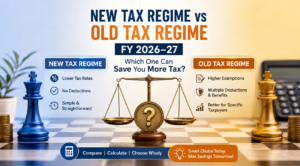
For FY 2026–27 (AY 2027–28), the new regime generally offers lower rates across more income slabs and permits fewer deductions and exemptions. The old regime has higher slab rates but allows a wider range of deductions and exemptions.
The important question is therefore not simply “Which regime has lower tax rates?” It is:
Which regime produces the lower final tax liability after considering your income, deductions, exemptions, investments and other eligible tax benefits?
Introduction
Choosing between the new tax regime and old tax regime can have a significant impact on your annual tax liability.
Two taxpayers earning the same salary may end up paying different amounts of tax because their deductions, exemptions, investments, home-loan interest and other eligible benefits may be completely different.
For FY 2026–27, the new regime continues to be the default regime for eligible taxpayers. However, taxpayers can opt for the old regime if it is more beneficial for their circumstances.
This makes tax planning more important than simply following whichever regime appears popular.
What Changed for FY 2026–27?
The new regime continues to have a wider range of income slabs and comparatively lower rates.
For individuals below 60 years of age, the official Income Tax Department’s AY 2026–27 guidance lists the following new-regime structure:
Taxable Income New Regime Rate
Up to ₹4 lakh Nil
₹4 lakh–₹8 lakh 5%
₹8 lakh–₹12 lakh 10%
₹12 lakh–₹16 lakh 15%
₹16 lakh–₹20 lakh 20%
₹20 lakh–₹24 lakh 25%
Above ₹24 lakh 30%
The Department also states that the Section 87A rebate under the new regime was increased to ₹60,000 for total income up to ₹12 lakh, applicable from AY 2026–27.
Important: FY 2026–27 corresponds to AY 2027–28. Taxpayers should always verify the provisions applicable to the relevant assessment year before filing.
New Tax Regime Slabs for FY 2026–27
For an individual below 60 years of age, the new regime provides:
Income Slab Tax Rate
Up to ₹4,00,000 0%
₹4,00,001–₹8,00,000 5%
₹8,00,001–₹12,00,000 10%
₹12,00,001–₹16,00,000 15%
₹16,00,001–₹20,00,000 20%
₹20,00,001–₹24,00,000 25%
Above ₹24,00,000 30%
These are the official slabs published by the Income Tax Department for AY 2026–27.
Taxpayers should also consider applicable rebate, surcharge, marginal relief and 4% Health and Education Cess while calculating the final liability.
Old Tax Regime Slabs for FY 2026–27
For individuals below 60 years, the traditional regime continues to use the following basic slabs:
Income Slab Tax Rate
Up to ₹2,50,000 0%
₹2,50,001–₹5,00,000 5%
₹5,00,001–₹10,00,000 20%
Above ₹10,00,000 30%
The old regime may nevertheless become attractive for taxpayers who have substantial eligible deductions and exemptions.
New Tax Regime vs Old Tax Regime: Key Differences
Feature New Tax Regime Old Tax Regime
Default regime Yes No
Tax rates Generally lower Generally higher
Number of slabs More Fewer
80C deduction Generally not available Available, subject to conditions
80D deduction Generally restricted/not available Available, subject to conditions
HRA exemption Generally not available Available, subject to conditions
Standard deduction for salaried taxpayers Available Available
Tax planning complexity Lower Higher
Suitable for Taxpayers with fewer deductions Taxpayers with substantial eligible deductions
The Income Tax Department describes the core distinction clearly: the new regime offers lower rates with fewer deductions and exemptions, while the old regime permits various deductions and exemptions.
What Deductions Are Available Under Each Regime?
This is where many taxpayers make the wrong decision.
The old regime can be beneficial when a taxpayer has significant eligible deductions and exemptions.
Common Old-Regime Tax Benefits
Depending on eligibility and applicable conditions, these can include:
Section 80C investments
Section 80D medical insurance
Section 80CCD(1B) additional NPS contribution
HRA exemption
Home-loan interest under applicable provisions
Certain education-loan interest deductions
Certain disability-related deductions
Other deductions permitted under the Income Tax Act
The exact availability depends on the taxpayer’s circumstances and the relevant provision.
Is Section 80C Available Under the New Tax Regime?
Generally, the popular Section 80C deduction is not available under the new regime, except for specific deductions that remain permitted under the applicable provisions.
This is an important distinction for taxpayers who regularly claim deductions for:
PPF
ELSS
Life insurance premiums
Eligible tuition fees
Certain principal repayments
Other qualifying Section 80C investments/payments
A taxpayer who has historically relied heavily on 80C should therefore calculate the tax under both regimes before deciding.
Standard Deduction Under the Two Regimes
For salaried taxpayers, standard deduction remains an important component of the comparison.
The new regime provides a higher standard deduction for eligible salaried/pension income compared with the old regime under the current rules.
This means taxpayers should compare taxable income after the applicable standard deduction, rather than comparing gross salary directly with the tax slabs.
For example:
Gross Salary → Applicable Standard Deduction → Taxable Salary → Other eligible adjustments → Tax Calculation
This distinction becomes particularly important when comparing salaries around ₹10 lakh, ₹12 lakh, ₹15 lakh and ₹20 lakh.
Section 87A Rebate Under the New Regime
The Section 87A rebate is one of the most important features of the current new regime.
For AY 2026–27, the Income Tax Department states that the rebate was increased from ₹25,000 to ₹60,000 for eligible resident individuals with total income up to ₹12 lakh.
This significantly changes the tax calculation for taxpayers around the ₹12 lakh income level.
However, taxpayers should not interpret this as meaning that every person earning exactly ₹12 lakh or less automatically has zero tax in every situation. Eligibility conditions and the nature of income must be considered.
Which Tax Regime Is Better?
There is no single answer that works for every taxpayer.
The Income Tax Department itself states that the better option varies from person to person and recommends comparing the tax liability under both regimes before selecting one.
The New Regime May Be More Attractive If:
You have relatively few deductions.
You do not claim HRA exemption.
You have limited eligible investments.
You do not have significant eligible deductions.
You prefer simpler tax calculations.
Your taxable income falls within the lower new-regime slabs.
You want to avoid managing extensive deduction documentation.
The Old Regime May Be More Attractive If:
You claim substantial Section 80C deductions.
You have eligible health insurance deductions.
You receive HRA and qualify for exemption.
You have eligible home-loan interest benefits.
You make substantial qualifying NPS contributions.
Your overall deductions and exemptions significantly reduce taxable income.
Real-Life Example: Why Income Alone Is Not Enough
Consider two salaried taxpayers with similar gross income.
Taxpayer A
Annual salary: ₹15 lakh
Suppose this taxpayer has limited eligible deductions and exemptions.
The new regime may be attractive because of its lower rates and wider slabs.
Taxpayer B
Annual salary: ₹15 lakh
Suppose this taxpayer has substantial eligible benefits such as:
HRA exemption
Section 80C investments
Health insurance deduction
Eligible home-loan interest
Other permitted deductions
The old regime may become more competitive because the taxpayer can reduce taxable income through eligible deductions and exemptions.
The lesson: Do not select a regime based only on your salary figure.
New Regime vs Old Regime: A Simple Decision Framework
Before selecting your regime, calculate these five numbers:
-
Gross Total Income
Include salary, business/professional income, interest, rent, capital gains and other taxable income as applicable.
-
Eligible Exemptions
Calculate exemptions available under the regime you are considering.
-
Eligible Deductions
List deductions such as 80C, 80D, NPS and others where applicable.
-
Taxable Income
Calculate your taxable income after applicable deductions and exemptions.
-
Final Tax Liability
Calculate tax under both regimes, including applicable rebate, surcharge and cess.
Then compare:
Old Regime Tax Liability vs New Regime Tax Liability
The lower legitimate tax liability is generally the more tax-efficient option, subject to your individual circumstances and compliance requirements
Income-Wise Tax Regime Comparison for FY 2026–27
There is no universal income level at which the new regime is always better. Your deductions, exemptions, income sources and eligibility for rebates can change the result.
A practical comparison should therefore be based on taxable income and eligible benefits, not just gross salary.
Example 1: Annual Salary of ₹8 Lakh
A salaried taxpayer with ₹8 lakh income and limited deductions may find the new regime more attractive because of its lower rates and applicable rebate provisions.
If the taxpayer has substantial deductions under the old regime, however, the calculation should be performed under both options before making a final decision.
Example 2: Annual Salary of ₹12 Lakh
The ₹12 lakh level deserves particular attention because the Section 87A rebate under the new regime can substantially reduce tax for eligible taxpayers.
However, the nature of income matters. Special-rate income, such as certain capital gains, can be subject to separate rules and should not automatically be treated as ordinary slab-rate income.
Example 3: Annual Salary of ₹15 Lakh
At ₹15 lakh, the comparison becomes more dependent on deductions.
A taxpayer with minimal deductions may prefer the new regime, while someone with substantial eligible deductions and exemptions should calculate the old-regime liability carefully.
Example 4: Annual Salary of ₹20 Lakh
At higher income levels, the difference between the regimes can become significant.
A taxpayer should prepare a side-by-side calculation covering:
| Factor | New Regime | Old Regime |
|---|---|---|
| Gross income | Same | Same |
| Standard deduction | Applicable | Applicable |
| HRA exemption | Generally unavailable | Subject to eligibility |
| 80C | Generally unavailable | Subject to eligibility |
| 80D | Generally unavailable | Subject to eligibility |
| Other deductions | Restricted | Wider availability |
| Tax rate structure | Lower/wider slabs | Higher traditional slabs |
| Final liability | Calculate | Calculate |
The correct choice depends on the final numbers—not assumptions.
Who Should Prefer the New Tax Regime?
The new regime can be particularly convenient for taxpayers who want a simpler tax structure and do not have significant deductions.
It may suit you if:
You Have Few Tax-Saving Investments
If you do not invest heavily in eligible 80C instruments or other deduction-eligible products, the old regime’s deduction advantage may not provide enough benefit.
You Do Not Claim HRA
Taxpayers living in their own homes or otherwise not eligible for HRA exemption may have fewer reasons to prefer the old regime.
You Have Limited Insurance Deductions
If eligible deductions under provisions such as Section 80D are relatively small, the old regime’s higher tax rates may outweigh the deduction benefit.
You Prefer Simplicity
The new regime generally requires less deduction-based tax planning.
Instead of tracking numerous eligible investments and exemptions, taxpayers can focus on accurate income reporting and applicable deductions that remain permitted.
Who May Benefit From the Old Tax Regime?
The old regime can remain useful for taxpayers with substantial legitimate deductions.
It may be worth considering if you have:
- Significant Section 80C investments.
- Eligible health insurance premiums.
- Eligible HRA exemption.
- Qualifying home-loan interest.
- Additional NPS contributions.
- Education-loan interest deductions.
- Other deductions specifically permitted under the law.
The important point is that these benefits should not be created solely to save tax.
For example, investing ₹1 lakh merely to save a portion of tax may not make financial sense if the investment itself does not fit your long-term financial objectives.
Tax planning should support financial planning—not replace it.
What About Home Loan Borrowers?
Home-loan taxpayers should be particularly careful when selecting a regime.
Under the old regime, eligible taxpayers may claim deductions relating to home-loan interest subject to applicable conditions.
The new regime restricts several deductions and exemptions available under the old system.
Therefore, before selecting the regime, consider:
- Whether the property is self-occupied or let out.
- Amount of eligible interest.
- Principal repayment.
- Whether the property is under construction or completed.
- Whether other conditions under the relevant provisions are satisfied.
- Whether you have any business or professional income.
A home-loan calculation can materially change the outcome of a regime comparison.
New Tax Regime vs Old Tax Regime for Salaried Employees
Salaried employees often receive several components in their salary structure.
These may include:
- Basic salary
- HRA
- Special allowance
- Bonus
- LTA
- Employer NPS contribution
- Other allowances
Not every component receives identical treatment under both regimes.
Therefore, employees should not compare regimes using only their CTC.
A better approach is:
CTC → Gross Salary → Exemptions → Standard Deduction → Eligible Deductions → Taxable Income → Final Tax
This produces a much more reliable comparison.
What If You Have Business or Professional Income?
The regime-selection rules can be different for individuals earning income from business or profession.
This is particularly important for:
- Freelancers
- Consultants
- Doctors
- Lawyers
- Architects
- Chartered professionals
- Traders
- Proprietors
- Other self-employed taxpayers
Individuals with business or professional income should not treat regime switching as simply a payroll preference.
The option to change regimes can involve additional procedural considerations, and taxpayers should verify the applicable provisions for the relevant assessment year before filing.
This is one area where professional tax planning can prevent an expensive mistake.
Can You Switch Between the Old and New Tax Regimes?
The answer depends partly on the nature of your income.
For taxpayers without business or professional income, the regime can generally be selected each year while filing the return, subject to the applicable rules.
Taxpayers having business or professional income face additional conditions regarding exercising and withdrawing the option.
Therefore, do not assume that changing the regime during payroll declaration automatically settles your final tax position.
Your employer’s TDS calculation and your final ITR tax liability are not always the same thing.
Employer Choice vs ITR Choice
Many salaried employees become confused when their employer asks them to choose a tax regime.
The regime selected for TDS purposes affects how the employer calculates monthly tax deduction.
However, eligible taxpayers can generally determine their final tax position when filing their ITR, subject to the applicable rules.
This means:
TDS deducted during the year ≠ final tax liability
If excess TDS has been deducted, the difference may ultimately become part of your refund, assuming the return is correctly filed and processed.
Common Mistakes While Choosing a Tax Regime
Mistake 1: Choosing the New Regime Automatically
The new regime is the default regime, but “default” does not mean “best for everyone.”
Always compare the numbers.
Mistake 2: Choosing the Old Regime Because of 80C
Having ₹1.5 lakh of eligible 80C investment does not automatically make the old regime better.
The entire tax calculation must be compared.
Mistake 3: Ignoring HRA
If you are eligible for a significant HRA exemption, leaving it out can distort your comparison.
Mistake 4: Comparing Tax Rates Instead of Final Tax
A lower-looking rate does not tell the entire story.
Compare final tax payable after applicable benefits.
Mistake 5: Ignoring Other Income
Interest, rent, capital gains, dividends and other taxable income can affect your total tax liability.
Mistake 6: Treating Capital Gains Like Salary Income
Certain capital gains are taxed under special provisions. They should be separately considered rather than simply inserted into slab-rate calculations.
Mistake 7: Making Investments Only for Tax Saving
Tax-saving investments should make financial sense independently of the tax benefit.
A Practical Tax Regime Selection Checklist
Before filing your ITR for FY 2026–27, prepare this checklist:
Income
- [ ] Salary income calculated
- [ ] Interest income included
- [ ] Rental income considered
- [ ] Capital gains checked
- [ ] Freelance/business income included
- [ ] Other taxable income reconciled
Old Regime
- [ ] HRA eligibility checked
- [ ] 80C calculated
- [ ] 80D calculated
- [ ] NPS deduction checked
- [ ] Home-loan interest checked
- [ ] Other eligible deductions identified
New Regime
- [ ] Applicable standard deduction considered
- [ ] Eligible deductions under the new regime identified
- [ ] Section 87A eligibility checked
- [ ] Special-rate income considered separately
- [ ] Applicable surcharge and cess considered
Final Comparison
- [ ] Old-regime tax calculated
- [ ] New-regime tax calculated
- [ ] Final tax liability compared
- [ ] TDS reconciled
- [ ] AIS/Form 26AS checked
- [ ] Supporting documents retained
Should You Choose a Tax Regime Just to Save More Tax?
Not necessarily.
Suppose the old regime saves you ₹10,000 in tax but requires you to make investments you would not otherwise make.
That does not automatically mean you have made a better financial decision.
Good tax planning considers:
Tax saving + liquidity + investment objective + risk + long-term financial goals
The objective should be to minimise your legitimate tax liability without compromising your broader financial position.
How a Chartered Accountant Can Help You Compare Both Regimes
A professional tax comparison should go beyond simply entering salary into an online calculator.
A Chartered Accountant can review:
- Salary structure
- Business/professional income
- Investment portfolio
- HRA eligibility
- Home-loan details
- Insurance deductions
- NPS contributions
- Capital gains
- TDS credits
- AIS and Form 26AS
- Previous-year tax position
- Applicable exemptions and deductions
The result is a personalised comparison based on your actual financial position.
For businesses, tax planning can also be integrated with accounting, GST compliance, payroll and year-end financial planning.
Conclusion
The New Tax Regime vs Old Tax Regime for FY 2026–27 is not a simple question of which option has lower tax rates.
The new regime can be attractive because of its wider slabs, lower rates and simplified deduction structure. The old regime can remain valuable for taxpayers who can legitimately claim substantial exemptions and deductions.
The best choice depends on your income composition, deductions, exemptions, investments, home-loan position and other applicable tax provisions.
Before filing your ITR, calculate your liability under both regimes and choose based on the actual numbers.
If your tax situation includes multiple income sources, business income, capital gains, significant deductions or complex financial transactions, professional review can help you avoid choosing a regime based on an incomplete calculation.
Junaid Khan & Co, Chartered Accountants can assist with income-tax planning, ITR filing, tax compliance, accounting and related business advisory requirements.
Plan your taxes based on your complete financial picture—not assumptions.
FAQ SECTION
1. Which is better, the new or old tax regime for FY 2026–27?
There is no single answer for every taxpayer. The new regime may suit individuals with fewer deductions, while the old regime can benefit taxpayers with substantial eligible deductions and exemptions. Calculate the final liability under both regimes before deciding.
2. Is the new tax regime the default regime?
Yes. The new tax regime is the default regime for eligible individual taxpayers. However, eligible taxpayers can choose the old regime subject to the applicable rules.
3. Is Section 80C available under the new tax regime?
Generally, Section 80C deductions are not available under the new regime, although certain specified deductions continue to be permitted. Taxpayers should verify the applicable provisions for the relevant assessment year.
4. Can salaried employees switch between tax regimes?
Eligible salaried taxpayers without business or professional income can generally select the appropriate regime when filing their return, subject to applicable rules.
5. Which regime is better for someone with an ₹8 lakh salary?
The new regime can be highly attractive for eligible taxpayers around this income level, particularly where deductions under the old regime are limited. The exact liability should still be calculated based on the taxpayer’s complete income profile.
6. Which regime is better if I have a home loan?
It depends on the amount and type of eligible deductions and the taxpayer’s overall income. The old regime may become more attractive where substantial eligible home-loan-related benefits and other deductions are available.
7. Does choosing a tax regime with my employer permanently lock me into it?
Not necessarily. Employer TDS calculations and final ITR filing are separate considerations. The rules for changing regimes depend on the taxpayer’s income type, so business and professional taxpayers need particular care.
8. Should I invest only to reduce my income tax?
No. Tax-saving investments should also align with your financial objectives, liquidity requirements, risk tolerance and investment horizon.
Blog By : CA Junaid Khan
Written by CA Junaid Ahmed Khan, Junaid Khan & Co., Bhopal.