

AIS vs Books of Accounts: How to Find and Fix Income & Transaction Mismatches
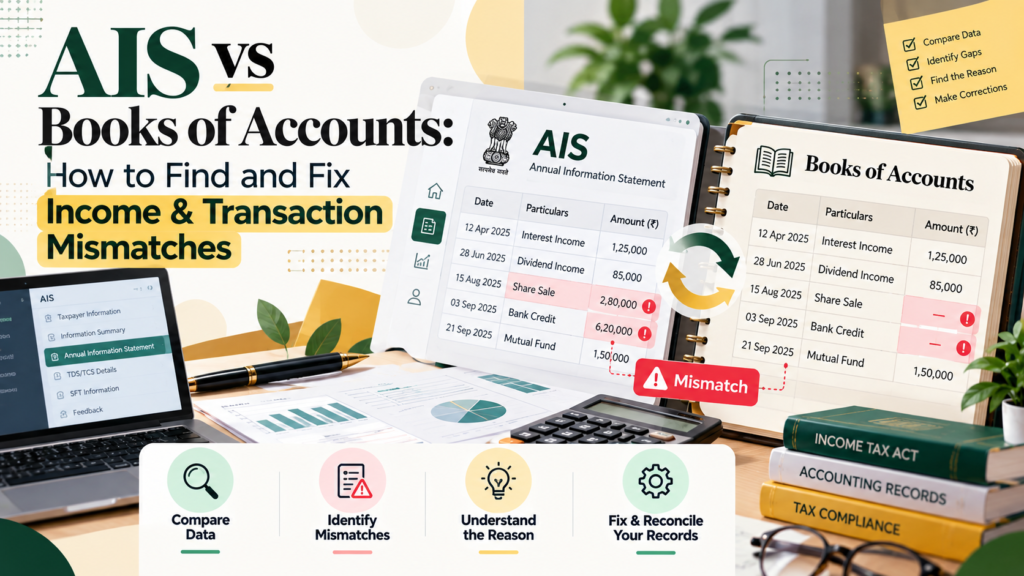
TL;DR AIS and Books of Accounts serve different purposes, so their figures do not always have to match exactly. However, unexplained differences between AIS, books, Form 26AS, bank statements, TDS records and the ITR can create compliance questions. Common mismatches include interest income, TDS, business receipts, property transactions, securities, dividends, foreign transactions and high-value financial activity. The right approach is to identify the source of the mismatch, verify supporting documents, provide AIS feedback where appropriate, correct accounting records if necessary and report the correct tax position in the ITR. Introduction Income tax compliance in 2026 is increasingly data-driven. The Income Tax Department receives financial information from taxpayers, banks, financial institutions, employers, companies, mutual funds, registrars and other reporting entities. Much of this information can appear in the taxpayer’s Annual Information Statement (AIS). At the same time, businesses and professionals maintain their own Books of Accounts, which record income, expenses, assets, liabilities, receivables, payments and other financial transactions. Ideally, the financial information reported through different sources should tell a consistent story. However, mismatches are common. For example, AIS may show interest income that was not recorded in the books, TDS may appear against a receipt that was accounted for in another period, or a property transaction may appear in AIS while the taxpayer’s books contain only the related bank payment. A mismatch does not automatically mean that income has been concealed. The important question is: Why is there a difference, and can it be properly explained with supporting documents? What Is AIS? The Annual Information Statement (AIS) provides a comprehensive view of information available with the Income Tax Department in relation to a taxpayer. According to the Income Tax Department, AIS can contain information relating to: TDS TCS Statement of Financial Transactions (SFT) Tax payments Demand and refund information Certain other information received by the department Taxpayers can also provide feedback where information displayed in AIS is incorrect. (Income Tax Department) AIS is therefore an important source for pre-filing tax reconciliation. However, AIS should not be treated as a complete substitute for the taxpayer’s own books and records. The department itself states that AIS may not contain every transaction relating to a taxpayer. Taxpayers remain responsible for reporting complete and accurate income. (Income Tax Department) What Are Books of Accounts? Books of Accounts are the accounting records maintained by a taxpayer or business. Depending on the nature of the business, these may include: Sales register Purchase register Cash book Bank book General ledger Journal Expense records Debtor ledger Creditor ledger Fixed-asset register Investment records Loan accounts GST records TDS records For businesses, the books ultimately form the basis for preparing financial statements and determining taxable income. Therefore, AIS should be compared with the underlying accounting records rather than being accepted blindly. AIS vs Books of Accounts: Why Can They Differ? AIS and books are generated from different information sources. AIS: Primarily reflects information reported to the Income Tax Department by taxpayers and reporting entities. Books: Reflect transactions recorded by the taxpayer based on accounting documents and business activity. A difference can therefore occur because of: Timing differences Reporting errors by third parties Accounting errors Duplicate reporting Incorrect PAN Transactions recorded under another entity Gross vs net reporting Credit notes Reversals Capital transactions Loans Gifts Non-taxable receipts Exempt income Transactions outside the scope of taxable income The objective of reconciliation is to determine which explanation applies to each difference. Common AIS vs Books Mismatches 1. Interest Income Mismatch Interest income is one of the most common differences. AIS may contain interest information reported by: Banks Financial institutions Companies Bond issuers Other reporting entities The books may show a different figure because of: Accrual accounting Cash accounting Interest credited but not received Interest received from multiple accounts TDS adjustments Wrong reporting by the bank The taxpayer should compare AIS with: Bank statements + interest certificates + ledger + TDS records The correct taxable income should then be determined under the applicable tax provisions. 2. TDS Income Mismatch Another common problem occurs when TDS appears in AIS or Form 26AS but the corresponding income is not visible in the books. For example, a professional may receive ₹1,00,000 from a client and have TDS deducted. The books may record the net bank receipt of ₹90,000 while AIS reflects the gross amount of ₹1,00,000 along with TDS. This is not necessarily a mismatch in taxable income. The reconciliation should consider: Gross income = Net receipt + TDS deducted This is why comparing only the bank credit with AIS can produce misleading conclusions. 3. Business Receipts Mismatch Businesses should compare AIS information with their sales and service-income records. A mismatch can occur when: Customer reports a payment under the wrong PAN Receipt is recorded in a different month Credit note is issued Advance is received Invoice is cancelled Customer reports a transaction incorrectly Receipt belongs to a different entity Businesses should trace the transaction back to: Customer → Invoice → Ledger → Bank statement → TDS → AIS 4. GST Turnover vs AIS and Books Businesses should also examine whether their GST and income-tax records are broadly consistent. A useful reconciliation is: Sales Register → GST Returns → Books → AIS/TDS → ITR Differences can arise due to: Exempt supplies Non-GST income Credit notes Advances Timing differences TDS-reporting differences Capital transactions The objective is not to force every figure to be identical but to explain material differences. 5. Dividend Income Mismatch Dividend information can appear in AIS through reporting by companies and other entities. A taxpayer may fail to record a dividend because: The amount was credited to a demat-linked bank account Multiple investments generated dividends The taxpayer overlooked small dividend amounts TDS was deducted and only the net amount was noticed The correct approach is to reconcile: AIS → Dividend statement → Bank statement → TDS → ITR 6. Mutual Fund Transactions AIS can contain information relating to financial transactions reported by relevant entities. For mutual funds, taxpayers should reconcile: Purchases Redemptions Dividends Capital gains
Income Tax Scrutiny 2026: Transactions That Can Trigger Questions From the Tax Department
TL;DR Income tax scrutiny does not necessarily mean that a taxpayer has committed an offence. The Income Tax Department uses information available through sources such as AIS, SFT, TDS/TCS records, tax payments and other reported information to identify potential inconsistencies and compliance risks. Transactions that do not match the income declared in the ITR, unexplained investments, significant cash transactions, property purchases, foreign assets, securities transactions, large deductions and differences between GST and income-tax data can attract questions. Taxpayers should therefore review AIS, TIS, Form 26AS, bank statements, investment records and supporting documents before filing and respond carefully if a notice is received. Introduction Income tax scrutiny in 2026 is increasingly data-driven. The Income Tax Department receives financial information from taxpayers, banks, financial institutions, reporting entities and other sources. This information can appear in the taxpayer’s Annual Information Statement (AIS) and may be used for compliance verification and risk analysis. AIS contains information such as TDS/TCS, Statement of Financial Transactions (SFT), tax payments, demand and refund information and certain other information received by the department. Taxpayers can also provide feedback where information displayed in AIS is incorrect. This means that filing an ITR with figures that do not reasonably reconcile with information available to the department can result in questions. Importantly, a transaction appearing in AIS does not automatically mean that it is taxable or that scrutiny will definitely happen. AIS itself states that it contains information presently available to the department and that taxpayers must independently verify all relevant information and report complete and accurate income. The real concern is an unexplained mismatch. What Is Income Tax Scrutiny? Income tax scrutiny is a detailed examination of a taxpayer’s return and supporting information by the Income Tax Department. The objective is to verify whether: Income has been correctly reported Tax has been correctly calculated Deductions and exemptions are genuine Transactions are properly explained Investments are supported by known sources Financial information is consistent Tax compliance requirements have been followed A scrutiny notice does not automatically mean that additional tax is payable. The taxpayer gets an opportunity to provide explanations and supporting documents. For AY 2026–27 and earlier assessment years, assessment proceedings continue under the Income Tax Act, 1961 even though the Income Tax Act, 2025 has come into force from 1 April 2026. The Income Tax Department has specifically clarified that scrutiny assessments for AY 2026–27 or earlier years continue under the old Act. Why Can a Transaction Attract Questions From the Tax Department? The department has access to information from multiple reporting channels. A transaction can attract attention when there is a significant difference between: Transaction reported by a third party → Information available in AIS/SFT → Transaction disclosed in ITR For example, if a financial institution reports a substantial transaction but the taxpayer’s return does not adequately explain the corresponding source or tax treatment, the department may seek clarification. Similarly, a large investment funded from an income level that appears insufficient may require supporting evidence. 1. High-Value Cash Deposits Large cash deposits into bank accounts can attract questions, particularly when they are inconsistent with the taxpayer’s declared income or normal business activity. For example, if an individual reports modest taxable income but deposits substantial cash during the year, the department may seek information regarding: Source of cash Business receipts Cash sales Withdrawals redeposited Loans Gifts Agricultural income Other legitimate sources Cash deposits are not automatically taxable. However, unexplained cash transactions can create significant tax issues. Businesses should therefore maintain proper cash books, sales records, invoices and supporting documents. 2. Large Cash Withdrawals Large cash withdrawals can also require explanation in certain circumstances. A withdrawal itself is not necessarily income. However, if a taxpayer later makes a significant investment or cash deposit and claims that the funds came from earlier withdrawals, proper documentation and a credible transaction trail may be important. The department can examine whether the explanation is consistent with the taxpayer’s financial records. 3. Property Purchases Purchase or sale of immovable property can generate substantial financial information. A property transaction may raise questions where: Purchase value is substantial compared with declared income Payment sources are unclear Loan details do not reconcile Co-owner contributions are unexplained Stamp-duty value and declared consideration require examination Capital gains are incorrectly reported Cash components are alleged or unsupported Taxpayers should retain: Sale deed Purchase agreement Bank statements Loan documents Payment proofs Stamp-duty records Capital-gains computation 4. Sale of Shares and Securities Share-market and securities transactions are increasingly visible through financial reporting systems. Questions can arise when taxpayers fail to correctly report: Sale of listed shares Short-term capital gains Long-term capital gains Securities transactions Dividend income Mutual fund redemptions Other investment income The transaction data should be reconciled with broker statements, contract notes, capital-gains statements and bank records. 5. Mutual Fund Investments and Redemptions Large mutual fund investments or redemptions may also require reconciliation. The taxpayer should be able to explain: Where the investment came from → How much was invested → When it was redeemed → What gain/loss resulted → How it was reported in the ITR A mismatch between investment records and the return can create unnecessary questions. 6. Foreign Assets and Foreign Income Foreign financial information has become increasingly important. The Income Tax Department announced in July 2026 that foreign-assets information received through CRS/FATCA would be made available in AIS. Taxpayers with relevant foreign assets or income should therefore carefully review: Foreign bank accounts Foreign shares Foreign securities Foreign property Foreign dividends Foreign interest Foreign employment income Foreign pension or investment income Where applicable, foreign assets and income should be disclosed correctly in the appropriate ITR schedules. 7. Foreign Remittances Large outward foreign remittances or purchases of foreign currency can form part of the information available to the tax department. AIS specifically includes certain information relating to outward foreign remittance/purchase of foreign currency. A taxpayer should therefore maintain documentation explaining the nature and source of significant remittances. Depending on the transaction, this may involve: Bank statements Form A2 Purpose of
October 2026 Income Tax Compliance: What Businesses Should Prepare After Tax Audit
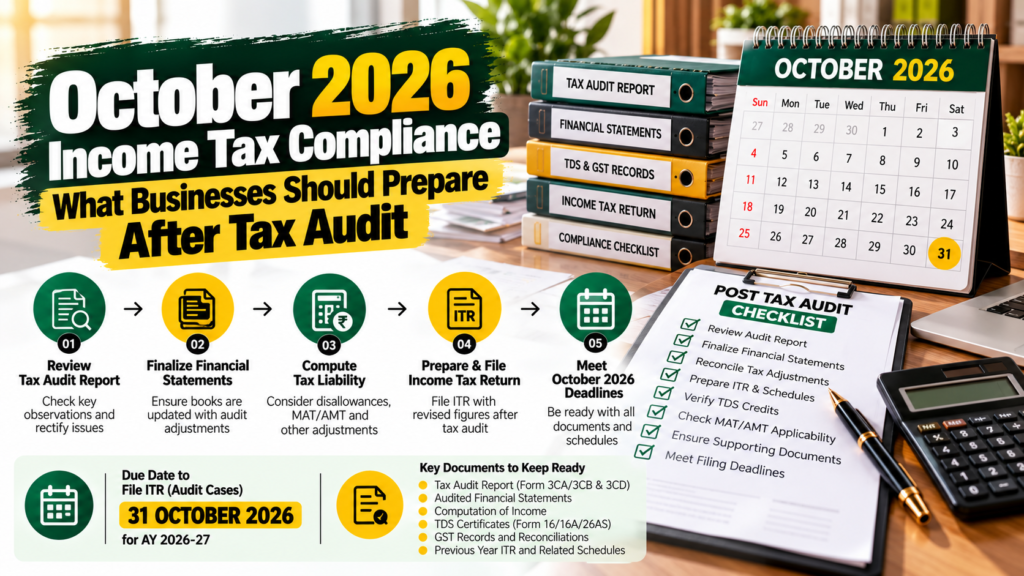
TL;DR October 2026 is an important compliance month for businesses that have completed their tax audit for FY 2025–26. After the tax-audit report is filed, businesses should review the audit figures, reconcile Form 3CD with the books and ITR, finalize the income-tax computation, pay any remaining tax liability and file the applicable ITR by the prescribed deadline. For AY 2026–27, businesses subject to tax audit generally have an ITR due date of 31 October 2026, while the tax-audit report is generally due by 30 September 2026. Businesses should also review TDS/TCS records, advance tax, GST reconciliations, carried-forward losses, depreciation, disallowances and outstanding tax demands before finalizing their October compliance. Introduction Completing a tax audit does not mean that a business’s income-tax compliance for FY 2025–26 is finished. The tax audit is an important stage in the compliance process, but businesses still need to ensure that the information reported in the audit report is correctly reflected in the income-tax return. This makes October 2026 particularly important for businesses that are required to file their audited ITR for AY 2026–27. For FY 2025–26, the applicable return continues to be governed by the Income Tax Act, 1961 because the income relates to the financial year beginning before 1 April 2026. The Income Tax Department has clarified that AY 2026–27 remains under the old Act even though the return is filed after the new Income Tax Act, 2025 has come into force. Once the tax audit report has been completed, businesses should use October to complete the remaining income-tax compliance carefully rather than simply uploading the ITR based on the audit figures. What Happens After the Tax Audit? A typical post-tax-audit process involves: Reviewing the final tax-audit report. Reconciling Form 3CD with the books. Finalizing taxable income. Checking tax already paid. Calculating the final tax liability or refund. Reviewing TDS and TCS credits. Checking advance-tax payments. Preparing and filing the applicable ITR. Verifying the return. Preserving supporting records. The tax audit report and ITR should tell a consistent financial and tax story. Differences between the two should be investigated before filing. 1. Review the Final Tax Audit Report The first step after the audit is to carefully review the final tax-audit report. For FY 2025–26, taxpayers subject to tax audit continue to use Form 3CA or Form 3CB along with Form 3CD, depending on the applicable circumstances. The tax-audit report is generally due by 30 September 2026 for cases where the corresponding ITR due date is 31 October 2026. Businesses should check: Name and PAN Assessment year Nature of business Turnover Gross receipts Depreciation Disallowances Statutory dues TDS/TCS information Loans and deposits MSME-related information Related-party transactions GST-related information Other Form 3CD disclosures Any obvious error should be discussed with the tax auditor before the return is finalized. 2. Reconcile Form 3CD With the ITR One of the most important October compliance checks is ensuring that the information in Form 3CD agrees with the corresponding information reported in the ITR. The Income Tax Department’s AY 2026–27 validation framework contains checks relating to audit information and requires relevant ITR details to be consistent with the applicable audit particulars. Businesses should compare: Turnover Gross receipts Profit Depreciation Taxable income Disallowances Brought-forward losses Depreciation carried forward Tax audit details TDS/TCS Tax payments A mismatch does not always mean that the return is incorrect, but unexplained differences should not be ignored. 3. Finalize the Taxable Income The audited profit shown in the financial statements is not necessarily the same as taxable income. Businesses may need to make tax adjustments for: Depreciation Disallowable expenses Statutory dues Employee-related payments TDS-related disallowances Certain cash transactions Expenses subject to specific tax provisions Brought-forward losses Tax deductions Other income-tax adjustments The final taxable income should be calculated after considering the relevant provisions of the Income Tax Act, 1961 applicable to FY 2025–26. 4. Check the ITR Filing Due Date For audited businesses, the ITR due date for AY 2026–27 is generally 31 October 2026 in cases where the taxpayer is not subject to transfer-pricing provisions. The tax-audit report generally precedes the return by one month. Transfer-pricing cases can have a different timeline, with the applicable return due date generally extending to 30 November 2026. Therefore, businesses should not assume that every audited taxpayer has the same October deadline. 5. Reconcile TDS and TCS Credits Before filing the ITR, businesses should verify whether all eligible TDS and TCS credits have been correctly reflected. The reconciliation should cover: Form 26AS AIS TDS certificates TDS ledger TCS records Customer/vendor records Tax deducted by customers Tax collected from applicable transactions If tax credit in the books does not match the tax credit available in the income-tax records, the difference should be investigated before filing. Incorrect TDS or TCS claims can affect the final tax payable or refund. 6. Verify Advance Tax Payments Businesses should reconcile all advance-tax instalments paid during FY 2025–26. The reconciliation should include: Challan date BSR code Challan serial number Amount paid Assessment year Tax head Total advance tax paid The advance-tax figures should match the tax records available on the income-tax portal. If there is an outstanding tax liability after considering advance tax, TDS and TCS, the business should calculate and pay the applicable amount before filing the return. 7. Calculate Any Remaining Self-Assessment Tax After finalizing taxable income and adjusting available tax credits, the business should determine whether any additional tax remains payable. This can arise because: Actual profit was higher than estimated. Additional income was identified during audit. Certain expenses were disallowed. TDS was lower than expected. Advance tax was insufficient. Tax deductions were reduced. Other taxable income was identified. Any remaining liability should be properly calculated before submitting the ITR. 8. Check Interest and Other Tax Consequences Businesses should not calculate only the basic income-tax liability. Where applicable, they should also review interest arising from: Short payment of advance tax Deferment of advance tax Delay in filing the return Other applicable statutory defaults For AY 2026–27, the relevant provisions continue
After Tax Audit: What Businesses Need to Check Before Filing Their ITR
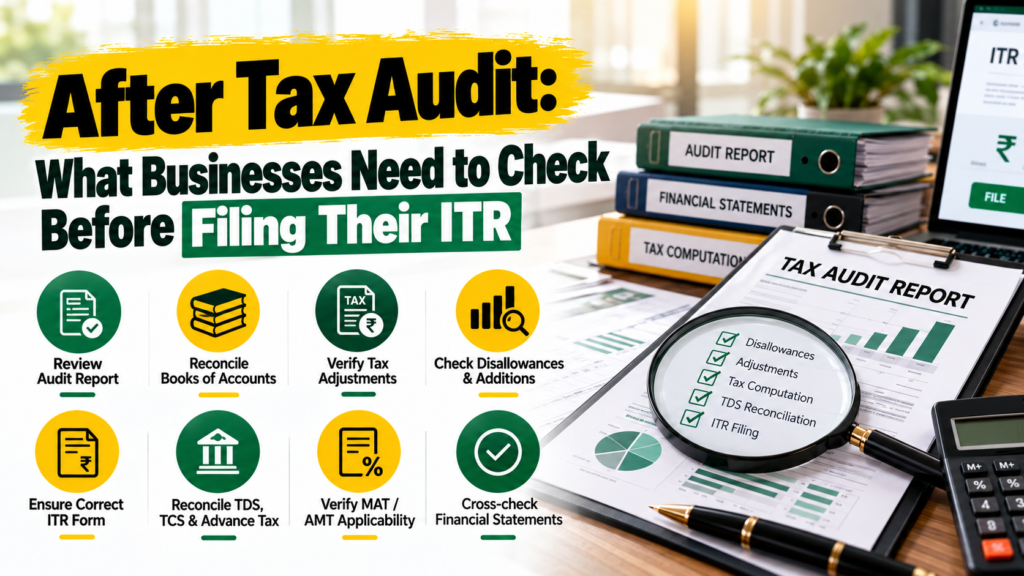
TL;DR Completing a tax audit does not mean the business’s tax compliance work is finished. Before filing the Income Tax Return, businesses should carefully verify the audited financial statements, tax-audit report, Form 3CD, depreciation, GST and TDS data, brought-forward losses, deductions, advance tax and self-assessment tax. Any discrepancy between the ITR and audited information should be resolved before filing. Introduction For businesses subject to tax audit, the completion of the audit is an important milestone—but it is not the final step. After the Chartered Accountant completes the tax audit and the applicable audit report is furnished, the business still needs to ensure that its Income Tax Return is prepared correctly. The figures reported in the ITR should be consistent with the audited financial statements and applicable information reported through the tax-audit process. A mismatch between the ITR, tax-audit report, GST returns, TDS records or other tax information can create unnecessary questions during processing or assessment. This makes the period immediately after the tax audit extremely important. For FY 2025–26 / AY 2026–27, businesses continue to follow the Income-tax Act, 1961 framework. The corresponding tax-audit provision under the Income Tax Act, 2025 applies to Tax Year 2026–27 onward. What Happens After a Tax Audit? Once the tax audit is completed, the business should not immediately file its ITR without reviewing the final numbers. The post-audit process generally involves: Reviewing the final audited financial statements Checking the tax-audit report Reviewing Form 3CD disclosures Calculating taxable income Verifying depreciation Reconciling tax credits Checking brought-forward losses Reviewing deductions and disallowances Calculating final tax liability Adjusting advance tax and TDS/TCS Reviewing the ITR before submission Verifying the filed return The exact process depends on the business structure and applicable ITR form. 1. Check the Final Audited Financial Statements The first step is to make sure the financial statements being used for the ITR are the finalised audited statements. Review: Profit and Loss Account Balance Sheet Cash-flow statement, where applicable Schedules Notes to accounts Debtors Creditors Loans Fixed assets Capital accounts Provisions Outstanding liabilities The profit or loss reported in the ITR should be based on the finalised financial information. Why this matters If financial statements are changed after the tax-audit report has been prepared, the corresponding tax implications and reporting requirements should be reviewed before filing the ITR. Businesses should avoid using an earlier draft of their accounts when preparing the final return. 2. Verify Form 3CD Details For FY 2025–26, where tax audit applies under Section 44AB of the Income-tax Act, 1961, Form 3CD contains various prescribed particulars relating to the taxpayer. The business should review the final tax-audit report and ensure that important information is correctly reflected in the ITR. Check items such as: Business nature Accounting method Turnover Taxable profit Depreciation Disallowable expenses Loans and deposits TDS/TCS compliance GST-related information Statutory liabilities Other prescribed disclosures A CA should review any significant discrepancy between the tax-audit report and the proposed ITR before filing. 3. Reconcile Turnover With GST Returns One of the most important post-audit checks is comparing business turnover with GST records. Businesses should compare their books with relevant GST information, including: GSTR-1 GSTR-3B GSTR-9, where applicable E-invoice records Credit notes Debit notes The turnover appearing in books may not always exactly match GST figures because of timing differences, exempt supplies, non-GST transactions, advances, credit notes or other accounting and GST-treatment differences. However, every material difference should be understood and properly supported. Example Suppose: Turnover as per books: ₹2.50 crore Turnover reported through GST: ₹2.45 crore The ₹5 lakh difference should not simply be ignored. The business should identify whether it relates to: Exempt supplies Credit notes Non-GST transactions Timing differences Accounting errors GST classification differences A proper reconciliation creates a clear audit trail. 4. Check TDS and TCS Credits Before filing the ITR, businesses should verify available tax credits. Compare: Books TDS certificates Form 26AS AIS TCS records Tax-payment challans If TDS appearing in the books is different from the amount reflected in Form 26AS or other tax records, the difference should be investigated. Why TDS reconciliation matters Incorrectly claiming TDS can result in a mismatch during return processing. At the same time, failing to claim legitimate TDS credit can increase the taxpayer’s final tax payable. Therefore, businesses should reconcile tax credits before filing rather than correcting them after the return has already been processed. 5. Verify Advance Tax Payments Businesses that paid advance tax during the year should verify every challan. Check: Challan number Payment date Amount Assessment year PAN Major head/minor head, where relevant The total advance tax reported in the ITR should agree with the available tax records. September advance tax matters For taxpayers following the regular advance-tax instalment system, payments are generally made during the year based on estimated tax liability. Before filing the final ITR, all advance-tax payments should be reconciled with the tax records so that the final tax calculation is accurate. 6. Recalculate Depreciation Depreciation is another area that should be reviewed carefully after the audit. Businesses should check: Fixed assets purchased during the year Date of purchase Date put to use Asset classification Applicable depreciation rate Additions Disposals Written-down value Depreciation claimed The depreciation recorded in the books and depreciation allowed for income-tax purposes can differ. Therefore, businesses should maintain a proper tax depreciation working rather than simply copying the depreciation figure from the Profit and Loss Account. 7. Check Disallowances Identified During the Audit The tax audit may identify expenses that require adjustment while calculating taxable income. These can include applicable disallowances relating to: Certain unpaid statutory liabilities TDS-related non-compliance Cash transactions Personal expenses Capital expenses Certain specified payments Other expenses restricted under the Income-tax Act The business should ensure that all relevant adjustments identified during the audit are correctly incorporated into the tax computation. 8. Verify Outstanding Statutory Liabilities Businesses should review statutory dues appearing in the Balance Sheet. These may include: GST TDS PF/ESI, where applicable Professional tax Other statutory liabilities The tax treatment of unpaid statutory liabilities depends
Advance Tax September 2026: Calculation, Payment Deadline & Section 234C Interest
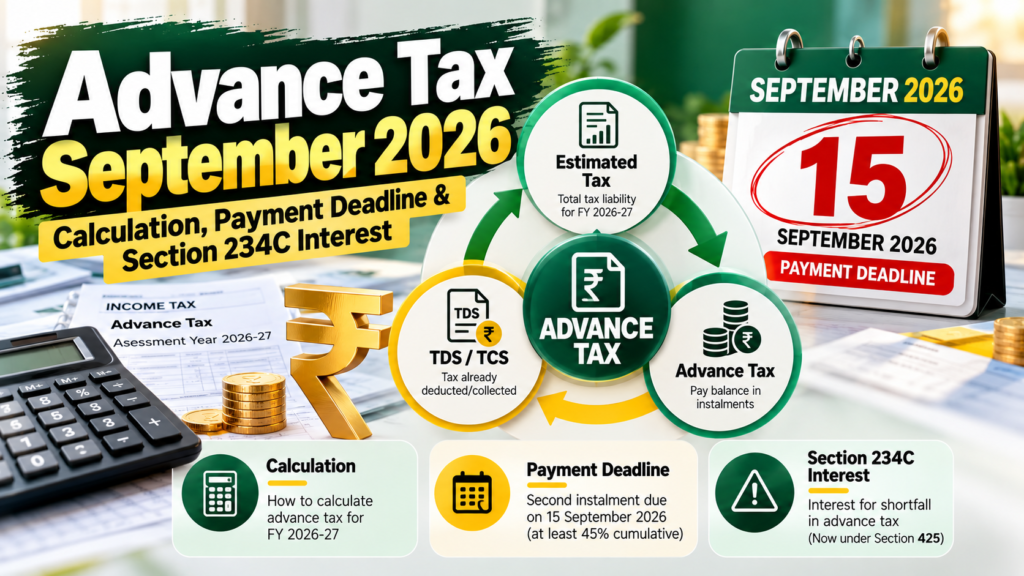
TL;DR The second advance-tax instalment for September 2026 is due on 15 September 2026. By this date, eligible taxpayers generally need to have paid 45% of their estimated annual advance-tax liability cumulatively, after considering the first instalment. Advance tax is calculated after estimating total taxable income and reducing eligible TDS/TCS and taxes already paid. Under the Income Tax Act, 1961, deferment of advance-tax instalments can attract interest under Section 234C. For Tax Year 2026–27 under the Income Tax Act, 2025, the corresponding provision is Section 425. Introduction September is an important month for taxpayers who are required to pay advance tax. The second instalment of advance tax is due on 15 September 2026, making it essential for individuals, businesses and professionals to reassess their expected income and tax liability before the deadline. Advance tax is essentially a system of paying income tax during the year instead of waiting until the end of the financial year. It can apply when the taxpayer’s estimated tax liability, after reducing eligible TDS/TCS, reaches the prescribed threshold. For taxpayers following the FY 2025–26 / AY 2026–27 framework, the relevant provisions continue under the Income-tax Act, 1961. For income falling under Tax Year 2026–27, the Income Tax Act, 2025 introduces new section numbers, with the advance-tax provisions corresponding to the earlier framework. Understanding the September instalment, calculation method and Section 234C interest can help taxpayers avoid unnecessary interest and cash-flow surprises. What Is Advance Tax? Advance tax is income tax paid during the financial year based on estimated taxable income. Instead of paying the entire tax liability after the year ends, eligible taxpayers make payments in instalments. Advance tax can become relevant for income such as: Business income Professional income Capital gains Interest income Rental income Dividend income Other taxable income TDS and TCS already deducted or collected are generally considered while determining the remaining advance-tax liability. Who Has to Pay Advance Tax? Under the existing framework, advance tax generally applies when the estimated tax payable for the year is ₹10,000 or more, after considering the applicable tax credits and subject to prescribed exceptions. For example, senior citizens who do not have income from business or profession may be eligible for an exemption from advance-tax payment under the applicable provisions. Businesses, professionals and individuals with significant non-salary income should therefore evaluate their estimated tax liability rather than assuming that TDS alone will cover their tax. Why Is 15 September 2026 Important? For taxpayers paying advance tax under the regular instalment system, the second instalment is due on 15 September 2026. The cumulative target by this date is generally: 45% of estimated annual advance-tax liability This is not an additional 45% payment on top of the June instalment. Instead, the taxpayer should calculate the total amount that should have been paid cumulatively by September and reduce the amount already paid. Example Suppose your estimated annual advance-tax liability is: ₹2,00,000 By 15 September, the cumulative amount should generally be: 45% × ₹2,00,000 = ₹90,000 If you already paid ₹30,000 in June, the September instalment would generally be: ₹90,000 − ₹30,000 = ₹60,000 The actual calculation should also account for changes in estimated income and applicable TDS/TCS credits. Advance Tax Instalment Schedule For taxpayers following the regular advance-tax payment schedule, the cumulative targets are generally: Due Date Cumulative Advance Tax 15 June 15% 15 September 45% 15 December 75% 15 March 100% For taxpayers covered by certain presumptive taxation provisions, different payment rules can apply. The important September target is therefore 45% cumulatively by 15 September. How to Calculate Advance Tax for September 2026 Calculating advance tax should start with an updated estimate of your full-year taxable income. Step 1: Estimate Your Total Income Calculate your expected income for the relevant tax year. Include: Business profits Professional receipts Salary income Rental income Interest income Capital gains Dividend income Other taxable receipts Do not calculate advance tax only from your business turnover. The calculation should be based on the applicable taxable income after considering relevant deductions and provisions. Step 2: Calculate Estimated Tax Liability Apply the relevant tax rates and provisions to your estimated taxable income. Your tax calculation may depend on: Applicable tax regime Type of income Applicable deductions Rebates Surcharge Health and education cess Other applicable provisions Step 3: Reduce TDS and TCS If tax has already been deducted or collected during the year, consider the available TDS/TCS credit while calculating the remaining advance-tax liability. For example: Estimated tax liability: ₹3,00,000 Expected TDS/TCS: ₹1,00,000 Estimated balance: ₹3,00,000 − ₹1,00,000 = ₹2,00,000 The advance-tax instalments are then calculated with reference to the remaining liability, subject to the applicable rules. Step 4: Reduce Advance Tax Already Paid If you have already paid an advance-tax instalment, subtract it from the cumulative amount due. Step 5: Calculate the September Instalment The September payment should bring cumulative advance tax to the applicable 45% level. September Advance Tax Calculation Example Consider a business owner who estimates: Annual taxable income: ₹12,00,000 Suppose the estimated final tax liability after applicable calculations is: ₹2,00,000 Assume expected TDS/TCS credit is: ₹20,000 Remaining advance-tax liability: ₹2,00,000 − ₹20,000 = ₹1,80,000 The cumulative amount required by 15 September would generally be: 45% × ₹1,80,000 = ₹81,000 If ₹27,000 was already paid in June: ₹81,000 − ₹27,000 = ₹54,000 So, approximately ₹54,000 would need to be paid in September to reach the 45% cumulative target, assuming the estimates and credits remain unchanged. What If Your Income Changes After June? This is extremely important for businesses and professionals. Advance tax is based on estimated income, so the calculation should be updated when your financial position changes significantly. For example, suppose a business initially estimated annual taxable income of ₹8 lakh but later expects ₹15 lakh because of: Higher sales New contracts Capital gains Increased professional receipts Higher interest income The taxpayer should revise the estimated tax liability rather than continuing to make instalments based on the old estimate. What Is Section 234C? For FY 2025–26 / AY 2026–27, Section 234C of
Advance Tax September 2026: 45% Payment Rule, Calculation & Section-Wise Interest
TL;DR The second instalment of Advance Tax for Tax Year 2026–27 is due on 15 September 2026. By this date, taxpayers liable to pay advance tax generally need to have paid at least 45% of their estimated annual advance-tax liability, after considering amounts already paid in earlier instalments. The Income Tax Department confirms the 15 June, 15 September, 15 December and 15 March instalment framework. The Income Tax Act, 2025 applies to advance tax for Tax Year 2026–27. The threshold remains ₹10,000 or more of tax payable during the year, after considering the applicable provisions. The new Act has reorganised the advance-tax provisions without changing the underlying policy. Section 405 provides the advance-tax computation formula, while Section 424 corresponds to old Section 234B for default in payment of advance tax and Section 425 corresponds to old Section 234C for deferment of instalments. The interest rates remain unchanged. Introduction September is an important month for taxpayers with income that is not completely covered by TDS. Business owners, professionals, freelancers, consultants, investors, landlords and other taxpayers may have additional tax liability during the year. Instead of paying the entire tax at the end of the financial year, the advance-tax system requires eligible taxpayers to pay tax progressively during the year. For Tax Year 2026–27, the second advance-tax instalment becomes due on 15 September 2026. The key requirement is the 45% cumulative payment rule. This means that by 15 September, the taxpayer should generally have paid at least 45% of the estimated annual advance-tax liability, after reducing the amount already paid in the first instalment. Understanding this calculation is important because an insufficient instalment can result in interest for deferment of advance tax. What Is Advance Tax? Advance tax is income tax paid during the financial year instead of waiting until the end of the year to pay the entire liability. It is particularly relevant when tax is payable on income where TDS or TCS does not fully cover the final tax liability. Examples include: Business income Professional income Freelance income Rental income Interest income Capital gains Dividend income Other taxable income not adequately covered by TDS Under the new Income Tax Act, 2025, the advance-tax threshold remains ₹10,000 or more of tax payable during the year under the applicable advance-tax provisions. Why Is 15 September 2026 Important? The 15 September 2026 deadline represents the second advance-tax instalment for Tax Year 2026–27. The cumulative payment target by this date is 45% of the estimated annual advance tax. The important word is cumulative. You do not necessarily have to pay 45% again in September. Instead, you calculate the total advance tax required up to September and subtract the amount already paid in June. Example Suppose your estimated annual advance-tax liability is ₹2,00,000. By September, 45% should have been paid: ₹2,00,000 × 45% = ₹90,000 If you already paid ₹30,000 in June, your September instalment would generally be: ₹90,000 − ₹30,000 = ₹60,000 Therefore, your cumulative advance tax after the September payment becomes ₹90,000. The official Income Tax Department guidance confirms the 45% cumulative requirement for the second instalment. Advance Tax Due Dates for Tax Year 2026–27 The regular advance-tax schedule is based on cumulative percentages. 15 June 2026 – First Instalment Taxpayers generally need to pay at least 15% of the estimated annual advance-tax liability by 15 June. 15 September 2026 – Second Instalment By 15 September, cumulative advance-tax payment should generally reach 45%. 15 December 2026 – Third Instalment By 15 December, cumulative payment should generally reach 75%. 15 March 2027 – Final Instalment By 15 March, the taxpayer should generally have paid 100% of the advance-tax liability. The notified 2026 tax rules retain this instalment structure. Advance Tax September 2026: How to Calculate the 45% Payment Calculating the September instalment requires estimating your total tax liability for Tax Year 2026–27. A simplified calculation can be approached as follows. Step 1: Estimate Your Total Annual Income Start by estimating all taxable income expected during the year. This may include: Salary Business income Professional receipts Interest Rental income Capital gains Dividend income Other taxable receipts Step 2: Calculate the Estimated Tax Apply the relevant tax rates and applicable provisions to your estimated taxable income. The calculation should also consider applicable deductions, exemptions, surcharge and cess where relevant. Step 3: Reduce TDS and TCS Estimate the TDS and TCS that will actually be available as credit. This is important because advance tax is not calculated simply on gross income. If sufficient TDS is already being deducted, the remaining advance-tax liability may be lower. Step 4: Determine Advance-Tax Liability After considering applicable tax credits, determine the estimated advance-tax amount payable for the year. Step 5: Calculate 45% Multiply the estimated annual advance-tax liability by 45%. Step 6: Subtract Advance Tax Already Paid Finally, subtract the amount already paid in the June instalment. The resulting amount is generally the amount required to bring cumulative advance-tax payment to the September target. Example of September Advance Tax Calculation Suppose a professional estimates the following for Tax Year 2026–27: Estimated total tax liability: ₹3,00,000 Estimated TDS/TCS credit: ₹50,000 Therefore: Estimated advance-tax liability = ₹3,00,000 − ₹50,000 = ₹2,50,000 The September cumulative requirement is: ₹2,50,000 × 45% = ₹1,12,500 If ₹37,500 was already paid in June: September payment = ₹1,12,500 − ₹37,500 = ₹75,000 After paying ₹75,000 in September, cumulative advance tax becomes ₹1,12,500. Who Needs to Pay Advance Tax? Advance tax generally applies when the taxpayer’s estimated tax payable for the year reaches the prescribed threshold after considering relevant tax credits. It can affect: Business Owners Business owners may have substantial tax liability that is not fully covered by TDS. Freelancers and Consultants Professionals receiving payments with limited or insufficient TDS may need to estimate their annual tax liability. Investors Large capital gains, dividend income or interest income can create additional tax liability. Landlords Rental income can create tax liability beyond the TDS deducted by other income sources. Salaried Individuals Salaried taxpayers are often covered substantially through employer TDS,
Revised ITR 2026: New Rules, Last Date & How to Correct Mistakes in Your Tax Return
TL;DR If you have already filed your Income Tax Return for AY 2026–27 and later discover a genuine mistake or missing information, you may be able to correct it by filing a Revised ITR within the prescribed time limit. Common reasons for revising an ITR include missing income, incorrect TDS details, wrong deductions, capital gains errors, incorrect bank details, or other inaccurate information reported in the original return. A revised return is not a completely new tax return. It is a corrected version of the original return and must be filed using the appropriate procedure. Before submitting it, taxpayers should reconcile their income and tax details with AIS, Form 26AS, bank statements, TDS certificates and other financial records. The important point is that taxpayers should not wait until the last date to correct an error. Identifying and correcting mistakes early can reduce the possibility of tax mismatches, incorrect refunds or unnecessary notices. Introduction Filing an Income Tax Return correctly is important because the information reported in your ITR is compared with several sources of financial and tax information available with the Income Tax Department. Sometimes, however, taxpayers discover an error only after submitting their return. You may realise that you forgot to report bank interest, entered an incorrect TDS amount, missed a capital-gains transaction, claimed the wrong deduction or accidentally provided incorrect information in your original ITR. This does not necessarily mean that you have to live with the mistake. The Income Tax framework provides the facility of filing a Revised Income Tax Return in eligible cases. A revised return allows taxpayers to correct an omission or incorrect statement made in their original return, subject to the applicable conditions and statutory deadline. For taxpayers filing returns for AY 2026–27, understanding how revised ITR filing works can help avoid unnecessary tax complications. What Is a Revised ITR? A Revised ITR is a corrected Income Tax Return filed after an original return has already been submitted. Suppose you filed your ITR in July 2026. A few weeks later, you discover that you forgot to include interest earned from a fixed deposit. Instead of leaving the original return unchanged, you can examine whether the error can be corrected through a revised return. The revised return should contain the complete and correct information, rather than only the newly added information. This means you should review the entire return before submitting the revised version. Why Do Taxpayers Need to Revise Their ITR? There can be several reasons why a taxpayer may need to revise an Income Tax Return. Missing Income One of the most common reasons is failure to report an income source. For example, a taxpayer may forget to include: Savings account interest Fixed deposit interest Dividend income Rental income Freelance income Professional receipts Capital gains Income from another source If such income appears in AIS or other information available with the department, the mismatch may require clarification. Incorrect TDS Details Another common mistake is entering incorrect TDS information. A taxpayer may have received TDS credit but entered the wrong amount while filing the original return. Before revising the ITR, taxpayers should compare the return with Form 26AS, AIS and TDS certificates. Incorrect Deduction Taxpayers sometimes enter a deduction incorrectly or claim an amount different from what their supporting documents show. For example, an eligible deduction may have been missed or an incorrect amount may have been entered. If the error is identified within the permitted revision period, the taxpayer can examine whether a revised return should be filed. Capital Gains Mistakes Capital gains reporting can become complicated, particularly for taxpayers who have transactions involving shares, mutual funds, property or other investments. Errors may occur in purchase price, sale consideration, dates, gain or loss calculations and other details. A revised ITR may be required if the original return contains an incorrect capital-gains calculation. What Is the Revised ITR Last Date for AY 2026–27? The revised return must be filed within the statutory time limit prescribed for the relevant assessment year. For AY 2026–27, taxpayers should verify the applicable deadline under the current Income Tax provisions before filing. The important practical rule is simple: If you have discovered a genuine mistake, do not wait until the final revision date. Waiting can create unnecessary pressure, particularly when you need to obtain documents, reconcile AIS information or recalculate capital gains and tax liability. Can a Belated ITR Be Revised? A belated return and a revised return are two different concepts. A taxpayer who files an eligible return after the original due date may still be able to revise that return within the applicable statutory period. However, the taxpayer should carefully check whether the original return was filed within the legally permitted period and whether the revision facility is available for that particular return. Therefore, taxpayers should not assume that filing late automatically prevents revision or that every type of return can be revised indefinitely. What Mistakes Can Be Corrected Through Revised ITR? A revised return can be used to correct many genuine reporting errors. Personal Information Errors Depending on the nature of the information and the correction mechanism available, taxpayers may need to correct details such as: Bank account information Contact information Address-related information Other return particulars Income Reporting Errors You may revise the return if you discover that you incorrectly reported or omitted: Salary Business income Professional income Interest Rent Dividend Capital gains Other taxable income Tax Credit Errors TDS and TCS details should be checked carefully. If eligible tax credit was missed or incorrectly reported, the return may need to be corrected. Deduction Errors If an eligible deduction was omitted or an incorrect deduction amount was reported, taxpayers should review whether the return should be revised. However, taxpayers should never claim a deduction merely because it increases the refund. The deduction must satisfy all applicable legal conditions. How to File a Revised ITR in 2026 The revised return can generally be filed electronically through the Income Tax e-filing portal. Step 1: Log in to
Income Tax Act 2025 vs Income Tax Act 1961: What Changes for Taxpayers in Tax Year 2026–27?
TL;DR Income Tax Act 2025 vs Income Tax Act 1961: What Changes for Taxpayers in Tax Year 2026–27? Introduction India’s income-tax framework is undergoing one of its biggest structural changes in decades. The Income Tax Act, 2025 replaces the Income-tax Act, 1961, with the objective of making tax law simpler, more organised and easier to interpret. For taxpayers, however, the change is not simply about replacing one law with another. The new Act introduces a reorganised legal framework, changes terminology and restructures several provisions while many familiar tax concepts continue. For Tax Year 2026–27, taxpayers need to understand how the new framework differs from the old Act and what these changes mean for income-tax return filing, deductions, assessments, notices, TDS, capital gains and tax compliance. This guide explains the Income Tax Act 2025 vs Income Tax Act 1961, the major structural changes and the practical points taxpayers should know while transitioning to the new regime. Why Was the Income Tax Act, 1961 Replaced? The Income-tax Act, 1961 has governed India’s direct-tax framework for decades. Over time, numerous amendments, Finance Acts, notifications, circulars, judicial decisions and additional provisions made the legislation increasingly complex. The new Income Tax Act was introduced with an emphasis on: Simplifying the language of tax law Reducing unnecessary complexity Removing obsolete provisions Reorganising provisions Improving clarity Making interpretation easier Creating a more streamlined tax framework The objective is to make the legislation easier for taxpayers, tax professionals and authorities to navigate. Income Tax Act 2025 vs Income Tax Act 1961: At a Glance Particular Income-tax Act, 1961 Income Tax Act, 2025 Existing framework Legacy direct-tax law New direct-tax framework Structure Developed through decades of amendments Reorganised and simplified Terminology Previous terminology Updated terminology in several areas Tax year concept Previous assessment-year framework Tax Year framework Provisions Spread across numerous sections and amendments Reorganised provisions Language More complex and heavily amended Intended to be simpler Applicability Existing framework before transition Applies from the notified commencement framework Main objective Comprehensive income-tax legislation Simplification and rationalisation What Is a “Tax Year”? One of the most noticeable changes for taxpayers is the terminology surrounding the tax year. Under the earlier framework, taxpayers were familiar with terms such as: Previous Year (PY) and Assessment Year (AY). The new framework moves toward the concept of a Tax Year. This is intended to make the period for which income is earned and taxed easier to understand. Example Suppose income is earned during the financial period beginning 1 April 2026 and ending 31 March 2027. Under the new terminology, this period is referred to as the relevant Tax Year 2026–27. This is a significant terminology change because taxpayers will encounter the new expression in tax-related documentation and compliance processes. Assessment Year vs Tax Year Under the older system, taxpayers commonly had to understand two different concepts: Previous Year: The year in which income was earned. Assessment Year: The following year in which that income was assessed and the return was generally filed. This distinction often confused individual taxpayers. The new framework aims to simplify this by using the term Tax Year for the relevant period. However, taxpayers should not assume that every historical reference to an assessment year disappears immediately from all tax records. Previous years, assessments and proceedings under the old law can continue to be relevant. Major Structural Change in the New Income Tax Act One of the key objectives of the Income Tax Act, 2025 is restructuring. Instead of taxpayers having to navigate a law that has accumulated provisions over many decades, the new legislation reorganises the framework. The restructuring is intended to: Reduce repetition Improve readability Group related provisions Remove obsolete provisions Make compliance provisions easier to locate Improve clarity for taxpayers This is particularly relevant for tax professionals who regularly work with multiple sections and cross-references. Has the Income Tax Rate Structure Completely Changed? The replacement of the Income-tax Act, 1961 does not automatically mean that every tax rate has changed. Tax rates, slabs, deductions, exemptions and other financial provisions must be considered based on the relevant provisions and Finance Act applicable to the particular Tax Year. Therefore, taxpayers should not assume: New Act = completely new tax rates. The legislation and the applicable Finance Act need to be read together. For Tax Year 2026–27, taxpayers should use the tax rates, regimes, exemptions and deductions applicable to that specific period. What Happens to Existing Deductions? A common concern among taxpayers is whether familiar deductions automatically disappear because the new Act replaces the 1961 Act. The answer is more nuanced. The new law reorganises and restates tax provisions, but taxpayers need to examine the specific provision applicable to each deduction rather than assuming that every old deduction has been removed or retained unchanged. Common areas taxpayers may need to examine include: Housing-loan related deductions Certain investments Health insurance Education-related provisions Donations Business expenditure Depreciation Retirement-related deductions The availability of a deduction ultimately depends on the applicable provision, taxpayer category, tax regime and conditions. New Income Tax Act and Tax Regimes The distinction between the old tax regime and new tax regime continues to be important for taxpayers. Taxpayers should not confuse the replacement of the Income-tax Act with the introduction of the new tax regime. These are two separate developments. The new Act changes the legal framework. The tax regime determines the applicable taxation structure and the availability of deductions and exemptions, subject to the rules applicable for the relevant Tax Year. What Changes for Salaried Employees? Salaried taxpayers should pay particular attention to: Salary income reporting TDS Form 16 Tax regime selection Eligible deductions Exemptions Interest income Capital gains AIS and tax information ITR filing requirements The transition to the new Act may change the way provisions are referenced, but taxpayers should continue maintaining accurate income and deduction records. Practical Tip Do not rely solely on the section number mentioned in an old article or previous year’s tax document. Always verify the corresponding provision under the applicable law for
ITR Filing for Freelancers and Consultants: Tax, Expenses & Deductions Explained
TL;DR ITR filing for freelancers and independent consultants are generally taxed on income from business or profession, rather than treating their freelance receipts like ordinary salary income. For FY 2025-26 / AY 2026-27, the major decision is whether you qualify for and want to use presumptive taxation under Section 44ADA, or whether you should report your professional income using regular books and actual expenses. Under Section 44ADA, eligible resident individuals and partnership firms carrying on specified professions can generally declare 50% of eligible gross receipts as presumptive income. The receipt threshold is ₹50 lakh, extended to ₹75 lakh where cash receipts do not exceed 5% of total gross receipts. That creates an important trade-off: 44ADA = simpler compliance and presumptive income Regular books = actual expenses, depreciation and more detailed reporting The right option depends on your profession, receipts, expenses, other income, investments and overall tax position. How Is Freelance Income Taxed in India? A freelancer does not become a salaried employee simply because a client pays them every month. If you independently provide services such as: Software development Graphic design Content writing Digital marketing Technical consulting Architecture Legal services Accountancy Engineering Professional consultancy Interior design your receipts may fall under profits and gains from business or profession, depending on the nature of your activity. The Income Tax Department specifically recognises specified professions for Section 44ADA, including legal, medical, engineering or architectural, accountancy, technical consultancy and interior decoration. The first question, therefore, is not: “How much tax will I pay?” It is: “How should my professional income be computed?” That decision affects your ITR form, expense treatment, documentation and tax calculation. Which ITR Form Should Freelancers File? For AY 2026-27, freelancers with business or professional income generally need to examine ITR-3 or ITR-4, depending on their circumstances. The Income Tax Department states that ITR-3 applies to individuals and HUFs having income from business or profession where ITR-1, ITR-2 or ITR-4 does not apply. ITR-4 is available to eligible resident individuals, HUFs and firms other than LLPs using presumptive taxation under Sections 44AD, 44ADA or 44AE, subject to the applicable conditions. ITR-4 May Be Relevant If: You are an eligible taxpayer and: Use presumptive taxation under Section 44ADA Meet the applicable receipt limit Meet the residency requirements Have total income within the applicable ₹50 lakh limit for ITR-4 Do not fall under one of the exclusions for ITR-4 ITR-3 May Be Required If: You have business/professional income but cannot use ITR-4 because of circumstances such as: Ineligible income or activities Certain capital gains Foreign assets or foreign income Income above the ITR-4 limit Losses requiring carry-forward Other conditions that make ITR-4 unavailable The Income Tax Department’s AY 2026-27 guidance specifically lists several exclusions from ITR-4, including being a company director, having short-term capital gains, certain capital gains above the specified limit, foreign assets/income and total income above ₹50 lakh. Do not choose ITR-4 simply because your freelance receipts are below ₹75 lakh. Eligibility depends on the complete tax profile. ITR-3 vs ITR-4 for Freelancers Factor ITR-4 ITR-3 Presumptive taxation Yes Can report business/professional income Section 44ADA Yes Can be relevant depending on circumstances Actual expenses Generally not separately claimed under 44ADA Yes, under regular computation Detailed books Simplified reporting More detailed Total income limit ₹50 lakh for ITR-4 eligibility No equivalent ₹50 lakh ceiling Foreign assets/income Generally exclusion May be applicable Complex capital gains Can make ITR-4 unavailable May be required Loss carry-forward Certain cases make ITR-4 unavailable More suitable Best suited for Eligible presumptive taxpayers More complex professional/business profiles The Income Tax Department confirms that ITR-4 is a simplified, optional return for eligible taxpayers using presumptive taxation; it is not automatically mandatory simply because a taxpayer qualifies. What Is Section 44ADA? Section 44ADA is a presumptive taxation scheme for eligible specified professionals. Instead of calculating taxable professional profit by maintaining a detailed expense-by-expense computation, the law permits eligible taxpayers to declare a prescribed percentage of gross receipts as professional income. For FY 2025-26, the standard presumptive income under 44ADA is 50% of eligible gross receipts. Example Suppose a consultant has eligible professional receipts of: ₹20,00,000 Under 44ADA: Presumptive income = ₹20,00,000 × 50% = ₹10,00,000 The remaining 50% is effectively treated as the professional expenditure component for the presumptive computation. This does not mean the freelancer must actually spend ₹10 lakh. That is precisely the benefit of presumptive taxation: the taxable professional profit is determined using the statutory presumptive mechanism rather than requiring the taxpayer to establish each individual business expense. What Is the 44ADA Limit for FY 2025-26? For AY 2026-27, the normal gross-receipts threshold under Section 44ADA is ₹50 lakh. However, the limit can extend to ₹75 lakh where cash receipts during the year do not exceed 5% of total gross receipts. Example A consultant earns: Gross professional receipts: ₹70 lakh If the cash-receipt condition is satisfied, the extended threshold may permit use of Section 44ADA. However, if the conditions are not satisfied, the ₹50 lakh threshold becomes relevant. Therefore, do not look only at total annual turnover. How you receive your professional fees can also matter. Can Freelancers Claim Expenses Under 44ADA? This is one of the biggest misconceptions. If you declare professional income under Section 44ADA at the prescribed presumptive percentage, you generally cannot separately deduct the same business expenses again from that presumptive professional income. For example, suppose your receipts are: ₹30 lakh You declare: ₹15 lakh as presumptive professional income You generally cannot then reduce that ₹15 lakh by separately claiming: Laptop expenses Internet bills Office rent Software subscriptions Telephone bills Travel expenses as additional professional deductions under the same presumptive computation. Why? Because the presumptive mechanism already treats the prescribed percentage as professional income after considering the expenditure component. This is why freelancers should compare 44ADA versus regular books before choosing their approach. Actual Expenses Under Regular Taxation If you are not using presumptive taxation and are reporting professional income based on actual books, genuine business or professional expenses can generally be
Form 16 vs Form 26AS vs AIS: What to Check Before Filing Your Income Tax Return
TL;DR If you are filing your Income Tax Return for FY 2025-26 / AY 2026-27, do not rely only on Form 16. You should review Form 16, Form 26AS and AIS together, along with your salary slips, bank statements, investment records and other relevant documents. Here is the simplest way to remember them: Form 16: What your employer reports about your salary and salary TDS. Form 26AS: Your tax-credit statement, primarily useful for checking TDS/TCS and other tax-related credits. AIS: A broader information statement containing TDS/TCS and other financial information reported to the Income Tax Department. Bank/broker statements: Supporting records that help establish the actual income or transaction. ITR: Your final declaration of taxable income, deductions and taxes. The Income Tax Department specifically advises taxpayers to download AIS and Form 26AS and reconcile actual TDS/TCS/tax-paid information before filing. The key principle is simple: Reconcile first. File second. Form 16 vs Form 26AS vs AIS: Quick Comparison Particular Form 16 Form 26AS AIS Provided by Employer Income Tax Department Income Tax Department Main purpose Salary and salary TDS certificate Tax-credit statement Comprehensive information statement Salary details Yes Primarily tax-credit information Can contain reported salary information Salary TDS Yes Yes Yes Non-salary TDS No Yes Yes TCS No Yes Yes Bank interest Not generally Limited tax-credit relevance Yes, where reported Dividend information No Limited Can be reported Securities information No No Can be reported SFT information No Limited Yes Tax payments No Yes Yes Demand/refund information No Relevant tax information Yes Feedback facility No No Yes The Income Tax Department describes Form 26AS as primarily displaying TDS/TCS-related information, while AIS provides a more comprehensive view including TDS/TCS, SFT information, tax payments, demand/refund and other reported information. What Is Form 16? Form 16 is the TDS certificate issued by an employer for salary income. It gives an employee a structured summary of salary-related information and tax deducted by the employer. For a salaried taxpayer, Form 16 is one of the most important documents used while preparing the ITR. The Income Tax Department identifies Form 16 as the certificate of tax deducted at source on salary and states that it contains information relating to employee income, deductions/exemptions and TDS for computing tax payable or refundable. What Should You Check in Form 16? When you receive Form 16, do not simply upload it to your tax preparer and forget about it. Check: PAN details Employer name TAN Assessment/financial-year details Gross salary Salary components Exemptions considered by the employer Standard deduction, where applicable Chapter VI-A deductions considered Taxable salary TDS deducted TDS deposited Tax-regime-related calculations What If You Changed Jobs During the Year? This is an important point for salaried taxpayers. If you worked for two employers during FY 2025-26, your income and TDS may be reflected through two separate Form 16 certificates. Do not file your return using only the Form 16 from your current employer. Combine the information from both employers and reconcile it with AIS, Form 26AS, salary slips and your own records. What Is Form 26AS? Form 26AS is primarily a tax-credit statement available through the Income Tax e-Filing ecosystem. It is particularly useful for verifying whether tax deducted or collected against your PAN is reflected correctly. For example, suppose: Employer TDS: ₹85,000 Bank TDS: ₹5,000 You should verify that the relevant tax credits have been properly reported. The Income Tax Department’s current guidance states that Form 26AS contains TDS/TCS-related information, while several other categories of information that taxpayers may need for return preparation are available through AIS. Why Form 26AS Matters Imagine your Form 16 says that your employer deducted: ₹72,000 TDS But your tax-credit records do not reflect the expected amount. Do not automatically claim the full ₹72,000 without investigating. The deductor may need to correct its TDS statement, or the information may not yet have been reflected. The Income Tax Department specifically recommends reconciling discrepancies with the employer, tax deductor or bank. What Is AIS? AIS stands for Annual Information Statement. It is broader than Form 26AS and is designed to give taxpayers a comprehensive view of information available with the Income Tax Department before filing their return. The department says AIS is intended to display complete information to taxpayers, support voluntary compliance and enable smoother pre-filling of returns. What Can AIS Show? Depending on the information reported to the department, AIS can contain: Salary-related information TDS TCS Interest income Dividend information Securities-related information Specified financial transactions Tax payments Refund-related information Demand information Other reported financial information The precise entries will depend on the taxpayer and reporting entities. AIS Also Has a Feedback Facility One important feature of AIS is that taxpayers can provide feedback on reported information. The Income Tax Department explains that AIS contains information reported by sources and provides a facility through which taxpayers can submit feedback. This is useful when an entry appears incorrect, duplicated or otherwise inconsistent with your actual records. Form 16 vs Form 26AS vs AIS: Key Differences 1. Source Form 16 comes from your employer. Form 26AS and AIS are available through the Income Tax Department’s e-filing ecosystem. 2. Coverage Form 16 is focused on salary income and salary TDS. Form 26AS is primarily focused on tax credits such as TDS/TCS. AIS provides a much broader view of financial and tax-related information reported against your PAN. 3. Main Use During ITR Filing Use Form 16 to understand your salary computation. Use Form 26AS to verify tax credits. Use AIS to identify additional income and transactions that may need to be considered while preparing the return. 4. Should They Match Exactly? No. This is one of the most important points. These documents have different purposes and different data sources. For example, your Form 16 may show salary income while AIS may also contain interest income from your bank. That does not mean the documents are inconsistent. The objective is to make sure that all relevant information is correctly reflected in your ITR. Which Document Should You Trust While Filing ITR? Do