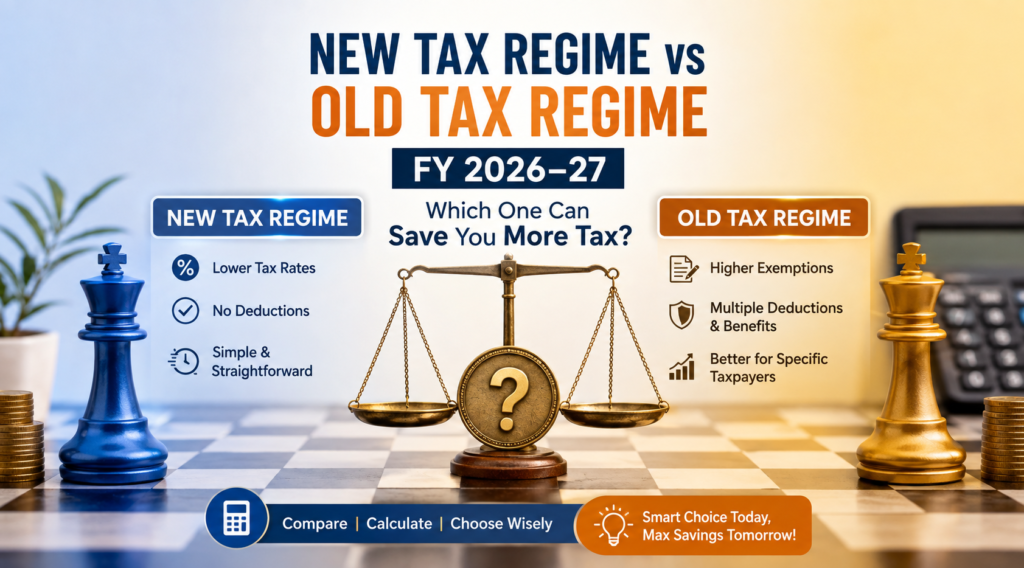
New Tax Regime vs Old Tax Regime FY 2026–27: Which One Can Save You More Tax?
TL;DR The new tax regime is the default tax regime for eligible individual taxpayers, but the old regime continues to be available to eligible taxpayers who choose to opt out. The Income Tax Department specifically advises taxpayers to compare their tax liability under both regimes before making a choice. For FY 2026–27 (AY 2027–28), the new regime generally offers lower rates across more income slabs and permits fewer deductions and exemptions. The old regime has higher slab rates but allows a wider range of deductions and exemptions. The important question is therefore not simply “Which regime has lower tax rates?” It is: Which regime produces the lower final tax liability after considering your income, deductions, exemptions, investments and other eligible tax benefits? Introduction Choosing between the new tax regime and old tax regime can have a significant impact on your annual tax liability. Two taxpayers earning the same salary may end up paying different amounts of tax because their deductions, exemptions, investments, home-loan interest and other eligible benefits may be completely different. For FY 2026–27, the new regime continues to be the default regime for eligible taxpayers. However, taxpayers can opt for the old regime if it is more beneficial for their circumstances. This makes tax planning more important than simply following whichever regime appears popular. What Changed for FY 2026–27? The new regime continues to have a wider range of income slabs and comparatively lower rates. For individuals below 60 years of age, the official Income Tax Department’s AY 2026–27 guidance lists the following new-regime structure: Taxable Income New Regime Rate Up to ₹4 lakh Nil ₹4 lakh–₹8 lakh 5% ₹8 lakh–₹12 lakh 10% ₹12 lakh–₹16 lakh 15% ₹16 lakh–₹20 lakh 20% ₹20 lakh–₹24 lakh 25% Above ₹24 lakh 30% The Department also states that the Section 87A rebate under the new regime was increased to ₹60,000 for total income up to ₹12 lakh, applicable from AY 2026–27. Important: FY 2026–27 corresponds to AY 2027–28. Taxpayers should always verify the provisions applicable to the relevant assessment year before filing. New Tax Regime Slabs for FY 2026–27 For an individual below 60 years of age, the new regime provides: Income Slab Tax Rate Up to ₹4,00,000 0% ₹4,00,001–₹8,00,000 5% ₹8,00,001–₹12,00,000 10% ₹12,00,001–₹16,00,000 15% ₹16,00,001–₹20,00,000 20% ₹20,00,001–₹24,00,000 25% Above ₹24,00,000 30% These are the official slabs published by the Income Tax Department for AY 2026–27. Taxpayers should also consider applicable rebate, surcharge, marginal relief and 4% Health and Education Cess while calculating the final liability. Old Tax Regime Slabs for FY 2026–27 For individuals below 60 years, the traditional regime continues to use the following basic slabs: Income Slab Tax Rate Up to ₹2,50,000 0% ₹2,50,001–₹5,00,000 5% ₹5,00,001–₹10,00,000 20% Above ₹10,00,000 30% The old regime may nevertheless become attractive for taxpayers who have substantial eligible deductions and exemptions. New Tax Regime vs Old Tax Regime: Key Differences Feature New Tax Regime Old Tax Regime Default regime Yes No Tax rates Generally lower Generally higher Number of slabs More Fewer 80C deduction Generally not available Available, subject to conditions 80D deduction Generally restricted/not available Available, subject to conditions HRA exemption Generally not available Available, subject to conditions Standard deduction for salaried taxpayers Available Available Tax planning complexity Lower Higher Suitable for Taxpayers with fewer deductions Taxpayers with substantial eligible deductions The Income Tax Department describes the core distinction clearly: the new regime offers lower rates with fewer deductions and exemptions, while the old regime permits various deductions and exemptions. What Deductions Are Available Under Each Regime? This is where many taxpayers make the wrong decision. The old regime can be beneficial when a taxpayer has significant eligible deductions and exemptions. Common Old-Regime Tax Benefits Depending on eligibility and applicable conditions, these can include: Section 80C investments Section 80D medical insurance Section 80CCD(1B) additional NPS contribution HRA exemption Home-loan interest under applicable provisions Certain education-loan interest deductions Certain disability-related deductions Other deductions permitted under the Income Tax Act The exact availability depends on the taxpayer’s circumstances and the relevant provision. Is Section 80C Available Under the New Tax Regime? Generally, the popular Section 80C deduction is not available under the new regime, except for specific deductions that remain permitted under the applicable provisions. This is an important distinction for taxpayers who regularly claim deductions for: PPF ELSS Life insurance premiums Eligible tuition fees Certain principal repayments Other qualifying Section 80C investments/payments A taxpayer who has historically relied heavily on 80C should therefore calculate the tax under both regimes before deciding. Standard Deduction Under the Two Regimes For salaried taxpayers, standard deduction remains an important component of the comparison. The new regime provides a higher standard deduction for eligible salaried/pension income compared with the old regime under the current rules. This means taxpayers should compare taxable income after the applicable standard deduction, rather than comparing gross salary directly with the tax slabs. For example: Gross Salary → Applicable Standard Deduction → Taxable Salary → Other eligible adjustments → Tax Calculation This distinction becomes particularly important when comparing salaries around ₹10 lakh, ₹12 lakh, ₹15 lakh and ₹20 lakh. Section 87A Rebate Under the New Regime The Section 87A rebate is one of the most important features of the current new regime. For AY 2026–27, the Income Tax Department states that the rebate was increased from ₹25,000 to ₹60,000 for eligible resident individuals with total income up to ₹12 lakh. This significantly changes the tax calculation for taxpayers around the ₹12 lakh income level. However, taxpayers should not interpret this as meaning that every person earning exactly ₹12 lakh or less automatically has zero tax in every situation. Eligibility conditions and the nature of income must be considered. Which Tax Regime Is Better? There is no single answer that works for every taxpayer. The Income Tax Department itself states that the better option varies from person to person and recommends comparing the tax liability under both regimes before selecting one. The New Regime May Be More Attractive If: You have relatively few deductions. You