

How Small Businesses in Bhopal Can Avoid GST Notices & Compliance Penalties

TL;DR GST notices are becoming increasingly common for small businesses due to: Return mismatches Incorrect invoicing ITC claim errors Vendor non-compliance Late filing Incomplete documentation Many businesses in Bhopal unknowingly trigger compliance risks because they lack: Proper GST monitoring Monthly reconciliation systems Structured accounting practices This guide explains how small businesses can reduce GST risks, maintain compliance, and avoid penalties through practical and proactive GST management strategies in 2026. Why GST Notices Are Increasing for Small Businesses The GST ecosystem has become significantly more data-driven. Authorities now use: Automated return matching AI-based risk analysis E-invoice validations ITC reconciliation systems Vendor compliance tracking As a result, even small inconsistencies can trigger: Notices Scrutiny Penalty proceedings ITC reversals Many small businesses in Bhopal still rely on manual bookkeeping or irregular filing systems, increasing compliance exposure. Common Reasons Businesses Receive GST Notices Understanding the root causes is the first step toward prevention. 1. Late GST Return Filing Delayed filing remains one of the most common reasons businesses receive notices. Frequent delays create: Compliance flags Late fee accumulation Higher scrutiny probability 2. Incorrect GST Invoices Invoice errors often lead to: ITC rejection Mismatches Buyer complaints GST scrutiny Common invoice mistakes include: Wrong GSTIN Incorrect HSN/SAC codes Tax calculation errors Missing invoice details 3. Input Tax Credit (ITC) Mismatches ITC mismatch notices are increasing rapidly. This usually happens when: Vendors fail to upload invoices properly Incorrect GST returns are filed Purchase data does not match GST records 4. Mismatch Between GSTR-1 and GSTR-3B Sales reported in one return but missing in another often trigger automated scrutiny. Even minor inconsistencies can attract: Clarification notices Department inquiries Additional verification requests 5. Non-Compliance by Vendors Your GST compliance is also affected by your suppliers. If vendors: Fail to file returns Use incorrect GST details Become inactive taxpayers your business may face ITC complications. GST Compliance Mistakes That Trigger Penalties Many penalties are avoidable. The problem is not always tax liability. It is often poor compliance discipline. Common Mistakes Ignoring reconciliation Missing filing deadlines Poor documentation Claiming unsupported ITC Using outdated accounting systems Failing to monitor notices Not verifying vendors Importance of Proper GST Record Keeping Documentation is one of the strongest defenses against GST disputes. Businesses should maintain: Purchase invoices Sales invoices E-way bills Payment records Vendor communications GST return copies Reconciliation reports Proper records help businesses: Respond faster to notices Reduce audit risk Improve compliance accuracy How Invoice Errors Create GST Problems Incorrect invoicing is a major compliance risk. Businesses Should Verify: GSTIN accuracy Invoice numbering Tax breakup HSN/SAC codes Reverse charge applicability Place of supply details A small invoice mistake can create: ITC disputes Customer dissatisfaction Department notices Input Tax Credit Mismatch Issues ITC is one of the most sensitive GST areas. Authorities closely monitor: Fake ITC claims Duplicate claims Vendor mismatches Excessive credits Best Practices for ITC Compliance Conduct monthly reconciliation Match invoices with portal data Verify vendor filing status Avoid unsupported claims Maintain digital records GST Return Filing Best Practices Consistent filing discipline significantly reduces notice risks. Recommended Practices File returns before due dates Reconcile books monthly Cross-check sales and purchase data Review tax liability carefully Monitor GST portal communications Maintain filing acknowledgment records Vendor Compliance Monitoring One non-compliant vendor can create major issues. Businesses Should: Verify vendor GST registration Check filing consistency Avoid high-risk suppliers Conduct periodic vendor reviews Vendor due diligence is now an essential GST compliance activity. GST Audit & Scrutiny Preparedness Even compliant businesses may receive notices. The goal is not panic avoidance. It is preparedness. Audit Readiness Checklist Organized financial records Proper invoice management Monthly reconciliation reports GST payment proofs Vendor documentation Accurate books of accounts Businesses with proper systems typically respond faster and reduce escalation risk. Digital Accounting & Automation Benefits Manual accounting increases compliance risk. Modern accounting systems help: Reduce human error Automate reconciliations Generate accurate reports Improve filing accuracy Track GST liabilities Automation improves both: Compliance quality Operational efficiency ]GST Compliance Checklist for Bhopal Businesses Compliance Area Recommended Action GST Return Filing File before deadlines ITC Reconciliation Monthly review Vendor Verification Quarterly checks Invoice Accuracy Pre-submission validation Record Keeping Digital documentation GST Notices Immediate review Accounting System Automation preferred Audit Preparation Maintain organized records How Junaid Khan & Co Helps Businesses Stay Compliant Junaid Khan & Co assists businesses with: GST registration GST return filing GST reconciliation Notice response assistance GST compliance review Vendor compliance analysis Accounting advisory Tax planning support The firm supports startups, traders, retailers, service providers, and MSMEs across Bhopal and other regions. Conclusion GST compliance in 2026 requires more than basic return filing. Businesses in Bhopal must adopt: Accurate documentation Timely filings ITC reconciliation Vendor monitoring Strong accounting systems Most GST notices arise from preventable compliance gaps. Businesses that implement proactive compliance systems can significantly reduce: Penalty exposure Scrutiny risks Operational disruptions A structured GST strategy not only improves compliance but also strengthens long-term business credibility and financial discipline. 6. FAQ SECTION 1. Why do small businesses receive GST notices? Businesses usually receive GST notices due to filing mismatches, late returns, ITC errors, or incorrect invoices. 2. How can businesses avoid GST penalties? Timely filing, monthly reconciliation, proper documentation, and vendor verification help reduce penalty risks. 3. What is the biggest GST compliance mistake? Ignoring reconciliation between GST returns and accounting records is one of the most common mistakes. 4. Can vendor mistakes affect my GST compliance? Yes. Non-compliant vendors can create ITC mismatches and increase scrutiny risk. 5. How often should GST reconciliation be done? Monthly reconciliation is recommended for accurate compliance management. 6. What should businesses do after receiving a GST notice? Businesses should review the notice carefully, verify records, and respond within the prescribed timeline. 7. Is digital accounting necessary for GST compliance? Digital accounting significantly improves accuracy and reduces manual compliance errors. 8. Can incorrect invoices trigger GST notices? Yes. Errors in GSTIN, tax calculation, or HSN codes may trigger scrutiny. BLOG BY: Junaid Khan & Co.
Income Tax Return Filing 2026: Complete Checklist for Salaried Professionals, Freelancers & Business Owners

TL;DR Income Tax Return (ITR) filing is no longer just a legal formality. With increasing digital tracking, AIS reporting, PAN-based monitoring, and financial data integration, taxpayers must file accurate returns backed by proper documentation. This complete 2026 ITR filing guide explains: Documents required for tax filing ITR checklist for salaried employees Tax filing tips for freelancers Business owner compliance requirements Common filing mistakes Tax-saving preparation strategies Ways to avoid notices and penalties Why Income Tax Return Filing Matters Income tax filing plays a crucial role in: Legal tax compliance Loan and visa approvals Financial transparency Claiming refunds Carrying forward losses Maintaining clean financial records Today, the Income Tax Department uses advanced data analytics to match : Bank transactions TDS records Mutual fund investments Stock trading activity Credit card usage Property transactions Even small mismatches can trigger scrutiny or notices. For salaried individuals, freelancers, and businesses, timely and accurate filing has become essential. Who Should File an Income Tax Return? Many taxpayers incorrectly assume ITR filing is required only if taxes are payable. However, filing may be important for: Salaried employees Freelancers and consultants Proprietorship businesses Companies and LLPs Startup founders Ecommerce sellers Investors and traders Professionals earning foreign income Even individuals with lower taxable liability often file returns for: Loan eligibility Financial proof Refund claims Visa applications Compliance continuity Important Documents Required for ITR Filing Before starting your return filing, organize all financial documents properly. Document Purpose PAN Card Taxpayer identification Aadhaar Card Verification Form 16 Salary income details Form 26AS TDS verification AIS/TIS Financial transaction summary Bank Statements Income reconciliation Investment Proofs Deduction claims Home Loan Statement Interest deduction Rent Receipts HRA claims Capital Gain Statements Investment taxation Maintaining proper documentation reduces filing errors significantly. ITR Filing Checklist for Salaried Professionals Salaried employees often assume Form 16 alone is enough for filing. In reality, multiple financial disclosures must be verified. 1. Verify Form 16 Carefully Check: Salary breakup TDS deductions Employer PAN Exemptions and deductions Mismatch between Form 16 and Form 26AS can create issues. 2. Review AIS and Form 26AS AIS (Annual Information Statement) may contain: Interest income Dividend income Mutual fund transactions Securities transactions High-value banking activities Ignoring AIS discrepancies is a common reason for tax notices. 3. Declare Additional Income Many salaried individuals forget to disclose: Savings account interest FD interest Freelance side income Rental income Capital gains All taxable income must be reported. 4. Check Deduction Eligibility Review deductions under applicable provisions such as: Insurance premiums Investment-linked deductions Education loan interest Housing loan benefits Medical insurance 5. Choose Correct Tax Regime The old and new tax regimes have different deduction structures. A comparative analysis helps determine the better option. ITR Filing Checklist for Freelancers & Consultants Freelancers face unique compliance challenges because income may come from multiple clients and platforms. 1. Maintain Proper Income Records Track: Client payments Online receipts Foreign remittances Platform commissions Poor record keeping often leads to inaccurate reporting. 2. Separate Personal and Business Expenses Using separate bank accounts improves: Audit readiness Expense tracking Tax computation accuracy 3. Reconcile TDS Entries Clients may deduct TDS under different sections. Verify entries in Form 26AS. 4. Maintain Expense Documentation Freelancers should preserve: Software subscriptions Internet bills Laptop expenses Office rent Travel expenses Professional tools 5. Review Advance Tax Liability Freelancers with significant tax liability may need advance tax compliance. ITR Filing Checklist for Business Owners Business owners require deeper financial reconciliation before filing returns. 1. Finalize Bookkeeping Ensure: Sales records are accurate Expense entries are verified GST reconciliation is complete Debtors and creditors match 2. Verify GST and Income Tax Consistency Mismatch between GST turnover and income tax turnover may trigger scrutiny. 3. Review Cash Transactions Large unexplained cash transactions increase risk exposure. 4. Reconcile Bank Accounts All business bank accounts should align with accounting records. 5. Check Depreciation and Asset Records Incorrect depreciation claims are common filing errors among businesses. Choosing the Correct ITR Form Selecting the wrong ITR form can invalidate returns. Commonly Used ITR Forms ITR Form Suitable For ITR-1 Salaried individuals ITR-2 Capital gains and multiple income sources ITR-3 Business/professional income ITR-4 Presumptive taxation Form selection depends on: Income type Business structure Capital gains Foreign income Tax regime Old Tax Regime vs New Tax Regime Choosing the correct tax regime requires evaluating: Deductions available Investment structure Salary components Housing loan benefits Professional expenses Old Regime Suitable for taxpayers claiming substantial deductions. New Regime Suitable for taxpayers preferring simplified taxation with lower deductions. Tax planning should be personalized rather than generic. Common Income Tax Filing Mistakes 1. Filing Incorrect ITR Form Wrong form selection may invalidate returns. 2. Ignoring AIS Data AIS mismatches are now a major scrutiny trigger. 3. Missing Income Disclosure Undisclosed interest or side income often results in notices. 4. Incorrect Deduction Claims Unsupported deduction claims increase compliance risks. 5. Last-Minute Filing Rushed filings often lead to errors and omissions. 6. Ignoring Foreign Income Reporting Foreign assets and overseas income require proper disclosure. How to Avoid Tax Notices Maintain Accurate Documentation Organized records simplify compliance. Match All Tax Data Cross-check: Form 16 AIS 26AS Bank records Avoid Artificial Deductions Claim only genuine deductions supported by evidence. File Returns Before Deadline Timely filing improves compliance credibility. Seek Professional Review Expert review helps identify risks before submission. Why Professional Tax Assistance Matters Tax laws continue evolving every year. Professional tax assistance helps: Reduce filing errors Optimize deductions Improve compliance Handle notices Select appropriate tax regime Maintain audit-ready records This is especially important for: High-income professionals Freelancers Startups Business owners Investors How Junaid Khan & Co Supports Taxpayers Junaid Khan & Co assists individuals and businesses with: Income tax return filing Tax planning and advisory Business tax compliance Freelance taxation GST and accounting support Tax notice response assistance Financial documentation review The firm works with salaried professionals, startups, consultants, and businesses across multiple sectors. Conclusion Income Tax Return Filing in 2026 requires much more than basic data entry. Taxpayers must carefully reconcile income, deductions, financial disclosures, and compliance
LLP vs Private Limited Company in India: Which Structure Saves More Tax in 2026?
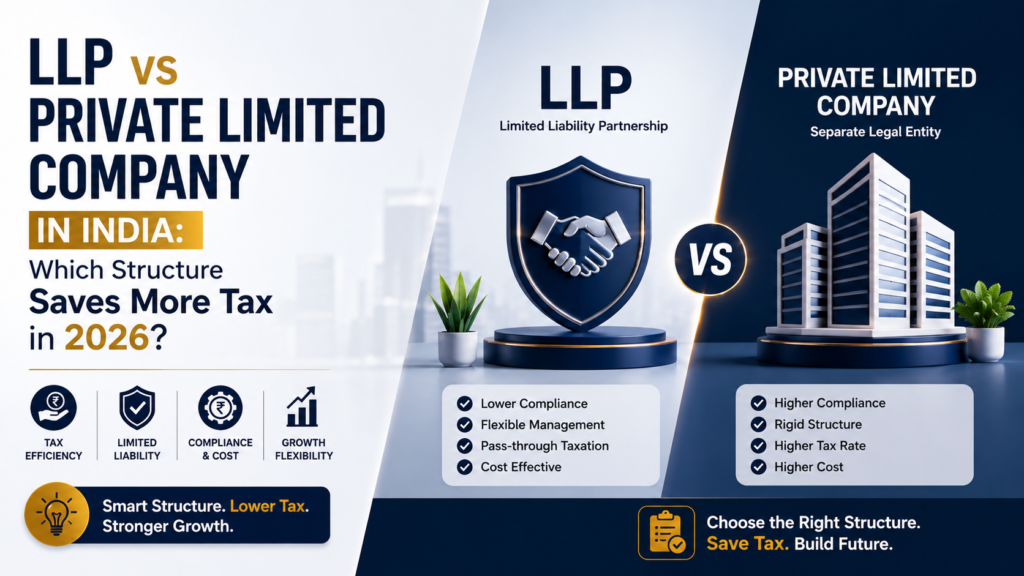
TL;DR Choosing between an LLP and a Private Limited Company is one of the most important decisions for startups, consultants, agencies, and growing businesses in India. The right structure impacts: Tax efficiency Compliance burden Investor readiness Business scalability Legal protection Long-term growth opportunities In 2026, the choice is no longer just about registration simplicity. Businesses must evaluate future expansion, taxation strategy, startup funding goals, and operational flexibility before selecting a structure. This guide explains the practical differences between LLP and Private Limited Company structures and helps businesses determine which option may be more tax-efficient and growth-friendly. Why Choosing the Right Business Structure Matters Many businesses select a structure based only on: Initial setup convenience Advice from friends Short-term tax assumptions This often creates long-term issues such as: High compliance costs Investor rejection Tax inefficiency Operational limitations Difficulty raising capital The correct structure should align with: Revenue model Growth plans Funding goals Compliance capability Ownership strategy Understanding LLP Structure A Limited Liability Partnership (LLP) combines elements of: Partnership flexibility Limited liability protection LLPs are commonly preferred by: Consultants Professional firms Agencies Small service businesses Family-run businesses Core Features of LLP Separate legal entity Limited liability protection Flexible internal management Lower regulatory complexity compared to companies Partner-based ownership structure Understanding Private Limited Company Structure A Private Limited Company is a separate legal entity governed under the Companies Act. It is commonly chosen by: Startups Fundraising-focused businesses Tech companies Scalable ventures Ecommerce brands Core Features of Private Limited Company Shareholder ownership structure Strong investor preference Better scalability Easier equity dilution Higher compliance requirements LLP vs Private Limited Company: Key Differences Feature LLP Private Limited Company Ownership Partners Shareholders Management Flexible Structured Compliance Level Moderate Higher Investor Preference Limited Strong Equity Funding Restricted Easier Governance Flexible Formal Transferability More restricted Easier Scalability Moderate High Taxation Comparison in 2026 Taxation is one of the biggest factors businesses evaluate while choosing a structure. However, businesses should avoid choosing purely based on short-term tax assumptions. LLP Taxation in India LLPs are generally taxed as partnership entities. Advantages Often Associated with LLPs Simpler profit withdrawal structure Flexible internal distribution Reduced procedural formalities Simplified operational management LLPs may work efficiently for: Professional firms Consulting businesses Small agencies Service-based operations Private Limited Company Taxation Private Limited Companies follow corporate taxation rules. Key Considerations Corporate compliance obligations Director remuneration structuring Dividend considerations Shareholding structures Investor-related compliance Despite higher compliance requirements, Private Limited Companies often provide stronger scalability advantages. Which Structure Saves More Tax? There is no universal answer. Tax efficiency depends on: Revenue level Profit margins Reinvestment plans Founder withdrawals Funding goals Compliance discipline LLP May Be More Suitable If: The business is service-oriented External funding is not a priority Partners want operational flexibility Compliance simplicity is preferred Private Limited Company May Be Better If: The startup plans to raise investment Equity allocation is important Long-term scaling is a priority The business wants stronger corporate positioning Compliance Comparison Compliance is another critical factor often ignored during business registration. LLP Compliance LLPs generally have: Fewer governance formalities Simplified operational procedures Reduced documentation complexity However, LLPs still require: Annual filings Tax compliance GST compliance where applicable Financial documentation Private Limited Company Compliance Private Limited Companies typically require: Board-related documentation Annual ROC filings Financial reporting Corporate governance compliance Structured statutory documentation This makes compliance comparatively more structured and rigorous. Funding & Investor Readiness This is where the biggest difference usually appears. Investor Preference Most angel investors, venture capital firms, and institutional investors prefer: Private Limited Companies because: Equity allocation is easier Shareholding structures are clearer Exit strategies are more practical Corporate governance standards are stronger Can LLPs Raise Funding? Yes, but large-scale equity investment becomes comparatively more complex. For bootstrap businesses or professional firms, this may not be a major concern. Scalability & Business Growth Businesses planning: Franchising Venture funding National expansion ESOP structures Multi-founder scaling often prefer the Private Limited model. LLPs are commonly preferred for: Stable professional practices Consulting operations Smaller service-based models Which Structure is Better for Professionals? Doctors, consultants, architects, agencies, and freelancers often prefer LLPs because: Management is flexible Compliance is comparatively simpler Operational structure suits service businesses However, growth-focused firms may later convert into Private Limited Companies. Which Structure is Better for Startups? For startups aiming at: Fundraising Investor onboarding Rapid scaling ESOP issuance Technology expansion Private Limited Company structures are generally more suitable. This is why most funded Indian startups operate as Private Limited Companies. Common Mistakes While Choosing Business Structure 1. Selecting Structure Only for Tax Saving Short-term tax focus can create long-term growth limitations. 2. Ignoring Investor Expectations Many startups later struggle to restructure before fundraising. 3. Underestimating Compliance Businesses often fail to assess future compliance obligations. 4. Choosing Incorrect Ownership Models Poor structuring creates partnership and governance conflicts. 5. Ignoring Scalability A structure suitable today may not support future expansion. How to Decide the Right Structure Before choosing LLP or Private Limited Company, businesses should evaluate: Key Decision Factors Growth objectives Investor plans Revenue expectations Ownership flexibility Tax planning strategy Operational complexity Long-term vision The ideal structure is the one aligned with both: Present operations Future business goals How Junaid Khan & Co Helps Businesses Junaid Khan & Co assists startups and businesses with: Business structure consultation LLP registration Private Limited Company incorporation Startup advisory Tax planning GST compliance ROC compliance Financial structuring The firm works with startups, consultants, agencies, professionals, and growing businesses across India. Conclusion The LLP vs Private Limited Company decision in 2026 is not only about taxation. It is about: Business goals Scalability Funding readiness Compliance capability Long-term operational strategy For many professional firms and service businesses, LLPs offer operational simplicity and flexibility. For startups planning aggressive growth and investor participation, Private Limited Companies usually provide stronger strategic advantages. The best structure is the one that supports sustainable growth while maintaining compliance efficiency and financial clarity. FAQ SECTION 1. Which is better LLP or Private Limited Company? The ideal structure depends on business goals, taxation strategy, investor plans, and
Tax Planning for Doctors, Consultants & Service Businesses: Legal Ways to Save More in FY 2026–27

TL;DR Doctors, consultants, freelancers, and service businesses often pay significantly higher taxes due to poor planning rather than high income alone. Strategic and legal tax planning in FY 2026–27 can help professionals: Optimize deductions Improve financial structuring Reduce compliance risks Manage GST and income tax efficiently Maintain audit-ready records Improve long-term financial planning This guide explains practical and legal tax-saving methods professionals can use while maintaining full compliance with Indian tax regulations. Why Tax Planning Matters More in FY 2026–27 The Income Tax Department now uses advanced digital systems to track: Professional receipts GST turnover Banking activity Foreign remittances Investment transactions TDS reporting High-value expenditures As compliance monitoring increases, professionals can no longer rely on informal or unstructured accounting methods. Proper tax planning today is not about hiding income — it is about: Structuring finances correctly Claiming legitimate deductions Maintaining accurate records Improving tax efficiency legally For doctors, consultants, and service providers, this has become essential. Common Tax Challenges Faced by Professionals Professionals often face taxation challenges because income structures are different from salaried employees. Common Issues Include Mixed personal and business expenses Improper bookkeeping Incorrect deduction claims Missing GST reconciliation Advance tax defaults Unorganized invoices Poor expense documentation These mistakes increase the risk of: Notices Penalties Scrutiny Refund delays Tax Planning for Doctors Doctors often generate income through: Consultation fees Clinic operations Hospital retainerships Diagnostic services Online consultations Medical speaking assignments Without structured planning, tax leakage becomes significant. Common Deductible Expenses for Doctors Doctors may generally claim eligible professional expenses such as: Clinic rent Staff salaries Medical equipment maintenance Internet and software tools Professional indemnity insurance Medical subscriptions Electricity and utility expenses Accounting and compliance support Maintaining proper invoices and records is critical. Separate Professional and Personal Transactions Many practitioners use a single bank account for all transactions, creating compliance confusion. Maintaining separate: Professional accounts Expense records GST documentation improves tax efficiency and financial transparency. Plan Capital Purchases Strategically Medical equipment and infrastructure investments should be planned carefully for proper accounting treatment and depreciation benefits. Tax Planning for Consultants & Freelancers Consultants and freelancers often work with: Multiple clients International payments Digital platforms Retainer contracts This creates unique compliance responsibilities. Maintain Accurate Revenue Tracking Professionals should track: Client invoices Payment receipts Foreign remittances TDS deductions Platform commissions Mismatch in income reporting is one of the biggest causes of notices. Claim Legitimate Business Expenses Freelancers and consultants may generally claim eligible business expenses including: Laptop and devices Software subscriptions Internet expenses Office rent Travel costs Marketing expenses Professional memberships Only genuine and properly documented expenses should be claimed. Review Advance Tax Liability Professionals with substantial income may need advance tax planning to avoid interest implications. Tax Planning for Service Businesses Service businesses often overlook operational tax planning. Important Areas to Review GST and Income Reconciliation GST turnover and income tax turnover should remain consistent. Employee and Contractor Payments Maintain proper TDS compliance for vendors and contractors. Business Expense Structuring Document all operational expenses properly. Financial Reporting Monthly bookkeeping improves year-end tax planning significantly. Presumptive Taxation for Professionals Presumptive taxation may simplify compliance for eligible professionals. Potential Advantages Simplified record maintenance Reduced compliance burden Easier tax computation However, presumptive taxation may not suit every professional or business structure. Proper evaluation is important before opting for it. Old Tax Regime vs New Tax Regime for Professionals Professionals should compare: Deduction eligibility Expense claims Investment structure Housing loan benefits Insurance benefits Business expense treatment Old Tax Regime Suitable for professionals with significant deductions and structured expenses. New Tax Regime May benefit individuals preferring simplified tax structures. The correct choice depends on personalized tax analysis. Legal Business Expense Deductions Professionals can optimize taxes legally by maintaining proper expense documentation. Commonly Claimed Eligible Expenses Expense Category Examples Office Expenses Rent, electricity, furniture Technology Expenses Software, laptops, internet Professional Expenses Memberships, certifications Employee Costs Salaries, retainers Marketing Expenses Ads, branding, digital marketing Travel Expenses Business travel and meetings Improper or unsupported deductions can trigger scrutiny. GST & Income Tax Coordination Professionals registered under GST should ensure: Invoice consistency Proper turnover reporting Timely GST filing Correct expense classification Mismatch between GST returns and income tax records is a common scrutiny trigger. Common Tax Planning Mistakes 1. Mixing Personal and Business Finances This creates inaccurate expense reporting. 2. Ignoring Advance Tax Many professionals forget advance tax obligations until year-end. 3. Claiming Unsupported Expenses Improper deductions increase compliance risks. 4. Poor Bookkeeping Unorganized records reduce tax efficiency. 5. Missing GST Reconciliation GST mismatch can trigger notices. 6. Delayed Financial Planning Tax planning done only at year-end limits optimization opportunities. Financial Record-Keeping Best Practices Professionals should maintain: Digital invoices Expense bills Separate bank accounts GST records TDS certificates Investment proofs Cloud-based bookkeeping systems improve: Accuracy Audit readiness Tax efficiency Compliance monitoring Why Professional Tax Advisory Matters Doctors, consultants, and service businesses operate under increasingly complex compliance environments. Professional advisory helps: Reduce tax leakage legally Improve deduction planning Maintain compliance Avoid notices Optimize tax structures Improve financial clarity This becomes especially important for high-income professionals and growing service firms. How Junaid Khan & Co Supports Professionals Junaid Khan & Co assists professionals and service businesses with: Income tax planning GST advisory Professional bookkeeping Tax compliance management Advance tax planning Financial structuring Tax return filing Notice handling support The firm works with doctors, consultants, startups, freelancers, agencies, and service-based businesses across multiple sectors. Conclusion Tax planning in FY 2026–27 requires a strategic approach rather than last-minute deduction hunting. Doctors, consultants, freelancers, and service businesses that maintain: Structured finances Proper bookkeeping Legitimate expense documentation Consistent compliance are usually able to improve tax efficiency while reducing compliance risks. The goal of professional tax planning is not aggressive tax avoidance — it is smart, legal, and sustainable financial structuring that supports long-term business growth and financial stability. FAQ SECTION 1. How can doctors legally save income tax? Doctors can legally optimize taxes through proper expense documentation, structured bookkeeping, and strategic tax planning. 2. What expenses can consultants claim as deductions? Eligible business expenses may
Startup India + DPIIT Registration: Hidden Benefits Most Startups Still Ignore in 2026

TL;DR Many startups in India still treat Startup India and DPIIT Registration as optional paperwork rather than a strategic business advantage. In reality, DPIIT recognition can help startups: Improve investor confidence Access government schemes Unlock startup ecosystem credibility Apply for tax-related benefits Participate in startup-focused opportunities Reduce regulatory burdens Build long-term compliance structure This guide explains the hidden benefits of Startup India and DPIIT registration in 2026, the eligibility criteria, registration process, common mistakes founders make, and why strategic compliance matters for scaling startups. What is Startup India & DPIIT Registration? Startup India is a flagship initiative launched to promote innovation, entrepreneurship, and startup growth in India. Under this initiative, eligible startups can obtain recognition from DPIIT (Department for Promotion of Industry and Internal Trade). DPIIT recognition acts as an official government acknowledgment that a business qualifies as a startup under applicable criteria. This recognition helps startups access: Regulatory support Startup ecosystem benefits Tax-related opportunities Intellectual property support Networking and incubation access Why DPIIT Recognition Matters in 2026 India’s startup ecosystem has become significantly more competitive. Investors, incubators, accelerators, and enterprise clients increasingly evaluate startups based on: Legal structure Compliance readiness Documentation quality Scalability Regulatory credibility DPIIT recognition strengthens a startup’s positioning in all these areas. In 2026, startups that maintain proper compliance and structured documentation are likely to gain better visibility in: Investor discussions Government initiatives Corporate partnerships Procurement opportunities Eligibility Criteria for Startup India Registration Not every business qualifies as a startup under DPIIT guidelines. Common Eligibility Factors A startup generally must: Be incorporated as: Private Limited Company LLP Registered Partnership Firm Be within prescribed operational timelines Work toward innovation, scalability, or process improvement Avoid being formed through business reconstruction Eligibility assessment is important before filing the application. Step-by-Step DPIIT Registration Process Step 1: Business Incorporation Before DPIIT recognition, the business must be legally incorporated. Common structures include: Private Limited Company LLP Partnership Firm Step 2: Startup India Portal Registration The startup creates a profile on the Startup India platform. Step 3: Document Submission The application generally includes: Incorporation certificate PAN details Business description Innovation details Website or pitch deck information Step 4: DPIIT Application Review Authorities review the startup’s eligibility and business nature. Step 5: Recognition Certificate Issuance Once approved, the startup receives DPIIT recognition. Hidden Benefits Most Startups Ignore Many founders only focus on the “startup certificate” and completely overlook the strategic advantages. 1. Increased Investor Confidence DPIIT recognition signals that: The startup is formally structured Compliance standards are maintained Business legitimacy has been verified This often improves investor perception during: Seed funding discussions Angel investment rounds Accelerator applications 2. Better Access to Startup Ecosystems Recognized startups gain better access to: Incubators Accelerators Startup communities Government startup programs Innovation hubs These networks can significantly influence growth opportunities. 3. Intellectual Property (IP) Advantages Many startups underestimate the importance of: Trademark protection Patent filing Brand ownership DPIIT-recognized startups may receive support in protecting intellectual property assets. This becomes especially important for: SaaS businesses Tech startups D2C brands Product companies 4. Improved Tender Participation Opportunities Government procurement frameworks increasingly encourage startup participation. Recognized startups may receive procedural advantages in: Startup-specific procurement opportunities Innovation-based projects Government-backed startup initiatives 5. Strategic Tax Planning Opportunities Many founders misunderstand startup tax benefits. The actual advantage lies in: Structured tax planning Better documentation Compliance readiness Long-term tax efficiency Improper planning often causes startups to miss legitimate opportunities. 6. Stronger Business Credibility Corporate clients, enterprise partners, and investors often prefer working with: Registered entities Compliance-focused startups Legally structured organizations DPIIT recognition enhances professional positioning. 7. Easier Access to Funding Conversations While DPIIT recognition does not guarantee funding, it improves: Startup profiling Documentation quality Investor preparedness Due diligence readiness This matters significantly during fundraising stages. Tax & Compliance Advantages Many startups delay compliance until they face: Investor due diligence GST notices Tax scrutiny Funding documentation requests DPIIT-recognized startups often become more structured in: Accounting systems Tax filing Record maintenance Corporate governance This improves operational stability. Investor & Funding Benefits Investors increasingly prioritize startups with: Clean legal documentation Financial discipline Compliance consistency Transparent records A startup with proper compliance systems is easier to evaluate and fund. Common Investor Red Flags Missing filings Poor bookkeeping Unstructured founder agreements Tax mismatches Compliance delays Founders should address these issues early. Government Tender and Procurement Advantages Government-backed procurement opportunities increasingly support innovation-driven startups. Recognized startups may receive benefits such as: Startup-focused opportunities Reduced procedural complexity Innovation recognition This can open new revenue channels for early-stage companies. Intellectual Property (IP) Benefits For startups building unique products, technology, or branding, IP protection is critical. Areas Startups Often Ignore Trademark registration Patent strategy Copyright ownership Founder IP agreements Ignoring IP protection can create future disputes and investor concerns. Common Startup Registration Mistakes 1. Choosing the Wrong Business Structure Improper entity selection creates long-term compliance and taxation complications. 2. Filing Incomplete Documentation Poor applications may lead to delays or rejection. 3. Ignoring Compliance After Registration Recognition alone is not enough. Ongoing compliance matters. 4. Weak Financial Documentation Investors expect accurate records and bookkeeping. 5. Delaying Trademark Protection Brand ownership disputes can become expensive later. 6. Confusing Recognition with Automatic Funding DPIIT recognition improves opportunities but does not guarantee investment. Why Founders Need Professional Compliance Guidance Most startup founders focus heavily on: Product development Growth Marketing Fundraising but underestimate compliance planning. Professional guidance helps startups: Structure operations correctly Reduce legal risks Maintain tax compliance Improve investor readiness Avoid future disputes This becomes increasingly important as the startup scales. How Junaid Khan & Co Helps Startups Junaid Khan & Co supports startups with: Startup incorporation DPIIT registration assistance Tax compliance GST advisory Accounting and bookkeeping Startup financial structuring Trademark coordination support Investor documentation readiness The firm works with startups, founders, freelancers, and growing businesses across multiple industries. Suggested Internal Linking Opportunities Startup registration services GST registration support Accounting and bookkeeping Tax planning services Company incorporation consultancy Conclusion Startup India and DPIIT registration are far more than compliance formalities in 2026. For modern startups, proper recognition and
Income Tax Return Filing 2026: Complete Checklist for Salaried Professionals, Freelancers & Business Owners
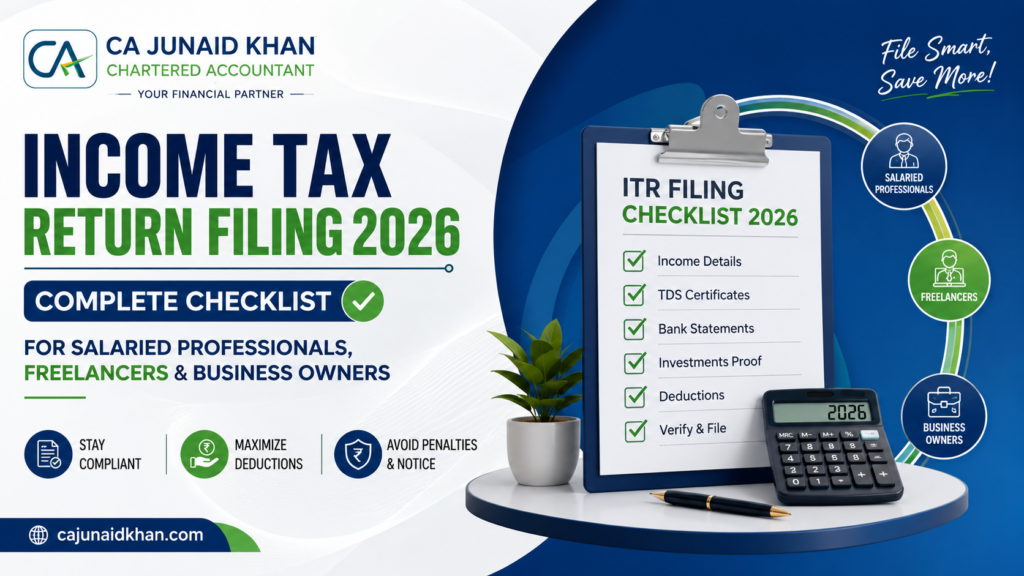
TL;DR Income Tax Return (ITR) filing is no longer just a legal formality. With increasing digital tracking, AIS reporting, PAN-based monitoring, and financial data integration, taxpayers must file accurate returns backed by proper documentation. This complete 2026 ITR filing guide explains: Documents required for tax filing ITR checklist for salaried employees Tax filing tips for freelancers Business owner compliance requirements Common filing mistakes Tax-saving preparation strategies Ways to avoid notices and penalties Why Income Tax Return Filing Matters Income tax filing plays a crucial role in: Legal tax compliance Loan and visa approvals Financial transparency Claiming refunds Carrying forward losses Maintaining clean financial records Today, the Income Tax Department uses advanced data analytics to match: Bank transactions TDS records Mutual fund investments Stock trading activity Credit card usage Property transactions Even small mismatches can trigger scrutiny or notices. For salaried individuals, freelancers, and businesses, timely and accurate filing has become essential. Who Should File an Income Tax Return? Many taxpayers incorrectly assume ITR filing is required only if taxes are payable. However, filing may be important for: Salaried employees Freelancers and consultants Proprietorship businesses Companies and LLPs Startup founders Ecommerce sellers Investors and traders Professionals earning foreign income Even individuals with lower taxable liability often file returns for: Loan eligibility Financial proof Refund claims Visa applications Compliance continuity Important Documents Required for ITR Filing Before starting your return filing, organize all financial documents properly. Document Purpose PAN Card Taxpayer identification Aadhaar Card Verification Form 16 Salary income details Form 26AS TDS verification AIS/TIS Financial transaction summary Bank Statements Income reconciliation Investment Proofs Deduction claims Home Loan Statement Interest deduction Rent Receipts HRA claims Capital Gain Statements Investment taxation Maintaining proper documentation reduces filing errors significantly. ITR Filing Checklist for Salaried Professionals Salaried employees often assume Form 16 alone is enough for filing. In reality, multiple financial disclosures must be verified. 1. Verify Form 16 Carefully Check: Salary breakup TDS deductions Employer PAN Exemptions and deductions Mismatch between Form 16 and Form 26AS can create issues. 2. Review AIS and Form 26AS AIS (Annual Information Statement) may contain: Interest income Dividend income Mutual fund transactions Securities transactions High-value banking activities Ignoring AIS discrepancies is a common reason for tax notices. 3. Declare Additional Income Many salaried individuals forget to disclose: Savings account interest FD interest Freelance side income Rental income Capital gains All taxable income must be reported. 4. Check Deduction Eligibility Review deductions under applicable provisions such as: Insurance premiums Investment-linked deductions Education loan interest Housing loan benefits Medical insurance 5. Choose Correct Tax Regime The old and new tax regimes have different deduction structures. A comparative analysis helps determine the better option. ITR Filing Checklist for Freelancers & Consultants Freelancers face unique compliance challenges because income may come from multiple clients and platforms. 1. Maintain Proper Income Records Track: Client payments Online receipts Foreign remittances Platform commissions Poor record keeping often leads to inaccurate reporting. 2. Separate Personal and Business Expenses Using separate bank accounts improves: Audit readiness Expense tracking Tax computation accuracy 3. Reconcile TDS Entries Clients may deduct TDS under different sections. Verify entries in Form 26AS. 4. Maintain Expense Documentation Freelancers should preserve: Software subscriptions Internet bills Laptop expenses Office rent Travel expenses Professional tools 5. Review Advance Tax Liability Freelancers with significant tax liability may need advance tax compliance. ITR Filing Checklist for Business Owners Business owners require deeper financial reconciliation before filing returns. 1. Finalize Bookkeeping Ensure: Sales records are accurate Expense entries are verified GST reconciliation is complete Debtors and creditors match 2. Verify GST and Income Tax Consistency Mismatch between GST turnover and income tax turnover may trigger scrutiny. 3. Review Cash Transactions Large unexplained cash transactions increase risk exposure. 4. Reconcile Bank Accounts All business bank accounts should align with accounting records. 5. Check Depreciation and Asset Records Incorrect depreciation claims are common filing errors among businesses. Choosing the Correct ITR Form Selecting the wrong ITR form can invalidate returns. Commonly Used ITR Forms ITR Form Suitable For ITR-1 Salaried individuals ITR-2 Capital gains and multiple income sources ITR-3 Business/professional income ITR-4 Presumptive taxation Form selection depends on: Income type Business structure Capital gains Foreign income Tax regime Old Tax Regime vs New Tax Regime Choosing the correct tax regime requires evaluating: Deductions available Investment structure Salary components Housing loan benefits Professional expenses Old Regime Suitable for taxpayers claiming substantial deductions. New Regime Suitable for taxpayers preferring simplified taxation with lower deductions. Tax planning should be personalized rather than generic. Common Income Tax Filing Mistakes 1. Filing Incorrect ITR Form Wrong form selection may invalidate returns. 2. Ignoring AIS Data AIS mismatches are now a major scrutiny trigger. 3. Missing Income Disclosure Undisclosed interest or side income often results in notices. 4. Incorrect Deduction Claims Unsupported deduction claims increase compliance risks. 5. Last-Minute Filing Rushed filings often lead to errors and omissions. 6. Ignoring Foreign Income Reporting Foreign assets and overseas income require proper disclosure. How to Avoid Tax Notices Maintain Accurate Documentation Organized records simplify compliance. Match All Tax Data Cross-check: Form 16 AIS 26AS Bank records Avoid Artificial Deductions Claim only genuine deductions supported by evidence. File Returns Before Deadline Timely filing improves compliance credibility. Seek Professional Review Expert review helps identify risks before submission. Why Professional Tax Assistance Matters Tax laws continue evolving every year. Professional tax assistance helps: Reduce filing errors Optimize deductions Improve compliance Handle notices Select appropriate tax regime Maintain audit-ready records This is especially important for: High-income professionals Freelancers Startups Business owners Investors How Junaid Khan & Co Supports Taxpayers Junaid Khan & Co assists individuals and businesses with: Income tax return filing Tax planning and advisory Business tax compliance Freelance taxation GST and accounting support Tax notice response assistance Financial documentation review The firm works with salaried professionals, startups, consultants, and businesses across multiple sectors. Conclusion Income Tax Return Filing in 2026 requires much more than basic data entry. Taxpayers must carefully reconcile income, deductions, financial disclosures, and compliance obligations. Whether you