


TL;DR
Tax audit is an important compliance requirement for eligible businesses and professionals. For FY 2025–26 (AY 2026–27), tax audit continues under Section 44AB of the Income-tax Act, 1961, with the tax audit report generally due by 30 September 2026. The applicable forms are Form 3CA/3CB along with Form 3CD. From Tax Year 2026–27, the corresponding provision under the Income Tax Act, 2025 is Section 63, and the new unified Form 26 will be used.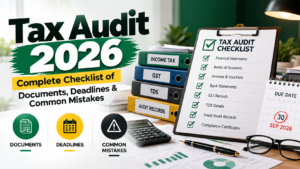
Introduction
Tax audit is more than simply checking a business’s financial statements. It involves examining books of account, financial transactions, tax deductions, payments, statutory compliance and other information that must be reported to the Income Tax Department.
For businesses and professionals covered by tax-audit provisions, incomplete records or incorrect reporting can create unnecessary compliance problems. This is especially important in 2026 because India is going through a transition from the Income-tax Act, 1961 to the Income Tax Act, 2025.
For FY 2025–26, taxpayers continue to follow the old Act for tax-audit reporting. The new Act applies to income earned from 1 April 2026, which is referred to as Tax Year 2026–27.
Understanding the applicable threshold, documents, forms, deadlines and common errors can make the tax-audit process much smoother.
What Is a Tax Audit?
A tax audit is an examination of the accounts of certain taxpayers by a Chartered Accountant to verify and report specified financial and tax information under the applicable provisions of the Income Tax law.
For FY 2025–26, the requirement is governed by Section 44AB of the Income-tax Act, 1961.
The audit report provides information about the taxpayer’s accounts and specified particulars that help the Income Tax Department assess compliance.
Tax audit is therefore not simply about checking whether the business made a profit or loss. It involves reviewing financial and tax-related information in detail.
Who Is Required to Get a Tax Audit in 2026?
The applicability depends on the nature of income, turnover or gross receipts and other prescribed conditions.
Tax Audit for Business
Generally, tax audit applies where business turnover or gross receipts exceed ₹1 crore.
However, the threshold can increase to ₹10 crore where both cash receipts and cash payments do not exceed 5% of the relevant total receipts and payments, subject to the applicable conditions.
Tax Audit for Professionals
For specified professions, the threshold is generally ₹50 lakh of gross receipts.
Professionals should also consider whether other conditions relating to presumptive taxation or declaring income below prescribed levels trigger audit requirements.
Presumptive Taxation Cases
Certain taxpayers opting out of presumptive taxation and declaring income below the prescribed threshold can also become subject to tax-audit requirements.
Because applicability depends on the specific facts of the taxpayer, businesses should evaluate the applicable provisions before assuming that they are outside the audit requirement.
Tax Audit Deadline for FY 2025–26
For FY 2025–26 / AY 2026–27, the tax audit report is due by 30 September 2026 in cases where the corresponding ITR due date is 31 October 2026.
For transfer-pricing cases, a different timeline may apply. Therefore, businesses should confirm the applicable due date based on their specific circumstances.
The important point is that taxpayers should not wait until the last few days to begin preparing their audit documents.
Which Forms Are Used for Tax Audit in 2026?
For FY 2025–26, the old Income-tax Act, 1961 framework continues to apply.
Form 3CA and Form 3CD
Form 3CA is applicable where the taxpayer’s accounts have already been audited under another law.
Form 3CD contains the statement of particulars required to be reported under Section 44AB.
Form 3CB and Form 3CD
Form 3CB is generally used in cases where the taxpayer is required to obtain a tax audit report but the accounts are not audited under another law.
It is accompanied by Form 3CD.
What Changes Under the Income Tax Act, 2025?
One of the major changes businesses need to understand is the transition to the new Income Tax Act, 2025.
For Tax Year 2026–27, Section 63 corresponds to the old Section 44AB tax-audit provision. The Income Tax Department has confirmed that the tax-audit thresholds remain the same.
The reporting form also changes.
Instead of separate Forms 3CA, 3CB and 3CD, the new framework uses Form 26, which consolidates the earlier audit forms into a unified tax-audit report.
For Tax Year 2026–27, the tax-audit report due date is 30 September 2027.
Complete Tax Audit 2026 Document Checklist
Preparing documents early can significantly reduce last-minute errors.
1. Books of Account
Keep updated:
- Cash book
- Bank book
- General ledger
- Purchase register
- Sales register
- Journal entries
- Expense records
- Debtors ledger
- Creditors ledger
- Fixed asset register
The books should be properly reconciled before the audit begins.
2. Bank Statements
Provide complete bank statements for all business accounts.
The auditor may need to verify:
- Business receipts
- Payments
- Loans
- Interest
- Bank charges
- Transfers
- Large or unusual transactions
- Closing balances
Bank balances should be reconciled with the books.
3. Sales and Purchase Records
Maintain detailed sales and purchase documentation, including invoices and supporting records.
For GST-registered businesses, it is also important to reconcile accounting records with GST returns.
4. GST Records
Depending on the business, relevant GST documents can include:
- GST registration details
- GSTR-1
- GSTR-3B
- GSTR-2B
- GSTR-9, where applicable
- E-invoices
- E-way bills
- Input Tax Credit workings
- GST payment challans
- Credit and debit notes
Differences between books and GST records should be investigated before finalisation.
5. TDS and TCS Records
Keep:
- TDS returns
- TDS challans
- TDS certificates
- TCS records, where applicable
- Vendor TDS details
- Salary TDS records
- Form 26AS/AIS reconciliation
The Income Tax Department’s AIS includes information such as TDS/TCS, SFT information, tax payments, demand/refund and other reported information.
6. Fixed Asset and Depreciation Details
Maintain a fixed asset register containing:
- Asset description
- Purchase date
- Purchase value
- Additions
- Disposals
- Depreciation
- Closing written-down value
Supporting invoices should also be retained.
7. Loan and Interest Documents
If the business has loans, maintain:
- Loan statements
- Sanction letters
- Interest certificates
- Repayment schedules
- Security documentation
- Details of loans received or repaid
This helps verify both principal and interest accounting.
8. Expense Supporting Documents
Major expenses should have proper supporting documentation.
Examples include:
- Rent agreements
- Salary records
- Professional-fee invoices
- Travel bills
- Insurance documents
- Utility bills
- Advertisement expenses
- Repairs and maintenance records
Proper documentation helps establish the nature and business purpose of expenses.
9. Capital and Investment Records
Maintain documentation for:
- Capital introduced
- Drawings
- Investments
- Sale of investments
- Partner capital
- Share capital
- Securities transactions
Large financial transactions should be properly supported.
Tax Audit Preparation Checklist
Before submitting the final audit information, businesses should review the following:
Accounting Reconciliation
Check whether:
Books = Bank Statements = GST Records = TDS Records = Tax Reporting
Any significant difference should be investigated.
Debtors and Creditors Review
Review outstanding balances and identify:
- Old receivables
- Doubtful balances
- Advance payments
- Credit balances
- Unreconciled vendor balances
GST Reconciliation
Compare sales and purchase records with applicable GST data.
Pay particular attention to:
- Missing invoices
- Wrong GSTIN
- Credit notes
- Duplicate entries
- ITC differences
- Supplier filing issues
TDS Reconciliation
Verify that applicable TDS has been:
- Correctly deducted
- Deposited on time
- Reported in the relevant return
- Reflected correctly in available tax records
Cash Transaction Review
Businesses should review cash receipts and payments carefully because cash transaction levels can affect the applicable tax-audit turnover threshold and may also trigger other reporting considerations.
Common Tax Audit Mistakes Businesses Should Avoid
1. Starting the Audit at the Last Minute
Waiting until September to organise documents can lead to missing information and rushed decisions.
Start the process well before the deadline.
2. Ignoring Bank Reconciliation
Book balances and bank balances should not be assumed to match automatically.
Unreconciled transactions can affect reported income and expenses.
3. Incorrect GST Reconciliation
Businesses sometimes rely entirely on the figures in GST returns without comparing them with accounting records.
This can result in unexplained differences.
4. Missing TDS Entries
TDS should be reviewed transaction by transaction where applicable.
Incorrect deduction or reporting can create tax and compliance consequences.
5. Incorrect Expense Classification
Personal, capital and business expenses should be appropriately classified.
Incorrect classification can affect both financial statements and tax computation.
6. Ignoring Old Outstanding Balances
Old receivables and payables should be reviewed rather than carried forward without explanation.
7. Not Maintaining Supporting Documents
An accounting entry without proper supporting documentation can create questions during an audit.
8. Using the Wrong Tax-Year Framework
This is especially important in 2026.
FY 2025–26 / AY 2026–27 continues under the Income-tax Act, 1961, while income earned from FY 2026–27 falls under the new Tax Year framework of the Income Tax Act, 2025.
9. Assuming the New Form Applies to FY 2025–26
Form 26 belongs to the new Tax Year 2026–27 framework.
For FY 2025–26, the applicable tax-audit forms remain Form 3CA/3CB with Form 3CD.
10. Waiting Until the Due Date
The statutory deadline should be treated as the final compliance date, not the preparation date.
Early preparation gives businesses time to resolve discrepancies before the report is filed.
How a CA Can Help With Tax Audit
A Chartered Accountant can assist with the complete tax-audit process, including:
- Reviewing books of account
- Checking financial statements
- Reconciling bank accounts
- Reviewing GST records
- Checking TDS compliance
- Verifying expenses
- Reviewing depreciation
- Examining statutory payments
- Identifying reporting issues
- Preparing applicable audit forms
- Filing the tax-audit report
- Coordinating audit-related documentation
For businesses with multiple transactions, GST compliance, TDS obligations or complex financial structures, professional support can reduce the risk of avoidable errors.
Tax Audit vs Statutory Audit
These two audits should not be confused.
A tax audit focuses on reporting information required under Income Tax law.
A statutory audit may be required under another applicable law, such as company law.
A business may sometimes be subject to both. In such cases, the accounts may already have been audited under another law, which is one reason the Form 3CA framework exists for applicable FY 2025–26 cases.
Why Early Tax Audit Preparation Matters
Early preparation provides businesses with an opportunity to identify discrepancies before they become compliance problems.
It can help identify:
- Unrecorded transactions
- Bank reconciliation differences
- GST mismatches
- TDS issues
- Incorrect expense classification
- Missing invoices
- Depreciation errors
- Outstanding statutory liabilities
- Documentation gaps
Instead of treating tax audit as a year-end formality, businesses should treat it as part of their overall financial-control process.
Conclusion
Tax Audit 2026 requires careful preparation, accurate accounting records and awareness of the applicable legal framework.
For FY 2025–26 / AY 2026–27, tax audit continues under Section 44AB of the Income-tax Act, 1961, with the applicable report generally due by 30 September 2026. Form 3CA/3CB with Form 3CD remains applicable for this year. From Tax Year 2026–27, Section 63 of the Income Tax Act, 2025 applies, with the new Form 26 replacing the earlier audit-form structure.
Businesses should begin preparing their books, bank records, GST data, TDS information, invoices and supporting documents well before the deadline. Working with a qualified Chartered Accountant can also help identify discrepancies and ensure that the audit report is prepared using the correct requirements.
Frequently Asked Questions
1. What is the tax audit due date for FY 2025–26?
For FY 2025–26 / AY 2026–27, the tax audit report is generally due by 30 September 2026, subject to applicable exceptions such as transfer-pricing cases.
2. What is the tax audit turnover limit for businesses in 2026?
The general business threshold is ₹1 crore. It can increase to ₹10 crore where cash receipts and cash payments each do not exceed 5% of the applicable totals, subject to the prescribed conditions.
3. What is the tax audit limit for professionals?
For specified professions, the general gross-receipts threshold is ₹50 lakh, subject to the applicable provisions and conditions.
4. Which forms are used for tax audit for FY 2025–26?
For FY 2025–26, taxpayers continue to use Form 3CA or Form 3CB along with Form 3CD, depending on the applicable circumstances.
5. Is Form 26 applicable for FY 2025–26 tax audit?
No. Form 26 applies to tax audits for Tax Year 2026–27 under the Income Tax Act, 2025. FY 2025–26 tax audits continue under the old Act and applicable Forms 3CA/3CB/3CD.
6. What documents are required for a tax audit?
Common documents include books of account, bank statements, sales and purchase records, GST returns, TDS records, invoices, fixed-asset details, loan statements, expense records and other supporting financial documents.
7. Can a business prepare for tax audit without a CA?
Businesses can organise their records internally, but where tax audit is applicable, the prescribed audit report must be prepared and furnished by a Chartered Accountant in accordance with the applicable requirements.
8. What happens if tax-audit information contains errors?
Incorrect or incomplete reporting can create compliance issues and may require correction or further clarification. Businesses should therefore reconcile their records and verify the information before the report is finalised.
9. Has the tax-audit threshold changed under the Income Tax Act, 2025?
The Income Tax Department states that the tax-audit thresholds under Section 63 of the Income Tax Act, 2025 remain the same as under the earlier framework.
10. What is the biggest mistake businesses make during tax audit?
One of the most common problems is leaving reconciliation and documentation until the last minute. Early review of books, bank statements, GST, TDS and supporting documents can help identify and resolve discrepancies before filing.
Blog By : CA Junaid Khan
Written by CA Junaid Ahmed Khan, Junaid Khan & Co., Bhopal.