

Tax Audit Mistakes That Can Lead to Penalties: 15 Errors Businesses Should Avoid
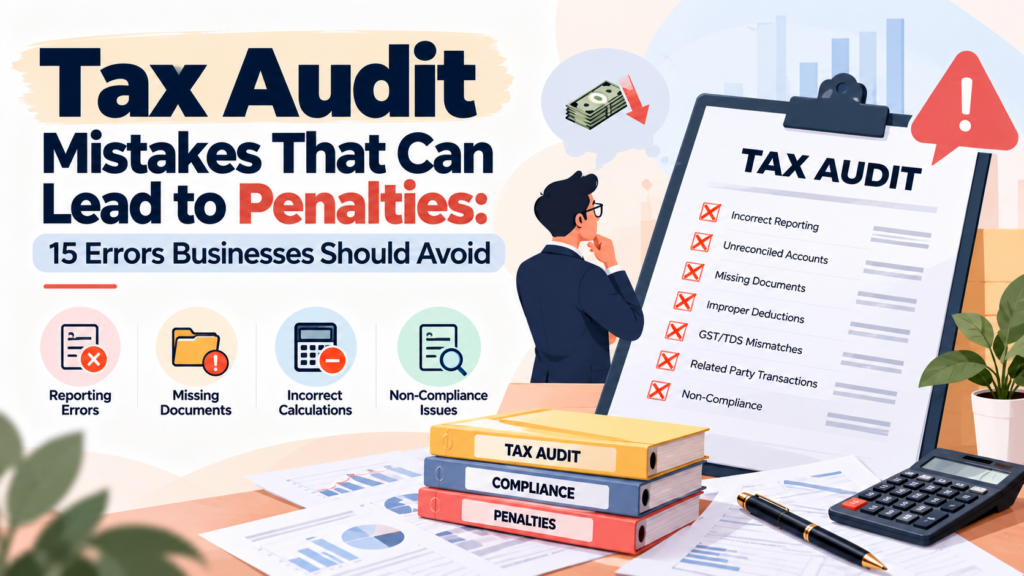
TL;DR Tax audit is more than submitting Form 3CA/3CB and Form 3CD. Errors in books of accounts, turnover reporting, GST reconciliation, TDS, expenses, depreciation, loans, related-party transactions and tax disclosures can create compliance issues and may expose businesses to penalties where applicable. For FY 2025–26 / AY 2026–27, tax audits continue under Section 44AB of the Income Tax Act, 1961, with Form 3CA/3CD or 3CB/3CD, as applicable. The tax audit report is generally due by 30 September 2026 in standard cases. From Tax Year 2026–27, Section 63 of the Income Tax Act, 2025 applies and the new Form 26 consolidates the earlier audit forms. Businesses should therefore ensure that their accounting records, supporting documents, tax returns and audit disclosures are accurate and properly reconciled before the tax audit report is filed. Introduction A tax audit is an important compliance requirement for businesses and professionals who fall within the prescribed audit provisions. It enables the Income Tax Department to obtain verified information about turnover, expenses, deductions, depreciation, tax compliance and other financial particulars. However, many businesses treat tax audit as simply a form-filing exercise. In reality, the quality of the underlying books and supporting records can significantly affect the accuracy of the audit report. A mismatch between books and GST returns, incorrect turnover, missing expense documents, unreconciled TDS, incorrect depreciation or incomplete Form 3CD disclosures can create unnecessary complications. The Income Tax Department explains that tax audit is intended to help ensure proper maintenance and correctness of books, report discrepancies and provide prescribed information under the Income Tax Act. Here are 15 common tax audit mistakes businesses should avoid. 1. Reporting Incorrect Turnover One of the most important areas during a tax audit is turnover or gross receipts. Businesses sometimes calculate turnover only from their accounting software without reconciling it with bank statements, GST returns, invoices and other records. This can result in: Understatement of business receipts Incorrect tax-audit applicability GST and income-tax mismatches Incorrect profit calculations Incorrect reporting in Form 3CD Businesses should reconcile sales and receipts with their books, GST data, bank statements and other relevant records before finalising the audit. 2. Ignoring the Tax Audit Applicability Threshold Another common mistake is assuming that tax audit is applicable only when turnover crosses a particular limit without checking the complete provisions. For businesses, the general threshold remains ₹1 crore, with the higher ₹10 crore threshold available where cash receipts and cash payments do not exceed the prescribed 5% conditions. For professionals, the general threshold is ₹50 lakh. Certain presumptive-taxation situations can also trigger audit requirements. Therefore, businesses should calculate turnover and review their cash transactions carefully before deciding whether a tax audit is required. 3. Failing to Reconcile GST Turnover With Books GST returns and books of accounts should not be treated as completely separate records. Differences may arise because of: Credit notes Debit notes Advances Export transactions Exempt supplies Year-end adjustments Sales returns Amendments Timing differences An unexplained difference between GST turnover and books can attract questions during tax compliance reviews. Businesses should prepare a proper GST-to-books reconciliation before the tax audit. 4. Incorrect or Incomplete Form 3CD Reporting Form 3CD contains numerous particulars relating to the taxpayer’s business, books, expenses, deductions, depreciation, loans, TDS and other matters. Simply copying information from accounting software without reviewing each applicable clause can result in incorrect disclosures. For FY 2025–26 / AY 2026–27, Form 3CD continues to be used with Form 3CA or Form 3CB under the Income Tax Act, 1961. Businesses should provide complete and accurate information to the tax auditor instead of assuming that every disclosure will automatically be generated from the books. 5. Claiming Expenses Without Proper Supporting Documents An expense recorded in the books does not automatically mean that it is properly supported. Businesses should maintain appropriate documentation such as: Tax invoices Bills Payment records Agreements Purchase orders Bank statements Expense vouchers Supporting correspondence where relevant Missing documentation can make it difficult to establish the nature and business purpose of an expense. 6. Ignoring Cash Expenses and Payment Restrictions Cash transactions require special attention during tax audit. Businesses should review cash payments against the applicable restrictions and maintain proper supporting records. Particular attention should be given to: Large cash payments Payments to related parties Payments to vendors Employee reimbursements Cash purchases Payments that may attract disallowance A proper cash-payment review before the audit can help identify potentially disallowable expenses early. 7. Not Reconciling TDS and TCS TDS and TCS information should be reconciled with the books and relevant tax records. Common mistakes include: TDS deducted but not recorded correctly Incorrect TDS receivable TDS payable not reconciled Wrong deduction classification Differences between books and Form 26AS/AIS TDS returns not matching accounting records The Income Tax Department’s current taxpayer information includes TDS/TCS data through AIS and related systems, making reconciliation increasingly important. 8. Incorrect Depreciation Calculation Depreciation errors are another common tax-audit issue. Businesses may incorrectly calculate depreciation because of: Wrong asset classification Incorrect purchase date Incorrect date of put-to-use Asset additions not recorded Asset disposals not updated Incorrect depreciation rates Failure to reconcile fixed-asset registers with books The fixed-asset register should therefore be reviewed carefully before the audit. 9. Missing MSME Payment Information Payments to micro and small enterprises require careful review because delayed payments can have tax implications. Businesses should identify applicable MSME vendors and verify: Vendor classification Invoice dates Payment dates Outstanding balances Amounts paid after the applicable period Year-end outstanding amounts Maintaining updated vendor records can make this review much easier. 10. Incorrect Reporting of Loans and Deposits Loans, advances and deposits should be carefully reviewed during tax audit. Businesses should maintain documentation for: Loans received Loans given Repayments Advances Security deposits Related-party loans Bank borrowings The mode of receipt and repayment should also be reviewed wherever applicable under the relevant provisions. Large unexplained movements in loan accounts can create unnecessary questions during tax scrutiny. 11. Not Disclosing Related-Party Transactions Properly Transactions with directors, partners, relatives, associated enterprises or other specified persons require additional attention.
Tax Audit 2026 Under Section 44AB: Who Is Required to Get a Tax Audit?
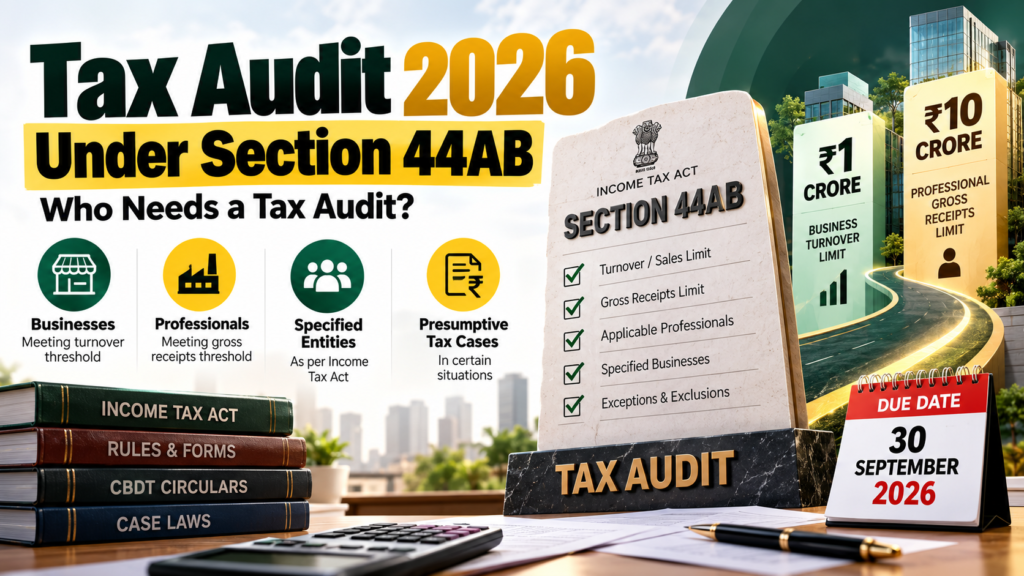
TL;DR Tax audit is mandatory for certain businesses and professionals under Section 44AB of the Income Tax Act, 1961. For FY 2025–26, businesses generally need a tax audit when turnover exceeds ₹1 crore, with the threshold increasing to ₹10 crore where both cash receipts and cash payments do not exceed 5% of the respective totals. For professionals, the general threshold is ₹50 lakh. Certain taxpayers opting out of presumptive taxation may also become liable for audit. For FY 2025–26, the tax audit report is generally due by 30 September 2026. From Tax Year 2026–27, the corresponding provision is Section 63 under the Income Tax Act, 2025. Introduction A tax audit is an important income tax compliance requirement for businesses and professionals whose accounts fall within the specified conditions under the Income Tax Act. The purpose of a tax audit is to ensure that financial records, income, expenses, deductions and other tax-related information are properly maintained and accurately reported. For FY 2025–26, tax audit requirements continue to be governed by Section 44AB of the Income Tax Act, 1961. This means businesses and professionals need to check their turnover, gross receipts, cash transactions and presumptive taxation status to determine whether a tax audit is applicable. The introduction of the Income Tax Act, 2025 also brings a change in section numbering. From Tax Year 2026–27, the corresponding tax-audit provision is Section 63, while the underlying thresholds remain broadly the same. Understanding these rules is important because missing a mandatory tax audit can result in additional compliance issues and potential penalties. What Is a Tax Audit Under Section 44AB? A tax audit is an examination of a taxpayer’s books of accounts by a Chartered Accountant to determine whether the financial information and prescribed particulars are properly maintained and reported. Section 44AB specifies the circumstances in which a person carrying on business or profession must get their accounts audited. The tax audit report contains important information relating to turnover, expenses, deductions, depreciation, tax payments, specified transactions and other financial particulars required under the applicable rules. For FY 2025–26, taxpayers subject to Section 44AB generally use Form 3CA/3CD or Form 3CB/3CD, depending on whether their accounts are already required to be audited under another law. Who Is Required to Get a Tax Audit in 2026? The requirement primarily applies to businesses and professionals crossing the prescribed turnover or gross-receipt thresholds. Certain taxpayers using or opting out of presumptive taxation can also fall under the tax-audit provisions. 1. Businesses With Turnover Above ₹1 Crore A person carrying on business is generally required to get a tax audit if their total sales, turnover or gross receipts exceed ₹1 crore during the relevant previous year. For example, if a business has annual turnover of ₹1.25 crore, it generally falls within the tax-audit requirement. However, there is an important higher threshold for businesses with limited cash transactions. 2. Businesses With Turnover Up to ₹10 Crore and Limited Cash Transactions The tax-audit threshold can increase from ₹1 crore to ₹10 crore if both of the following conditions are satisfied: Cash receipts do not exceed 5% of total receipts Cash payments do not exceed 5% of total payments Therefore, a business with turnover of ₹6 crore may not necessarily require a tax audit solely because its turnover exceeds ₹1 crore, provided the applicable cash-transaction conditions are satisfied. However, if either the cash-receipt or cash-payment condition exceeds the prescribed 5% limit, the enhanced ₹10 crore threshold cannot be relied upon. 3. Professionals With Gross Receipts Above ₹50 Lakh Professionals are subject to a separate threshold. If the gross receipts from a profession exceed ₹50 lakh during the relevant previous year, a tax audit is generally required. This can apply to professionals such as: Chartered Accountants Lawyers Doctors Architects Engineers Consultants Interior designers Technical professionals Other specified professionals The applicable threshold should be evaluated based on the nature of professional activity and the provisions applicable to that taxpayer. 4. Taxpayers Opting Out of Presumptive Taxation Tax audit requirements can also arise when a taxpayer who was eligible for presumptive taxation does not follow the presumptive scheme and declares income below the prescribed level, subject to the conditions of the relevant presumptive-tax provisions. This is particularly important for businesses and professionals using provisions such as presumptive taxation under Sections 44AD and 44ADA of the old Act. The Income Tax Department specifically includes persons opting out of presumptive taxation and declaring income below the prescribed threshold among cases where tax audit requirements can apply. Tax Audit Threshold for Business vs Profession The basic thresholds can be summarized as follows: Category General Tax Audit Threshold Business Turnover/gross receipts exceeding ₹1 crore Business with prescribed low cash transactions Up to ₹10 crore threshold Profession Gross receipts exceeding ₹50 lakh Certain presumptive-tax cases Depends on applicable presumptive-tax conditions The ₹10 crore threshold for businesses is conditional. It is available where both cash receipts and cash payments remain within the prescribed 5% limits. What Happens If Cash Transactions Exceed 5%? The cash transaction condition is important for businesses that want to use the enhanced ₹10 crore threshold. Suppose a business has turnover of ₹5 crore but its cash receipts exceed 5% of total receipts. In that situation, the business cannot automatically rely on the ₹10 crore threshold. Similarly, if cash payments exceed 5% of total payments, the enhanced threshold condition is not satisfied. Therefore, businesses should monitor both: Cash Receipts ÷ Total Receipts and Cash Payments ÷ Total Payments throughout the financial year rather than checking the numbers only at year-end. Does GST Turnover Automatically Decide Tax Audit Applicability? Not always. GST turnover and income-tax turnover are related in many business situations, but tax-audit applicability has to be determined according to the provisions of the Income Tax Act and the nature of receipts. Businesses should therefore reconcile their books, GST records, sales records, credit notes, advances and other relevant transactions before deciding whether a tax audit is required. A business should not simply assume that the turnover shown in
Tax Audit 2026: Complete Checklist of Documents, Deadlines & Common Mistakes
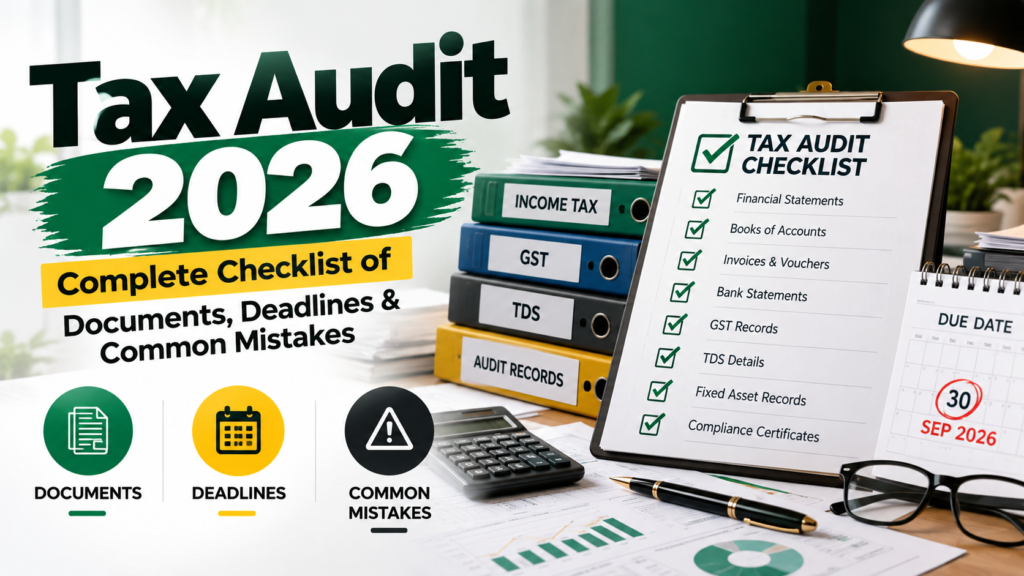
TL;DR Tax audit is an important compliance requirement for eligible businesses and professionals. For FY 2025–26 (AY 2026–27), tax audit continues under Section 44AB of the Income-tax Act, 1961, with the tax audit report generally due by 30 September 2026. The applicable forms are Form 3CA/3CB along with Form 3CD. From Tax Year 2026–27, the corresponding provision under the Income Tax Act, 2025 is Section 63, and the new unified Form 26 will be used. Introduction Tax audit is more than simply checking a business’s financial statements. It involves examining books of account, financial transactions, tax deductions, payments, statutory compliance and other information that must be reported to the Income Tax Department. For businesses and professionals covered by tax-audit provisions, incomplete records or incorrect reporting can create unnecessary compliance problems. This is especially important in 2026 because India is going through a transition from the Income-tax Act, 1961 to the Income Tax Act, 2025. For FY 2025–26, taxpayers continue to follow the old Act for tax-audit reporting. The new Act applies to income earned from 1 April 2026, which is referred to as Tax Year 2026–27. Understanding the applicable threshold, documents, forms, deadlines and common errors can make the tax-audit process much smoother. What Is a Tax Audit? A tax audit is an examination of the accounts of certain taxpayers by a Chartered Accountant to verify and report specified financial and tax information under the applicable provisions of the Income Tax law. For FY 2025–26, the requirement is governed by Section 44AB of the Income-tax Act, 1961. The audit report provides information about the taxpayer’s accounts and specified particulars that help the Income Tax Department assess compliance. Tax audit is therefore not simply about checking whether the business made a profit or loss. It involves reviewing financial and tax-related information in detail. Who Is Required to Get a Tax Audit in 2026? The applicability depends on the nature of income, turnover or gross receipts and other prescribed conditions. Tax Audit for Business Generally, tax audit applies where business turnover or gross receipts exceed ₹1 crore. However, the threshold can increase to ₹10 crore where both cash receipts and cash payments do not exceed 5% of the relevant total receipts and payments, subject to the applicable conditions. Tax Audit for Professionals For specified professions, the threshold is generally ₹50 lakh of gross receipts. Professionals should also consider whether other conditions relating to presumptive taxation or declaring income below prescribed levels trigger audit requirements. Presumptive Taxation Cases Certain taxpayers opting out of presumptive taxation and declaring income below the prescribed threshold can also become subject to tax-audit requirements. Because applicability depends on the specific facts of the taxpayer, businesses should evaluate the applicable provisions before assuming that they are outside the audit requirement. Tax Audit Deadline for FY 2025–26 For FY 2025–26 / AY 2026–27, the tax audit report is due by 30 September 2026 in cases where the corresponding ITR due date is 31 October 2026. For transfer-pricing cases, a different timeline may apply. Therefore, businesses should confirm the applicable due date based on their specific circumstances. The important point is that taxpayers should not wait until the last few days to begin preparing their audit documents. Which Forms Are Used for Tax Audit in 2026? For FY 2025–26, the old Income-tax Act, 1961 framework continues to apply. Form 3CA and Form 3CD Form 3CA is applicable where the taxpayer’s accounts have already been audited under another law. Form 3CD contains the statement of particulars required to be reported under Section 44AB. Form 3CB and Form 3CD Form 3CB is generally used in cases where the taxpayer is required to obtain a tax audit report but the accounts are not audited under another law. It is accompanied by Form 3CD. What Changes Under the Income Tax Act, 2025? One of the major changes businesses need to understand is the transition to the new Income Tax Act, 2025. For Tax Year 2026–27, Section 63 corresponds to the old Section 44AB tax-audit provision. The Income Tax Department has confirmed that the tax-audit thresholds remain the same. The reporting form also changes. Instead of separate Forms 3CA, 3CB and 3CD, the new framework uses Form 26, which consolidates the earlier audit forms into a unified tax-audit report. For Tax Year 2026–27, the tax-audit report due date is 30 September 2027. Complete Tax Audit 2026 Document Checklist Preparing documents early can significantly reduce last-minute errors. 1. Books of Account Keep updated: Cash book Bank book General ledger Purchase register Sales register Journal entries Expense records Debtors ledger Creditors ledger Fixed asset register The books should be properly reconciled before the audit begins. 2. Bank Statements Provide complete bank statements for all business accounts. The auditor may need to verify: Business receipts Payments Loans Interest Bank charges Transfers Large or unusual transactions Closing balances Bank balances should be reconciled with the books. 3. Sales and Purchase Records Maintain detailed sales and purchase documentation, including invoices and supporting records. For GST-registered businesses, it is also important to reconcile accounting records with GST returns. 4. GST Records Depending on the business, relevant GST documents can include: GST registration details GSTR-1 GSTR-3B GSTR-2B GSTR-9, where applicable E-invoices E-way bills Input Tax Credit workings GST payment challans Credit and debit notes Differences between books and GST records should be investigated before finalisation. 5. TDS and TCS Records Keep: TDS returns TDS challans TDS certificates TCS records, where applicable Vendor TDS details Salary TDS records Form 26AS/AIS reconciliation The Income Tax Department’s AIS includes information such as TDS/TCS, SFT information, tax payments, demand/refund and other reported information. 6. Fixed Asset and Depreciation Details Maintain a fixed asset register containing: Asset description Purchase date Purchase value Additions Disposals Depreciation Closing written-down value Supporting invoices should also be retained. 7. Loan and Interest Documents If the business has loans, maintain: Loan statements Sanction letters Interest certificates Repayment schedules Security documentation Details of loans received or repaid This helps verify both principal and
Internal Audit vs Statutory Audit: Which One Does Your Business Need?
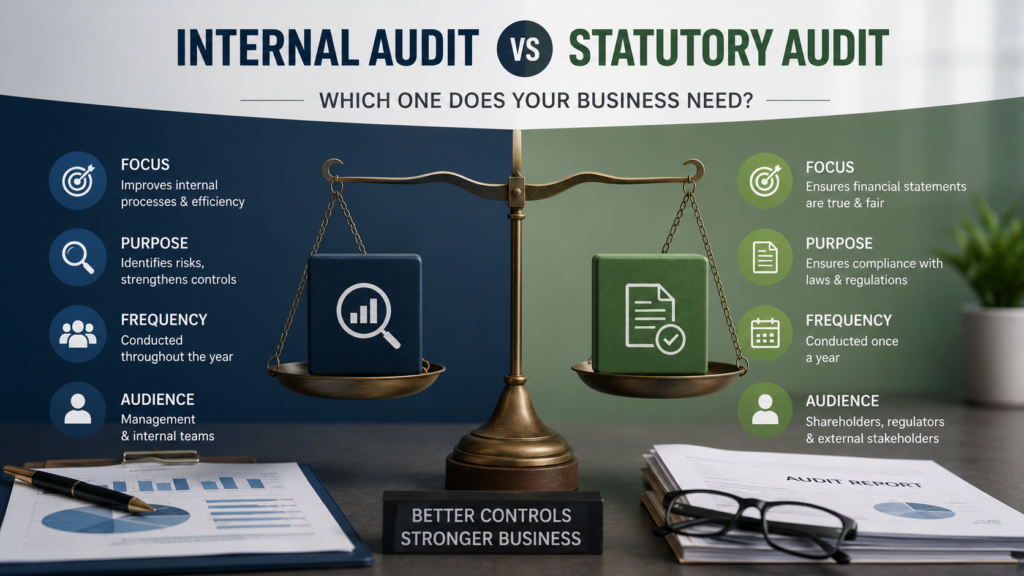
TL;DR Internal audits help businesses improve operations, strengthen internal controls, and identify risks before they become costly problems. Statutory audits are legally mandated for eligible entities to ensure financial statements present a true and fair view. While internal audits focus on improving business performance, statutory audits focus on regulatory compliance and financial reporting. Many growing businesses benefit from both. Understanding Business Audits As businesses expand, financial transactions become more complex, compliance obligations increase, and operational risks multiply. Conducting regular audits is one of the most effective ways to maintain financial discipline, improve transparency, and build stakeholder confidence. However, many entrepreneurs confuse internal audits with statutory audits, assuming they serve the same purpose. Although both involve examining financial records and business processes, their objectives, scope, frequency, and legal requirements differ significantly. Understanding these differences enables business owners to select the right audit approach and strengthen their overall financial governance. What is an Internal Audit? An internal audit is an independent evaluation of a company’s internal controls, financial processes, operational efficiency, and risk management systems. Unlike statutory audits, internal audits are primarily conducted for management. Their objective is not merely to verify financial statements but to identify weaknesses, improve efficiency, and recommend corrective actions. Internal audits typically evaluate: Accounting systems Internal financial controls Operational procedures Inventory management Procurement processes Revenue recognition Expense controls Payroll systems IT security controls Regulatory compliance Fraud prevention mechanisms Risk management practices Internal audits provide management with practical recommendations that enhance profitability and reduce business risks. What is a Statutory Audit? A statutory audit is an audit mandated by law under applicable legislation such as the Companies Act, Income Tax Act, or other regulatory frameworks. Its primary objective is to determine whether a company’s financial statements accurately reflect its financial position and comply with applicable accounting standards and legal requirements. Statutory audits are conducted by independent Chartered Accountants appointed according to statutory provisions. The audit report is typically submitted to: Shareholders Banks Investors Government authorities Regulatory agencies Financial institutions A statutory audit enhances credibility and assures stakeholders that the financial statements are reliable. Internal Audit vs Statutory Audit: Key Differences Parameter Internal Audit Statutory Audit Purpose Improve operations and controls Verify financial statements Mandatory Depends on applicable laws and business needs Mandatory for eligible entities under law Conducted By Internal audit team or external professionals Independent Chartered Accountant Primary Users Management Shareholders, regulators, lenders Frequency Monthly, quarterly, half-yearly, or annual Generally annual Focus Processes, risks, controls, efficiency Financial statements and compliance Reporting Management reports Statutory audit report Value Addition Operational improvement Regulatory compliance and financial credibility Benefits of Internal Audit An effective internal audit contributes significantly to operational excellence. Better Risk Management Internal audits identify potential financial, operational, and compliance risks before they escalate. Stronger Internal Controls Reviewing approval workflows, payment systems, inventory controls, and financial processes reduces opportunities for errors and fraud. Fraud Detection Regular audits help uncover irregular transactions, unauthorized activities, and control weaknesses at an early stage. Improved Operational Efficiency Businesses often discover redundant processes, unnecessary costs, and workflow inefficiencies that can be optimized. Enhanced Compliance Internal audits ensure adherence to GST, Income Tax, Companies Act provisions, labor laws, and internal company policies. Better Decision-Making Management receives detailed reports with actionable recommendations supported by accurate financial and operational data. Benefits of Statutory Audit Statutory audits provide assurance to stakeholders and strengthen the company’s reputation. Increased Financial Credibility Audited financial statements inspire confidence among banks, investors, suppliers, and customers. Legal Compliance Statutory audits help businesses fulfill mandatory obligations under applicable laws and avoid penalties for non-compliance. Easier Access to Finance Financial institutions often require audited statements when evaluating loan applications or credit facilities. Greater Investor Confidence Investors prefer businesses with independently audited financial statements, as they indicate transparency and sound governance. Accurate Financial Reporting Statutory audits help detect material misstatements and improve the reliability of financial information. Which Businesses Need Internal Audit? Internal audits are particularly valuable for organizations with growing operations or increasing complexity. Businesses that commonly benefit include: Growing startups Manufacturing companies Trading businesses Retail chains Construction companies Healthcare organizations Educational institutions Logistics companies IT and software firms Companies with multiple branches Businesses handling large inventories Organizations seeking operational efficiency Even where not legally required, internal audits can significantly improve governance and reduce long-term risks. Which Audit Is Right for Your Business? Choosing between an internal audit and a statutory audit depends on your business size, legal obligations, industry, and long-term objectives. While many companies assume they only need the audit mandated by law, proactive businesses often benefit from both. Here’s a simple comparison: Business Situation Internal Audit Statutory Audit Startup looking to improve financial processes ✅ Recommended ❌ Not always mandatory SME wanting stronger internal controls ✅ Highly Recommended Depends on turnover and legal requirements Company requiring statutory compliance Optional ✅ Mandatory Business preparing for funding or investors ✅ Strongly Recommended Usually Required Company facing rapid expansion ✅ Essential Depends on legal thresholds Government contract bidding Recommended Often Mandatory Manufacturing business with inventory risks ✅ Highly Beneficial Mandatory if applicable Family-owned business seeking fraud prevention ✅ Recommended Limited fraud detection scope Can a Business Conduct Both Internal and Statutory Audits? Absolutely. Many successful businesses conduct both because they serve completely different purposes. The internal audit helps management continuously improve business performance throughout the year, while the statutory audit independently verifies financial statements at the end of the financial year. Using both provides several advantages: Better compliance management Reduced financial risks Faster audit completion Higher investor confidence Improved corporate governance Stronger fraud prevention Better tax planning Increased operational efficiency Common Audit Mistakes Businesses Should Avoid Businesses often create unnecessary financial and compliance risks by making avoidable mistakes. Some of the most common include: Waiting until the financial year-end to prepare records Maintaining incomplete accounting books Ignoring GST reconciliation Delaying TDS payments Poor inventory documentation Lack of supporting invoices Weak approval systems Mixing personal and business expensesa Ignoring internal financial controls Not consulting experienced Chartered Accountants before audits Avoiding these mistakes can significantly reduce
Audit Requirements in India Explained: Does Your Business Actually Need an Audit?
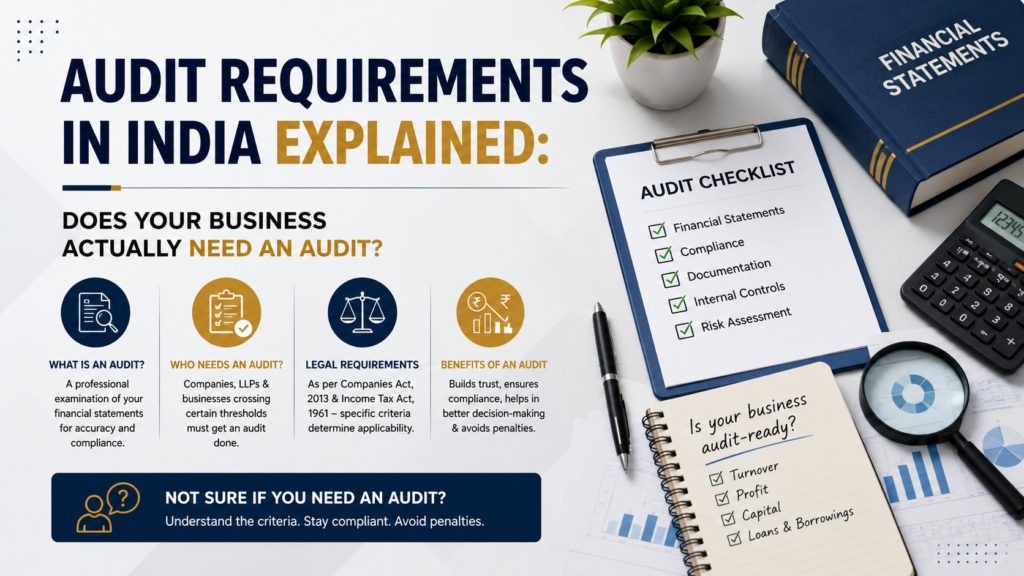
TL;DR Not every business in India requires the same type of audit. However, depending on: Business structure Turnover Profit declaration Tax regime Compliance category your business may require: Statutory audit Tax audit Internal audit GST-related compliance review Many startups and small businesses misunderstand audit applicability and either: Ignore mandatory compliance, or Spend unnecessarily on audits they may not require This guide explains: Which audits apply to which businesses Important turnover thresholds Common misconceptions Practical audit preparedness strategies for FY 2026–27 Why Audit Compliance Matters in India Audits are not just regulatory formalities. They help: Improve financial transparency Strengthen credibility Detect accounting inconsistencies Reduce compliance risks Support funding and banking processes Today, tax departments and regulatory authorities increasingly rely on: digital reconciliation, data analytics, AI-based scrutiny systems, and automated mismatch detection. As a result, proper audit compliance has become essential for businesses of all sizes. Types of Audits Businesses Should Know Many business owners use the term “audit” broadly, but different audits serve different purposes. Major Audit Categories in India Audit Type Purpose Statutory Audit Mandatory under company law Tax Audit Required under Income Tax Act Internal Audit Operational and risk review GST Compliance Review GST reconciliation and compliance analysis Stock Audit Inventory verification Forensic Audit Fraud investigation Understanding which audit applies to your business is critical. What Is a Statutory Audit? A statutory audit is mandated under the Companies Act. Usually Applicable To: Private Limited Companies Public Limited Companies Certain LLPs Regulated entities The purpose is to verify: financial statements, accounting records, and regulatory compliance. Key Objective To ensure that the financial statements present a true and fair view of the business. Even startups with minimal transactions may require statutory audit if incorporated as companies. What Is a Tax Audit? A tax audit is governed under the Income Tax Act. It evaluates whether: books of accounts are properly maintained, income is correctly reported, and tax compliance requirements are fulfilled. Businesses Typically Trigger Tax Audit Based On: turnover, gross receipts, or profit declaration criteria. Tax audit applicability can also change under presumptive taxation schemes. Audit Requirements for Different Business Structures Different entity types have different compliance obligations. Sole Proprietorship Audit applicability depends mainly on: turnover, profit reporting, and taxation scheme. Many small proprietors assume audits never apply to them, which is incorrect. Partnership Firms Partnerships may require: tax audit, accounting compliance, and financial reporting obligations depending on turnover and taxation structure. LLP (Limited Liability Partnership) LLPs may require audit depending on: turnover levels, contribution thresholds, and statutory obligations. LLPs are often preferred for flexibility, but compliance requirements still apply. Private Limited Companies Private limited companies generally require: statutory audit, annual ROC compliance, financial statement reporting, and structured accounting documentation. This applies even if the company is newly incorporated. Turnover Limits & Audit Applicability Turnover thresholds are among the most misunderstood compliance areas. Businesses should evaluate: total sales, digital transaction percentage, presumptive taxation eligibility, and declared profits. Common Mistakes Businesses Make Assuming GST turnover equals tax audit turnover Ignoring digital transaction provisions Mixing personal and business accounts Underreporting receipts Not maintaining proper books Regular professional review helps businesses avoid incorrect assumptions. Tax Audit for Professionals & Consultants Doctors, architects, consultants, freelancers, and other professionals may also face audit applicability. Common Professional Categories Medical practitioners Legal consultants IT consultants Marketing agencies Financial advisors Architects Designers Professionals using presumptive taxation must carefully evaluate: declared profit percentages, receipts, and compliance conditions. Is GST Audit Mandatory? Many businesses still believe GST audit is compulsory for all taxpayers. However, GST regulations have evolved significantly. Today, businesses mainly need: accurate GST reconciliation, return consistency, invoice matching, and documentation readiness. Authorities increasingly focus on: ITC mismatches, fake invoicing, e-invoice inconsistencies, and vendor compliance. Therefore, GST compliance reviews remain extremely important even when formal GST audit applicability differs. Common Audit Myths Businesses Believe Myth 1: Small Businesses Never Need Audit Incorrect. Many small businesses cross compliance thresholds without realizing it. Myth 2: Digital Payments Eliminate Audit Requirements Digital transactions may affect thresholds but do not automatically remove compliance obligations. Myth 3: Startups Can Ignore Audit in Initial Years Private limited companies generally require statutory audit regardless of early-stage activity. Myth 4: Freelancers Never Require Audit Professionals and freelancers may require audit depending on receipts and tax structure. Consequences of Ignoring Audit Compliance Ignoring audit obligations can create serious issues. Possible Risks Income tax notices Penalties Disallowance of expenses Increased scrutiny Delayed funding approvals Banking complications Compliance litigation Loss of financial credibility Businesses with poor accounting systems often struggle most during scrutiny. How Proper Accounting Reduces Audit Risk Strong accounting systems simplify compliance significantly. Best Practices Maintain organized books Separate personal and business expenses Use accounting software Reconcile GST regularly Track vendor documentation Preserve invoices digitally Review compliance monthly Businesses with structured bookkeeping experience: fewer notices, smoother audits, and stronger financial control. Audit Readiness Checklist for Businesses Compliance Area Recommended Action Books of Accounts Maintain updated records GST Reconciliation Monthly review Invoice Management Proper documentation Expense Tracking Categorize correctly Bank Reconciliation Monthly matching Financial Statements Prepare periodically Vendor Verification Maintain compliance records Tax Filing Timely submissions How Junaid Khan & Co Helps Businesses Stay Compliant Junaid Khan & Co assists businesses with: statutory audit support, tax audit compliance, GST reconciliation, accounting advisory, ROC compliance, startup compliance guidance, bookkeeping support, and financial reporting assistance. The firm works with: startups, MSMEs, LLPs, private limited companies, professionals, and growing businesses across India. Conclusion Audit compliance in India is more nuanced than many businesses realize. Not every business requires every type of audit. However, ignoring applicability rules can create: financial risk, penalties, scrutiny, and operational complications. Businesses should regularly review: turnover, business structure, taxation method, and compliance obligations. A proactive compliance strategy not only reduces audit risk but also improves: credibility, investor confidence, financial discipline, and long-term business stability. 6. FAQ SECTION 1. Is audit mandatory for every business in India? No. Audit applicability depends on business structure, turnover, receipts, and tax provisions. 2. What is the difference between statutory audit and tax audit?