


TL;DR
If you are filing your Income Tax Return for FY 2025-26 / AY 2026-27, do not rely only on Form 16.
You should review Form 16, Form 26AS and AIS together, along with your salary slips, bank statements, investment records and other relevant documents.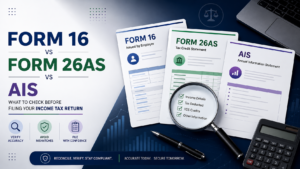
Here is the simplest way to remember them:
- Form 16: What your employer reports about your salary and salary TDS.
- Form 26AS: Your tax-credit statement, primarily useful for checking TDS/TCS and other tax-related credits.
- AIS: A broader information statement containing TDS/TCS and other financial information reported to the Income Tax Department.
- Bank/broker statements: Supporting records that help establish the actual income or transaction.
- ITR: Your final declaration of taxable income, deductions and taxes.
The Income Tax Department specifically advises taxpayers to download AIS and Form 26AS and reconcile actual TDS/TCS/tax-paid information before filing.
The key principle is simple:
Reconcile first. File second.
Form 16 vs Form 26AS vs AIS: Quick Comparison
| Particular | Form 16 | Form 26AS | AIS |
|---|---|---|---|
| Provided by | Employer | Income Tax Department | Income Tax Department |
| Main purpose | Salary and salary TDS certificate | Tax-credit statement | Comprehensive information statement |
| Salary details | Yes | Primarily tax-credit information | Can contain reported salary information |
| Salary TDS | Yes | Yes | Yes |
| Non-salary TDS | No | Yes | Yes |
| TCS | No | Yes | Yes |
| Bank interest | Not generally | Limited tax-credit relevance | Yes, where reported |
| Dividend information | No | Limited | Can be reported |
| Securities information | No | No | Can be reported |
| SFT information | No | Limited | Yes |
| Tax payments | No | Yes | Yes |
| Demand/refund information | No | Relevant tax information | Yes |
| Feedback facility | No | No | Yes |
The Income Tax Department describes Form 26AS as primarily displaying TDS/TCS-related information, while AIS provides a more comprehensive view including TDS/TCS, SFT information, tax payments, demand/refund and other reported information.
What Is Form 16?
Form 16 is the TDS certificate issued by an employer for salary income.
It gives an employee a structured summary of salary-related information and tax deducted by the employer.
For a salaried taxpayer, Form 16 is one of the most important documents used while preparing the ITR.
The Income Tax Department identifies Form 16 as the certificate of tax deducted at source on salary and states that it contains information relating to employee income, deductions/exemptions and TDS for computing tax payable or refundable.
What Should You Check in Form 16?
When you receive Form 16, do not simply upload it to your tax preparer and forget about it.
Check:
- PAN details
- Employer name
- TAN
- Assessment/financial-year details
- Gross salary
- Salary components
- Exemptions considered by the employer
- Standard deduction, where applicable
- Chapter VI-A deductions considered
- Taxable salary
- TDS deducted
- TDS deposited
- Tax-regime-related calculations
What If You Changed Jobs During the Year?
This is an important point for salaried taxpayers.
If you worked for two employers during FY 2025-26, your income and TDS may be reflected through two separate Form 16 certificates.
Do not file your return using only the Form 16 from your current employer.
Combine the information from both employers and reconcile it with AIS, Form 26AS, salary slips and your own records.
What Is Form 26AS?
Form 26AS is primarily a tax-credit statement available through the Income Tax e-Filing ecosystem.
It is particularly useful for verifying whether tax deducted or collected against your PAN is reflected correctly.
For example, suppose:
Employer TDS: ₹85,000
Bank TDS: ₹5,000
You should verify that the relevant tax credits have been properly reported.
The Income Tax Department’s current guidance states that Form 26AS contains TDS/TCS-related information, while several other categories of information that taxpayers may need for return preparation are available through AIS.
Why Form 26AS Matters
Imagine your Form 16 says that your employer deducted:
₹72,000 TDS
But your tax-credit records do not reflect the expected amount.
Do not automatically claim the full ₹72,000 without investigating.
The deductor may need to correct its TDS statement, or the information may not yet have been reflected.
The Income Tax Department specifically recommends reconciling discrepancies with the employer, tax deductor or bank.
What Is AIS?
AIS stands for Annual Information Statement.
It is broader than Form 26AS and is designed to give taxpayers a comprehensive view of information available with the Income Tax Department before filing their return.
The department says AIS is intended to display complete information to taxpayers, support voluntary compliance and enable smoother pre-filling of returns.
What Can AIS Show?
Depending on the information reported to the department, AIS can contain:
- Salary-related information
- TDS
- TCS
- Interest income
- Dividend information
- Securities-related information
- Specified financial transactions
- Tax payments
- Refund-related information
- Demand information
- Other reported financial information
The precise entries will depend on the taxpayer and reporting entities.
AIS Also Has a Feedback Facility
One important feature of AIS is that taxpayers can provide feedback on reported information.
The Income Tax Department explains that AIS contains information reported by sources and provides a facility through which taxpayers can submit feedback.
This is useful when an entry appears incorrect, duplicated or otherwise inconsistent with your actual records.
Form 16 vs Form 26AS vs AIS: Key Differences
1. Source
Form 16 comes from your employer.
Form 26AS and AIS are available through the Income Tax Department’s e-filing ecosystem.
2. Coverage
Form 16 is focused on salary income and salary TDS.
Form 26AS is primarily focused on tax credits such as TDS/TCS.
AIS provides a much broader view of financial and tax-related information reported against your PAN.
3. Main Use During ITR Filing
Use Form 16 to understand your salary computation.
Use Form 26AS to verify tax credits.
Use AIS to identify additional income and transactions that may need to be considered while preparing the return.
4. Should They Match Exactly?
No.
This is one of the most important points.
These documents have different purposes and different data sources.
For example, your Form 16 may show salary income while AIS may also contain interest income from your bank.
That does not mean the documents are inconsistent.
The objective is to make sure that all relevant information is correctly reflected in your ITR.
Which Document Should You Trust While Filing ITR?
Do not ask:
“Should I use Form 16, AIS or Form 26AS?”
Instead ask:
“What does each document tell me, and do all relevant figures reconcile with my actual records?”
The Income Tax Department’s own ITR guidance recommends reviewing Form 16, Form 26AS, AIS, bank statements, investment proofs and other supporting documents before filing.
A practical hierarchy is:
Form 16 → Salary verification
Form 26AS → Tax-credit verification
AIS → Wider income/transaction verification
Bank/Broker/Investment records → Actual transaction verification
ITR → Final tax declaration
What to Check Before Filing Your ITR
Check 1: Match Salary With Form 16
Start with your salary.
Compare:
Salary slips → Form 16 → AIS → ITR
Look for:
- Gross salary
- Taxable salary
- Employer contributions where applicable
- Exemptions
- Perquisites
- Arrears
- TDS
If you changed jobs, perform this exercise separately for each employer.
Check 2: Verify TDS in Form 26AS
Now verify your TDS.
For example:
| Source | TDS as per document |
|---|---|
| Employer | ₹80,000 |
| Bank FD | ₹8,000 |
| Other deductor | ₹2,000 |
| Total | ₹90,000 |
The relevant tax credits should be properly reflected in the tax records used for your return.
If a TDS credit is missing, contact the deductor and seek correction rather than blindly claiming an unsupported credit.
Check 3: Review AIS for Additional Income
This is where many taxpayers make mistakes.
A person may remember salary but forget:
- Savings-account interest
- Fixed-deposit interest
- Dividend income
- Securities transactions
- Other taxable receipts
- Certain financial transactions reported under SFT
The AIS can bring such information to your attention.
The Income Tax Department specifically advises taxpayers to study AIS and other financial records before filing.
Check 4: Compare Bank Interest
Do not assume that interest income is automatically included in your Form 16.
For example:
Salary: ₹8,50,000
Savings interest: ₹7,500
FD interest: ₹42,000
Your employer may correctly report only your salary-related information.
You still need to consider the applicable interest income while preparing your ITR.
Compare:
Bank statements → Interest certificates → AIS → ITR
Check 5: Review Investments and Capital Gains
If you invested in:
- Shares
- Mutual funds
- ETFs
- Bonds
- Other securities
you should review the relevant transaction and capital-gain records.
Do not rely solely on AIS for calculating the final taxable capital gain.
Use appropriate broker, registrar or investment statements to determine:
- Purchase cost
- Sale value
- Purchase date
- Sale date
- Corporate actions
- Capital gains/losses
- Applicable holding period
Then reconcile the relevant information appearing in AIS.
Can You File ITR Without Form 16?
Yes, in some situations, a taxpayer can prepare and file an ITR without having Form 16, but the absence of Form 16 does not eliminate the need to accurately determine salary income and TDS.
If Form 16 is unavailable, use other reliable records such as:
- Salary slips
- Bank statements
- Form 26AS
- AIS
- Employer payroll records
- TDS information
Recent 2026 guidance also notes that salaried taxpayers may still be able to file using AIS and Form 26AS when Form 16 is unavailable, provided their income and tax details can be accurately established.
However, if your employer was required to issue Form 16 and has not done so, it is advisable to follow up with the employer.
What If Form 16, AIS and 26AS Show Different Numbers?
This is one of the most common questions during ITR season.
The answer is:
Do not automatically choose the highest or lowest figure. Find the reason for the difference.
For example:
Form 16 salary: ₹10,00,000
AIS salary: ₹10,15,000
Bank credits: ₹10,15,000
The ₹15,000 difference might relate to a salary adjustment, bonus, arrear or another component.
Similarly, if Form 26AS shows TDS of ₹70,000 while Form 16 shows ₹75,000, investigate the difference before claiming the credit.
The purpose of reconciliation is to identify the correct underlying transaction, not merely to make three documents look identical.
A Simple Pre-ITR Checklist for AY 2026-27
Before clicking Submit, check the following:
- Download Form 16 from every employer.
- Download Form 26AS.
- Download and review AIS.
- Review TIS where useful.
- Match salary with Form 16.
- Match salary information with AIS.
- Verify TDS in Form 26AS.
- Check TDS/TCS information in AIS.
- Verify savings and FD interest.
- Check dividend income.
- Review share and mutual-fund transactions.
- Reconcile capital gains with broker statements.
- Check advance/self-assessment tax payments.
- Review eligible deductions.
- Check bank-account details.
- Select the correct ITR form.
- Review tax-regime selection.
- Check the final tax payable/refund.
- Submit and e-verify the return.
Why Reconciliation Matters More Than Ever
Tax reporting is increasingly data-driven.
The Income Tax Department receives information from multiple reporting sources, and AIS is specifically designed to provide taxpayers with a comprehensive view of information available before filing.
That means the old approach of:
“My Form 16 looks correct, so I will file.”
is no longer sufficient for many taxpayers.
A better approach is:
Form 16 + Form 26AS + AIS + Bank/Broker Records + ITR
This five-point check can help identify forgotten income, missing TDS, incorrect information and other discrepancies before submission.
When Should You Take Professional ITR Assistance?
Self-filing may be straightforward when you have one employer, one salary source and limited investments.
Professional assistance can become valuable when you have:
- Multiple employers
- Capital gains
- Rental income
- Foreign income/assets
- Multiple investment accounts
- Significant dividend income
- Business or professional income
- Large deductions
- TDS mismatches
- AIS discrepancies
- Tax notices
- Complicated tax-regime decisions
Junaid Khan & Co. offers Income Tax & Tax Planning and TDS/TCS Compliance services, along with accounting and broader financial advisory services.
The objective should not simply be to submit the ITR. It should be to submit a return that is complete, internally consistent and supported by reliable records.
Conclusion
Understanding Form 16 vs Form 26AS vs AIS is only the first step.
The more important task is knowing how to use all three before filing your Income Tax Return.
Form 16 helps verify salary and employer TDS. Form 26AS helps confirm tax credits. AIS provides a broader view of information reported to the Income Tax Department.
None should be treated as a substitute for your actual financial records.
Before filing your ITR for AY 2026-27, follow this sequence:
Collect → Compare → Reconcile → Correct → File → E-Verify
A few minutes spent checking your documents can help prevent avoidable TDS mismatches, missed income and compliance problems later.
Need help with ITR filing, TDS reconciliation or income-tax planning? Junaid Khan & Co. provides professional income-tax and compliance support to help taxpayers prepare accurate and properly reconciled returns.
6. FAQ SECTION
1. What is the difference between Form 16, Form 26AS and AIS?
Form 16 is an employer-issued salary TDS certificate. Form 26AS primarily provides tax-credit information such as TDS/TCS. AIS provides a broader view of financial and tax-related information reported to the Income Tax Department.
2. Is Form 16 enough to file an ITR?
No. Form 16 mainly covers salary-related information. Taxpayers may also need to check AIS, Form 26AS, bank statements, investment records and other documents to identify additional income and verify taxes paid.
3. Which is more important, AIS or Form 26AS?
Neither completely replaces the other. Form 26AS is particularly useful for checking tax credits, while AIS provides broader information about reported financial transactions and income-related information. Both should be reviewed before filing.
4. What should I do if Form 16 and AIS do not match?
First compare your salary slips, employer records and Form 16. Identify whether the difference relates to arrears, bonuses, job changes, adjustments or an employer reporting issue. If necessary, contact the employer for correction and ensure your ITR reflects the correct income.
5. Why is TDS missing from Form 26AS?
TDS may be missing because the deductor’s TDS statement has not been correctly filed, the PAN details may be incorrect, a correction may be pending or the information may not yet have been reflected. Contact the deductor and verify the relevant TDS records before claiming the credit.
6. Does AIS show salary income?
AIS can contain salary-related information reported by the relevant source. However, taxpayers should still verify salary against Form 16, salary slips and employer records rather than relying on AIS alone.
7. Can I file my ITR without Form 16?
Yes, depending on your circumstances, you may be able to prepare the return using salary records, AIS, Form 26AS and other supporting documents. However, if Form 16 should have been issued, it is advisable to obtain it from the employer.
8. Should I check AIS before filing my ITR?
Yes. The Income Tax Department itself advises taxpayers to download AIS and Form 26AS and reconcile the information before filing their return.
Blog By : CA Junaid Khan
Written by CA Junaid Ahmed Khan, Junaid Khan & Co., Bhopal.