

Form 16 vs Form 26AS vs AIS: What to Check Before Filing Your Income Tax Return
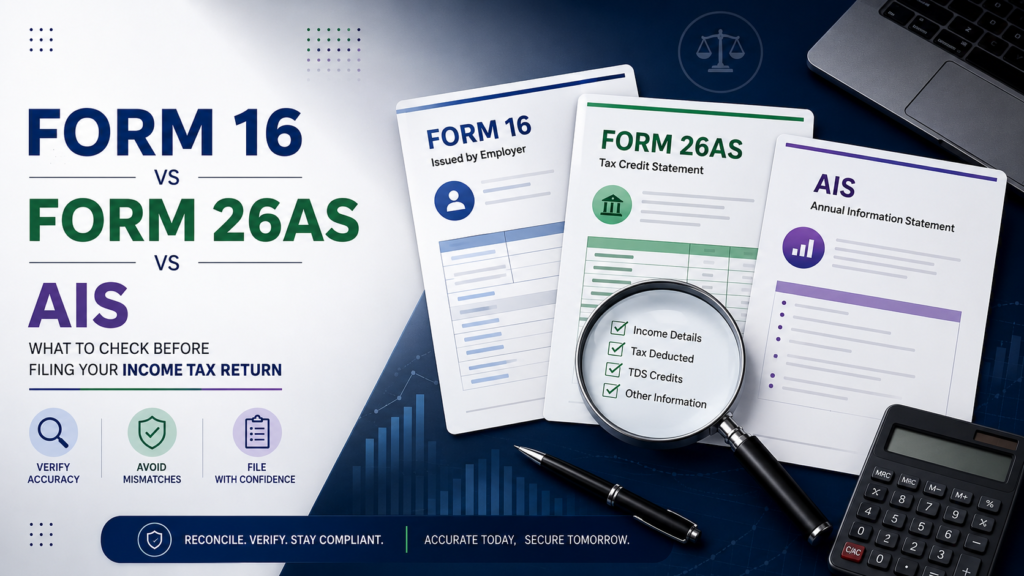
TL;DR If you are filing your Income Tax Return for FY 2025-26 / AY 2026-27, do not rely only on Form 16. You should review Form 16, Form 26AS and AIS together, along with your salary slips, bank statements, investment records and other relevant documents. Here is the simplest way to remember them: Form 16: What your employer reports about your salary and salary TDS. Form 26AS: Your tax-credit statement, primarily useful for checking TDS/TCS and other tax-related credits. AIS: A broader information statement containing TDS/TCS and other financial information reported to the Income Tax Department. Bank/broker statements: Supporting records that help establish the actual income or transaction. ITR: Your final declaration of taxable income, deductions and taxes. The Income Tax Department specifically advises taxpayers to download AIS and Form 26AS and reconcile actual TDS/TCS/tax-paid information before filing. The key principle is simple: Reconcile first. File second. Form 16 vs Form 26AS vs AIS: Quick Comparison Particular Form 16 Form 26AS AIS Provided by Employer Income Tax Department Income Tax Department Main purpose Salary and salary TDS certificate Tax-credit statement Comprehensive information statement Salary details Yes Primarily tax-credit information Can contain reported salary information Salary TDS Yes Yes Yes Non-salary TDS No Yes Yes TCS No Yes Yes Bank interest Not generally Limited tax-credit relevance Yes, where reported Dividend information No Limited Can be reported Securities information No No Can be reported SFT information No Limited Yes Tax payments No Yes Yes Demand/refund information No Relevant tax information Yes Feedback facility No No Yes The Income Tax Department describes Form 26AS as primarily displaying TDS/TCS-related information, while AIS provides a more comprehensive view including TDS/TCS, SFT information, tax payments, demand/refund and other reported information. What Is Form 16? Form 16 is the TDS certificate issued by an employer for salary income. It gives an employee a structured summary of salary-related information and tax deducted by the employer. For a salaried taxpayer, Form 16 is one of the most important documents used while preparing the ITR. The Income Tax Department identifies Form 16 as the certificate of tax deducted at source on salary and states that it contains information relating to employee income, deductions/exemptions and TDS for computing tax payable or refundable. What Should You Check in Form 16? When you receive Form 16, do not simply upload it to your tax preparer and forget about it. Check: PAN details Employer name TAN Assessment/financial-year details Gross salary Salary components Exemptions considered by the employer Standard deduction, where applicable Chapter VI-A deductions considered Taxable salary TDS deducted TDS deposited Tax-regime-related calculations What If You Changed Jobs During the Year? This is an important point for salaried taxpayers. If you worked for two employers during FY 2025-26, your income and TDS may be reflected through two separate Form 16 certificates. Do not file your return using only the Form 16 from your current employer. Combine the information from both employers and reconcile it with AIS, Form 26AS, salary slips and your own records. What Is Form 26AS? Form 26AS is primarily a tax-credit statement available through the Income Tax e-Filing ecosystem. It is particularly useful for verifying whether tax deducted or collected against your PAN is reflected correctly. For example, suppose: Employer TDS: ₹85,000 Bank TDS: ₹5,000 You should verify that the relevant tax credits have been properly reported. The Income Tax Department’s current guidance states that Form 26AS contains TDS/TCS-related information, while several other categories of information that taxpayers may need for return preparation are available through AIS. Why Form 26AS Matters Imagine your Form 16 says that your employer deducted: ₹72,000 TDS But your tax-credit records do not reflect the expected amount. Do not automatically claim the full ₹72,000 without investigating. The deductor may need to correct its TDS statement, or the information may not yet have been reflected. The Income Tax Department specifically recommends reconciling discrepancies with the employer, tax deductor or bank. What Is AIS? AIS stands for Annual Information Statement. It is broader than Form 26AS and is designed to give taxpayers a comprehensive view of information available with the Income Tax Department before filing their return. The department says AIS is intended to display complete information to taxpayers, support voluntary compliance and enable smoother pre-filling of returns. What Can AIS Show? Depending on the information reported to the department, AIS can contain: Salary-related information TDS TCS Interest income Dividend information Securities-related information Specified financial transactions Tax payments Refund-related information Demand information Other reported financial information The precise entries will depend on the taxpayer and reporting entities. AIS Also Has a Feedback Facility One important feature of AIS is that taxpayers can provide feedback on reported information. The Income Tax Department explains that AIS contains information reported by sources and provides a facility through which taxpayers can submit feedback. This is useful when an entry appears incorrect, duplicated or otherwise inconsistent with your actual records. Form 16 vs Form 26AS vs AIS: Key Differences 1. Source Form 16 comes from your employer. Form 26AS and AIS are available through the Income Tax Department’s e-filing ecosystem. 2. Coverage Form 16 is focused on salary income and salary TDS. Form 26AS is primarily focused on tax credits such as TDS/TCS. AIS provides a much broader view of financial and tax-related information reported against your PAN. 3. Main Use During ITR Filing Use Form 16 to understand your salary computation. Use Form 26AS to verify tax credits. Use AIS to identify additional income and transactions that may need to be considered while preparing the return. 4. Should They Match Exactly? No. This is one of the most important points. These documents have different purposes and different data sources. For example, your Form 16 may show salary income while AIS may also contain interest income from your bank. That does not mean the documents are inconsistent. The objective is to make sure that all relevant information is correctly reflected in your ITR. Which Document Should You Trust While Filing ITR? Do