


TL;DR
Introduction
GST return filing is one of the most important recurring compliance responsibilities for registered businesses in India. However, many business owners find it difficult to understand the difference between GSTR-1, GSTR-3B and GSTR-9.
Although these returns are connected, each serves a different purpose.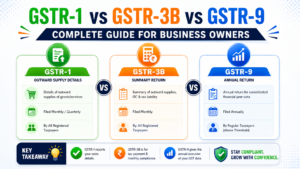
GSTR-1 primarily reports details of outward supplies. GSTR-3B is a summary return used to report GST liability and eligible Input Tax Credit (ITC) and pay the resulting tax. GSTR-9 is an annual return that consolidates relevant GST information for the financial year, subject to applicable requirements and exemptions.
Understanding GSTR-1 vs GSTR-3B vs GSTR-9 is important because errors in one return can create reconciliation issues in another. Differences between sales records, GST returns, books of accounts and ITC records can eventually result in notices, additional tax liability or compliance complications.
This guide explains what each return means, how they differ, how they work together and how business owners can maintain accurate GST compliance.
What Is GSTR-1?
GSTR-1 is a GST return used to report details of outward supplies made by a registered taxpayer during the relevant tax period.
It primarily focuses on sales and other applicable outward-supply transactions.
Depending on the taxpayer and transactions, GSTR-1 may contain information relating to:
- Business-to-business (B2B) supplies
- Business-to-consumer (B2C) supplies
- Export supplies
- Credit notes
- Debit notes
- Amendments to previously reported transactions
- Other applicable outward supplies
Why Is GSTR-1 Important?
GSTR-1 is important not only for the supplier but also for customers purchasing from that supplier.
For example, if a business makes a B2B sale and reports the customer’s GSTIN incorrectly, the recipient may face difficulty reconciling the purchase and claiming eligible ITC.
Similarly, an incorrect invoice number, taxable value or GST amount can create discrepancies between the supplier’s records and the recipient’s records.
Therefore, businesses should prepare GSTR-1 using accurate sales records and verify the information before filing.
What Is GSTR-3B?
GSTR-3B is a summary GST return used to declare applicable outward tax liability, eligible Input Tax Credit and the resulting tax payable.
Unlike GSTR-1, GSTR-3B does not primarily function as an invoice-by-invoice outward-supply reporting return.
A business generally uses information from its:
- Books of accounts
- Sales register
- GSTR-1
- GSTR-2B
- Purchase records
- ITC workings
- Previous-period adjustments
to prepare GSTR-3B.
Why Is GSTR-3B Important?
GSTR-3B directly relates to the taxpayer’s GST liability and tax payment.
An incorrect GSTR-3B can therefore affect:
- GST payable
- ITC claimed
- Cash flow
- Interest exposure
- Reconciliation
- Future GST scrutiny
Businesses should avoid simply copying figures from their accounting software without performing appropriate GST reconciliation.
What Is GSTR-9?
GSTR-9 is an annual GST return applicable to specified registered taxpayers, subject to the exemptions, thresholds and requirements applicable for the relevant financial year.
It provides an annual view of relevant GST information reported during the year.
GSTR-9 can involve information relating to:
- Outward supplies
- Taxable turnover
- Tax liability
- ITC
- Tax paid
- Amendments
- Other relevant GST information
The annual return should ideally be prepared after reconciling the underlying books and periodic GST returns.
GSTR-1 vs GSTR-3B vs GSTR-9: Key Difference
The simplest way to understand the three returns is:
GSTR-1 = What did the business sell?
GSTR-3B = What GST liability and eligible ITC does the business need to report and pay?
GSTR-9 = What was the business’s overall GST position for the financial year?
| Particular | GSTR-1 | GSTR-3B | GSTR-9 |
|---|---|---|---|
| Main purpose | Report outward supplies | Report liability and ITC and pay tax | Annual GST return |
| Frequency | Periodic | Periodic | Annual |
| Main focus | Sales/outward supplies | GST liability and eligible ITC | Annual consolidation |
| Invoice-level outward details | Yes, where applicable | No | Annual reporting |
| ITC | Not its primary purpose | Reported | Annual reporting/reconciliation |
| Tax payment | No direct payment through the return | Yes | Annual return framework |
| Main records used | Sales register | Books, sales and ITC records | Books + periodic GST returns |
How GSTR-1, GSTR-3B and GSTR-9 Work Together
These returns should not be treated as completely separate compliance activities.
A business’s GST compliance process can be viewed as:
Sales Transactions
↓
Sales Register
↓
GSTR-1
↓
GSTR-3B
↓
Annual Reconciliation
↓
GSTR-9
On the purchase and ITC side, businesses should maintain:
Purchase Register
↓
GSTR-2B
↓
Eligible ITC Calculation
↓
GSTR-3B
↓
Annual Reconciliation
This is why maintaining accurate books and performing regular reconciliation is essential.
Difference Between GSTR-1 and GSTR-3B
The primary difference is their reporting purpose.
GSTR-1
Focuses mainly on details of outward supplies.
GSTR-3B
Focuses on summary GST liability, eligible ITC and payment of the resulting tax liability.
For example, if a business sells goods worth ₹20 lakh during a tax period, the detailed applicable outward-supply information is reported through GSTR-1.
The corresponding GST liability is then considered while preparing GSTR-3B, along with eligible ITC and other applicable adjustments.
Therefore, the two returns should be reconciled regularly.
Difference Between GSTR-3B and GSTR-9
The major difference is their filing frequency and purpose.
GSTR-3B is a periodic return.
GSTR-9 is an annual return, where applicable.
GSTR-3B deals with the tax liability and ITC position for the relevant filing period, whereas GSTR-9 provides an annual view of the relevant GST information for the financial year.
Because GSTR-9 covers the year as a whole, businesses should ideally complete annual reconciliation before preparing it.
Why GSTR-1 and GSTR-3B Reconciliation Is Important
One common GST compliance issue is a mismatch between outward supplies reported in GSTR-1 and the corresponding figures reported in GSTR-3B.
For example:
GSTR-1 taxable turnover: ₹60 lakh
GSTR-3B taxable turnover: ₹55 lakh
Difference: ₹5 lakh
This does not automatically mean that the business has made an error.
The difference could arise because of:
- Credit notes
- Amendments
- Timing differences
- Previous-period transactions
- Classification errors
- Data-entry mistakes
- Incorrect reporting
- Other legitimate adjustments
However, the difference should be investigated and properly documented.
Common GSTR-1 Mistakes
Incorrect GSTIN
Entering an incorrect customer GSTIN can affect the recipient’s GST reconciliation.
Incorrect Invoice Details
Invoice numbers and dates should correspond with the books and supporting documents.
Wrong Tax Rate
Applying an incorrect GST rate can result in incorrect tax reporting.
Incorrect Place of Supply
Place-of-supply errors can affect whether a transaction is reported under IGST or CGST/SGST.
Duplicate Invoices
The same invoice should not be reported more than once.
Credit and Debit Note Errors
Credit notes and debit notes should be properly recorded and reported.
Ignoring Amendments
Businesses should maintain appropriate records of corrections and amendments to previously reported transactions.
Common GSTR-3B Mistakes
Businesses may face problems when they:
- Report incorrect outward tax liability
- Claim ineligible ITC
- Miss eligible ITC
- Ignore ITC reversal requirements
- Fail to reconcile GSTR-2B
- Incorrectly classify IGST, CGST or SGST
- Copy figures without reviewing the underlying records
- Ignore previous-period adjustments
- Report incorrect tax payments
Since GSTR-3B is directly connected with GST payment, these mistakes can have a direct financial impact.
Why GSTR-9 Reconciliation Matters
GSTR-9 should ideally be prepared after comparing the annual books with the GST returns filed throughout the year.
A useful reconciliation framework is:
Books of Accounts
↕
GSTR-1
↕
GSTR-3B
↕
GSTR-2B / ITC Records
The reconciliation can help identify:
- Turnover differences
- Unreported sales
- Excess reporting
- ITC differences
- Credit-note mismatches
- Tax-payment differences
- Amendments
- Classification errors
- Previous-period adjustments
Practical Example: GSTR-1 vs GSTR-3B
Suppose a business has taxable outward supplies of ₹50 lakh during a particular period.
The business records the transactions in its accounting system and reports the applicable details through GSTR-1.
While preparing GSTR-3B, the business determines its applicable GST liability and eligible ITC.
If the business reports ₹50 lakh of taxable outward supplies in GSTR-1 but ₹47 lakh in GSTR-3B, the ₹3 lakh difference should be reviewed.
The business should determine whether the difference is caused by:
- A credit note
- A reporting adjustment
- A timing issue
- An incorrect entry
- An actual omission
This type of reconciliation should be completed before the difference becomes a larger compliance problem.
GSTR-9 Preparation: Step-by-Step Process
Step 1: Finalise the Books
Make sure the accounting records for the relevant financial year are complete and properly reviewed.
Step 2: Reconcile Annual Turnover
Compare turnover in the books with turnover reported through GST returns.
Step 3: Reconcile GSTR-1
Review outward supplies, amendments, credit notes and debit notes.
Step 4: Reconcile GSTR-3B
Compare reported liability and tax payments with the underlying records.
Step 5: Review ITC
Reconcile purchase records, GSTR-2B and ITC reported in GSTR-3B.
Step 6: Investigate Differences
Prepare explanations and supporting documentation for material differences.
Step 7: Verify GSTR-9 Applicability
Check the filing requirements, exemptions and applicable rules for the relevant financial year.
GST Return Filing Checklist for Business Owners
Before Filing GSTR-1
- Review sales register
- Verify GSTINs
- Check invoice numbers
- Verify taxable values
- Check GST rates
- Review place of supply
- Verify credit notes
- Check debit notes
- Review amendments
- Remove duplicate entries
Before Filing GSTR-3B
- Reconcile GSTR-1
- Review outward GST liability
- Reconcile GSTR-2B
- Calculate eligible ITC
- Review blocked ITC
- Check ITC reversals
- Verify tax payable
- Review previous-period adjustments
- Confirm tax payment
Before Preparing GSTR-9
- Finalise annual books
- Reconcile annual turnover
- Reconcile GSTR-1
- Reconcile GSTR-3B
- Review ITC
- Review tax payments
- Check amendments
- Investigate differences
- Maintain supporting reconciliation workings
- Verify annual return applicability
How Businesses Can Avoid GST Return Mismatches
GST reconciliation should not be treated as a year-end activity.
A monthly process is much more effective.
Businesses should maintain a reconciliation system covering:
Sales Register → GSTR-1 → GSTR-3B
and:
Purchase Register → GSTR-2B → Eligible ITC → GSTR-3B
This allows businesses to identify discrepancies while the relevant transaction details are still easy to verify.
Why Professional GST Assistance Can Help
GST compliance becomes increasingly complex as a business grows.
A Chartered Accountant or GST professional can assist with:
- GSTR-1 preparation
- GSTR-3B filing
- GSTR-2B reconciliation
- ITC review
- ITC reversal
- GSTR-9 preparation
- GST reconciliation
- GST compliance reviews
- GST notice assistance
- Accounting and bookkeeping
For businesses with high transaction volumes, multiple vendors or complex transactions, professional review can help establish stronger GST controls.
Conclusion
Understanding GSTR-1 vs GSTR-3B vs GSTR-9 is essential for maintaining accurate GST compliance.
GSTR-1 focuses primarily on outward-supply reporting. GSTR-3B provides a periodic summary of applicable GST liability and eligible ITC along with tax payment. GSTR-9 provides an annual view of relevant GST information where applicable.
The most important principle for business owners is to avoid treating these returns as isolated forms.
Instead, maintain a connected compliance system:
Books → GSTR-1 → GSTR-2B → GSTR-3B → Annual Reconciliation → GSTR-9
Regular reconciliation can help identify errors early, improve financial control and reduce the risk of unexplained GST discrepancies.
Frequently Asked Questions
1. What is the difference between GSTR-1 and GSTR-3B?
GSTR-1 primarily reports applicable details of outward supplies, while GSTR-3B is a summary return used to report GST liability and eligible ITC and discharge the resulting tax liability.
2. What is the difference between GSTR-3B and GSTR-9?
GSTR-3B is a periodic GST return, while GSTR-9 is an annual return applicable to specified taxpayers, subject to the rules and exemptions applicable for the relevant financial year.
3. Does GSTR-9 replace GSTR-1 and GSTR-3B?
No. GSTR-9 does not replace periodic GST returns. Businesses must continue filing the applicable periodic returns such as GSTR-1 and GSTR-3B.
4. Can GSTR-1 and GSTR-3B have different figures?
Differences can occur because of credit notes, amendments, timing differences, previous-period transactions or reporting errors. However, material differences should be investigated and properly reconciled.
5. What happens if GSTR-1 turnover is higher than GSTR-3B?
The difference should be investigated to determine whether it results from a legitimate adjustment, timing difference, reporting mistake or potential tax short-payment. The appropriate corrective action depends on the underlying transactions and applicable GST provisions.
6. What happens if GSTR-3B turnover is higher than GSTR-1?
The difference should also be reconciled. Businesses should check their books, GST returns, amendments, credit notes and reporting periods to identify the reason.
7. Who needs to file GSTR-9?
GSTR-9 applies to specified registered taxpayers, subject to applicable exemptions, thresholds and government notifications for the relevant financial year. Businesses should verify the requirements applicable to their specific circumstances.
8. How often should GST returns be reconciled?
Businesses should ideally reconcile their GST data during every filing period rather than waiting until the end of the financial year. Annual reconciliation should then be completed before preparing the applicable annual return.
9. What are common GSTR-1 mistakes?
Common mistakes include incorrect GSTINs, invoice numbers, taxable values, GST rates, place-of-supply details, duplicate invoices, credit-note errors and incorrect amendments.
10. What are common GSTR-3B mistakes?
Common mistakes include incorrect GST liability, excess or ineligible ITC, missed reversals, failure to reconcile GSTR-2B, incorrect tax classification and errors in tax payment.
11. How can businesses avoid GST return mismatches?
Businesses should regularly reconcile their books with GSTR-1, GSTR-2B and GSTR-3B. Any material difference should be investigated and supported with proper documentation.
12. Can a Chartered Accountant help with GSTR-1, GSTR-3B and GSTR-9?
Yes. A Chartered Accountant can assist with applicable GST return filing, reconciliation, ITC review, annual-return preparation and GST compliance based on the business’s requirements.
Blog By : CA Junaid Khan
Written by CA Junaid Ahmed Khan, Junaid Khan & Co., Bhopal.