

GST Reconciliation Before Tax Audit: How to Match Books, GSTR-1 & GSTR-3B
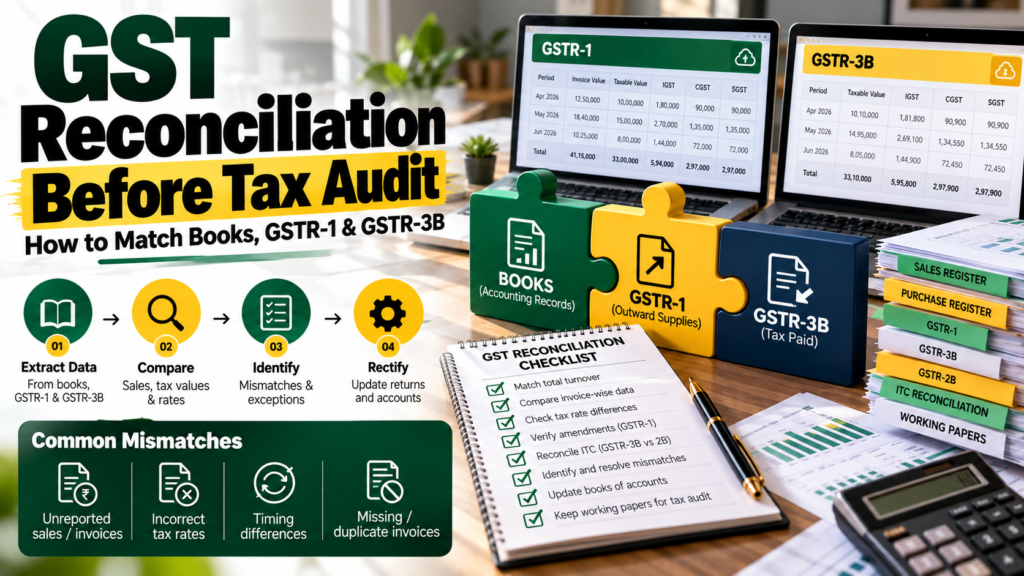
TL;DR GST reconciliation before a tax audit helps businesses identify differences between accounting records, outward-supply data reported in GSTR-1 and tax liability declared in GSTR-3B. Common differences arise due to credit notes, amendments, advances, exempt supplies, timing differences, wrong GST rates, missed invoices and accounting adjustments. A proper reconciliation should compare the books with GST returns, classify every difference, verify tax liability and document the reasons before finalizing the tax audit and income-tax return. Introduction GST data has become an important part of a business’s overall tax-compliance framework. Before completing a tax audit, businesses should ensure that their accounting records and GST returns present a consistent picture of sales, purchases, expenses and tax liabilities. One of the most important checks is the reconciliation between Books of Accounts, GSTR-1 and GSTR-3B. The three records serve different purposes. Books contain the business’s accounting records, GSTR-1 primarily reports outward supplies, while GSTR-3B is a summary return through which taxpayers declare GST liabilities and eligible input tax credit. Because these records are prepared for different purposes, a difference does not automatically mean that there is an error. However, every material difference should be identified, investigated and properly explained. A detailed GST reconciliation before tax audit can help businesses detect under-reporting, excess reporting, incorrect tax rates, missed invoices, duplicate entries and other issues before the financial statements and tax computation are finalized. Why GST Reconciliation Is Important Before Tax Audit GST reconciliation is important because turnover reported in GST returns can be compared with the turnover recorded in the financial statements and considered during income-tax compliance. An unexplained difference can create questions about: Turnover GST liability Sales invoices Credit notes Taxable and exempt supplies Revenue recognition Input tax credit Tax payments Year-end accounting adjustments A proper reconciliation does not necessarily mean that all three figures must be identical. Instead, the objective is to understand and document legitimate differences. For example, a business may have income in its books that is outside the scope of GST, or an accounting entry may relate to a transaction reported in a different GST period. Books vs GSTR-1 vs GSTR-3B: What Is the Difference? Before beginning reconciliation, it is important to understand what each record represents. Books of Accounts The books record the business’s financial transactions, including: Sales Purchases Expenses Receipts Credit notes Debit notes Other income GST collected GST paid Receivables and payables The financial statements are ultimately prepared from these accounting records. GSTR-1 GSTR-1 contains details of outward supplies reported by the taxpayer. Depending on the taxpayer and transaction, it can include information relating to: Business-to-business supplies Business-to-consumer supplies Export supplies Credit notes Debit notes Amendments Advances in applicable cases Other outward-supply information GSTR-3B GSTR-3B is a summary return used to declare GST liability and eligible input tax credit and to discharge the resulting tax liability. Therefore, GSTR-3B should not be expected to contain the same invoice-level information as GSTR-1. The reconciliation should focus on whether the underlying transactions and tax liabilities have been correctly captured across the three records. Step 1: Extract the Sales Data From the Books The first step is to obtain the complete sales data from the accounting system for the relevant financial year. The reconciliation file should ideally include: Invoice number Invoice date Customer GSTIN Taxable value CGST SGST/UTGST IGST GST rate Place of supply Credit notes Debit notes Amendments Exempt supplies Zero-rated supplies Non-GST supplies The sales register should be finalized before comparing it with GST returns. Step 2: Download and Compile GSTR-1 Data Businesses should compile their GSTR-1 data for all relevant tax periods. Rather than checking only the annual total, an invoice-level or transaction-level comparison is more useful. The reconciliation should consider: B2B invoices B2C supplies Export invoices Credit notes Debit notes Amendments Advances where applicable Nil-rated/exempt supplies Other outward supplies Businesses should also check whether invoices reported in one period were amended or cancelled in a subsequent period. Step 3: Reconcile GSTR-1 With GSTR-3B The next step is to compare outward-supply information reported in GSTR-1 with the corresponding liability declared in GSTR-3B. The comparison should cover: Taxable turnover IGST liability CGST liability SGST/UTGST liability Reverse-charge liability where relevant Credit notes Adjustments Amendments A mismatch may be caused by timing differences, corrections or other legitimate adjustments. However, unexplained differences should be investigated before tax-audit reporting is finalized. Step 4: Compare GST Turnover With Books After reconciling GSTR-1 and GSTR-3B, compare GST turnover with the sales and revenue figures in the books. A simple reconciliation can be structured as: Turnover as per Books Add: Items recorded in books but not reported in GST returns, where applicable Less: Items reported in GST returns but not recognized as revenue in the books, where applicable Add/Less: Timing differences, credit notes, advances and other reconciling items Equals: GST-reconciled turnover The exact format should depend on the nature of the business and the transactions involved. Common Reasons for Differences Between Books and GSTR-1 1. Credit Notes A credit note may be recorded in the books in one period but reported in a different GST period. This can create a temporary mismatch. 2. Debit Notes Debit notes can similarly create differences when accounting recognition and GST reporting occur in different periods. 3. Amendments An invoice may initially be reported incorrectly and subsequently amended through the GST return. If the books reflect the corrected transaction while the return history contains both original and amended reporting, a simple total comparison may be misleading. 4. Exempt or Non-GST Income Not every amount appearing in the income statement is necessarily taxable under GST. Examples can include certain: Interest income Exempt supplies Non-GST supplies Other income items The nature of each item should be reviewed rather than assuming that all accounting revenue must appear as taxable turnover in GSTR-1. 5. Timing Differences An invoice may be accounted for at one point while its GST reporting falls into another tax period depending on the applicable GST rules and transaction circumstances. Year-end transactions require particular attention. Common Reasons for Differences Between GSTR-1 and
GST Compliance in 2026: New Rules, ITC Reconciliation & Common Business Mistakes
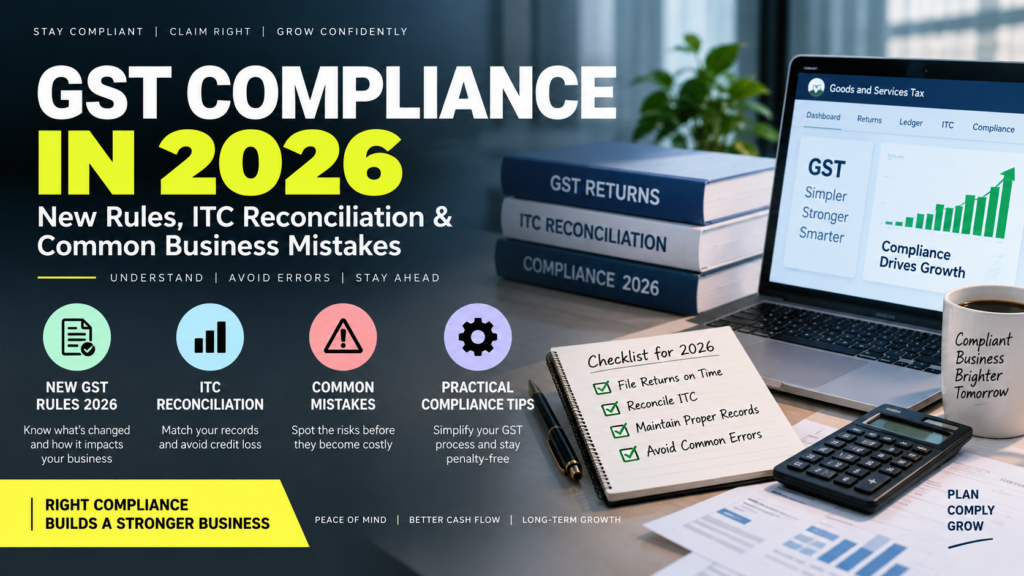
TL;DR GST compliance in 2026 is becoming increasingly data-driven and reconciliation-focused. Businesses can no longer treat GST return filing as simply entering figures into GSTR-1 and GSTR-3B. Accurate ITC reconciliation, invoice matching, timely return filing, e-invoicing compliance and supplier follow-up are now critical parts of GST management. The Invoice Management System (IMS), GSTR-1/GSTR-1A, GSTR-2B and e-invoicing ecosystem have made invoice-level accuracy increasingly important. Businesses should regularly compare their purchase register with GST portal data before claiming ITC. Common mistakes such as claiming credit without proper documentation, ignoring supplier mismatches, reporting incorrect invoice details, missing amendments and failing to reconcile ITC can result in blocked credit, interest, notices and unnecessary working-capital pressure. Introduction GST compliance has changed significantly since the introduction of India’s indirect-tax system. For businesses in 2026, simply filing GSTR-1 and GSTR-3B on time is not enough. Businesses must also ensure that the information reported by them aligns with invoices uploaded by suppliers and the data available through the GST system. This is particularly important for Input Tax Credit (ITC). A purchase invoice may appear correctly in a company’s accounting software, but that does not automatically mean the corresponding ITC can be claimed without verification. Businesses now need a structured process involving purchase-register reconciliation, supplier communication, invoice verification and periodic review of GST portal data. The GST ecosystem has also become more technology-driven through mechanisms such as Invoice Management System (IMS), GSTR-2B, e-invoicing and return-level validations. This makes GST compliance an ongoing financial-control function rather than a once-a-month filing activity. What Is GST Compliance in 2026? GST compliance refers to the complete process of meeting the requirements applicable to a registered taxpayer under GST. This can include: GST registration maintenance Tax invoice compliance E-invoicing where applicable GSTR-1 filing GSTR-3B filing GSTR-2B review ITC reconciliation Reverse charge compliance GST payment E-way bill compliance GST refund documentation Credit and debit note reporting Annual return requirements where applicable Responding to GST notices A business that focuses only on return filing can still have significant compliance gaps. The objective should therefore be to maintain accurate books → accurate invoices → accurate GST data → reconciled ITC → accurate returns. Major GST Compliance Areas Businesses Should Watch in 2026 Invoice-Level Accuracy The first step toward GST compliance is generating accurate invoices. Businesses should verify: GSTIN of supplier and recipient Legal name Place of supply HSN/SAC Taxable value GST rate CGST/SGST/IGST Invoice number Invoice date E-invoice details where applicable Even a small error in GSTIN or invoice number can create reconciliation problems. GSTR-1 Compliance GSTR-1 contains details of outward supplies. Businesses should reconcile sales data from their accounting system with the invoices reported in GSTR-1. Errors in outward supplies can affect the recipient’s ITC and may also create differences between books, GSTR-1 and GSTR-3B. GSTR-3B Compliance GSTR-3B is used to report summary information relating to outward supplies, tax liability and ITC. Businesses should ensure that the ITC reported in GSTR-3B is supported by proper reconciliation and eligibility checks. The goal should not simply be to “match the number” but to establish that the claimed credit is legally eligible and properly supported. What Is ITC Reconciliation? ITC reconciliation is the process of comparing the ITC recorded in the company’s books with the ITC reflected through GST portal data and identifying differences. A typical reconciliation compares: Purchase Register with GSTR-2B and relevant supplier-reported invoice data. The reconciliation process helps identify: Missing invoices Duplicate invoices Incorrect GSTIN Incorrect invoice numbers Wrong invoice dates Supplier filing delays Credit notes Debit notes Amendments Ineligible ITC ITC already claimed ITC requiring further verification Why GSTR-2B Reconciliation Matters GSTR-2B provides taxpayers with a statement of eligible and other relevant ITC information based on supplier filings and other data available on the GST system. Businesses should therefore review GSTR-2B before finalising their ITC claim. However, matching an invoice with GSTR-2B does not by itself establish that the credit is legally eligible. The business should also consider other statutory conditions. For example, the underlying purchase should relate to business purposes and the taxpayer should possess the required tax documentation. Therefore: GSTR-2B matching ≠ automatic ITC eligibility. This distinction is extremely important. Invoice Management System and ITC in 2026 The Invoice Management System (IMS) has made invoice-level review even more relevant. IMS enables recipients to interact with supplier-reported invoices by taking appropriate actions according to the functionality available on the GST portal. Businesses should therefore establish an internal process for reviewing invoices rather than leaving the entire exercise until the GSTR-3B filing deadline. A finance team should periodically review whether invoices appearing in the GST system are: Accepted Rejected or require appropriate action/review. The objective is to ensure that only appropriate credit flows into the return-filing process. GSTR-1A and Correction of Outward Supplies Businesses should also understand the role of GSTR-1A. GSTR-1A provides an opportunity, where applicable, to amend or add details of outward supplies for a particular tax period before filing GSTR-3B. This can be useful when errors or omissions are identified after GSTR-1 has been filed. However, businesses should not treat GSTR-1A as a substitute for proper invoice-level controls. The best approach is still to verify sales data before the original GSTR-1 is filed. GST ITC Reconciliation Process for Businesses Step 1: Export the Purchase Register Start with the company’s accounting records. Prepare a complete purchase register containing: Supplier GSTIN Invoice number Invoice date Taxable value IGST CGST SGST Total invoice value Step 2: Download GSTR-2B Obtain the relevant GSTR-2B from the GST portal. The data should then be compared with the company’s purchase register. Step 3: Match Invoice Details Match invoices using relevant fields such as: GSTIN + invoice number + invoice date + taxable value + tax amount This helps identify exact matches and exceptions. Step 4: Categorise Differences Not every mismatch has the same reason. Businesses can classify differences as: Missing in GSTR-2B The invoice exists in the books but is not appearing in the GST data. Missing in Books The supplier has reported an invoice but the business
GST Registration in 2026: New Bank Account Verification Rules & Common Rejection Reasons
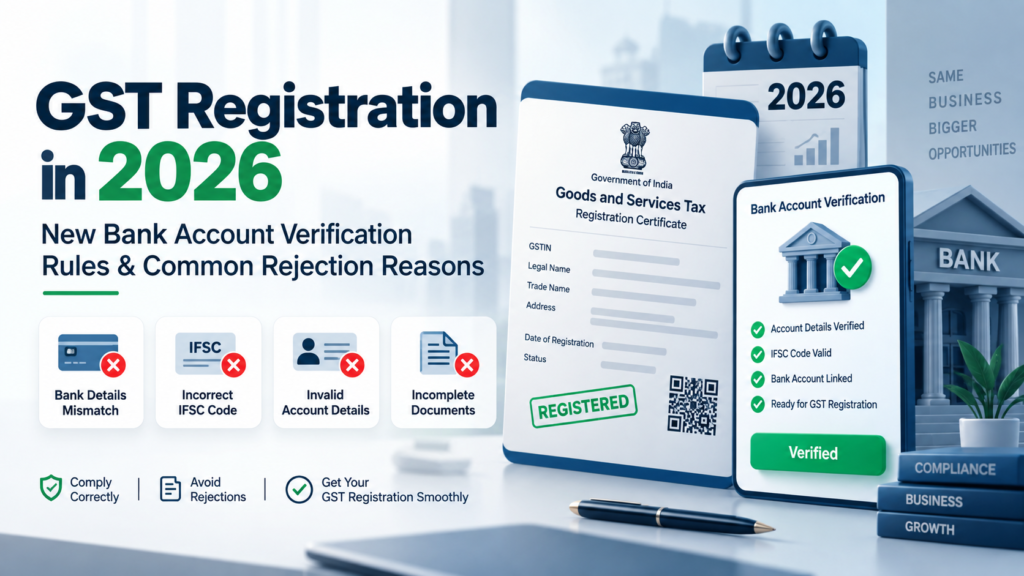
TL;DR GST registration in 2026 involves more than simply submitting PAN, Aadhaar and business documents. The GST system has strengthened verification and compliance checks, particularly around bank account details, Aadhaar authentication, business premises and supporting documents. Under Rule 10A of the CGST Rules, registered taxpayers generally have to furnish valid bank account details within 30 days of registration or before furnishing GSTR-1/IFF, whichever is earlier. GSTN has also operationalised an automated suspension mechanism where required bank details are not furnished within the prescribed period. Applicants can also face queries, clarification notices or rejection when business addresses, ownership/rent documents, PAN details, authorised signatory information or Aadhaar authentication do not match the information submitted. Introduction GST registration is an important compliance step for businesses, freelancers, professionals, traders and service providers crossing the applicable registration threshold or becoming liable under other provisions of GST law. However, obtaining a GSTIN in 2026 requires greater attention to document consistency and verification. The GST Portal uses several checks involving PAN, Aadhaar, business constitution, principal place of business, authorised signatories and bank-account information. One important point often misunderstood is that bank account details are generally furnished after GST registration rather than being a mandatory field for obtaining the GSTIN itself. The GST Portal’s current guidance states that the bank-account tab is optional during the initial registration process and that bank details are added through a non-core amendment after registration. At the same time, failing to provide the required bank information after registration can have serious consequences. So, what exactly has changed, what does bank verification mean in practice, and why are GST registration applications rejected or delayed? GST Registration in 2026: What Applicants Need to Know The GST registration process starts with submission of FORM GST REG-01 on the GST Portal. Depending on the applicant and risk parameters, the process can involve: PAN verification Aadhaar authentication OTP-based verification Biometric authentication Verification of business premises Document scrutiny by the tax officer Clarification through REG-03 Bank-account verification after registration Aadhaar authentication has become an important part of the registration ecosystem. The GST Portal explains that applicants opting for Aadhaar authentication may receive either an OTP-based authentication link or a requirement for biometric verification at a designated GST Suvidha Kendra, depending on applicable risk parameters. New Bank Account Verification Rules in 2026 Is a Bank Account Mandatory for GST Registration? This is one of the most important distinctions. Bank-account details are not generally required to be entered in the initial GST registration application. The GST Portal currently states that the Bank Accounts tab is optional and that taxpayers can furnish the information after GSTIN is granted through a non-core amendment. This does not mean that businesses can permanently operate without providing bank details. Once GST registration has been granted, Rule 10A becomes relevant. What Does Rule 10A Require? Under Rule 10A, a registered person, subject to the applicable exceptions, must furnish bank-account information on the common portal within: 30 days from the date of grant of registration OR before furnishing GSTR-1/IFF, whichever is earlier. Therefore, a newly registered business should not wait until the end of the 30-day period if it is likely to file GSTR-1 or IFF earlier. What Happens If Bank Details Are Not Furnished? GSTN has operationalised an automated mechanism for non-compliance with the bank-account requirement. If the required bank details are not furnished within the prescribed period, the GST registration can be suspended, with the relevant intimation/order available through the GST Portal. The GST Portal also states that failure to furnish bank details can result in the taxpayer being prevented from filing further GSTR-1/IFF. If the details remain unprovided even after suspension, the registration may subsequently be taken up for cancellation proceedings. How Can a Suspended GSTIN Be Restored? The taxpayer should furnish valid bank-account details through the appropriate non-core amendment on the GST Portal. The GST Portal states that once the bank details are updated, suspension arising from this issue can be automatically revoked. If the proceedings do not drop automatically, the taxpayer can use the applicable option to initiate dropping of proceedings. What Documents Can Be Used for Bank Account Verification? The GST Portal’s bank-account guidance allows supporting documentation such as: Monthly bank statement First page of the passbook The portal also allows taxpayers to add multiple bank accounts, with the current guidance permitting up to 10 bank accounts. The most important thing is that the bank information submitted should correspond with the actual account details. Businesses should carefully verify: Account number IFSC Bank name Account-holder details Supporting document Business/entity information Does the Bank Account Have to Be in the Business Name? Not necessarily in every situation. The GST Portal specifically states that where a business bank account has not yet been opened, an applicant can add a personal bank account and update it later when the business account is opened. However, businesses should avoid treating this as a reason to provide arbitrary or unrelated bank information. The account should be genuinely connected with the registered taxpayer and the supporting documentation should be accurate. Common GST Registration Rejection Reasons in 2026 A GST application can be delayed, queried or rejected because of inconsistencies in the application or supporting documents. 1. PAN Details Do Not Match PAN is one of the fundamental identifiers used during GST registration. Common problems include: Incorrect PAN number Name mismatch Incorrect constitution of business PAN belonging to another person/entity Proprietor/company details entered incorrectly Even a small discrepancy can result in validation problems. 2. Aadhaar Authentication Failure Aadhaar authentication is another major verification stage. Problems may arise because of: Incorrect Aadhaar details OTP not received Mobile/email issues linked to Aadhaar Authentication not completed within the permitted period Biometric verification failure Incorrect promoter/partner information The GST Portal states that Aadhaar verification generally needs to be completed within 15 days of submission of Part B of REG-01. If Aadhaar authentication is unsuccessful, the application may be subjected to further verification rather than receiving automatic approval. The current GST Portal guidance says such
GSTR-1 vs GSTR-3B vs GSTR-9: Complete Guide for Business Owners
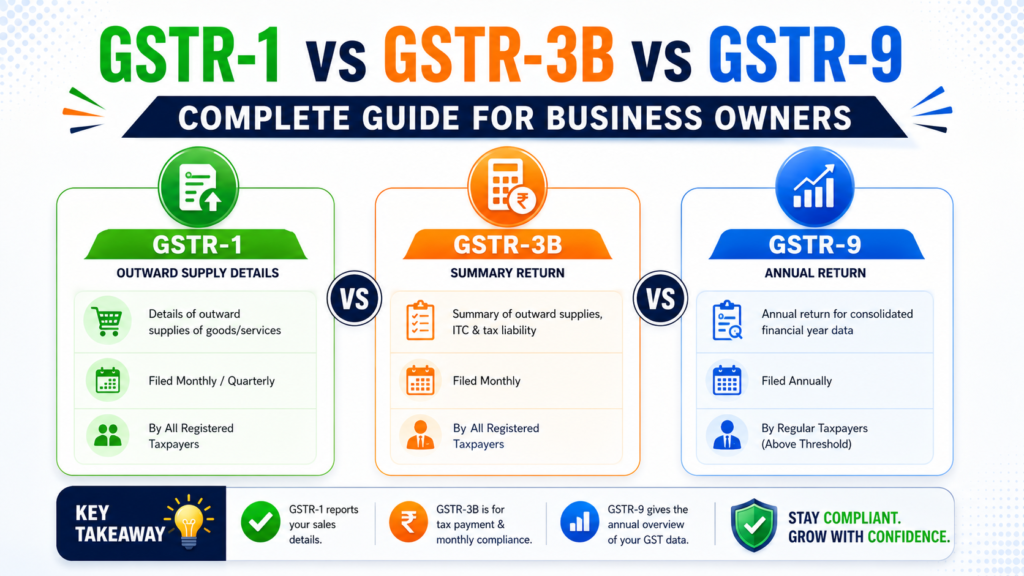
TL;DR Introduction GST return filing is one of the most important recurring compliance responsibilities for registered businesses in India. However, many business owners find it difficult to understand the difference between GSTR-1, GSTR-3B and GSTR-9. Although these returns are connected, each serves a different purpose. GSTR-1 primarily reports details of outward supplies. GSTR-3B is a summary return used to report GST liability and eligible Input Tax Credit (ITC) and pay the resulting tax. GSTR-9 is an annual return that consolidates relevant GST information for the financial year, subject to applicable requirements and exemptions. Understanding GSTR-1 vs GSTR-3B vs GSTR-9 is important because errors in one return can create reconciliation issues in another. Differences between sales records, GST returns, books of accounts and ITC records can eventually result in notices, additional tax liability or compliance complications. This guide explains what each return means, how they differ, how they work together and how business owners can maintain accurate GST compliance. What Is GSTR-1? GSTR-1 is a GST return used to report details of outward supplies made by a registered taxpayer during the relevant tax period. It primarily focuses on sales and other applicable outward-supply transactions. Depending on the taxpayer and transactions, GSTR-1 may contain information relating to: Business-to-business (B2B) supplies Business-to-consumer (B2C) supplies Export supplies Credit notes Debit notes Amendments to previously reported transactions Other applicable outward supplies Why Is GSTR-1 Important? GSTR-1 is important not only for the supplier but also for customers purchasing from that supplier. For example, if a business makes a B2B sale and reports the customer’s GSTIN incorrectly, the recipient may face difficulty reconciling the purchase and claiming eligible ITC. Similarly, an incorrect invoice number, taxable value or GST amount can create discrepancies between the supplier’s records and the recipient’s records. Therefore, businesses should prepare GSTR-1 using accurate sales records and verify the information before filing. What Is GSTR-3B? GSTR-3B is a summary GST return used to declare applicable outward tax liability, eligible Input Tax Credit and the resulting tax payable. Unlike GSTR-1, GSTR-3B does not primarily function as an invoice-by-invoice outward-supply reporting return. A business generally uses information from its: Books of accounts Sales register GSTR-1 GSTR-2B Purchase records ITC workings Previous-period adjustments to prepare GSTR-3B. Why Is GSTR-3B Important? GSTR-3B directly relates to the taxpayer’s GST liability and tax payment. An incorrect GSTR-3B can therefore affect: GST payable ITC claimed Cash flow Interest exposure Reconciliation Future GST scrutiny Businesses should avoid simply copying figures from their accounting software without performing appropriate GST reconciliation. What Is GSTR-9? GSTR-9 is an annual GST return applicable to specified registered taxpayers, subject to the exemptions, thresholds and requirements applicable for the relevant financial year. It provides an annual view of relevant GST information reported during the year. GSTR-9 can involve information relating to: Outward supplies Taxable turnover Tax liability ITC Tax paid Amendments Other relevant GST information The annual return should ideally be prepared after reconciling the underlying books and periodic GST returns. GSTR-1 vs GSTR-3B vs GSTR-9: Key Difference The simplest way to understand the three returns is: GSTR-1 = What did the business sell? GSTR-3B = What GST liability and eligible ITC does the business need to report and pay? GSTR-9 = What was the business’s overall GST position for the financial year? Particular GSTR-1 GSTR-3B GSTR-9 Main purpose Report outward supplies Report liability and ITC and pay tax Annual GST return Frequency Periodic Periodic Annual Main focus Sales/outward supplies GST liability and eligible ITC Annual consolidation Invoice-level outward details Yes, where applicable No Annual reporting ITC Not its primary purpose Reported Annual reporting/reconciliation Tax payment No direct payment through the return Yes Annual return framework Main records used Sales register Books, sales and ITC records Books + periodic GST returns How GSTR-1, GSTR-3B and GSTR-9 Work Together These returns should not be treated as completely separate compliance activities. A business’s GST compliance process can be viewed as: Sales Transactions ↓ Sales Register ↓ GSTR-1 ↓ GSTR-3B ↓ Annual Reconciliation ↓ GSTR-9 On the purchase and ITC side, businesses should maintain: Purchase Register ↓ GSTR-2B ↓ Eligible ITC Calculation ↓ GSTR-3B ↓ Annual Reconciliation This is why maintaining accurate books and performing regular reconciliation is essential. Difference Between GSTR-1 and GSTR-3B The primary difference is their reporting purpose. GSTR-1 Focuses mainly on details of outward supplies. GSTR-3B Focuses on summary GST liability, eligible ITC and payment of the resulting tax liability. For example, if a business sells goods worth ₹20 lakh during a tax period, the detailed applicable outward-supply information is reported through GSTR-1. The corresponding GST liability is then considered while preparing GSTR-3B, along with eligible ITC and other applicable adjustments. Therefore, the two returns should be reconciled regularly. Difference Between GSTR-3B and GSTR-9 The major difference is their filing frequency and purpose. GSTR-3B is a periodic return. GSTR-9 is an annual return, where applicable. GSTR-3B deals with the tax liability and ITC position for the relevant filing period, whereas GSTR-9 provides an annual view of the relevant GST information for the financial year. Because GSTR-9 covers the year as a whole, businesses should ideally complete annual reconciliation before preparing it. Why GSTR-1 and GSTR-3B Reconciliation Is Important One common GST compliance issue is a mismatch between outward supplies reported in GSTR-1 and the corresponding figures reported in GSTR-3B. For example: GSTR-1 taxable turnover: ₹60 lakh GSTR-3B taxable turnover: ₹55 lakh Difference: ₹5 lakh This does not automatically mean that the business has made an error. The difference could arise because of: Credit notes Amendments Timing differences Previous-period transactions Classification errors Data-entry mistakes Incorrect reporting Other legitimate adjustments However, the difference should be investigated and properly documented. Common GSTR-1 Mistakes Incorrect GSTIN Entering an incorrect customer GSTIN can affect the recipient’s GST reconciliation. Incorrect Invoice Details Invoice numbers and dates should correspond with the books and supporting documents. Wrong Tax Rate Applying an incorrect GST rate can result in incorrect tax reporting. Incorrect Place of Supply Place-of-supply errors can affect whether a transaction is reported
GST Input Tax Credit Rules 2026: Eligibility, Conditions & Common ITC Mistakes
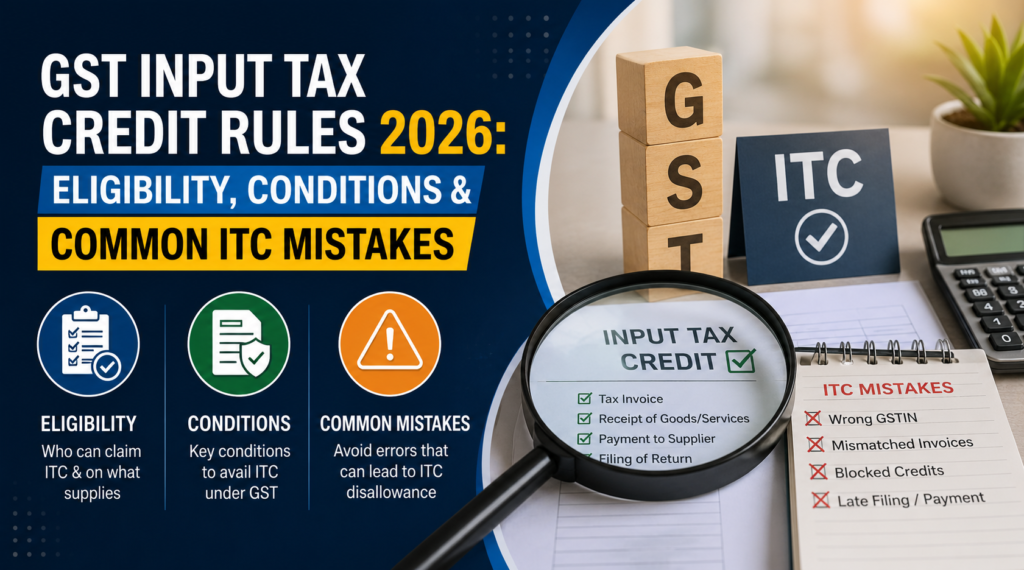
TL;DR Input Tax Credit (ITC) is one of the most important features of GST because it allows eligible registered taxpayers to reduce their output GST liability using qualifying GST paid on business purchases. However, GST paid on an invoice does not automatically mean that the entire amount is eligible for ITC. Businesses must satisfy the applicable conditions under GST law, maintain appropriate documents, confirm receipt of goods or services, reconcile purchase data, identify blocked credits and account for applicable reversals. For 2026, businesses should pay particular attention to: Section 16 ITC eligibility conditions Valid invoices and prescribed documents GSTR-2B reconciliation Supplier compliance ITC time limits Blocked credits under Section 17(5) ITC reversal requirements Correct GSTR-3B reporting Duplicate and unsupported ITC claims The objective should not be to claim the maximum possible ITC, but to claim the maximum eligible ITC supported by proper records. What Is Input Tax Credit Under GST? Input Tax Credit allows an eligible registered person to claim credit for GST paid on qualifying purchases used in the course or furtherance of business. For example, assume a business purchases raw materials worth: ₹5,00,000 + ₹90,000 GST During the same period, it has output GST liability of: ₹1,50,000 If the entire ₹90,000 qualifies as ITC and all applicable conditions are satisfied, the business may use that credit against its output tax liability. Simplified calculation Output GST: ₹1,50,000 Eligible ITC: ₹90,000 Balance GST liability: ₹60,000 This mechanism helps prevent cascading taxation. But the ₹90,000 cannot simply be claimed because GST appears on the purchase invoice. The taxpayer must first establish that the credit is legally eligible. Why GST ITC Compliance Matters in 2026 ITC directly affects a business’s working capital and cash flow. When eligible credit is properly claimed, a business can avoid paying more GST from its own funds than necessary. On the other hand, incorrect ITC claims can create: Additional GST liability Interest exposure ITC reversals Penalties where applicable GST notices Reconciliation problems Cash-flow pressure Example Suppose a company claims: ₹10 lakh ITC After reconciliation, ₹2 lakh is identified as ineligible. That means the business may have to reverse the ₹2 lakh incorrectly claimed, along with any applicable interest or other consequences. For this reason, ITC should be treated as a monthly financial-control process, not something to be checked only at year-end. Who Can Claim Input Tax Credit? Generally, a registered person satisfying the statutory requirements can claim eligible ITC. This can include: Manufacturers Traders Wholesalers Retailers Service providers Consultants Restaurants E-commerce businesses Exporters Startups MSMEs However, GST registration alone does not make every business expense eligible. The relevant question is: Does this particular purchase satisfy the conditions for ITC under GST? A business should therefore assess each category of expense rather than applying a blanket assumption that all GST paid is creditable. Conditions for Claiming ITC Under Section 16 Section 16 of the CGST Act contains important conditions governing ITC. Businesses should evaluate the following before taking credit. 1. The Taxpayer Must Be Eligible to Claim ITC The taxpayer must be a registered person and the transaction must fall within the applicable GST framework. The nature of the supply, registration status and use of the goods or services should be considered before claiming credit. 2. A Valid Tax Document Should Be Available ITC generally needs to be supported by an appropriate prescribed document. Depending on the transaction, this may include: Tax invoice Debit note Bill of entry Other prescribed documents The document should contain the relevant particulars and correspond to a genuine transaction. Maintain a proper audit trail For important purchases, businesses should preserve: Invoice Purchase order Delivery documentation Payment records Goods receipt records Contract or agreement Relevant correspondence Good documentation can become extremely important if a transaction is later questioned. 3. Goods or Services Must Be Received A taxpayer should not claim ITC merely because an invoice has been generated. The goods or services should actually be received in accordance with the applicable provisions. For goods, evidence may include: Delivery challans E-way bills Goods receipt notes Warehouse records Stock records For services, businesses may maintain: Agreements Work orders Service reports Completion certificates Email correspondence Payment records The stronger the documentation, the easier it becomes to establish the commercial substance of the transaction. 4. Supplier Compliance Must Be Monitored GST compliance increasingly requires businesses to look beyond their own accounting systems. Purchase-related information should be reconciled with GST records. This is where GSTR-2B becomes an important compliance tool. Businesses should compare: Purchase Register ↔ GSTR-2B ↔ Books of Accounts ↔ GSTR-3B Differences should be investigated instead of being ignored. 5. Payment-Related Conditions Need Attention GST law contains specific conditions relating to payment to suppliers and corresponding ITC treatment. Businesses should therefore monitor unpaid vendor invoices instead of assuming that ITC remains permanently available regardless of the payment status. A proper vendor ageing report can help identify transactions requiring review. 6. ITC Must Be Appropriately Reported Eligible ITC should be correctly reflected in the relevant GST return. A mismatch between: Books Purchase register GSTR-2B ITC working GSTR-3B can create unnecessary compliance risk. Businesses should maintain a clear reconciliation file supporting the figures reported in their returns. GST Input Tax Credit Time Limit The law prescribes a time limit for claiming ITC relating to invoices and debit notes, subject to applicable provisions. This means businesses should not treat old purchase invoices as permanently claimable. A practical ITC ageing system can help. Invoice Status Recommended Action Current invoice Verify and reconcile Recent unmatched invoice Follow up with supplier Older unmatched invoice Investigate immediately Near statutory deadline Prioritise Potentially time-barred Obtain professional review Businesses handling hundreds or thousands of invoices should automate or systematise this process wherever possible. GSTR-2B and ITC Reconciliation One of the most important GST compliance exercises is reconciling the business’s purchase records with GSTR-2B. A typical monthly reconciliation should identify: Matched invoices Missing invoices Duplicate invoices GSTIN mismatches Tax-value differences Supplier filing delays Credit notes Debit notes Amendments Potentially ineligible ITC Basic reconciliation structure Category Action
GST Registration vs GST Composition Scheme: Which Is Better for Small Businesses?
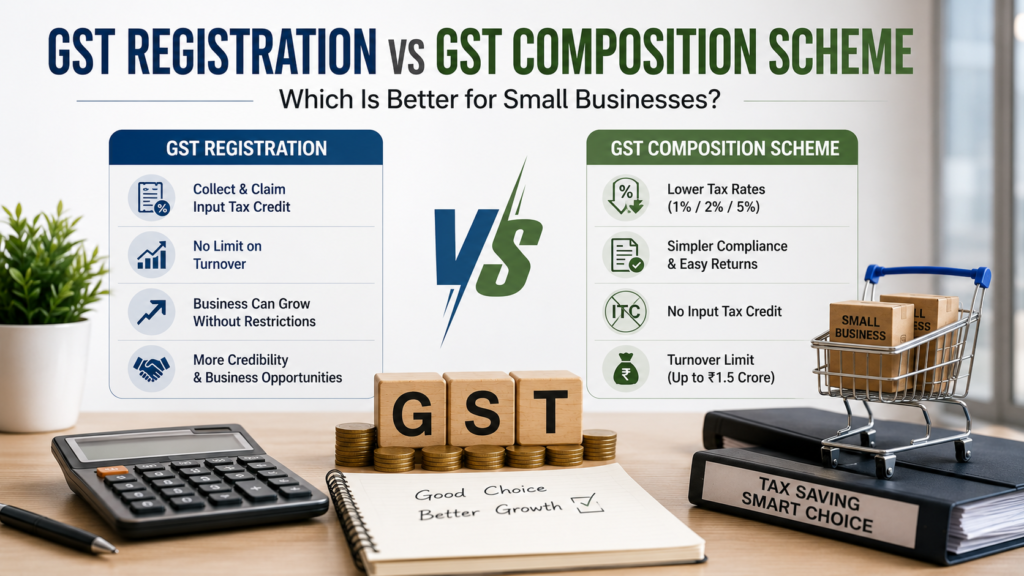
TL;DR Choosing between Regular GST Registration and the GST Composition Scheme is an important decision for every small business. While the Composition Scheme offers simplified compliance and reduced administrative burden for eligible taxpayers, Regular GST Registration provides broader business opportunities, Input Tax Credit (ITC) benefits, and greater flexibility for growing enterprises. The right choice depends on your business model, turnover, customers, and long-term growth plans. Introduction For many entrepreneurs, one of the earliest tax decisions is choosing the appropriate GST framework for their business. This decision influences not only day-to-day compliance but also cash flow, pricing strategy, customer relationships, and future expansion. Many small business owners assume that the Composition Scheme is always the better option because of its simpler compliance requirements. Others immediately choose Regular GST Registration without fully understanding the obligations involved. In reality, both options have distinct advantages and limitations. Selecting the right one requires a careful assessment of your business operations, expected turnover, customer profile, and future plans. This guide explains the key differences between the two so you can make an informed decision. What Is Regular GST Registration? Regular GST Registration is the standard GST framework under which eligible businesses collect GST from customers, file prescribed returns, maintain detailed records, and comply with applicable GST provisions. Businesses registered under the regular scheme generally have broader operational flexibility and can participate in a wider range of commercial activities. Some key features include: Collection of GST from customers. Eligibility to claim Input Tax Credit (subject to applicable conditions). Issuance of tax invoices. Participation in B2B transactions. Ability to deal with customers requiring GST-compliant invoices. Greater suitability for expanding businesses. What Is the GST Composition Scheme? The GST Composition Scheme is a simplified compliance mechanism available to eligible small taxpayers subject to prescribed turnover limits and other conditions under GST law. Instead of following the full compliance framework applicable to regular taxpayers, eligible businesses under the Composition Scheme generally benefit from simplified tax payment procedures and reduced return filing obligations. The scheme is primarily designed to reduce the compliance burden on small businesses with relatively straightforward operations. Key Differences Between Regular GST Registration and the Composition Scheme Feature Regular GST Registration GST Composition Scheme GST Collection GST collected from customers Composition taxpayers generally cannot collect GST separately from customers Input Tax Credit Eligible to claim ITC subject to conditions ITC generally not available Tax Invoice Can issue tax invoices Cannot issue standard GST tax invoices in the same manner as regular taxpayers Compliance Detailed compliance and return filing Simplified compliance for eligible taxpayers Business Expansion Suitable for growing businesses Best suited for smaller businesses meeting eligibility conditions Business Flexibility Greater operational flexibility Certain restrictions apply under the scheme Advantages of Regular GST Registration Many growing businesses choose Regular GST Registration because it offers long-term operational advantages. Input Tax Credit (ITC) Eligible businesses can claim Input Tax Credit on qualifying business purchases, helping reduce the overall tax cost and improve cash flow. Better Business Credibility Large organizations and corporate customers often prefer dealing with regular GST-registered businesses that issue compliant tax invoices. Supports Business Growth Regular registration is generally more suitable for businesses planning expansion, increasing turnover, or serving a broader customer base. Wider Commercial Opportunities Businesses under the regular scheme are better positioned to participate in commercial transactions that require full GST compliance. Better Financial Reporting Detailed accounting and GST compliance encourage stronger financial discipline and more accurate business reporting. Advantages of the GST Composition Scheme For eligible businesses with relatively simple operations, the Composition Scheme offers several practical benefits. Simplified Compliance The scheme reduces the administrative burden associated with GST compliance compared to the regular framework. Lower Compliance Costs Businesses may spend less time and fewer resources on maintaining detailed GST records and filing requirements. Easier Accounting Accounting procedures are generally simpler, making compliance more manageable for smaller enterprises. Suitable for Local Businesses Retail shops, small traders, and local businesses with straightforward operations may find the Composition Scheme beneficial, provided they satisfy all eligibility conditions. Reduced Administrative Burden Owners can devote more attention to running and growing their business rather than managing extensive GST compliance. Which Businesses Should Choose Regular GST Registration? Regular GST Registration is generally more suitable for businesses that: Plan rapid growth. Deal primarily with other businesses (B2B). Wish to claim eligible Input Tax Credit. Require tax invoices for commercial transactions. Have complex business operations. Anticipate expansion into new markets. Need stronger credibility with corporate customers. Which Businesses May Benefit from the Composition Scheme? Subject to eligibility under GST law, the Composition Scheme may be appropriate for businesses that: Operate on a relatively small scale. Primarily serve end consumers. Prefer simplified compliance. Have straightforward business operations. Do not require Input Tax Credit for their business model. Want to reduce administrative responsibilities. Common Mistakes Businesses Make While Choosing a GST Scheme Selecting the wrong GST option can increase compliance costs, affect profitability, and create operational challenges. Many businesses choose a scheme without considering their long-term goals, customer base, or tax implications. Some common mistakes include: Choosing the Composition Scheme only because compliance appears simpler. Ignoring eligibility conditions before opting for the scheme. Not evaluating future business expansion plans. Overlooking the importance of Input Tax Credit (ITC). Failing to understand customer expectations for GST tax invoices. Not reviewing turnover trends regularly. Assuming the same GST option suits every type of business. Taking GST-related decisions without professional advice. A careful evaluation before registration helps businesses avoid unnecessary complications and supports sustainable growth. Can You Switch Between Regular GST Registration and the Composition Scheme? Yes. Subject to the provisions of GST law and applicable eligibility conditions, businesses may move between the Regular GST Scheme and the Composition Scheme. A switch may be appropriate when: Business turnover changes significantly. The nature of business operations evolves. The customer profile shifts from B2C to B2B. Expansion plans require greater operational flexibility. The business becomes eligible or ineligible for the Composition Scheme. Before making any change, businesses should carefully evaluate the
New GST Rules 2026: Latest Compliance Updates Every Business Must Know
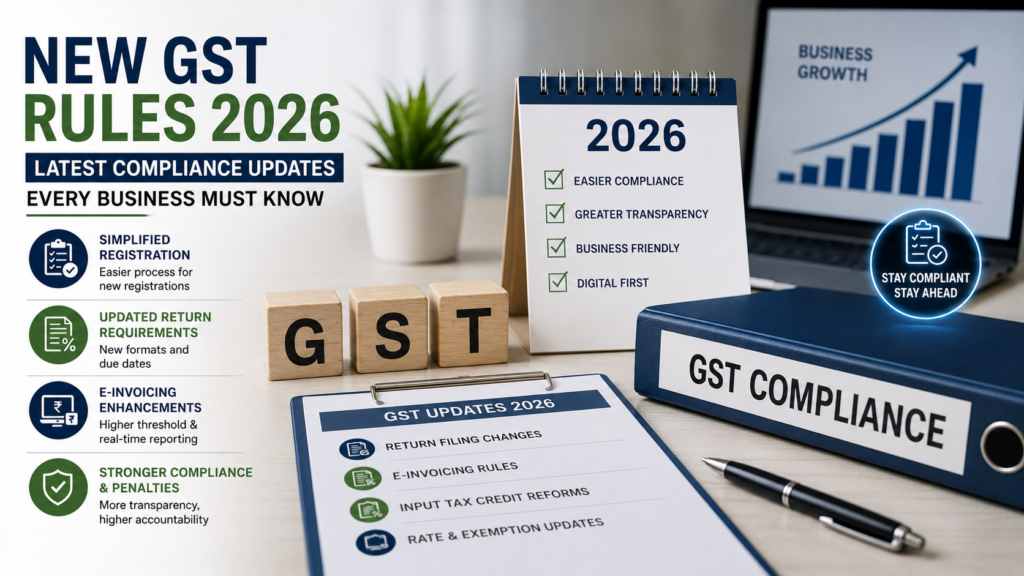
TL;DR GST compliance continues to evolve as tax administration becomes more digital and data-driven. Businesses should stay updated with applicable GST provisions, maintain accurate documentation, reconcile returns regularly, and strengthen internal controls to minimize compliance risks. This guide highlights the key compliance areas businesses should monitor in 2026 and explains how proactive GST management supports long-term business growth. Why Keeping Up with GST Rules Matters The Goods and Services Tax (GST) has transformed indirect taxation in India by creating a unified tax system across goods and services. As the business environment evolves, compliance requirements continue to be refined through amendments, notifications, procedural improvements, and increased use of technology. Today’s GST ecosystem relies heavily on digital reporting, automated reconciliations, analytics, and data matching. Businesses that fail to keep their records updated may face delayed Input Tax Credit (ITC), notices, interest, penalties, or unnecessary compliance challenges. Rather than viewing GST as a routine filing obligation, businesses should consider it an essential part of sound financial governance. Why Businesses Should Monitor GST Updates Regularly GST rules may change over time due to: Government notifications CBIC circulars Judicial decisions Process improvements Technology enhancements Return filing updates Compliance simplification initiatives Keeping track of these developments helps businesses remain compliant and avoid operational disruptions. Key GST Compliance Areas Businesses Should Focus on in 2026 Instead of reacting to notices after they arrive, businesses should strengthen the following compliance practices throughout the year. Accurate GST Registration Information Businesses should periodically review their GST registration details to ensure information such as business address, bank account, contact details, and authorized signatory remains accurate and updated. Failure to maintain current information may create difficulties during departmental verification or communication. Timely GST Return Filing One of the most important compliance responsibilities is filing GST returns within the prescribed due dates. Timely filing helps businesses: Avoid late fees. Reduce interest liabilities. Maintain compliance ratings. Facilitate smoother Input Tax Credit claims. Build credibility with customers and vendors. Maintaining a compliance calendar can significantly reduce the risk of missed deadlines. Regular Reconciliation of GST Records Businesses should frequently reconcile: Sales registers Purchase registers GST returns E-invoices (where applicable) Books of accounts Vendor invoices Regular reconciliation helps identify discrepancies early and minimizes future compliance issues. Proper Input Tax Credit (ITC) Management Input Tax Credit is one of the most valuable benefits available under GST. To maximize eligible ITC, businesses should: Maintain valid tax invoices. Verify supplier compliance. Match purchase records. Monitor vendor return filings. Maintain complete documentation. Effective ITC management improves working capital and reduces tax costs. Strong Invoice Management Invoices remain the foundation of GST compliance. Businesses should ensure that invoices contain all mandatory particulars and are issued accurately and on time. Maintaining organized digital records also supports smoother audits and reconciliations. Digital Record Keeping As tax administration becomes increasingly technology-driven, maintaining digital accounting records has become essential. Businesses should preserve: Purchase invoices Sales invoices Debit notes Credit notes E-way bills Bank statements GST returns Payment records Vendor contracts Cloud-based accounting systems can improve record management while simplifying future audits. Vendor Compliance Monitoring A business’s GST compliance is influenced not only by its own practices but also by the compliance behavior of its suppliers. Regularly reviewing vendor GST status, return filing history, and invoice accuracy helps reduce Input Tax Credit disputes and strengthens overall compliance. How New GST Compliance Practices Impact Small Businesses Small businesses often have limited accounting resources, making proactive compliance even more important. Improved GST management can help businesses: Reduce avoidable penalties. Improve cash flow through timely ITC. Build stronger relationships with vendors. Increase confidence during bank loan applications. Prepare for departmental audits. Improve financial reporting. Rather than viewing GST as a burden, businesses should integrate compliance into their everyday accounting processes. Best Practices for GST Compliance in 2026 To remain compliant and avoid unnecessary complications, businesses should adopt the following practices: Maintain updated books of accounts. Reconcile GST records every month. File returns within due dates. Preserve supporting documentation. Verify supplier GST compliance. Review Input Tax Credit eligibility regularly. Conduct periodic internal compliance reviews. Stay informed about official GST notifications. Seek professional advice whenever complex issues arise. Following these practices creates a strong compliance framework and reduces long-term business risks. Common GST Compliance Mistakes Businesses Should Avoid Even businesses with experienced accounting teams can make GST compliance mistakes that lead to notices, blocked Input Tax Credit (ITC), interest liabilities, or penalties. Identifying these issues early can save both time and money. Some of the most common mistakes include: Filing GST returns after the due date. Claiming ineligible Input Tax Credit. Failing to reconcile books of accounts with GST returns. Incorrect GST classification or tax rates. Issuing invoices with missing or inaccurate details. Ignoring vendor compliance before claiming ITC. Delayed payment of GST liability. Not maintaining proper accounting records and supporting documents. Failing to update GST registration details after business changes. Overlooking departmental notices or communications. Regular internal reviews and professional guidance help businesses minimize these risks and maintain smooth compliance. How a Chartered Accountant Can Help with GST Compliance GST regulations continue to evolve, making professional support increasingly valuable for businesses of every size. A Chartered Accountant not only ensures compliance but also helps improve tax efficiency and reduce operational risks. A professional CA can assist with: GST Registration and amendments. GST Return Filing. Input Tax Credit reconciliation. GST compliance reviews. GST audit preparation. E-invoicing guidance. E-way bill compliance. GST litigation support. Departmental notice responses. Monthly GST reconciliation. Business advisory on indirect taxation. Compliance planning for business expansion. Professional assistance allows business owners to focus on growth while ensuring that GST obligations are managed accurately and on time. Why Choose Junaid Khan & Co., Chartered Accountants in Bhopal? Managing GST compliance requires technical expertise, timely reporting, and continuous monitoring of regulatory developments. Businesses benefit from working with professionals who understand both the legal framework and the practical challenges of day-to-day operations. Junaid Khan & Co., Chartered Accountants in Bhopal offers end-to-end GST advisory and compliance solutions tailored to startups,
GST Registration in Bhopal: Eligibility, Required Documents, Process, and Benefits
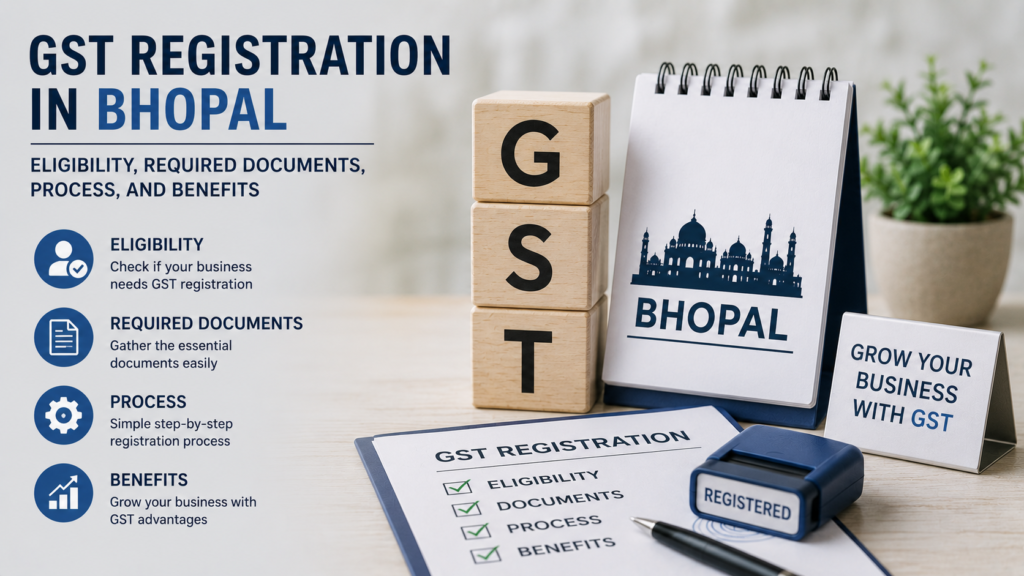
TL;DR GST Registration is one of the first compliance requirements for many businesses operating in India. Whether you’re a startup, retailer, manufacturer, service provider, freelancer, or e-commerce seller in Bhopal, obtaining GST registration helps your business remain legally compliant, claim input tax credit, and build credibility. This guide explains who should register, required documents, registration steps, benefits, and why professional assistance can simplify the process. What is GST Registration? Goods and Services Tax (GST) Registration is the process through which a business obtains a unique Goods and Services Tax Identification Number (GSTIN) from the Government of India. Once registered, a business becomes legally authorized to: Collect GST from customers Claim Input Tax Credit (ITC) Issue GST-compliant tax invoices File GST Returns Conduct interstate business legally Supply products through e-commerce marketplaces GST registration is a legal requirement for many businesses depending on their turnover, business activities, and nature of supplies. Why is GST Registration Important? GST Registration is more than a compliance formality. It provides several business advantages: Legal recognition Better business credibility Input Tax Credit benefits Easier loan approvals Improved vendor trust Eligibility for government tenders Smooth interstate trade Expansion through online marketplaces Many corporate clients also prefer working only with GST-registered suppliers. Who Needs GST Registration? GST Registration becomes mandatory in several situations. Businesses that generally require GST Registration include: Businesses Crossing Prescribed Turnover Limits If annual turnover exceeds the applicable threshold under GST law, registration becomes mandatory. Interstate Suppliers Businesses supplying goods or services across state borders may need GST registration depending on applicable provisions. E-commerce Sellers Selling through online platforms generally requires GST registration. Examples include: Amazon Flipkart Meesho IndiaMART JioMart Input Service Distributors Businesses distributing Input Tax Credit among branches require GST registration. Casual Taxable Persons Temporary businesses participating in exhibitions, trade fairs, or seasonal operations may also require GST registration. Non-Resident Taxable Persons Foreign businesses supplying goods or services in India need GST registration under applicable provisions. Agents of Registered Businesses Certain agents acting on behalf of GST-registered businesses must obtain registration. Reverse Charge Mechanism Cases Some businesses liable to pay tax under the Reverse Charge Mechanism may need registration. Eligibility for GST Registration A business should evaluate registration based on: Annual turnover Nature of goods supplied Nature of services provided Interstate transactions E-commerce operations Tax liability under GST law Even if registration is not mandatory, businesses may voluntarily register to enjoy various commercial benefits. Documents Required for GST Registration Preparing accurate documents helps avoid application rejection. Commonly required documents include: Identity Proof PAN Card Aadhaar Card Passport (where applicable) Business Registration Documents Depending on business type: Partnership Deed Certificate of Incorporation LLP Agreement Shop Establishment Certificate MSME Registration (if available) Address Proof Electricity Bill Property Tax Receipt Municipal Tax Receipt Rent Agreement NOC from Property Owner Bank Account Details Cancelled Cheque Bank Statement Passbook Copy Business Photographs Recent passport-size photographs of: Proprietor Partners Directors Authorized Signatory Digital Signature (Where Applicable) Certain business entities may require Digital Signature Certificates for application submission. Step-by-Step GST Registration Process Step 1 Collect all business documents. Step 2 Prepare identity and address proofs. Step 3 Complete the online GST registration application. Step 4 Upload supporting documents. Step 5 Verify the application using OTP or Digital Signature. Step 6 Application is processed by GST authorities. Step 7 Receive GSTIN and GST Registration Certificate after approval. Benefits of GST Registration A GST registration offers several long-term advantages for growing businesses. Claim Input Tax Credit (ITC) Registered businesses can claim credit for GST paid on eligible business purchases, reducing the overall tax burden. Enhanced Business Credibility Many corporate clients, government departments, and larger organizations prefer dealing with GST-registered businesses, improving trust and business opportunities. Easier Interstate Trade GST registration enables businesses to expand operations across different states while remaining compliant with tax regulations. Eligibility for E-commerce Platforms Most online marketplaces require sellers to have a valid GSTIN before listing products or services. Improved Access to Business Loans Financial institutions often view GST registration as a sign of formal business operations, which can support loan and credit applications. Better Compliance and Growth Maintaining GST compliance helps businesses avoid penalties and creates a strong foundation for future expansion. Common Mistakes to Avoid During GST Registration Many GST registration applications are delayed or rejected because of avoidable errors. Paying attention to details during the application process can save valuable time and prevent compliance issues. Some of the most common mistakes include: Entering incorrect PAN, Aadhaar, or business details. Using an address that does not match supporting documents. Uploading unclear or expired documents. Selecting the wrong business constitution. Choosing incorrect HSN or SAC codes. Mentioning inaccurate bank account information. Ignoring GST notices requesting additional clarification. Applying under the wrong state jurisdiction. Not updating mobile number or email for OTP verification. Delaying registration even after crossing the mandatory turnover threshold. Working with an experienced Chartered Accountant helps ensure your application is accurate, complete, and approved without unnecessary delays. GST Registration Fees in Bhopal The cost of GST registration depends on your business structure, documentation readiness, and whether additional registrations are required. Typical professional fees may vary based on: Service Estimated Professional Fee* Basic GST Registration ₹1,000 – ₹3,000 GST Registration with Business Consultation ₹3,000 – ₹7,000 GST Registration + MSME + PAN/TAN Assistance ₹5,000 – ₹10,000+ Actual fees may differ depending on business complexity and additional compliance requirements. Why Hire a Chartered Accountant for GST Registration? Although GST registration can be completed online, many businesses benefit from professional assistance to avoid costly mistakes. A Chartered Accountant can help you: Determine whether GST registration is mandatory or voluntary. Select the correct business category. Prepare accurate documentation. Respond to GST department queries. Obtain GSTIN faster. Ensure future GST compliance. Assist with GST return filing and tax planning. Reduce the risk of penalties due to incorrect registration. Instead of viewing GST registration as a one-time formality, businesses should consider it the first step toward long-term tax compliance. Why Businesses in Bhopal Trust Junaid Khan & Co. Whether you are
GST Registration vs Composition Scheme: Which Is Better for Small Businesses in Bhopal?
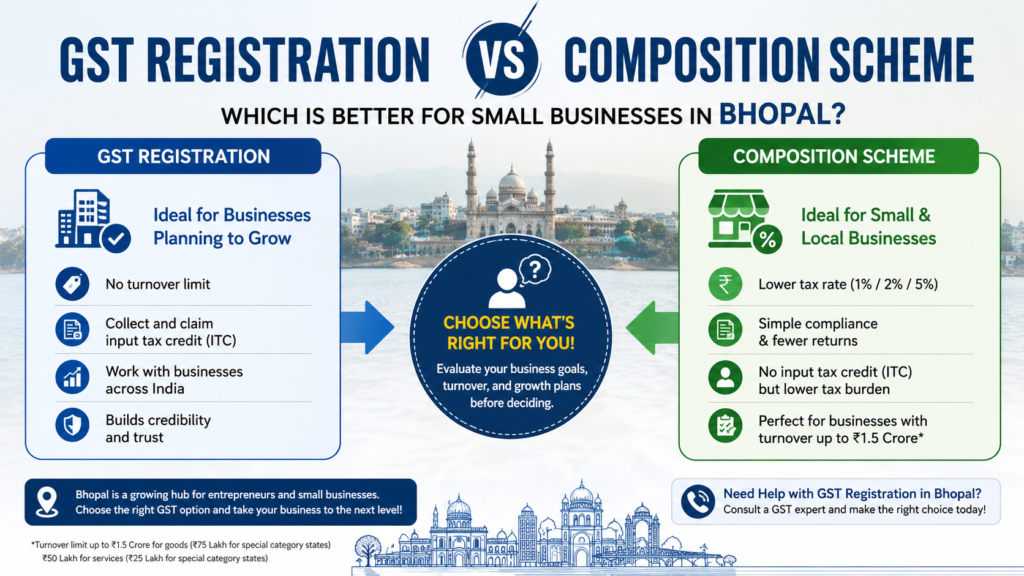
TL;DR If your business has growth ambitions, works with corporate clients, wants Input Tax Credit benefits, or operates across multiple states, Regular GST Registration is usually the better option. If your business is small, locally focused, has limited compliance capacity, and wants simplified taxation, the Composition Scheme may be suitable. The right choice depends on: ✔ Annual turnover ✔ Customer type ✔ Profit margins ✔ Growth plans ✔ Compliance capability ✔ GST Input Tax Credit requirements This guide explains both options in detail to help Bhopal business owners make an informed decision. Why This Decision Matters More Than Ever For many small businesses in Bhopal, GST compliance is no longer just a legal requirement—it directly affects profitability, cash flow, pricing strategy, and business growth. One of the most common questions business owners ask is: “Should I register under the normal GST scheme or opt for the Composition Scheme?” Choosing the wrong option can lead to: Higher tax costs Reduced competitiveness Limited growth opportunities Compliance challenges Cash flow issues On the other hand, selecting the right scheme can simplify operations and improve profitability. Let’s break down both options. Understanding Regular GST Registration Regular GST Registration is the standard GST framework under which businesses collect GST from customers and remit it to the government. Businesses registered under the regular scheme can: Charge GST on invoices Claim Input Tax Credit (ITC) Conduct interstate business Sell through e-commerce platforms Supply goods and services to corporate clients Participate in government tenders This scheme is generally designed for businesses that expect growth and need operational flexibility. Key Features of Regular GST Registration Input Tax Credit Available One of the biggest advantages is the ability to claim GST paid on purchases. For example: If a trader purchases inventory worth ₹10 lakh and pays GST on those purchases, the GST amount can be claimed as Input Tax Credit. This significantly reduces the final tax burden. Interstate Business Allowed Businesses can freely sell products and services across India. This is particularly beneficial for: Online sellers Manufacturers Service providers Export-oriented businesses Better Business Credibility Corporate clients often prefer dealing with GST-registered suppliers who can issue tax invoices and provide Input Tax Credit benefits. This can directly impact business opportunities. Understanding the GST Composition Scheme The Composition Scheme was introduced to reduce the compliance burden for small taxpayers. Instead of following regular GST procedures, eligible businesses can pay tax at a fixed lower rate based on turnover. The scheme is primarily designed for: Small traders Local retailers Small restaurants Certain service providers Key Features of Composition Scheme Simplified Compliance Businesses generally face: Reduced recordkeeping requirements Simpler return filing Less administrative burden This is attractive for small businesses with limited accounting resources. Lower Tax Rates Composition taxpayers typically pay tax at prescribed composition rates rather than normal GST rates. However, lower tax rates do not always mean lower overall tax costs. The impact depends on Input Tax Credit eligibility and business model. No Input Tax Credit This is the biggest limitation. Composition dealers: Cannot claim Input Tax Credit Cannot pass ITC benefits to customers For many businesses, this can significantly affect competitiveness. GST Registration vs Composition Scheme: Detailed Comparison Factor Regular GST Registration Composition Scheme Input Tax Credit Available Not Available Interstate Sales Allowed Restricted in many cases E-commerce Selling Allowed Limited GST Invoice Allowed Not Allowed as Tax Invoice Compliance Higher Lower Growth Flexibility High Limited Corporate Clients Preferred Less Preferred Tax Administration Detailed Simplified Who Should Choose Regular GST Registration? Regular GST registration is usually ideal for businesses that: Plan to Grow Aggressively If you expect turnover growth over the next few years, switching later may create operational disruptions. Starting with regular registration can be more practical. Sell to Businesses B2B customers prefer vendors who can provide Input Tax Credit benefits. Without ITC benefits, customers may prefer competitors. Operate Online Businesses selling through: Amazon Flipkart Meesho Other marketplaces typically require regular GST registration. Have Significant Purchase Costs When businesses purchase inventory, machinery, or raw materials regularly, Input Tax Credit becomes highly valuable. This often outweighs the compliance burden. Who Should Choose the Composition Scheme? The composition scheme may work well for: Local Retail Shops Businesses serving local consumers often find compliance simplicity attractive. Examples: Grocery stores Gift shops Local traders Small retail outlets Businesses with Minimal Input Tax Credit Requirements If purchase-related GST is relatively low, losing ITC may have limited impact. Owners Seeking Simpler Compliance For business owners who prefer a straightforward taxation framework, composition can reduce administrative workload. Real-Life Bhopal Business Examples Example 1: Local Grocery Store Annual Turnover: ₹60 lakh Customer Base: Local consumers Interstate Sales: None ITC Requirement: Low Recommended Option: Composition Scheme Reason: Compliance simplicity may outweigh ITC benefits. Example 2: Manufacturing Unit Annual Turnover: ₹1.2 crore Raw Material Purchases: High B2B Customers: Yes Recommended Option: Regular GST Registration Reason: Input Tax Credit benefits can significantly reduce tax costs. Example 3: Digital Marketing Agency Annual Turnover: ₹45 lakh Clients Across India Growing Business Recommended Option: Regular GST Registration Reason: Interstate services and future growth make regular registration more suitable. Example 4: Restaurant Business Annual Turnover: ₹75 lakh Local Customer Base Limited Expansion Plans Recommended Option: Depends on cost structure and tax planning analysis. Professional evaluation is recommended. Common Mistakes Businesses Make Choosing Based Only on Tax Rate Many business owners focus only on lower composition rates and ignore ITC losses. Ignoring Growth Plans A scheme suitable today may become restrictive within a year. Not Evaluating Customer Type B2B and B2C businesses often require different GST strategies. Poor Record Keeping Regardless of the chosen scheme, proper documentation remains essential. How to Switch Between Schemes Businesses may switch between schemes if eligibility conditions are met. Before switching: Review turnover projections Analyze customer profile Estimate ITC benefits Evaluate compliance costs Consult a GST professional A structured analysis prevents costly mistakes. Expert Recommendation from Chartered Accountants In our experience advising businesses across Bhopal, most growth-oriented businesses benefit more from Regular GST Registration. While the Composition Scheme provides simplicity,
Monthly vs Quarterly GST Filing: Which Option Is Better for Small Businesses in 2026?
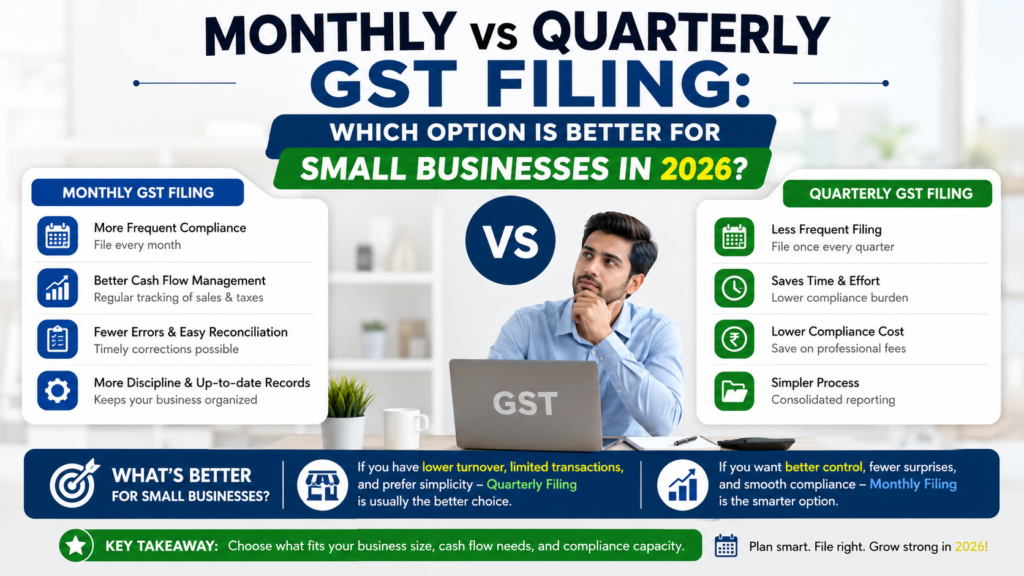
TL;DR GST filing frequency is one of the most important compliance decisions for small businesses in India. Choosing between monthly and quarterly GST filing affects bookkeeping, cash flow visibility, reconciliation, and overall financial management.GST filing frequency directly influences compliance workload, financial visibility, and operational efficiency. Small businesses often struggle to decide between monthly and quarterly GST filing due to unclear rules and operational constraints. The right choice depends on: Business size Transaction volume Cash flow stability Accounting systems Growth stage A structured approach to GST filing reduces compliance errors and improves financial planning. Understanding GST Filing Frequency in India GST return filing is a structured compliance system that requires businesses to report transactions periodically. Two commonly used filing patterns include: Monthly GST filing cycle Quarterly GST filing cycle Each structure affects: Reporting workload Cash flow visibility Tax reconciliation process Operational discipline The selection is not arbitrary; it depends on turnover patterns and compliance eligibility. How GST Filing Cycles Work in Practice GST filing is designed to ensure transparency in: Sales reporting Input tax credit claims Tax liability calculations Vendor reconciliation Businesses must align internal accounting systems with filing cycles to avoid: Mismatch errors Delayed submissions Compliance inconsistencies Monthly GST Filing Explained Monthly GST filing follows a structured reporting cycle where transactions are recorded and submitted every month. This system is generally aligned with: Higher transaction volumes Frequent sales activity Detailed reconciliation requirements Operational Characteristics Continuous bookkeeping required Frequent invoice reconciliation Monthly reporting discipline Real-time financial tracking needed Quarterly GST Filing Explained Quarterly GST filing consolidates transactions into a three-month reporting cycle. This structure is generally suited for: Lower transaction volumes Stable business operations Simplified compliance workflows Operational Characteristics Less frequent reporting Consolidated reconciliation process Reduced administrative workload Delayed financial visibility compared to monthly cycle Key Factors That Influence GST Filing Choice 1. Business Size Smaller businesses with limited transactions often manage quarterly cycles effectively, while high-volume businesses require monthly reporting accuracy. 2. Cash Flow Stability Frequent filing improves financial visibility, which helps in monitoring inflows and outflows more closely. 3. Transaction Volume Higher transaction frequency requires structured monthly reconciliation to maintain accuracy. 4. Compliance Capacity Businesses with limited accounting systems often find quarterly cycles easier to manage initially. Impact of GST Filing Frequency on Business Operations GST filing structure directly impacts: Accounting workload Invoice management systems Tax reconciliation accuracy Financial reporting cycles Decision-making speed Businesses with structured accounting systems handle frequent filings more efficiently due to real-time data availability. Common Mistakes in GST Filing Selection Several operational errors occur when businesses choose filing cycles without evaluating internal systems: Selecting filing frequency without accounting setup Ignoring transaction complexity Missing reconciliation timelines Poor invoice tracking systems Lack of compliance calendar discipline These issues often lead to reporting inconsistencies and financial mismanagement. How Filing Frequency Affects Financial Planning GST filing cycles influence how financial data is interpreted. Monthly systems allow: Faster decision cycles Real-time financial monitoring Improved forecasting accuracy Quarterly systems provide: Consolidated reporting views Reduced administrative load Delayed financial insights Both systems require strong bookkeeping discipline to maintain accuracy. Choosing the Right GST Structure for Growth Stage Business evolution often requires reassessment of filing strategy: Early stage: simplified reporting may suffice Growth stage: structured monthly systems become necessary Scaling stage: automation and integrated accounting become critical The decision should align with operational maturity rather than convenience alone. Transitioning Between Filing Frequencies Businesses often shift between filing structures as operations evolve. Key triggers include: Increase in transaction volume Expansion into new markets Hiring of finance teams Integration of accounting systems Smooth transitions require: Updated bookkeeping systems Clean financial records Consistent invoice management Final Decision Framework A structured decision approach includes evaluating: Transaction volume consistency Internal accounting readiness Cash flow tracking needs Compliance discipline capability Growth trajectory Businesses that align filing frequency with operational structure experience fewer compliance disruptions. Conclusion GST filing frequency is not merely a compliance requirement—it directly impacts financial discipline and operational efficiency. The choice between monthly and quarterly filing depends on business maturity, accounting systems, and transaction behavior. Structured financial systems ensure smoother compliance, accurate reporting, and better decision-making across all stages of business growth. 6. FAQ SECTION 1. Is monthly GST filing mandatory for all businesses? Not all businesses require monthly filing; eligibility depends on turnover and compliance category. 2. Who can file GST quarterly in India? Businesses with specific turnover thresholds and eligible schemes can opt for quarterly filing. 3. Which GST filing method is easier for small businesses? Quarterly filing may reduce administrative frequency, but suitability depends on transaction complexity. 4. Does GST filing frequency affect cash flow? Yes, filing cycles influence financial tracking and reporting visibility. 5. Can businesses switch filing frequency later? Yes, filing structure can be adjusted based on operational requirements and eligibility. 6. What happens if GST returns are delayed? Delays may result in compliance notices and financial penalties. 7. Which filing method is better for growing businesses? Growing businesses often require structured monthly reporting for better financial control. BLOG BY: JUNAID KHAN & CO. Written by CA Junaid Ahmed Khan, Junaid Khan & Co., Bhopal.