

GSTR-1 vs GSTR-3B vs GSTR-9: Complete Guide for Business Owners
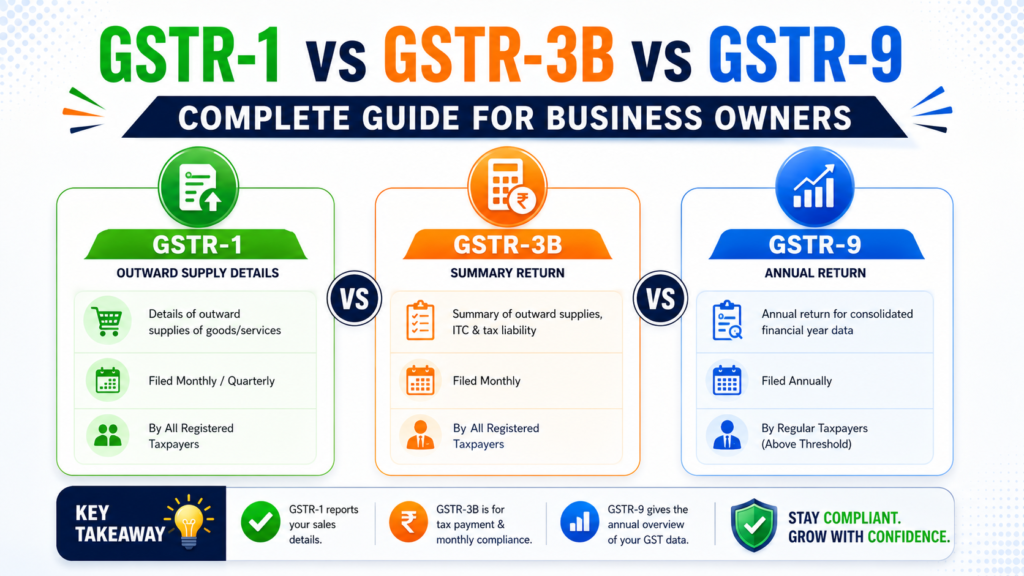
TL;DR Introduction GST return filing is one of the most important recurring compliance responsibilities for registered businesses in India. However, many business owners find it difficult to understand the difference between GSTR-1, GSTR-3B and GSTR-9. Although these returns are connected, each serves a different purpose. GSTR-1 primarily reports details of outward supplies. GSTR-3B is a summary return used to report GST liability and eligible Input Tax Credit (ITC) and pay the resulting tax. GSTR-9 is an annual return that consolidates relevant GST information for the financial year, subject to applicable requirements and exemptions. Understanding GSTR-1 vs GSTR-3B vs GSTR-9 is important because errors in one return can create reconciliation issues in another. Differences between sales records, GST returns, books of accounts and ITC records can eventually result in notices, additional tax liability or compliance complications. This guide explains what each return means, how they differ, how they work together and how business owners can maintain accurate GST compliance. What Is GSTR-1? GSTR-1 is a GST return used to report details of outward supplies made by a registered taxpayer during the relevant tax period. It primarily focuses on sales and other applicable outward-supply transactions. Depending on the taxpayer and transactions, GSTR-1 may contain information relating to: Business-to-business (B2B) supplies Business-to-consumer (B2C) supplies Export supplies Credit notes Debit notes Amendments to previously reported transactions Other applicable outward supplies Why Is GSTR-1 Important? GSTR-1 is important not only for the supplier but also for customers purchasing from that supplier. For example, if a business makes a B2B sale and reports the customer’s GSTIN incorrectly, the recipient may face difficulty reconciling the purchase and claiming eligible ITC. Similarly, an incorrect invoice number, taxable value or GST amount can create discrepancies between the supplier’s records and the recipient’s records. Therefore, businesses should prepare GSTR-1 using accurate sales records and verify the information before filing. What Is GSTR-3B? GSTR-3B is a summary GST return used to declare applicable outward tax liability, eligible Input Tax Credit and the resulting tax payable. Unlike GSTR-1, GSTR-3B does not primarily function as an invoice-by-invoice outward-supply reporting return. A business generally uses information from its: Books of accounts Sales register GSTR-1 GSTR-2B Purchase records ITC workings Previous-period adjustments to prepare GSTR-3B. Why Is GSTR-3B Important? GSTR-3B directly relates to the taxpayer’s GST liability and tax payment. An incorrect GSTR-3B can therefore affect: GST payable ITC claimed Cash flow Interest exposure Reconciliation Future GST scrutiny Businesses should avoid simply copying figures from their accounting software without performing appropriate GST reconciliation. What Is GSTR-9? GSTR-9 is an annual GST return applicable to specified registered taxpayers, subject to the exemptions, thresholds and requirements applicable for the relevant financial year. It provides an annual view of relevant GST information reported during the year. GSTR-9 can involve information relating to: Outward supplies Taxable turnover Tax liability ITC Tax paid Amendments Other relevant GST information The annual return should ideally be prepared after reconciling the underlying books and periodic GST returns. GSTR-1 vs GSTR-3B vs GSTR-9: Key Difference The simplest way to understand the three returns is: GSTR-1 = What did the business sell? GSTR-3B = What GST liability and eligible ITC does the business need to report and pay? GSTR-9 = What was the business’s overall GST position for the financial year? Particular GSTR-1 GSTR-3B GSTR-9 Main purpose Report outward supplies Report liability and ITC and pay tax Annual GST return Frequency Periodic Periodic Annual Main focus Sales/outward supplies GST liability and eligible ITC Annual consolidation Invoice-level outward details Yes, where applicable No Annual reporting ITC Not its primary purpose Reported Annual reporting/reconciliation Tax payment No direct payment through the return Yes Annual return framework Main records used Sales register Books, sales and ITC records Books + periodic GST returns How GSTR-1, GSTR-3B and GSTR-9 Work Together These returns should not be treated as completely separate compliance activities. A business’s GST compliance process can be viewed as: Sales Transactions ↓ Sales Register ↓ GSTR-1 ↓ GSTR-3B ↓ Annual Reconciliation ↓ GSTR-9 On the purchase and ITC side, businesses should maintain: Purchase Register ↓ GSTR-2B ↓ Eligible ITC Calculation ↓ GSTR-3B ↓ Annual Reconciliation This is why maintaining accurate books and performing regular reconciliation is essential. Difference Between GSTR-1 and GSTR-3B The primary difference is their reporting purpose. GSTR-1 Focuses mainly on details of outward supplies. GSTR-3B Focuses on summary GST liability, eligible ITC and payment of the resulting tax liability. For example, if a business sells goods worth ₹20 lakh during a tax period, the detailed applicable outward-supply information is reported through GSTR-1. The corresponding GST liability is then considered while preparing GSTR-3B, along with eligible ITC and other applicable adjustments. Therefore, the two returns should be reconciled regularly. Difference Between GSTR-3B and GSTR-9 The major difference is their filing frequency and purpose. GSTR-3B is a periodic return. GSTR-9 is an annual return, where applicable. GSTR-3B deals with the tax liability and ITC position for the relevant filing period, whereas GSTR-9 provides an annual view of the relevant GST information for the financial year. Because GSTR-9 covers the year as a whole, businesses should ideally complete annual reconciliation before preparing it. Why GSTR-1 and GSTR-3B Reconciliation Is Important One common GST compliance issue is a mismatch between outward supplies reported in GSTR-1 and the corresponding figures reported in GSTR-3B. For example: GSTR-1 taxable turnover: ₹60 lakh GSTR-3B taxable turnover: ₹55 lakh Difference: ₹5 lakh This does not automatically mean that the business has made an error. The difference could arise because of: Credit notes Amendments Timing differences Previous-period transactions Classification errors Data-entry mistakes Incorrect reporting Other legitimate adjustments However, the difference should be investigated and properly documented. Common GSTR-1 Mistakes Incorrect GSTIN Entering an incorrect customer GSTIN can affect the recipient’s GST reconciliation. Incorrect Invoice Details Invoice numbers and dates should correspond with the books and supporting documents. Wrong Tax Rate Applying an incorrect GST rate can result in incorrect tax reporting. Incorrect Place of Supply Place-of-supply errors can affect whether a transaction is reported