

AI in Accounting: How Chartered Accountants Are Transforming Business Finance in 2026
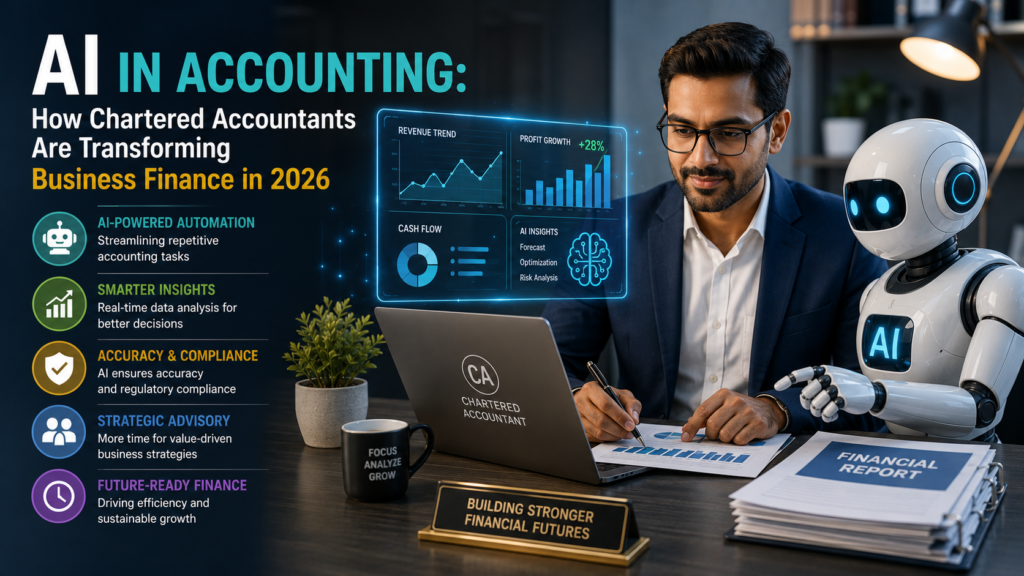
TL;DR Artificial Intelligence (AI) is reshaping the accounting profession by automating repetitive tasks, improving financial accuracy, enhancing compliance, and providing real-time business insights. Rather than replacing Chartered Accountants, AI is enabling them to focus on strategic advisory, tax planning, risk management, and business growth. Businesses that combine modern accounting technology with professional expertise are better positioned to improve efficiency, reduce costs, and make smarter financial decisions. Introduction The accounting profession is undergoing one of its biggest transformations in decades. Businesses are rapidly embracing Artificial Intelligence (AI), cloud accounting platforms, automation tools, and advanced analytics to simplify financial management. From automated bookkeeping and GST reconciliation to intelligent financial forecasting and fraud detection, AI is changing how organizations manage their finances. However, one common misconception remains: Will AI replace Chartered Accountants? The answer is no. Instead, AI is transforming the role of Chartered Accountants from traditional bookkeepers into strategic financial advisors who help businesses interpret data, ensure compliance, manage risks, and drive sustainable growth. For startups, MSMEs, and growing enterprises across India, understanding how AI and professional accounting work together is becoming essential for long-term success. What is AI in Accounting? Artificial Intelligence in accounting refers to the use of intelligent software and machine learning technologies to automate financial processes, analyze large volumes of data, identify anomalies, and support faster business decisions. Unlike traditional accounting software that relies on manual inputs, AI-powered systems continuously learn from historical financial data and improve their performance over time. Today, AI can assist with: Invoice processing Expense categorization Bank reconciliation GST calculations Tax data analysis Payroll automation Cash flow forecasting Financial reporting Risk identification Fraud detection This allows finance teams to spend less time on repetitive tasks and more time on strategic planning. Why AI is Revolutionizing Business Finance Modern businesses generate enormous amounts of financial data every day. Processing this information manually is time-consuming and increases the risk of human error. AI helps organizations by: Automating repetitive accounting work. Improving financial accuracy. Accelerating reporting timelines. Providing real-time dashboards. Enhancing compliance monitoring. Supporting better forecasting. Reducing operational costs. Identifying unusual transactions quickly. Instead of waiting until the end of the month for financial reports, businesses can access real-time insights that support faster decision-making. Top Applications of AI in Accounting 1. Automated Bookkeeping AI-powered accounting software automatically records transactions, categorizes expenses, and reconciles bank accounts with minimal manual intervention. Benefits include: Faster bookkeeping Fewer manual errors Better financial accuracy Time savings Improved productivity 2. Intelligent Invoice Processing Manual invoice entry consumes significant administrative time. AI can: Read invoices automatically. Extract supplier details. Verify invoice accuracy. Match purchase orders. Detect duplicate invoices. Process approvals faster. This significantly improves accounts payable efficiency. 3. GST Compliance Automation GST compliance involves multiple calculations, reconciliations, and return filings. AI assists by: Matching invoices automatically. Reconciling GST data. Identifying discrepancies. Monitoring Input Tax Credit. Reducing filing errors. Improving compliance accuracy. Businesses can reduce the likelihood of notices while simplifying GST management. 4. Financial Reporting Traditional reporting often takes days or weeks to prepare. AI-powered systems generate: Profit & Loss Statements Balance Sheets Cash Flow Statements Financial Ratios Business Dashboards Budget Reports within minutes using live financial data. 5. Fraud Detection One of AI’s strongest capabilities is identifying unusual financial behavior. AI can detect: Duplicate payments. Suspicious transactions. Unauthorized access. Abnormal expense patterns. Vendor fraud indicators. Unusual banking activities. Early detection helps businesses reduce financial losses and strengthen internal controls. 6. Cash Flow Forecasting Cash flow is one of the most important indicators of business health. AI analyzes: Historical transactions Customer payment behavior Seasonal trends Revenue patterns Expenses Outstanding receivables to generate more accurate cash flow forecasts and support better financial planning. 7. Tax Planning Assistance AI tools can organize financial information, identify eligible deductions, and highlight tax-saving opportunities based on available data. However, interpreting tax laws and applying them correctly still requires professional judgment from experienced Chartered Accountants. How Chartered Accountants Are Using AI Modern Chartered Accountants are embracing AI as a productivity tool rather than viewing it as competition. Today, CAs use AI to: Automate bookkeeping processes. Review financial transactions. Analyze business performance. Improve GST reconciliation. Monitor tax compliance. Generate management reports. Perform risk assessments. Support audit procedures. Enhance advisory services. Deliver faster client solutions. AI allows accountants to focus on strategic consulting while routine tasks are completed more efficiently. AI vs Human Chartered Accountants: Who Wins? One of the biggest questions businesses ask today is whether Artificial Intelligence can replace Chartered Accountants. While AI is highly effective at processing large volumes of financial data and automating repetitive tasks, it cannot replicate professional judgment, regulatory interpretation, ethical decision-making, or strategic business advice. AI Chartered Accountant Automates repetitive accounting tasks Provides professional judgment and expertise Processes large volumes of financial data quickly Interprets complex tax laws and regulations Identifies patterns and anomalies Advises on business strategy and financial planning Generates reports and dashboards Represents clients before tax authorities Performs data reconciliation Handles audits, litigation, and compliance matters Works based on historical data and algorithms Applies experience to unique business situations The future of accounting is not AI versus Chartered Accountants—it is AI working alongside Chartered Accountants to deliver faster, more accurate, and more valuable financial services. Benefits of AI in Accounting for Businesses Businesses that integrate AI with professional accounting support can experience significant operational and financial improvements. Improved Accuracy AI reduces manual data entry and minimizes calculation errors, resulting in more reliable financial records. Faster Decision-Making Real-time dashboards and financial reports provide management with timely information for strategic planning and operational decisions. Cost Efficiency Automation reduces repetitive administrative work, allowing accounting teams to focus on higher-value activities while improving productivity. Better Compliance AI assists with GST reconciliations, transaction monitoring, and financial record management, helping businesses strengthen tax compliance. Enhanced Fraud Prevention AI continuously monitors financial transactions and highlights unusual patterns that may indicate errors or fraudulent activities. Better Cash Flow Management Predictive analytics help businesses forecast cash inflows and outflows, improving budgeting and financial stability. Scalable Financial Operations As businesses grow,
AI in Accounting: How Chartered Accountants Are Transforming Business Finance in 2026
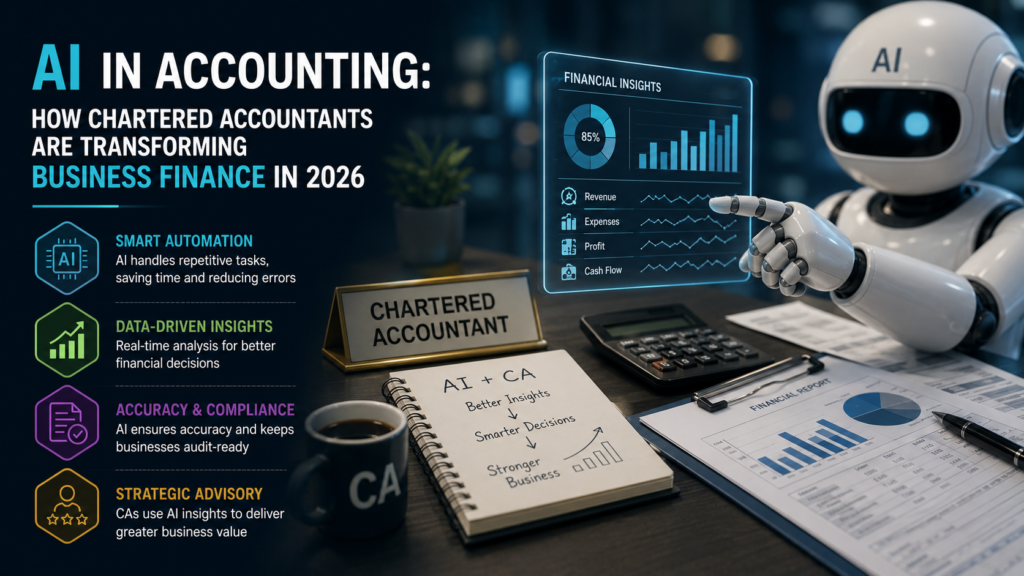
TL;DR Artificial Intelligence (AI) is reshaping the accounting profession by automating repetitive tasks, improving financial accuracy, enhancing compliance, and providing real-time business insights. Rather than replacing Chartered Accountants, AI is enabling them to focus on strategic advisory, tax planning, risk management, and business growth. Businesses that combine modern accounting technology with professional expertise are better positioned to improve efficiency, reduce costs, and make smarter financial decisions. Introduction The accounting profession is undergoing one of its biggest transformations in decades. Businesses are rapidly embracing Artificial Intelligence (AI), cloud accounting platforms, automation tools, and advanced analytics to simplify financial management. From automated bookkeeping and GST reconciliation to intelligent financial forecasting and fraud detection, AI is changing how organizations manage their finances. However, one common misconception remains: Will AI replace Chartered Accountants? The answer is no. Instead, AI is transforming the role of Chartered Accountants from traditional bookkeepers into strategic financial advisors who help businesses interpret data, ensure compliance, manage risks, and drive sustainable growth. For startups, MSMEs, and growing enterprises across India, understanding how AI and professional accounting work together is becoming essential for long-term success. What is AI in Accounting? Artificial Intelligence in accounting refers to the use of intelligent software and machine learning technologies to automate financial processes, analyze large volumes of data, identify anomalies, and support faster business decisions. Unlike traditional accounting software that relies on manual inputs, AI-powered systems continuously learn from historical financial data and improve their performance over time. Today, AI can assist with: Invoice processing Expense categorization Bank reconciliation GST calculations Tax data analysis Payroll automation Cash flow forecasting Financial reporting Risk identification Fraud detection This allows finance teams to spend less time on repetitive tasks and more time on strategic planning. Why AI is Revolutionizing Business Finance Modern businesses generate enormous amounts of financial data every day. Processing this information manually is time-consuming and increases the risk of human error. AI helps organizations by: Automating repetitive accounting work. Improving financial accuracy. Accelerating reporting timelines. Providing real-time dashboards. Enhancing compliance monitoring. Supporting better forecasting. Reducing operational costs. Identifying unusual transactions quickly. Instead of waiting until the end of the month for financial reports, businesses can access real-time insights that support faster decision-making. Top Applications of AI in Accounting 1. Automated Bookkeeping AI-powered accounting software automatically records transactions, categorizes expenses, and reconciles bank accounts with minimal manual intervention. Benefits include: Faster bookkeeping Fewer manual errors Better financial accuracy Time savings Improved productivity 2. Intelligent Invoice Processing Manual invoice entry consumes significant administrative time. AI can: Read invoices automatically. Extract supplier details. Verify invoice accuracy. Match purchase orders. Detect duplicate invoices. Process approvals faster. This significantly improves accounts payable efficiency. 3. GST Compliance Automation GST compliance involves multiple calculations, reconciliations, and return filings. AI assists by: Matching invoices automatically. Reconciling GST data. Identifying discrepancies. Monitoring Input Tax Credit. Reducing filing errors. Improving compliance accuracy. Businesses can reduce the likelihood of notices while simplifying GST management. 4. Financial Reporting Traditional reporting often takes days or weeks to prepare. AI-powered systems generate: Profit & Loss Statements Balance Sheets Cash Flow Statements Financial Ratios Business Dashboards Budget Reports within minutes using live financial data. 5. Fraud Detection One of AI’s strongest capabilities is identifying unusual financial behavior. AI can detect: Duplicate payments. Suspicious transactions. Unauthorized access. Abnormal expense patterns. Vendor fraud indicators. Unusual banking activities. Early detection helps businesses reduce financial losses and strengthen internal controls. 6. Cash Flow Forecasting Cash flow is one of the most important indicators of business health. AI analyzes: Historical transactions Customer payment behavior Seasonal trends Revenue patterns Expenses Outstanding receivables to generate more accurate cash flow forecasts and support better financial planning. 7. Tax Planning Assistance AI tools can organize financial information, identify eligible deductions, and highlight tax-saving opportunities based on available data. However, interpreting tax laws and applying them correctly still requires professional judgment from experienced Chartered Accountants. How Chartered Accountants Are Using AI Modern Chartered Accountants are embracing AI as a productivity tool rather than viewing it as competition. Today, CAs use AI to: Automate bookkeeping processes. Review financial transactions. Analyze business performance. Improve GST reconciliation. Monitor tax compliance. Generate management reports. Perform risk assessments. Support audit procedures. Enhance advisory services. Deliver faster client solutions. AI allows accountants to focus on strategic consulting while routine tasks are completed more efficiently. AI vs Human Chartered Accountants: Who Wins? One of the biggest questions businesses ask today is whether Artificial Intelligence can replace Chartered Accountants. While AI is highly effective at processing large volumes of financial data and automating repetitive tasks, it cannot replicate professional judgment, regulatory interpretation, ethical decision-making, or strategic business advice. AI Chartered Accountant Automates repetitive accounting tasks Provides professional judgment and expertise Processes large volumes of financial data quickly Interprets complex tax laws and regulations Identifies patterns and anomalies Advises on business strategy and financial planning Generates reports and dashboards Represents clients before tax authorities Performs data reconciliation Handles audits, litigation, and compliance matters Works based on historical data and algorithms Applies experience to unique business situations The future of accounting is not AI versus Chartered Accountants—it is AI working alongside Chartered Accountants to deliver faster, more accurate, and more valuable financial services. Benefits of AI in Accounting for Businesses Businesses that integrate AI with professional accounting support can experience significant operational and financial improvements. Improved Accuracy AI reduces manual data entry and minimizes calculation errors, resulting in more reliable financial records. Faster Decision-Making Real-time dashboards and financial reports provide management with timely information for strategic planning and operational decisions. Cost Efficiency Automation reduces repetitive administrative work, allowing accounting teams to focus on higher-value activities while improving productivity. Better Compliance AI assists with GST reconciliations, transaction monitoring, and financial record management, helping businesses strengthen tax compliance. Enhanced Fraud Prevention AI continuously monitors financial transactions and highlights unusual patterns that may indicate errors or fraudulent activities. Better Cash Flow Management Predictive analytics help businesses forecast cash inflows and outflows, improving budgeting and financial stability. Scalable Financial Operations As businesses grow,
Common Accounting Mistakes That Cost Small Businesses Thousands in Taxes
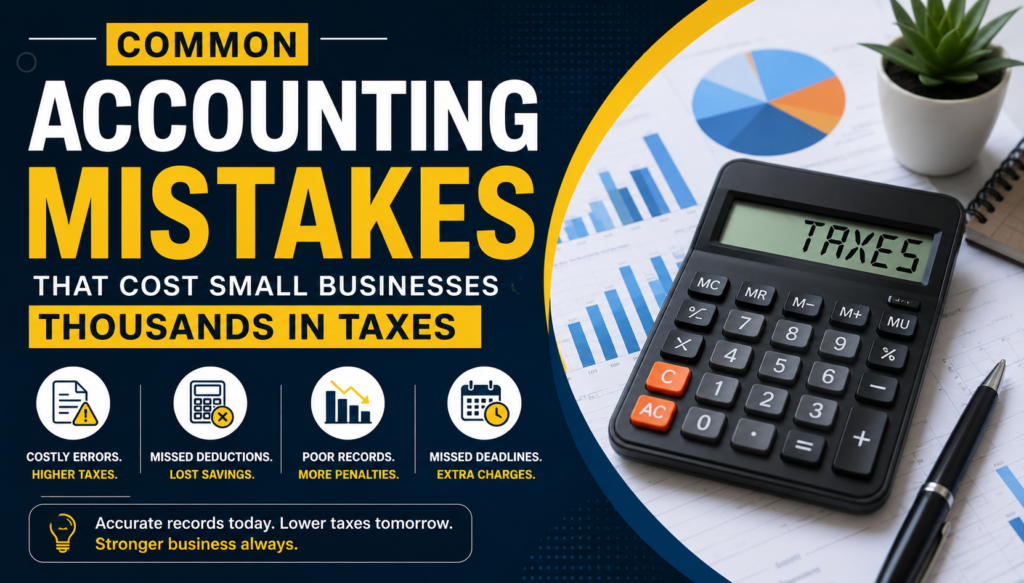
TL;DR Many small businesses lose significant amounts of money every year—not because of poor sales, but because of poor accounting. The most expensive accounting mistakes include: ✔ Mixing personal and business finances ✔ Missing deductible expenses ✔ Poor bookkeeping ✔ Incorrect GST records ✔ Delayed financial reporting ✔ Poor cash flow monitoring ✔ Weak tax planning ✔ Lack of professional accounting oversight Avoiding these mistakes can improve profitability, reduce tax liability, and strengthen long-term business growth. Why Accounting Matters More Than Most Business Owners Realize Many entrepreneurs focus heavily on sales, marketing, and operations. However, accounting is often the foundation that determines whether a business grows profitably or struggles financially. Good accounting helps business owners: Understand profitability Manage taxes efficiently Monitor cash flow Make informed decisions Avoid penalties Secure loans and investments Scale operations confidently Unfortunately, many small businesses treat accounting as a year-end activity rather than an ongoing business function. This mistake can be extremely costly. The Hidden Cost of Poor Accounting Accounting errors rarely create immediate problems. Instead, they gradually affect: Tax liability Business profitability Compliance status Cash flow Financial planning For example, a business that fails to record deductible expenses throughout the year may pay significantly more tax than necessary. Similarly, inaccurate financial records can trigger GST mismatches, compliance notices, and unnecessary scrutiny. The true cost often extends far beyond accounting fees. 1. Mixing Personal and Business Finances This is one of the most common mistakes among small business owners. Many entrepreneurs use the same bank account for: Business purchases Personal expenses Family spending Vendor payments This creates confusion and makes accurate accounting nearly impossible. Consequences Inaccurate financial statements Lost deductible expenses Tax filing complications Audit risks Best Practice Maintain separate: Bank accounts Credit cards Expense records for business and personal use. 2. Ignoring Regular Bookkeeping Many businesses postpone bookkeeping until tax season. Unfortunately, delayed bookkeeping often results in: Missing transactions Incorrect records Forgotten expenses Financial confusion Example A retailer with hundreds of monthly transactions may struggle to reconstruct records months later. The result is inaccurate reporting and lost tax deductions. Best Practice Update accounting records weekly or monthly. Consistent bookkeeping improves financial accuracy and decision-making. 3. Failing to Record Business Expenses Properly Every legitimate business expense should be documented appropriately. Commonly missed expenses include: Travel costs Professional subscriptions Office supplies Software expenses Communication costs Business meals Training expenses Impact When expenses are not recorded properly: Taxable income appears higher Tax liability increases Profit figures become misleading This is one of the easiest ways businesses unintentionally overpay taxes. 4. Poor GST Record Management GST compliance depends heavily on accurate accounting records. Many businesses make mistakes involving: Tax invoices GST classifications Input tax records Filing reconciliations Consequences Poor GST accounting can lead to: Input Tax Credit losses Compliance notices Interest liabilities Penalties Best Practice Reconcile GST records regularly and maintain accurate supporting documentation. 5. Not Reconciling Bank Accounts Bank reconciliation ensures accounting records match actual bank transactions. Without reconciliation: Duplicate entries go unnoticed Missing transactions remain hidden Fraud risks increase Cash balances become unreliable Recommended Frequency Monthly reconciliation is generally considered a minimum best practice. 6. Delaying Accounting Entries Many business owners record transactions weeks or months after they occur. Delayed accounting creates: Inaccurate reports Decision-making problems Tax planning difficulties Compliance risks Real-time accounting provides a far clearer picture of business performance. 7. Ignoring Cash Flow Management Profitability and cash flow are not the same thing. A business may appear profitable on paper while struggling to pay suppliers and employees. Common Cash Flow Mistakes Excessive credit sales Delayed collections Poor inventory management Lack of forecasting Best Practice Monitor: Incoming cash Outgoing cash Outstanding receivables Upcoming liabilities on a regular basis. 8. Poor Tax Planning Throughout the Year Many businesses only think about taxes when filing returns. This reactive approach limits tax-saving opportunities. Effective tax planning should occur throughout the financial year. Benefits Lower tax liability Better cash flow management Improved compliance Reduced year-end stress Tax planning is most effective when integrated into routine financial management. 9. Inaccurate Inventory Accounting For businesses dealing with physical products, inventory accounting directly affects profitability and taxation. Common mistakes include: Incorrect stock counts Outdated inventory records Inventory valuation errors Unrecorded losses Impact Inventory errors can distort: Profit calculations Taxable income Financial statements Accurate inventory controls are essential. 10. Trying to Manage Everything Without Professional Support Many business owners attempt to handle accounting themselves despite limited expertise. While this may appear cost-effective initially, it often becomes expensive later. Professional accountants can help identify: Tax-saving opportunities Compliance risks Financial inefficiencies Reporting errors Their expertise often saves businesses significantly more than the cost of professional services. How Accounting Errors Increase Tax Liability Many accounting mistakes directly affect tax outcomes. Accounting Error Potential Impact Missing expenses Higher taxable income Poor bookkeeping Incorrect tax reporting GST errors Penalties and interest Inventory mistakes Misstated profits Delayed accounting Missed tax planning opportunities Incomplete records Lost deductions The cumulative financial impact can be substantial over time. How to Build an Error-Free Accounting System Business owners can reduce accounting risks by implementing a structured process. Step 1 Maintain separate financial accounts. Step 2 Use accounting software. Step 3 Update records consistently. Step 4 Perform monthly reconciliations. Step 5 Track expenses systematically. Step 6 Review GST compliance regularly. Step 7 Conduct quarterly financial reviews. Step 8 Work with qualified accounting professionals. These steps create stronger financial controls and better decision-making capabilities. Benefits of Professional Accounting Services Professional accounting support provides advantages beyond compliance. Better Tax Efficiency Proper accounting helps identify legitimate deductions and planning opportunities. Improved Cash Flow Accurate financial information supports better operational decisions. Stronger Compliance Professional oversight reduces the risk of notices and penalties. Better Business Growth Reliable financial data enables confident expansion and investment decisions. Reduced Stress Business owners can focus on growth while professionals manage financial compliance. Conclusion Accounting mistakes are not merely administrative errors—they can directly affect profitability, tax liability, compliance, and long-term business success. Small businesses that neglect bookkeeping, fail to track expenses, ignore reconciliations, or
Accounting & Bookkeeping for Growing Businesses: Systems Every Founder Should Set Up Early
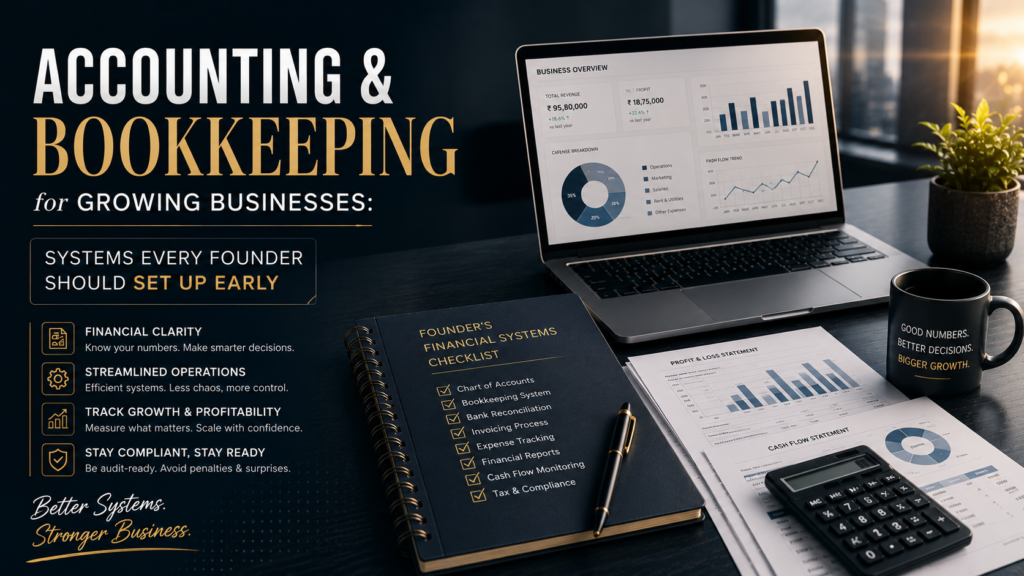
TL;DR Growing businesses often fail financially not because of poor sales, but because of weak accounting systems. Founders who establish proper bookkeeping workflows early gain better cash flow visibility, easier tax compliance, stronger investor confidence, and scalable operations. This guide explains: The accounting systems every growing business needs Common bookkeeping mistakes to avoid Financial reports founders should monitor How automation improves accuracy and efficiency When outsourcing accounting becomes necessary Why Early Accounting Systems Matter Most founders focus heavily on sales, hiring, and operations during the growth phase. Accounting becomes an afterthought until problems start appearing: GST mismatches Cash flow shortages Vendor disputes Missed tax deadlines Unclear profitability Investor due diligence issues Without structured bookkeeping systems, financial data becomes unreliable. That directly impacts strategic decisions. According to multiple SME finance studies, businesses with organized financial reporting are significantly more likely to maintain healthy cash flow and secure external funding. Strong accounting systems help businesses: Track profitability accurately Maintain compliance Forecast growth Improve operational efficiency Build lender and investor trust The Real Cost of Poor Bookkeeping Poor bookkeeping creates hidden financial risks that compound over time. Problem Business Impact Missing expense records Incorrect profit calculation Delayed invoicing Slower cash inflow GST reconciliation errors Notices and penalties No receivable tracking Bad debts Weak payroll records Compliance disputes Manual spreadsheets Human errors and duplication Founders often underestimate how quickly financial disorganization affects business growth. A business can grow revenue while simultaneously losing financial control. Core Accounting Systems Every Founder Needs 1. Separate Business and Personal Finances One of the earliest systems founders should establish is complete separation between business and personal transactions. This includes: Dedicated business bank accounts Separate credit/debit cards Structured reimbursement policies Clear owner withdrawal tracking Mixing personal and business expenses creates: Tax complications Audit risks Reporting inaccuracies Cash flow confusion Clean financial separation improves bookkeeping accuracy immediately. 2. Implement Cloud Accounting Software Early Manual bookkeeping becomes unsustainable once transaction volume increases. Cloud accounting software helps automate: Invoicing Expense categorization Bank reconciliation Financial reporting GST calculations Benefits include: Real-time financial visibility Reduced human errors Faster reporting Easier collaboration with accountants Secure cloud backups Founders should prioritize systems that integrate with: Banking GST filing Payroll Ecommerce platforms CRM tools 3. Build an Expense Management Workflow Uncontrolled expense tracking is one of the most common operational weaknesses in growing businesses. An effective workflow should include: Digital expense submissions Approval hierarchy Receipt storage Vendor categorization Monthly reconciliation Recommended categories: Marketing Salaries Travel Software subscriptions Vendor payments Operational expenses This improves budgeting accuracy and tax documentation readiness. 4. Set Up Invoice & Receivable Tracking Revenue means little if collections are delayed. Many businesses struggle because they track sales but fail to monitor receivables properly. Every founder should implement: Standardized invoicing Payment due-date tracking Automated reminders Customer ledger reconciliation Ageing analysis reports Aging reports help identify: Chronic late payers Cash flow risks Collection inefficiencies Strong receivable management improves liquidity significantly. 5. Create GST & Tax Compliance Tracking Systems Compliance becomes more complex as businesses scale. Growing businesses must track: GST input/output reconciliation TDS deductions Vendor compliance Filing deadlines Advance tax obligations Missing compliance deadlines can result in: Notices Interest liabilities Penalties ITC mismatches A structured compliance calendar reduces these risks. 6. Establish Payroll & Employee Payment Systems Payroll errors damage employee trust and create compliance exposure. Founders should implement: Salary processing workflows Leave tracking PF/ESI calculations Reimbursement systems Payroll documentation As teams grow, payroll complexity increases rapidly. Automated payroll systems improve: Accuracy Timeliness Statutory compliance Record maintenance 7. Review Monthly Financial Reports Many founders only review finances during tax season. That creates delayed decision-making. Businesses should review monthly: Report Why It Matters Profit & Loss Statement Tracks profitability Cash Flow Statement Monitors liquidity Balance Sheet Evaluates financial position Receivables Report Tracks collections Expense Summary Controls spending Monthly reviews help founders: Detect financial leaks Improve forecasting Optimize margins Make data-driven decisions 8. Maintain a Proper Document Management System Financial documentation becomes critical during: Tax assessments Funding rounds Audits Vendor disputes Due diligence Businesses should maintain: Digital invoices Contracts Tax filings Payroll records Bank statements Cloud storage with organized folders improves accessibility and audit readiness. Essential Financial Reports Founders Should Review Founders do not need to become accountants, but they must understand core business metrics. Key Metrics to Monitor Gross profit margin Net profit margin Burn rate Cash runway Accounts receivable turnover Operating expenses ratio These indicators reveal operational efficiency and growth sustainability. Common Bookkeeping Mistakes Growing Businesses Make Delaying Accounting Until Year-End This causes: Backlogs Errors Tax stress Inaccurate reports Over-Reliance on Excel Sheets Spreadsheets become risky during scaling due to: Manual errors Version conflicts Lack of automation Ignoring Cash Flow Profitability does not guarantee healthy cash flow. Many businesses fail because: Collections are delayed Expenses rise too quickly Inventory locks working capital Poor Vendor Documentation Missing invoices and contracts create: GST input issues Audit risks Payment disputes Automation vs Manual Accounting Automation significantly improves operational efficiency. Manual Systems Best for: Very early-stage businesses Minimal transactions Automated Systems Best for: Scaling companies Multi-location operations Ecommerce businesses Service firms with recurring invoicing Automation improves: Accuracy Speed Compliance tracking Reporting consistency However, automation still requires professional oversight. When to Outsource Accounting & Bookkeeping Many founders attempt to manage bookkeeping internally for too long. Outsourcing becomes beneficial when: Transaction volume increases Compliance complexity rises Financial reporting becomes inconsistent Internal teams lack expertise Professional accounting support helps businesses: Improve compliance Maintain accurate books Generate strategic reports Prepare for audits and funding How Proper Financial Systems Help Businesses Scale Businesses with structured accounting systems scale faster because they can: Access financing more easily Forecast accurately Reduce operational inefficiencies Improve profitability analysis Build investor confidence Financial discipline creates operational stability. As businesses expand into new markets, hire larger teams, or increase transaction volume, accounting systems become a strategic growth asset—not just a compliance function. Conclusion Accounting and bookkeeping are not merely administrative tasks. They form the operational backbone of a scalable business. Founders who establish structured financial systems early gain: Better visibility Stronger