

TL;DR
Artificial Intelligence (AI) is reshaping the accounting profession by automating repetitive tasks, improving financial accuracy, enhancing compliance, and providing real-time business insights. Rather than replacing Chartered Accountants, AI is enabling them to focus on strategic advisory, tax planning, risk management, and business growth. Businesses that combine modern accounting technology with professional expertise are better positioned to improve efficiency, reduce costs, and make smarter financial decisions.
Introduction
The accounting profession is undergoing one of its biggest transformations in decades. Businesses are rapidly embracing Artificial Intelligence (AI), cloud accounting platforms, automation tools, and advanced analytics to simplify financial management.
From automated bookkeeping and GST reconciliation to intelligent financial forecasting and fraud detection, AI is changing how organizations manage their finances.
However, one common misconception remains:
Will AI replace Chartered Accountants?
The answer is no.
Instead, AI is transforming the role of Chartered Accountants from traditional bookkeepers into strategic financial advisors who help businesses interpret data, ensure compliance, manage risks, and drive sustainable growth.
For startups, MSMEs, and growing enterprises across India, understanding how AI and professional accounting work together is becoming essential for long-term success.
What is AI in Accounting?
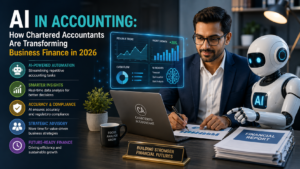
Artificial Intelligence in accounting refers to the use of intelligent software and machine learning technologies to automate financial processes, analyze large volumes of data, identify anomalies, and support faster business decisions.
Unlike traditional accounting software that relies on manual inputs, AI-powered systems continuously learn from historical financial data and improve their performance over time.
Today, AI can assist with:
- Invoice processing
- Expense categorization
- Bank reconciliation
- GST calculations
- Tax data analysis
- Payroll automation
- Cash flow forecasting
- Financial reporting
- Risk identification
- Fraud detection
This allows finance teams to spend less time on repetitive tasks and more time on strategic planning.
Why AI is Revolutionizing Business Finance
Modern businesses generate enormous amounts of financial data every day. Processing this information manually is time-consuming and increases the risk of human error.
AI helps organizations by:
- Automating repetitive accounting work.
- Improving financial accuracy.
- Accelerating reporting timelines.
- Providing real-time dashboards.
- Enhancing compliance monitoring.
- Supporting better forecasting.
- Reducing operational costs.
- Identifying unusual transactions quickly.
Instead of waiting until the end of the month for financial reports, businesses can access real-time insights that support faster decision-making.
Top Applications of AI in Accounting
1. Automated Bookkeeping
AI-powered accounting software automatically records transactions, categorizes expenses, and reconciles bank accounts with minimal manual intervention.
Benefits include:
- Faster bookkeeping
- Fewer manual errors
- Better financial accuracy
- Time savings
- Improved productivity
2. Intelligent Invoice Processing
Manual invoice entry consumes significant administrative time.
AI can:
- Read invoices automatically.
- Extract supplier details.
- Verify invoice accuracy.
- Match purchase orders.
- Detect duplicate invoices.
- Process approvals faster.
This significantly improves accounts payable efficiency.
3. GST Compliance Automation
GST compliance involves multiple calculations, reconciliations, and return filings.
AI assists by:
- Matching invoices automatically.
- Reconciling GST data.
- Identifying discrepancies.
- Monitoring Input Tax Credit.
- Reducing filing errors.
- Improving compliance accuracy.
Businesses can reduce the likelihood of notices while simplifying GST management.
4. Financial Reporting
Traditional reporting often takes days or weeks to prepare.
AI-powered systems generate:
- Profit & Loss Statements
- Balance Sheets
- Cash Flow Statements
- Financial Ratios
- Business Dashboards
- Budget Reports
within minutes using live financial data.
5. Fraud Detection
One of AI’s strongest capabilities is identifying unusual financial behavior.
AI can detect:
- Duplicate payments.
- Suspicious transactions.
- Unauthorized access.
- Abnormal expense patterns.
- Vendor fraud indicators.
- Unusual banking activities.
Early detection helps businesses reduce financial losses and strengthen internal controls.
6. Cash Flow Forecasting
Cash flow is one of the most important indicators of business health.
AI analyzes:
- Historical transactions
- Customer payment behavior
- Seasonal trends
- Revenue patterns
- Expenses
- Outstanding receivables
to generate more accurate cash flow forecasts and support better financial planning.
7. Tax Planning Assistance
AI tools can organize financial information, identify eligible deductions, and highlight tax-saving opportunities based on available data.
However, interpreting tax laws and applying them correctly still requires professional judgment from experienced Chartered Accountants.
How Chartered Accountants Are Using AI
Modern Chartered Accountants are embracing AI as a productivity tool rather than viewing it as competition.
Today, CAs use AI to:
- Automate bookkeeping processes.
- Review financial transactions.
- Analyze business performance.
- Improve GST reconciliation.
- Monitor tax compliance.
- Generate management reports.
- Perform risk assessments.
- Support audit procedures.
- Enhance advisory services.
- Deliver faster client solutions.
AI allows accountants to focus on strategic consulting while routine tasks are completed more efficiently.
AI vs Human Chartered Accountants: Who Wins?
One of the biggest questions businesses ask today is whether Artificial Intelligence can replace Chartered Accountants. While AI is highly effective at processing large volumes of financial data and automating repetitive tasks, it cannot replicate professional judgment, regulatory interpretation, ethical decision-making, or strategic business advice.
| AI | Chartered Accountant |
|---|---|
| Automates repetitive accounting tasks | Provides professional judgment and expertise |
| Processes large volumes of financial data quickly | Interprets complex tax laws and regulations |
| Identifies patterns and anomalies | Advises on business strategy and financial planning |
| Generates reports and dashboards | Represents clients before tax authorities |
| Performs data reconciliation | Handles audits, litigation, and compliance matters |
| Works based on historical data and algorithms | Applies experience to unique business situations |
The future of accounting is not AI versus Chartered Accountants—it is AI working alongside Chartered Accountants to deliver faster, more accurate, and more valuable financial services.
Benefits of AI in Accounting for Businesses
Businesses that integrate AI with professional accounting support can experience significant operational and financial improvements.
Improved Accuracy
AI reduces manual data entry and minimizes calculation errors, resulting in more reliable financial records.
Faster Decision-Making
Real-time dashboards and financial reports provide management with timely information for strategic planning and operational decisions.
Cost Efficiency
Automation reduces repetitive administrative work, allowing accounting teams to focus on higher-value activities while improving productivity.
Better Compliance
AI assists with GST reconciliations, transaction monitoring, and financial record management, helping businesses strengthen tax compliance.
Enhanced Fraud Prevention
AI continuously monitors financial transactions and highlights unusual patterns that may indicate errors or fraudulent activities.
Better Cash Flow Management
Predictive analytics help businesses forecast cash inflows and outflows, improving budgeting and financial stability.
Scalable Financial Operations
As businesses grow, AI-powered accounting systems can efficiently manage increasing transaction volumes without proportionally increasing manual effort.
Challenges of AI Adoption
Despite its advantages, AI implementation also presents several challenges that businesses should address carefully.
Data Security
Financial information is highly sensitive. Businesses should implement strong cybersecurity measures and use trusted accounting platforms.
Initial Investment
Adopting AI-enabled accounting software may involve upfront costs for software, implementation, and staff training.
Staff Training
Employees need appropriate training to use AI tools effectively and interpret the insights they generate.
Regulatory Compliance
AI systems must be configured to align with current tax laws, accounting standards, and regulatory requirements.
Human Oversight
AI supports decision-making but should not replace professional review. Critical financial and compliance decisions still require expert evaluation.
The Future of Accounting in India
The accounting profession is evolving rapidly as technology becomes more integrated into business operations. In the coming years, AI is expected to play an even greater role in financial management.
Key trends include:
- Increased adoption of cloud accounting platforms.
- AI-powered bookkeeping and reconciliations.
- Automated GST and tax compliance.
- Real-time financial reporting.
- Predictive financial analytics.
- Machine learning for fraud detection.
- Robotic Process Automation (RPA) in accounting.
- Greater focus on advisory and consulting services.
- Integrated business intelligence dashboards.
- Expansion of digital audits and compliance monitoring.
Chartered Accountants who combine technical expertise with modern technology will continue to provide significant value by helping businesses interpret financial information, manage risks, and plan for sustainable growth.
Why Choose Junaid Khan & Co., Chartered Accountants in Bhopal?
Technology alone cannot replace professional expertise. Businesses require experienced advisors who understand taxation, compliance, financial reporting, and strategic planning while effectively leveraging modern accounting tools.
Junaid Khan & Co., Chartered Accountants in Bhopal combines professional knowledge with technology-driven accounting solutions to help businesses improve efficiency, maintain compliance, and make informed financial decisions.
Our Services Include
- Digital Accounting Solutions
- Bookkeeping Services
- Financial Reporting
- GST Registration & Return Filing
- Income Tax Return Filing
- Tax Planning & Advisory
- Business Compliance Services
- Internal & Statutory Audits
- Company & LLP Registration
- Startup Advisory
- Payroll Management
- Financial Consulting
Our objective is to help businesses build accurate financial systems, improve operational efficiency, and support long-term growth through expert guidance and modern accounting practices.
Conclusion
Artificial Intelligence is redefining the accounting profession by automating repetitive tasks, improving data accuracy, and providing powerful business insights. However, technology works best when combined with professional expertise.
Chartered Accountants remain essential for interpreting tax laws, managing compliance, providing strategic financial advice, and helping businesses make informed decisions that technology alone cannot deliver.
Businesses that embrace AI while partnering with experienced accounting professionals are better positioned to improve productivity, strengthen compliance, optimize financial performance, and remain competitive in an increasingly digital economy.
If you’re looking for Digital Accounting Services, Tax Advisory, and Business Compliance Support in Bhopal, Junaid Khan & Co., Chartered Accountants in Bhopal offers practical, technology-enabled solutions tailored to the evolving needs of modern businesses.
FAQ Section
1. What is AI in accounting?
AI in accounting refers to the use of Artificial Intelligence technologies to automate bookkeeping, financial reporting, reconciliations, compliance monitoring, fraud detection, and data analysis, helping businesses improve efficiency and accuracy.
2. Can AI replace Chartered Accountants?
No. AI automates routine accounting tasks, but Chartered Accountants provide professional judgment, regulatory interpretation, strategic advice, audit support, and tax planning that require human expertise.
3. How does AI improve accounting accuracy?
AI minimizes manual data entry, performs automated reconciliations, detects anomalies, and analyzes financial data consistently, reducing the likelihood of human error.
4. Is AI useful for small businesses?
Yes. AI-powered accounting tools help small businesses save time, reduce administrative costs, improve financial reporting, and strengthen compliance without requiring large finance teams.
5. Does AI help with GST compliance?
AI assists by automating invoice matching, transaction categorization, GST reconciliations, and compliance monitoring, making return preparation more efficient.
6. What are the biggest benefits of AI in accounting?
The major benefits include automation, improved accuracy, faster reporting, enhanced fraud detection, better cash flow forecasting, cost efficiency, and real-time financial insights.
7. Is financial data safe with AI accounting software?
Security depends on the software provider and the business’s cybersecurity practices. Using reputable cloud accounting platforms with encryption and access controls helps protect sensitive financial information.
8. Why should businesses still hire a Chartered Accountant?
A Chartered Accountant ensures proper tax compliance, interprets financial information, advises on complex regulations, represents businesses before authorities, and provides strategic guidance that complements AI-driven automation.
Blog By : CA Junaid Khan
Written by CA Junaid Ahmed Khan, Junaid Khan & Co., Bhopal.