
TL;DR
GST compliance in 2026 is becoming increasingly data-driven and reconciliation-focused. Businesses can no longer treat GST return filing as simply entering figures into GSTR-1 and GSTR-3B.
Accurate ITC reconciliation, invoice matching, timely return filing, e-invoicing compliance and supplier follow-up are now critical parts of GST management.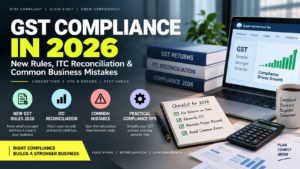
The Invoice Management System (IMS), GSTR-1/GSTR-1A, GSTR-2B and e-invoicing ecosystem have made invoice-level accuracy increasingly important. Businesses should regularly compare their purchase register with GST portal data before claiming ITC.
Common mistakes such as claiming credit without proper documentation, ignoring supplier mismatches, reporting incorrect invoice details, missing amendments and failing to reconcile ITC can result in blocked credit, interest, notices and unnecessary working-capital pressure.
Introduction
GST compliance has changed significantly since the introduction of India’s indirect-tax system.
For businesses in 2026, simply filing GSTR-1 and GSTR-3B on time is not enough. Businesses must also ensure that the information reported by them aligns with invoices uploaded by suppliers and the data available through the GST system.
This is particularly important for Input Tax Credit (ITC).
A purchase invoice may appear correctly in a company’s accounting software, but that does not automatically mean the corresponding ITC can be claimed without verification.
Businesses now need a structured process involving purchase-register reconciliation, supplier communication, invoice verification and periodic review of GST portal data.
The GST ecosystem has also become more technology-driven through mechanisms such as Invoice Management System (IMS), GSTR-2B, e-invoicing and return-level validations.
This makes GST compliance an ongoing financial-control function rather than a once-a-month filing activity.
What Is GST Compliance in 2026?
GST compliance refers to the complete process of meeting the requirements applicable to a registered taxpayer under GST.
This can include:
- GST registration maintenance
- Tax invoice compliance
- E-invoicing where applicable
- GSTR-1 filing
- GSTR-3B filing
- GSTR-2B review
- ITC reconciliation
- Reverse charge compliance
- GST payment
- E-way bill compliance
- GST refund documentation
- Credit and debit note reporting
- Annual return requirements where applicable
- Responding to GST notices
A business that focuses only on return filing can still have significant compliance gaps.
The objective should therefore be to maintain accurate books → accurate invoices → accurate GST data → reconciled ITC → accurate returns.
Major GST Compliance Areas Businesses Should Watch in 2026
Invoice-Level Accuracy
The first step toward GST compliance is generating accurate invoices.
Businesses should verify:
- GSTIN of supplier and recipient
- Legal name
- Place of supply
- HSN/SAC
- Taxable value
- GST rate
- CGST/SGST/IGST
- Invoice number
- Invoice date
- E-invoice details where applicable
Even a small error in GSTIN or invoice number can create reconciliation problems.
GSTR-1 Compliance
GSTR-1 contains details of outward supplies.
Businesses should reconcile sales data from their accounting system with the invoices reported in GSTR-1.
Errors in outward supplies can affect the recipient’s ITC and may also create differences between books, GSTR-1 and GSTR-3B.
GSTR-3B Compliance
GSTR-3B is used to report summary information relating to outward supplies, tax liability and ITC.
Businesses should ensure that the ITC reported in GSTR-3B is supported by proper reconciliation and eligibility checks.
The goal should not simply be to “match the number” but to establish that the claimed credit is legally eligible and properly supported.
What Is ITC Reconciliation?
ITC reconciliation is the process of comparing the ITC recorded in the company’s books with the ITC reflected through GST portal data and identifying differences.
A typical reconciliation compares:
Purchase Register
with
GSTR-2B
and relevant supplier-reported invoice data.
The reconciliation process helps identify:
- Missing invoices
- Duplicate invoices
- Incorrect GSTIN
- Incorrect invoice numbers
- Wrong invoice dates
- Supplier filing delays
- Credit notes
- Debit notes
- Amendments
- Ineligible ITC
- ITC already claimed
- ITC requiring further verification
Why GSTR-2B Reconciliation Matters
GSTR-2B provides taxpayers with a statement of eligible and other relevant ITC information based on supplier filings and other data available on the GST system.
Businesses should therefore review GSTR-2B before finalising their ITC claim.
However, matching an invoice with GSTR-2B does not by itself establish that the credit is legally eligible.
The business should also consider other statutory conditions.
For example, the underlying purchase should relate to business purposes and the taxpayer should possess the required tax documentation.
Therefore:
GSTR-2B matching ≠ automatic ITC eligibility.
This distinction is extremely important.
Invoice Management System and ITC in 2026
The Invoice Management System (IMS) has made invoice-level review even more relevant.
IMS enables recipients to interact with supplier-reported invoices by taking appropriate actions according to the functionality available on the GST portal.
Businesses should therefore establish an internal process for reviewing invoices rather than leaving the entire exercise until the GSTR-3B filing deadline.
A finance team should periodically review whether invoices appearing in the GST system are:
Accepted
Rejected
or require appropriate action/review.
The objective is to ensure that only appropriate credit flows into the return-filing process.
GSTR-1A and Correction of Outward Supplies
Businesses should also understand the role of GSTR-1A.
GSTR-1A provides an opportunity, where applicable, to amend or add details of outward supplies for a particular tax period before filing GSTR-3B.
This can be useful when errors or omissions are identified after GSTR-1 has been filed.
However, businesses should not treat GSTR-1A as a substitute for proper invoice-level controls.
The best approach is still to verify sales data before the original GSTR-1 is filed.
GST ITC Reconciliation Process for Businesses
Step 1: Export the Purchase Register
Start with the company’s accounting records.
Prepare a complete purchase register containing:
- Supplier GSTIN
- Invoice number
- Invoice date
- Taxable value
- IGST
- CGST
- SGST
- Total invoice value
Step 2: Download GSTR-2B
Obtain the relevant GSTR-2B from the GST portal.
The data should then be compared with the company’s purchase register.
Step 3: Match Invoice Details
Match invoices using relevant fields such as:
GSTIN + invoice number + invoice date + taxable value + tax amount
This helps identify exact matches and exceptions.
Step 4: Categorise Differences
Not every mismatch has the same reason.
Businesses can classify differences as:
Missing in GSTR-2B
The invoice exists in the books but is not appearing in the GST data.
Missing in Books
The supplier has reported an invoice but the business cannot locate it in its purchase records.
Value Mismatch
The invoice exists in both systems but the taxable value or tax amount differs.
GSTIN Mismatch
The supplier may have incorrectly reported the recipient GSTIN.
Duplicate Invoice
The same invoice may have been recorded or reported more than once.
Credit Note Difference
A supplier credit note may have reduced the eligible ITC.
Timing Difference
The supplier may report the invoice in a later tax period.
Each category should be tracked separately.
What Should You Do When ITC Is Missing?
Suppose a business has a genuine purchase invoice for ₹1,00,000 plus GST, but the corresponding invoice does not appear in the expected GST data.
The business should not simply assume that the credit can be claimed without checking.
First verify whether:
- The supplier has filed the relevant return.
- The invoice was reported correctly.
- The GSTIN is correct.
- The invoice was uploaded in another period.
- There is an amendment.
- The document is otherwise eligible for ITC.
The supplier should be contacted where the issue is attributable to supplier reporting.
This makes vendor compliance management an important part of ITC management.
Common GST Compliance Mistakes in 2026
Claiming ITC Without Reconciliation
One of the biggest mistakes is claiming ITC based entirely on the purchase register.
A company’s accounting records and GST portal data can differ significantly.
Regular reconciliation helps identify these differences before they become larger compliance issues.
Assuming GSTR-2B Automatically Makes ITC Eligible
The opposite mistake is equally important.
An invoice appearing in GSTR-2B does not mean the taxpayer should blindly claim the credit.
The taxpayer still needs to verify the applicable legal conditions.
Ignoring Supplier Compliance
Your supplier’s GST compliance can affect your ITC position.
If a supplier fails to report invoices correctly or reports incorrect recipient details, the recipient may face reconciliation problems.
Businesses should therefore monitor important vendors instead of treating supplier GST compliance as someone else’s problem.
Incorrect GSTIN on Invoices
A wrong GSTIN can result in invoices being reflected against another taxpayer or failing to appear correctly for the intended recipient.
GSTIN verification should therefore be part of the purchase and invoicing process.
Delayed Reconciliation
Waiting until the GSTR-3B filing deadline to reconcile thousands of invoices creates unnecessary pressure.
Monthly or even more frequent reconciliation is much easier to manage.
Ignoring Credit Notes
Credit notes can reduce the amount of ITC or otherwise affect the tax position.
They should be tracked separately and reconciled with supplier data.
Failing to Track Reverse Charge Transactions
Reverse charge transactions require separate attention because the tax payment and ITC treatment can differ from ordinary purchases.
Businesses should maintain a dedicated RCM tracker rather than mixing such transactions with regular purchase invoices.
GST Compliance Checklist for 2026
Businesses should ideally maintain a monthly GST compliance checklist.
Sales
Verify:
- Sales invoices
- Credit notes
- Debit notes
- HSN/SAC
- GST rates
- Place of supply
- Export transactions
- B2B/B2C classification
Purchases
Verify:
- Purchase invoices
- Supplier GSTIN
- GSTR-2B
- ITC eligibility
- Blocked credits
- Credit notes
- Reverse charge transactions
Returns
Before filing:
- Reconcile GSTR-1 with books
- Reconcile GSTR-3B with books
- Reconcile ITC with GSTR-2B
- Review amendments
- Review tax liability
- Verify cash/credit ledger
- Check previous-period adjustments
E-Invoicing
Where e-invoicing applies, businesses should verify:
- IRN generation
- QR code
- Invoice details
- Cancellation timelines
- Integration with accounting software
- Reporting of relevant documents
The GST e-invoicing ecosystem uses authorised Invoice Registration Portals to register applicable invoices and generate the Invoice Reference Number (IRN).
How Businesses Can Reduce GST Compliance Risk
Reconcile Monthly Instead of Annually
Monthly reconciliation prevents a small mismatch from becoming a large unresolved balance.
Create an ITC Exception Report
Instead of reviewing every invoice manually, businesses can create an exception report showing:
Matched invoices
Missing invoices
Value mismatches
GSTIN mismatches
Duplicate invoices
Credit notes
This makes the reconciliation process more efficient.
Maintain a Vendor Follow-Up Tracker
For missing invoices, maintain a record showing:
Vendor → Invoice → Difference → Follow-up date → Vendor response → Final action
This creates an audit trail and prevents unresolved items from being forgotten.
Integrate Accounting With GST Processes
Businesses using accounting software should ideally integrate GST data wherever practical.
Automation can reduce manual errors, but automated output should still be reviewed by the finance or tax team.
What Happens If GST Compliance Is Ignored?
Poor GST compliance can create several financial and operational problems.
These can include:
ITC mismatches
Interest liability
Late fees
Tax demands
Notices
Cash-flow pressure
Vendor disputes
Reconciliation workload
Potential penalties
The cost is not limited to the tax amount itself.
For example, if eligible ITC is not available at the expected time because of reconciliation issues, the business may have to use additional cash to discharge its GST liability.
This can directly affect working capital.
Why GST Compliance Is Now a Business Function
GST should not be viewed only as an accounting responsibility.
Sales teams generate invoices.
Procurement teams deal with vendors.
Finance teams record purchases.
Accounts teams reconcile GST data.
Management ultimately bears the financial and compliance consequences.
Therefore, GST compliance works best when there is coordination between sales, procurement, accounts, finance and management.
A proper GST process can also improve the quality of business data.
GST Compliance Automation in 2026
Technology can significantly reduce the workload associated with GST compliance.
Businesses can use automation for:
- Invoice matching
- GSTR-2B reconciliation
- Duplicate detection
- GSTIN validation
- ITC classification
- Vendor follow-up
- Exception reporting
- Return preparation
- E-invoice integration
However, automation should support professional review rather than completely replace it.
Taxability, ITC eligibility, place of supply and unusual transactions may still require human judgement.
Conclusion
GST compliance in 2026 is increasingly about accuracy, reconciliation and continuous monitoring.
Businesses should not wait until the return-filing deadline to discover that purchase invoices are missing from GSTR-2B, suppliers have reported incorrect GSTINs or credit notes have not been accounted for.
A strong GST compliance process should connect:
Books of Accounts → Invoices → GSTR-1 → GSTR-2B/IMS → ITC Reconciliation → GSTR-3B
The most important step is to establish a regular reconciliation process.
Businesses that review their GST data every month can identify errors earlier, communicate with suppliers faster and reduce the risk of unnecessary ITC disputes and compliance issues.
With GST becoming increasingly technology-driven, accurate accounting and proactive GST compliance are no longer optional for growing businesses.
Frequently Asked Questions
What is GST compliance in 2026?
GST compliance in 2026 includes timely GST returns, accurate invoicing, e-invoicing where applicable, ITC reconciliation, GST payments, reverse charge compliance, e-way bill requirements and maintaining supporting records.
What is ITC reconciliation?
ITC reconciliation is the process of comparing purchase records with GST portal data, particularly GSTR-2B, to identify missing invoices, mismatches, duplicates, credit notes and potentially ineligible ITC.
Is GSTR-2B enough to claim ITC?
No. GSTR-2B is an important reconciliation source, but taxpayers must independently verify whether the ITC satisfies the applicable legal conditions.
What should I do if an invoice is missing from GSTR-2B?
First verify the invoice, GSTIN and reporting period. Check whether the supplier has filed the relevant return and correctly reported the invoice. If necessary, follow up with the supplier.
Can supplier mistakes affect my ITC?
Yes. Incorrect GSTIN, invoice reporting errors, delayed filing or other supplier-side issues can create ITC reconciliation problems for the recipient.
How often should businesses reconcile ITC?
Monthly reconciliation is generally preferable because it allows businesses to identify mismatches while transactions and supplier communications are still recent.
What is the Invoice Management System in GST?
IMS is a GST-system functionality that enables recipients to manage and take appropriate actions on supplier-reported invoice records. It makes invoice-level review increasingly important for businesses.
What are the most common GST mistakes businesses make?
Common mistakes include incorrect invoices, claiming ITC without proper reconciliation, ignoring supplier compliance, incorrect GSTINs, missed credit notes, delayed reconciliation and errors in GSTR-1 or GSTR-3B.
Does e-invoicing apply to every GST-registered business?
No. E-invoicing applicability depends on the prescribed turnover and other conditions. Businesses should verify the current threshold and applicable notification before determining whether they are required to generate e-invoices.
Why is GST reconciliation important for small businesses?
Reconciliation helps small businesses detect ITC mismatches, supplier errors and accounting differences before they become larger compliance problems. It can also help protect working capital by ensuring eligible ITC is properly identified and supported.
Can GST compliance affect business cash flow?
Yes. Incorrect ITC claims, missing credits, delayed refunds, interest and additional tax payments can increase the amount of cash a business needs to deploy for GST obligations.
Should businesses use professional GST compliance support?
Businesses with high transaction volumes, multiple GST registrations, complex ITC positions, reverse-charge transactions or frequent reconciliations can benefit from professional GST compliance and reconciliation support.
Blog By : CA Junaid Khan
Written by CA Junaid Ahmed Khan, Junaid Khan & Co., Bhopal.