


TL;DR
Advance tax is a system under which eligible taxpayers pay their estimated income tax during the financial year instead of waiting until the year ends.
For FY 2026–27 (AY 2027–28), taxpayers liable to pay advance tax generally make payments in instalments during the financial year.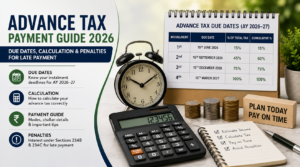
For most taxpayers, the statutory schedule is:
| Due Date | Cumulative Advance Tax Payable |
|---|---|
| 15 June 2026 | 15% |
| 15 September 2026 | 45% |
| 15 December 2026 | 75% |
| 15 March 2027 | 100% |
For taxpayers covered by the presumptive taxation provisions under Sections 44AD or 44ADA, the applicable advance tax payment is generally 100% by 15 March.
Missing or underpaying advance tax can result in interest under Sections 234B and 234C, subject to the conditions prescribed under the Income Tax Act.
What Is Advance Tax?
Advance tax is income tax paid during the financial year on income that is expected to be earned during that same year.
It is commonly described as a “pay-as-you-earn” tax system.
Instead of waiting until the end of the financial year to calculate and pay the entire tax liability, eligible taxpayers estimate their annual tax and pay it in instalments.
For example, a freelancer expects to earn substantial professional income throughout FY 2026–27.
Rather than waiting until March 2027, the taxpayer estimates the annual taxable income and pays the required tax progressively during the year.
This helps both taxpayers and the tax administration manage tax liabilities more systematically.
Who Is Required to Pay Advance Tax?
Under Section 208, advance tax generally applies when the estimated tax liability for the financial year is ₹10,000 or more, subject to the conditions and exemptions provided by law.
Advance tax can therefore apply to taxpayers such as:
- Business owners
- Freelancers
- Consultants
- Doctors
- Lawyers
- Chartered professionals
- Landlords
- Traders
- Investors with taxable income
- Salaried individuals with substantial additional income
- Companies and other taxpayers
Senior Citizen Exception
A resident individual who:
- is 60 years of age or more, and
- does not have income from a business or profession,
is generally not liable to pay advance tax.
This exception should be checked against the taxpayer’s actual circumstances and the applicable provisions.
Advance Tax Due Dates for FY 2026–27
For taxpayers following the regular advance-tax schedule, the payment structure is cumulative.
| Instalment | Due Date | Minimum Cumulative Payment |
|---|---|---|
| 1st | 15 June 2026 | 15% |
| 2nd | 15 September 2026 | 45% |
| 3rd | 15 December 2026 | 75% |
| 4th | 15 March 2027 | 100% |
Example
Suppose your estimated advance tax liability for FY 2026–27 is:
₹2,00,000
Your cumulative target would approximately be:
- By 15 June: ₹30,000
- By 15 September: ₹90,000
- By 15 December: ₹1,50,000
- By 15 March: ₹2,00,000
These percentages are cumulative, not additional amounts payable at each date.
So, if you have already paid ₹30,000 in June, you do not pay another ₹90,000 in September. You need to bring your cumulative payment up to ₹90,000.
How Is Advance Tax Calculated?
Advance tax should not be calculated simply by applying the tax slab to gross income.
A proper calculation generally follows this sequence:
Step 1: Estimate Total Income
Consider expected income from all relevant sources, including:
- Salary
- Business income
- Professional income
- Rental income
- Interest
- Dividends
- Capital gains
- Other taxable income
Step 2: Estimate Eligible Deductions
Depending on the applicable tax regime and taxpayer category, consider eligible deductions.
Step 3: Calculate Tax
Calculate tax using the applicable provisions and tax regime.
Step 4: Consider Rebate
Apply any eligible rebate available under the applicable provisions.
Step 5: Add Applicable Surcharge and Cess
Where applicable, consider:
- Surcharge
- Health and Education Cess
- Other applicable components
Step 6: Reduce TDS/TCS
This is critical.
Advance tax is generally calculated after considering taxes already expected to be deducted or collected and available for credit.
Basic Formula
Estimated Tax Liability − TDS/TCS Credits = Estimated Advance Tax Liability
The resulting amount should then be considered against the applicable ₹10,000 threshold and instalment requirements.
Example of Advance Tax Calculation
Suppose a freelancer estimates the following income for FY 2026–27:
| Particular | Amount |
|---|---|
| Professional income | ₹14,00,000 |
| Interest income | ₹50,000 |
| Gross income | ₹14,50,000 |
| Eligible adjustments/deductions | As applicable |
| Estimated final tax liability | ₹1,20,000 |
| Expected TDS | ₹30,000 |
| Advance tax to be paid | ₹90,000 |
The taxpayer should then distribute the ₹90,000 estimated advance-tax liability according to the applicable instalment schedule.
This is only an illustrative example. The actual liability depends on the taxpayer’s income, tax regime, deductions, special-rate income and applicable provisions.
Advance Tax for Salaried Employees
Many salaried employees assume advance tax never applies to them.
That is not always correct.
If your employer deducts sufficient TDS from your salary, you may not need to separately pay advance tax.
However, advance tax can become relevant if you earn significant additional income such as:
- Rental income
- Interest income
- Capital gains
- Freelance income
- Consultancy income
- Dividend income
- Other taxable receipts
Example
Suppose your employer deducts ₹1,50,000 as TDS.
You later earn ₹2,00,000 in taxable capital gains and ₹80,000 in interest income.
Your total final tax liability may exceed the tax already covered through TDS.
The resulting shortfall may need to be addressed through advance tax to avoid interest exposure, subject to the applicable provisions.
Advance Tax for Freelancers and Professionals
Advance tax is particularly important for self-employed professionals because income is not necessarily accompanied by regular monthly TDS.
Professionals such as:
- Consultants
- Doctors
- Lawyers
- Designers
- Architects
- Software professionals
- Marketing consultants
- Independent advisors
may have substantial tax liabilities even after considering TDS deducted by clients.
A good practice is to estimate income quarter by quarter rather than making a single annual guess.
This is particularly useful when professional receipts fluctuate.
Advance Tax for Businesses
Business owners should integrate advance-tax planning with monthly or quarterly accounting.
A business may experience:
- Seasonal sales
- Variable margins
- Large expenses
- New contracts
- Inventory changes
- Asset purchases
- Sudden revenue increases
Therefore, advance tax should ideally be reviewed as financial results become clearer.
Recommended Approach
Monthly bookkeeping → Profit estimation → Tax projection → TDS/TCS reconciliation → Advance-tax planning
This approach reduces the risk of reaching March with an unexpectedly large tax liability.
Advance Tax on Capital Gains
Capital gains can make advance-tax calculation more complicated.
Suppose an investor sells shares, property or another capital asset and realizes a taxable gain.
The taxpayer may suddenly have additional tax liability that was not present earlier in the year.
This is why capital gains should not simply be ignored until ITR filing.
Where tax becomes payable, the taxpayer should evaluate whether advance-tax obligations arise and whether interest exposure could result from delayed payment.
Certain rules also provide specific treatment for capital gains arising after earlier instalment dates. Professional review can therefore be useful for substantial or irregular transactions.
What Is the Difference Between Advance Tax and TDS?
These concepts are often confused.
TDS
Tax Deducted at Source is deducted by the person making certain payments.
Examples include:
- Employer deducting TDS from salary
- Bank deducting TDS on certain interest
- Client deducting TDS from professional fees
Advance Tax
Advance tax is paid directly by the taxpayer based on the taxpayer’s estimated tax liability.
Simple Difference
| TDS | Advance Tax |
|---|---|
| Deducted by payer | Paid by taxpayer |
| Happens at source | Paid by taxpayer |
| Based on applicable TDS provisions | Based on estimated tax liability |
| Credited against final tax | Credited against final tax |
Both can contribute toward your final income-tax liability.
How to Pay Advance Tax Online
Advance tax can be paid electronically through the official Income Tax Department’s tax-payment system.
Before making payment, verify:
- PAN
- Assessment Year
- Correct tax category
- Correct payment type
- Amount
- Bank/payment details
For FY 2026–27 income, the relevant assessment year will generally be AY 2027–28.
Selecting the wrong assessment year can create unnecessary complications in tax-credit reconciliation.
After payment, retain the challan/payment acknowledgement and verify that the payment is appropriately reflected in your tax records.
Section 234B Interest for Short Payment of Advance Tax
Interest under Section 234B can apply where the taxpayer has not paid sufficient advance tax, subject to the conditions specified by law.
Broadly, Section 234B is associated with situations where the advance tax paid is less than the required threshold and there is a tax shortfall.
The interest is generally calculated at 1% per month or part of a month, subject to the statutory calculation mechanism.
The exact liability should be calculated based on the taxpayer’s final assessed tax and advance-tax payments.
Section 234C Interest for Deferment of Instalments
Section 234C deals with interest arising from deferment of advance-tax instalments, subject to the prescribed conditions and exceptions.
This means a taxpayer could potentially pay the required total tax by the end of the year and still face interest if earlier instalment requirements were not properly met.
That is why simply saying:
“I’ll pay everything in March.”
can be a costly approach.
Advance Tax vs Self-Assessment Tax
Another common misunderstanding is treating advance tax and self-assessment tax as the same thing.
They are different stages of tax payment.
Advance Tax
Paid during the financial year based on estimated income.
Self-Assessment Tax
Generally paid after the financial year ends when calculating the final tax payable before filing the return.
Example
If your estimated tax liability during FY 2026–27 is ₹2 lakh and you pay advance tax throughout the year, your remaining liability at the time of ITR filing may be small.
If you do not pay sufficient advance tax, you may have to pay the remaining tax as self-assessment tax, along with possible interest where applicable.
What Happens If You Miss an Advance Tax Due Date?
Missing an instalment does not mean the tax liability disappears.
Instead, you should:
- Calculate the updated estimated tax liability.
- Determine how much has already been paid.
- Reconcile TDS/TCS credits.
- Pay the required amount as soon as possible.
- Review possible interest implications.
- Adjust subsequent instalments based on revised income projections.
Do not wait until the next financial year to discover the shortfall.
Common Advance Tax Mistakes
1. Ignoring Additional Income
Employees often calculate tax only on salary while ignoring interest, rent or capital gains.
2. Not Reconciling TDS
Advance tax should be calculated after considering expected TDS/TCS credits.
3. Using Gross Income Instead of Taxable Income
Tax is not simply calculated on gross receipts.
4. Forgetting Special-Rate Income
Capital gains and certain other income may have special tax treatment.
5. Paying the Entire Amount in March
This can create interest exposure where earlier instalment requirements were not met.
6. Selecting the Wrong Assessment Year
Always verify the applicable assessment year before payment.
7. Not Revising the Estimate
If your income increases substantially during the year, your original advance-tax calculation may become outdated.
Advance Tax Compliance Checklist for FY 2026–27
Before 15 June 2026
- [ ] Estimate annual income.
- [ ] Estimate taxable income.
- [ ] Calculate expected tax.
- [ ] Estimate TDS/TCS.
- [ ] Pay first instalment if applicable.
Before 15 September 2026
- [ ] Update income projection.
- [ ] Reconcile TDS/TCS.
- [ ] Review business/professional profits.
- [ ] Include new investments or capital gains.
- [ ] Bring cumulative payment to the applicable percentage.
Before 15 December 2026
- [ ] Recalculate projected annual tax.
- [ ] Review capital gains.
- [ ] Check additional income.
- [ ] Reconcile tax credits.
- [ ] Pay required cumulative amount.
Before 15 March 2027
- [ ] Finalise estimated annual tax.
- [ ] Reconcile all TDS/TCS.
- [ ] Consider remaining advance tax.
- [ ] Pay applicable final instalment.
- [ ] Preserve payment records.
Why Professional Advance Tax Planning Matters
Advance tax calculation becomes more complicated when a taxpayer has multiple income sources.
For example, a business owner may have:
Business profits + rental income + bank interest + capital gains + TDS credits
A simple calculator may not adequately capture every applicable provision.
A Chartered Accountant can help with:
- Income projection
- Tax-regime comparison
- Advance-tax calculation
- TDS reconciliation
- Capital-gains tax planning
- Business tax planning
- Tax payment compliance
- ITR filing
- Interest computation
For businesses, advance-tax planning should ideally be integrated with monthly accounting and financial reporting.
Conclusion
Advance tax is not simply another tax payment deadline. It is an important part of annual tax planning for individuals, professionals and businesses.
For FY 2026–27, eligible taxpayers should monitor their income throughout the year, estimate their tax liability, account for TDS/TCS credits and make advance-tax payments according to the applicable schedule.
The biggest mistake is waiting until March to think about tax.
If your income changes during the year, your advance-tax estimate should change with it.
For taxpayers with business income, professional receipts, capital gains or multiple income sources, a periodic tax review can help reduce the risk of short payment, unexpected interest and last-minute compliance pressure.
Junaid Khan & Co, Chartered Accountants, can assist with advance-tax calculation, tax planning, ITR filing, accounting and broader income-tax compliance.
Plan your tax liability before the deadline—not after it.
6. FAQ SECTION
1. What are the advance tax due dates for FY 2026–27?
For most taxpayers, advance tax is generally payable cumulatively by 15 June 2026, 15 September 2026, 15 December 2026 and 15 March 2027, at 15%, 45%, 75% and 100% respectively.
2. Who is required to pay advance tax?
Generally, taxpayers whose estimated tax liability is ₹10,000 or more after considering applicable tax credits may be required to pay advance tax, subject to statutory exceptions.
3. Is advance tax applicable to salaried employees?
It can be. If TDS from salary does not sufficiently cover the final tax liability and the taxpayer has additional taxable income, advance tax may become applicable.
4. What happens if I miss an advance tax instalment?
You should calculate the updated liability and make the required payment as soon as possible. Depending on the circumstances, interest under Sections 234B and/or 234C may apply.
5. What is the difference between Section 234B and Section 234C?
Section 234B generally relates to interest for specified shortfalls in advance tax, while Section 234C relates to deferment of specified advance-tax instalments. The exact calculation depends on the taxpayer’s circumstances.
6. Is advance tax applicable to capital gains?
Potentially, yes. Taxpayers earning taxable capital gains should consider the applicable advance-tax provisions. Certain rules provide specific treatment where capital gains arise after earlier instalment dates.
7. Can advance tax be paid online?
Yes. Advance tax can be paid electronically through the official Income Tax Department’s tax-payment system. Taxpayers should carefully select the correct assessment year and payment details.
8. What is the difference between advance tax and self-assessment tax?
Advance tax is paid during the financial year based on estimated tax liability. Self-assessment tax is generally paid after the financial year when the taxpayer calculates the final tax payable before filing the ITR.
Blog By : CA Junaid Khan
Written by CA Junaid Ahmed Khan, Junaid Khan & Co., Bhopal.