


TL;DR
Receiving an Income Tax Notice does not automatically mean that you have committed tax evasion or owe a penalty. A communication may be issued because the Income Tax Department requires clarification, detects a mismatch, processes an adjustment, finds the return defective, initiates scrutiny, or identifies a potential tax demand.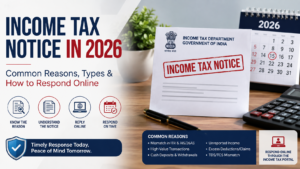
The most important steps are to verify the communication, understand the applicable section, check the response deadline, reconcile the information with your ITR, AIS and Form 26AS, gather supporting documents, and submit an accurate response through the appropriate facility on the Income Tax e-Filing portal.
The Income Tax Department’s e-Proceedings facility allows registered taxpayers or their authorized representatives to view and respond electronically to notices, intimations and letters.
What Is an Income Tax Notice?
An Income Tax notice is an official communication issued by the Income Tax Department concerning a taxpayer’s return, reported income, deductions, taxes, financial transactions, assessment or another compliance matter.
Not every communication means additional tax is payable.
Depending on its nature, the Department may simply be:
- Processing your return.
- Requesting additional information.
- Asking you to correct a defective return.
- Proposing an adjustment.
- Seeking clarification about a transaction.
- Conducting scrutiny.
- Communicating an outstanding demand.
Therefore, the first step should never be panic or immediate payment. It should be understanding exactly what the communication says and what action it requires.
Why Did You Receive an Income Tax Notice?
Modern tax administration increasingly relies on information reported by employers, banks, financial institutions, GST systems and other reporting entities. This makes accurate reconciliation before ITR filing extremely important.
Here are some common situations that can lead to a notice or further verification.
1. AIS or Form 26AS Does Not Match Your ITR
A mismatch between information available with the Department and the information reported in your Income Tax Return can attract attention.
For example, AIS or Form 26AS may contain:
- Salary information.
- Interest income.
- Dividend income.
- Securities transactions.
- TDS/TCS information.
- Other reportable financial transactions.
If your ITR does not correctly account for relevant income or tax information, clarification or correction may be required. Mismatches between ITR data and AIS/Form 26AS are among the commonly cited reasons for tax communications.
Practical Tip
Always reconcile your Form 16, Form 16A, AIS, TIS and Form 26AS with your own financial records before submitting your return.
2. Income From One or More Sources Was Not Reported
A taxpayer may correctly report salary or business income but accidentally forget another income source.
Examples can include:
- Savings or fixed-deposit interest.
- Rental income.
- Capital gains.
- Dividend income.
- Freelance income.
- Professional receipts.
- Income from investments.
The possibility of mismatches increases when taxpayers rely entirely on one document rather than reviewing their complete financial information.
3. Incorrect or Unsubstantiated Deduction Claims
Deductions and exemptions should be claimed only when the taxpayer meets the applicable legal conditions and can maintain appropriate supporting documentation.
Unusual or incorrect claims may require clarification.
Maintain records supporting significant claims rather than trying to reconstruct them only after receiving a notice.
4. High-Value Transactions Require Reconciliation
Certain transactions reported through the financial system may need to be properly reflected in your tax position.
Examples can include:
- Purchase or sale of property.
- Large investments.
- Significant securities transactions.
- High-value deposits or receipts.
A high-value transaction does not by itself establish wrongdoing. The key issue is whether the transaction and its tax implications have been correctly reported where required.
5. GST Turnover and Income Tax Records Do Not Match
For business taxpayers, consistency between financial statements, GST records and Income Tax reporting is important.
For example, a substantial difference between turnover reflected through GST-related records and the figures reported for Income Tax purposes may require reconciliation or explanation. GST/ITR turnover differences are also among the circumstances commonly discussed in relation to scrutiny.
6. Your Return Contains Errors or Is Incomplete
Incorrect or incomplete information can result in a defective return communication.
Possible issues include:
- Missing mandatory information.
- Incomplete schedules.
- Incorrect tax details.
- Income information not properly reported.
- Other inconsistencies affecting the validity of the return.
A defective return notice should be addressed within the deadline specified in the communication.
7. TDS Information Does Not Match
TDS-related mismatches can arise because of:
- Incorrect PAN.
- Incorrect TDS amount.
- Deductor reporting errors.
- Incorrect challan information.
- Delayed TDS deposit or reporting.
Such mismatches can affect return processing and tax credit claims.
Common Types of Income Tax Notices You Should Understand
Different communications serve different purposes. Identifying the applicable provision is therefore essential before preparing your response.
Section 139(9) – Defective Return
A communication under Section 139(9) may be issued when the return is considered defective because required information is missing or contains specified deficiencies.
What Should You Do?
Review the defect mentioned in the notice, compare it with the filed ITR, correct the relevant information, and submit the response within the prescribed time.
Section 143(1) – Intimation After Processing
An intimation under Section 143(1) is associated with processing of the Income Tax Return.
Processing may result in:
- No additional amount payable.
- Refund determination.
- Adjustment or tax demand.
Taxpayers should compare the figures in the intimation with the original return before taking further action.
Section 143(2) – Scrutiny Notice
A scrutiny notice requires considerably more attention.
Scrutiny can involve examination of matters such as reported income, deductions, losses, financial transactions or other information relevant to the assessment.
Illustrative situations associated with scrutiny can include significant AIS/Form 26AS mismatches, undisclosed high-value transactions and differences between GST-related turnover and tax records.
What Should You Do?
Do not send a rushed explanation. Review the issue carefully and organize documentary evidence supporting the figures reported in the return.
Section 142(1) – Inquiry Before Assessment
A notice under Section 142(1) may seek information, accounts or documents required for assessment-related purposes.
Depending on the circumstances, taxpayers may be asked to provide financial information or explanations concerning specific transactions.
Section 148 – Income Escaping Assessment
A notice relating to reassessment requires careful professional review because it can involve income that the Department believes may not have been appropriately assessed earlier.
The taxpayer should understand the relevant assessment year, facts and information referred to before preparing a response.
Section 156 – Notice of Demand
A demand notice communicates an amount determined as payable following an applicable order or proceeding.
Before making payment, taxpayers should reconcile:
- Tax calculation.
- TDS/TCS credits.
- Advance tax.
- Self-assessment tax.
- Interest.
- Previous payments or adjustments.
If the demand appears incorrect, the appropriate remedy should be evaluated instead of ignoring it.
Quick Income Tax Notice Reference Table
| Communication | Broad Purpose | Recommended First Action |
|---|---|---|
| 139(9) | Defective return | Identify and correct the stated defect |
| 143(1) | Processing/intimation | Compare processed figures with filed ITR |
| 143(2) | Scrutiny | Prepare records and issue-specific explanation |
| 142(1) | Information/inquiry | Gather information specifically requested |
| 148 | Reassessment-related proceeding | Obtain professional review of facts and applicable law |
| 156 | Tax demand | Reconcile demand before payment or response |
How to Respond to an Income Tax Notice Online
The Income Tax Department provides an electronic mechanism through its e-Filing portal for responding to applicable notices and proceedings.
Its current guidance states that registered users and authorized representatives can view and submit responses through e-Proceedings.
Step 1: Verify the Communication
Before responding, confirm that the notice/order is genuine. The Income Tax portal provides a facility to authenticate notices and orders issued by the Department.
Step 2: Read the Entire Notice
Identify:
- Assessment year.
- Relevant provision/section.
- Reason for communication.
- Information requested.
- Response deadline.
- Documents required.
Step 3: Reconcile Your Tax Records
Review the notice against:
- Filed ITR.
- AIS/TIS.
- Form 26AS.
- Form 16/16A.
- Bank statements.
- Books of accounts.
- GST returns, where relevant.
- Investment and transaction records.
Step 4: Prepare an Issue-Specific Response
Your response should directly address what the Department has asked.
Avoid irrelevant explanations or uploading large numbers of unrelated documents.
Step 5: Submit Through the Appropriate Portal Facility
The Department’s user manual currently directs taxpayers accessing e-Proceedings through:
Dashboard → Pending Actions → e-Proceedings
The portal allows applicable notices to be viewed and responses and supporting attachments to be submitted electronically.
Step 6: Review Everything Before Submission
This is particularly important because the Department’s current FAQ states that a response submitted through e-Proceedings cannot simply be edited after submission.
Step 7: Save the Submission Record
Keep the acknowledgement/transaction details and a copy of:
- Notice.
- Response.
- Supporting documents.
- Submission confirmation.
These records may be important for subsequent proceedings.
Documents Required to Respond to an Income Tax Notice
The documents required depend on the type of notice and the issue raised by the Income Tax Department. Avoid submitting unrelated records simply to make the response appear comprehensive.
Common supporting documents may include:
- Copy of the Income Tax notice or intimation
- Filed Income Tax Return
- ITR acknowledgement
- Form 16 and Form 16A
- Form 26AS
- Annual Information Statement (AIS)
- Taxpayer Information Summary (TIS)
- Bank statements
- Interest certificates
- Capital gains statements
- Investment proofs
- Deduction-related documents
- Rent or property-related documents
- Home loan certificates
- Books of accounts for businesses
- Profit & Loss Account
- Balance Sheet
- GST returns, where relevant
- Sales and purchase registers
- TDS certificates
- Tax payment challans
- Agreements, invoices or contracts relevant to the issue
Prepare an issue-wise document file rather than uploading everything available. This makes the response easier to understand and helps establish a clear connection between your explanation and supporting evidence.
Mistakes to Avoid While Responding to an Income Tax Notice
A poorly prepared response can create additional complications. Taxpayers should avoid the following mistakes:
1. Ignoring the Notice
Do not assume the issue will disappear automatically. Check the response deadline and determine what action is required.
2. Responding Without Understanding the Section
A defective-return communication and a scrutiny notice require very different approaches. Identify the provision and purpose before preparing your response.
3. Missing the Deadline
Waiting until the last day leaves little time to reconcile records, obtain documents or seek professional advice.
4. Providing Incorrect Information
Your response should be consistent with your ITR, financial records and supporting documents.
5. Uploading Irrelevant Documents
Submit records that directly support your explanation instead of overwhelming the proceeding with unnecessary attachments.
6. Ignoring AIS and Form 26AS
Reconcile the notice against information already available to the Department.
7. Paying a Demand Without Verification
If a demand is raised, first verify the underlying calculation, available tax credits, previous payments and applicable adjustments.
8. Filing a Generic Explanation
Responses should directly address the specific issue raised by the Department.
What Happens If You Ignore an Income Tax Notice?
Ignoring an official tax communication can make the situation more difficult.
Depending on the type of proceeding and applicable law, failure to respond may lead to further proceedings, assessment based on available information, continuation of a demand, interest or other consequences.
The appropriate action depends on the specific notice.
Therefore, when you receive a communication:
- Verify its authenticity.
- Identify the applicable section.
- Note the response deadline.
- Understand exactly what has been requested.
- Collect supporting records.
- Submit the appropriate response on time.
When Should You Consult a Chartered Accountant?
Straightforward corrections may sometimes be handled by taxpayers themselves. Professional assistance becomes particularly valuable when the notice involves significant amounts, multiple income sources, business transactions or complex tax provisions.
Consider consulting a CA when the matter involves:
- Scrutiny assessment
- Reassessment proceedings
- Significant tax demand
- Unreported income allegations
- Capital gains
- Property transactions
- Business income
- GST and Income Tax mismatches
- Large AIS discrepancies
- Incorrect TDS credits
- Multiple assessment years
- Complex deduction claims
- Books of accounts or audit issues
A Chartered Accountant can review the notice, reconcile records, identify discrepancies, organize supporting documents and prepare a technically appropriate response.
How a CA Can Help With Income Tax Notice Response
Professional assistance may include:
- Reviewing the notice and applicable provision
- Checking response deadlines
- Reconciling ITR with AIS and Form 26AS
- Reviewing tax calculations
- Analyzing financial transactions
- Preparing supporting documentation
- Drafting issue-specific explanations
- Assisting with online submissions
- Reviewing tax demands
- Providing representation support where applicable
- Advising on corrective or further proceedings
The objective is not simply to “reply” to a notice but to provide an accurate, evidence-backed response that properly addresses the Department’s query.
Why Choose Junaid Khan & Co., Chartered Accountants in Bhopal?
Tax notices can involve technical questions, strict timelines and extensive documentation. Junaid Khan & Co., Chartered Accountants in Bhopal assists individuals, professionals, startups and businesses with Income Tax compliance and notice-related matters.
Our Tax & Compliance Services Include
- Income Tax Notice Assistance
- Income Tax Return Filing
- Tax Planning & Advisory
- AIS and Form 26AS Reconciliation
- Business Income Tax Compliance
- TDS Compliance
- Accounting & Bookkeeping
- GST Compliance
- Tax Audit
- Financial Reporting
- Business Advisory
- Audit & Assurance
Our approach focuses on understanding the issue raised, reconciling financial information, preparing appropriate documentation and helping taxpayers address tax matters accurately and within applicable timelines.
Conclusion
Receiving an Income Tax Notice in 2026 should be treated seriously, but it should not automatically be treated as evidence that something is wrong.
Tax communications may arise from return processing, defective information, mismatches, scrutiny, requests for information, reassessment-related proceedings or tax demands.
The safest approach is systematic: verify the communication, identify the section, check the deadline, compare it with your filed ITR and financial records, gather relevant evidence, and submit an accurate response through the appropriate Income Tax e-Filing facility.
Most importantly, never submit an explanation you do not fully understand simply to meet the deadline.
For taxpayers dealing with complex notices, scrutiny matters, financial mismatches or significant tax demands, professional assistance can reduce errors and ensure that the response addresses the actual issue raised.
Junaid Khan & Co., Chartered Accountants in Bhopal provides professional assistance for Income Tax Return filing, tax notices, assessments, accounting, audits and business tax compliance.
6. FAQ SECTION
1. Why did I receive an Income Tax notice?
An Income Tax notice may be issued because of a defective return, income mismatch, processing adjustment, information requirement, scrutiny, potential reassessment issue or outstanding tax demand.
Review the section mentioned in the communication before deciding how to respond.
2. Can I respond to an Income Tax notice online?
Yes. Many Income Tax proceedings and communications can be handled electronically through the Income Tax e-Filing portal’s applicable services, including e-Proceedings.
The exact response process depends on the communication received.
3. What should I do immediately after receiving an Income Tax notice?
First verify that the communication is genuine. Then check the assessment year, applicable section, reason for the notice, response deadline and documents requested.
Do not submit a response until you understand the issue.
4. What happens if I don’t respond to an Income Tax notice?
The consequences depend on the notice and proceeding involved. Failure to respond may allow proceedings to continue based on available information and can potentially create additional tax or compliance consequences.
Timely action is therefore important.
5. How do I know whether an Income Tax notice is genuine?
Taxpayers should verify communications using the authentication facilities available through the official Income Tax e-Filing portal and check the communication details against their account.
6. Can a CA respond to my Income Tax notice?
A Chartered Accountant can assist with reviewing the notice, reconciling financial records, preparing explanations and supporting documents, and representing or assisting the taxpayer where legally permitted and appropriately authorized.
7. Does an Income Tax notice mean I have to pay a penalty?
No. Receiving a notice does not automatically mean a penalty is payable.
Some communications request information or correction, while others may relate to processing, scrutiny or a demand. The implications depend on the applicable provision and facts.
8. What documents should I keep ready for an Income Tax notice?
Depending on the issue, useful records may include your filed ITR, Form 16/16A, Form 26AS, AIS/TIS, bank statements, tax challans, investment proofs, capital gains statements, books of accounts and transaction-specific supporting documents.
Blog By : CA Junaid Khan
Written by CA Junaid Ahmed Khan, Junaid Khan & Co., Bhopal.