


TL;DR
Not every business in India requires the same type of audit.
However, depending on:
- Business structure
- Turnover
- Profit declaration
- Tax regime
- Compliance category
your business may require: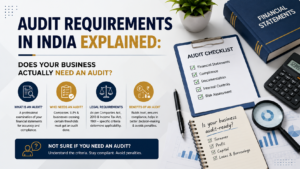
- Statutory audit
- Tax audit
- Internal audit
- GST-related compliance review
Many startups and small businesses misunderstand audit applicability and either:
- Ignore mandatory compliance, or
- Spend unnecessarily on audits they may not require
This guide explains:
- Which audits apply to which businesses
- Important turnover thresholds
- Common misconceptions
- Practical audit preparedness strategies for FY 2026–27
Why Audit Compliance Matters in India
Audits are not just regulatory formalities.
They help:
- Improve financial transparency
- Strengthen credibility
- Detect accounting inconsistencies
- Reduce compliance risks
- Support funding and banking processes
Today, tax departments and regulatory authorities increasingly rely on:
- digital reconciliation,
- data analytics,
- AI-based scrutiny systems,
- and automated mismatch detection.
As a result, proper audit compliance has become essential for businesses of all sizes.
Types of Audits Businesses Should Know
Many business owners use the term “audit” broadly, but different audits serve different purposes.
Major Audit Categories in India
| Audit Type | Purpose |
|---|---|
| Statutory Audit | Mandatory under company law |
| Tax Audit | Required under Income Tax Act |
| Internal Audit | Operational and risk review |
| GST Compliance Review | GST reconciliation and compliance analysis |
| Stock Audit | Inventory verification |
| Forensic Audit | Fraud investigation |
Understanding which audit applies to your business is critical.
What Is a Statutory Audit?
A statutory audit is mandated under the Companies Act.
Usually Applicable To:
- Private Limited Companies
- Public Limited Companies
- Certain LLPs
- Regulated entities
The purpose is to verify:
- financial statements,
- accounting records,
- and regulatory compliance.
Key Objective
To ensure that the financial statements present a true and fair view of the business.
Even startups with minimal transactions may require statutory audit if incorporated as companies.
What Is a Tax Audit?
A tax audit is governed under the Income Tax Act.
It evaluates whether:
- books of accounts are properly maintained,
- income is correctly reported,
- and tax compliance requirements are fulfilled.
Businesses Typically Trigger Tax Audit Based On:
- turnover,
- gross receipts,
- or profit declaration criteria.
Tax audit applicability can also change under presumptive taxation schemes.
Audit Requirements for Different Business Structures
Different entity types have different compliance obligations.
Sole Proprietorship
Audit applicability depends mainly on:
- turnover,
- profit reporting,
- and taxation scheme.
Many small proprietors assume audits never apply to them, which is incorrect.
Partnership Firms
Partnerships may require:
- tax audit,
- accounting compliance,
- and financial reporting obligations depending on turnover and taxation structure.
LLP (Limited Liability Partnership)
LLPs may require audit depending on:
- turnover levels,
- contribution thresholds,
- and statutory obligations.
LLPs are often preferred for flexibility, but compliance requirements still apply.
Private Limited Companies
Private limited companies generally require:
- statutory audit,
- annual ROC compliance,
- financial statement reporting,
- and structured accounting documentation.
This applies even if the company is newly incorporated.
Turnover Limits & Audit Applicability
Turnover thresholds are among the most misunderstood compliance areas.
Businesses should evaluate:
- total sales,
- digital transaction percentage,
- presumptive taxation eligibility,
- and declared profits.
Common Mistakes Businesses Make
- Assuming GST turnover equals tax audit turnover
- Ignoring digital transaction provisions
- Mixing personal and business accounts
- Underreporting receipts
- Not maintaining proper books
Regular professional review helps businesses avoid incorrect assumptions.
Tax Audit for Professionals & Consultants
Doctors, architects, consultants, freelancers, and other professionals may also face audit applicability.
Common Professional Categories
- Medical practitioners
- Legal consultants
- IT consultants
- Marketing agencies
- Financial advisors
- Architects
- Designers
Professionals using presumptive taxation must carefully evaluate:
- declared profit percentages,
- receipts,
- and compliance conditions.
Is GST Audit Mandatory?
Many businesses still believe GST audit is compulsory for all taxpayers.
However, GST regulations have evolved significantly.
Today, businesses mainly need:
- accurate GST reconciliation,
- return consistency,
- invoice matching,
- and documentation readiness.
Authorities increasingly focus on:
- ITC mismatches,
- fake invoicing,
- e-invoice inconsistencies,
- and vendor compliance.
Therefore, GST compliance reviews remain extremely important even when formal GST audit applicability differs.
Common Audit Myths Businesses Believe
Myth 1: Small Businesses Never Need Audit
Incorrect. Many small businesses cross compliance thresholds without realizing it.
Myth 2: Digital Payments Eliminate Audit Requirements
Digital transactions may affect thresholds but do not automatically remove compliance obligations.
Myth 3: Startups Can Ignore Audit in Initial Years
Private limited companies generally require statutory audit regardless of early-stage activity.
Myth 4: Freelancers Never Require Audit
Professionals and freelancers may require audit depending on receipts and tax structure.
Consequences of Ignoring Audit Compliance
Ignoring audit obligations can create serious issues.
Possible Risks
- Income tax notices
- Penalties
- Disallowance of expenses
- Increased scrutiny
- Delayed funding approvals
- Banking complications
- Compliance litigation
- Loss of financial credibility
Businesses with poor accounting systems often struggle most during scrutiny.
How Proper Accounting Reduces Audit Risk
Strong accounting systems simplify compliance significantly.
Best Practices
- Maintain organized books
- Separate personal and business expenses
- Use accounting software
- Reconcile GST regularly
- Track vendor documentation
- Preserve invoices digitally
- Review compliance monthly
Businesses with structured bookkeeping experience:
- fewer notices,
- smoother audits,
- and stronger financial control.
Audit Readiness Checklist for Businesses
| Compliance Area | Recommended Action |
|---|---|
| Books of Accounts | Maintain updated records |
| GST Reconciliation | Monthly review |
| Invoice Management | Proper documentation |
| Expense Tracking | Categorize correctly |
| Bank Reconciliation | Monthly matching |
| Financial Statements | Prepare periodically |
| Vendor Verification | Maintain compliance records |
| Tax Filing | Timely submissions |
How Junaid Khan & Co Helps Businesses Stay Compliant
Junaid Khan & Co assists businesses with:
- statutory audit support,
- tax audit compliance,
- GST reconciliation,
- accounting advisory,
- ROC compliance,
- startup compliance guidance,
- bookkeeping support,
- and financial reporting assistance.
The firm works with:
- startups,
- MSMEs,
- LLPs,
- private limited companies,
- professionals,
- and growing businesses across India.
Conclusion
Audit compliance in India is more nuanced than many businesses realize.
Not every business requires every type of audit. However, ignoring applicability rules can create:
- financial risk,
- penalties,
- scrutiny,
- and operational complications.
Businesses should regularly review:
- turnover,
- business structure,
- taxation method,
- and compliance obligations.
A proactive compliance strategy not only reduces audit risk but also improves:
- credibility,
- investor confidence,
- financial discipline,
- and long-term business stability.
6. FAQ SECTION
1. Is audit mandatory for every business in India?
No. Audit applicability depends on business structure, turnover, receipts, and tax provisions.
2. What is the difference between statutory audit and tax audit?
Statutory audit is governed by company law, while tax audit is governed by the Income Tax Act.
3. Do LLPs require audit in India?
LLPs may require audit depending on turnover and contribution criteria.
4. Can freelancers require tax audit?
Yes. Freelancers and professionals may require audit based on receipts and taxation structure.
5. Is GST audit compulsory in 2026?
Businesses still require strong GST compliance systems, reconciliation, and documentation management.
6. What happens if a business ignores audit requirements?
Businesses may face notices, penalties, scrutiny, and compliance complications.
7. Why is accounting important for audit compliance?
Proper accounting improves transparency and reduces mismatch-related issues.
8. Can startups avoid statutory audit?
Private limited companies generally require statutory audit regardless of scale.
BLOG BY:Junaid Khan & Co.
Written by CA Junaid Ahmed Khan, Junaid Khan & Co., Bhopal.