

GST Reconciliation Before Tax Audit: How to Match Books, GSTR-1 & GSTR-3B
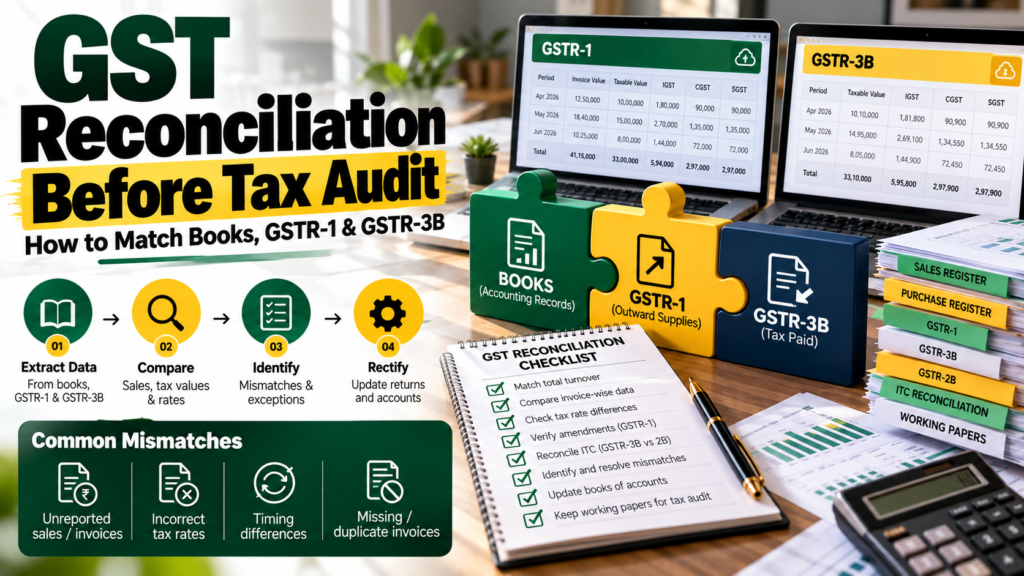
TL;DR GST reconciliation before a tax audit helps businesses identify differences between accounting records, outward-supply data reported in GSTR-1 and tax liability declared in GSTR-3B. Common differences arise due to credit notes, amendments, advances, exempt supplies, timing differences, wrong GST rates, missed invoices and accounting adjustments. A proper reconciliation should compare the books with GST returns, classify every difference, verify tax liability and document the reasons before finalizing the tax audit and income-tax return. Introduction GST data has become an important part of a business’s overall tax-compliance framework. Before completing a tax audit, businesses should ensure that their accounting records and GST returns present a consistent picture of sales, purchases, expenses and tax liabilities. One of the most important checks is the reconciliation between Books of Accounts, GSTR-1 and GSTR-3B. The three records serve different purposes. Books contain the business’s accounting records, GSTR-1 primarily reports outward supplies, while GSTR-3B is a summary return through which taxpayers declare GST liabilities and eligible input tax credit. Because these records are prepared for different purposes, a difference does not automatically mean that there is an error. However, every material difference should be identified, investigated and properly explained. A detailed GST reconciliation before tax audit can help businesses detect under-reporting, excess reporting, incorrect tax rates, missed invoices, duplicate entries and other issues before the financial statements and tax computation are finalized. Why GST Reconciliation Is Important Before Tax Audit GST reconciliation is important because turnover reported in GST returns can be compared with the turnover recorded in the financial statements and considered during income-tax compliance. An unexplained difference can create questions about: Turnover GST liability Sales invoices Credit notes Taxable and exempt supplies Revenue recognition Input tax credit Tax payments Year-end accounting adjustments A proper reconciliation does not necessarily mean that all three figures must be identical. Instead, the objective is to understand and document legitimate differences. For example, a business may have income in its books that is outside the scope of GST, or an accounting entry may relate to a transaction reported in a different GST period. Books vs GSTR-1 vs GSTR-3B: What Is the Difference? Before beginning reconciliation, it is important to understand what each record represents. Books of Accounts The books record the business’s financial transactions, including: Sales Purchases Expenses Receipts Credit notes Debit notes Other income GST collected GST paid Receivables and payables The financial statements are ultimately prepared from these accounting records. GSTR-1 GSTR-1 contains details of outward supplies reported by the taxpayer. Depending on the taxpayer and transaction, it can include information relating to: Business-to-business supplies Business-to-consumer supplies Export supplies Credit notes Debit notes Amendments Advances in applicable cases Other outward-supply information GSTR-3B GSTR-3B is a summary return used to declare GST liability and eligible input tax credit and to discharge the resulting tax liability. Therefore, GSTR-3B should not be expected to contain the same invoice-level information as GSTR-1. The reconciliation should focus on whether the underlying transactions and tax liabilities have been correctly captured across the three records. Step 1: Extract the Sales Data From the Books The first step is to obtain the complete sales data from the accounting system for the relevant financial year. The reconciliation file should ideally include: Invoice number Invoice date Customer GSTIN Taxable value CGST SGST/UTGST IGST GST rate Place of supply Credit notes Debit notes Amendments Exempt supplies Zero-rated supplies Non-GST supplies The sales register should be finalized before comparing it with GST returns. Step 2: Download and Compile GSTR-1 Data Businesses should compile their GSTR-1 data for all relevant tax periods. Rather than checking only the annual total, an invoice-level or transaction-level comparison is more useful. The reconciliation should consider: B2B invoices B2C supplies Export invoices Credit notes Debit notes Amendments Advances where applicable Nil-rated/exempt supplies Other outward supplies Businesses should also check whether invoices reported in one period were amended or cancelled in a subsequent period. Step 3: Reconcile GSTR-1 With GSTR-3B The next step is to compare outward-supply information reported in GSTR-1 with the corresponding liability declared in GSTR-3B. The comparison should cover: Taxable turnover IGST liability CGST liability SGST/UTGST liability Reverse-charge liability where relevant Credit notes Adjustments Amendments A mismatch may be caused by timing differences, corrections or other legitimate adjustments. However, unexplained differences should be investigated before tax-audit reporting is finalized. Step 4: Compare GST Turnover With Books After reconciling GSTR-1 and GSTR-3B, compare GST turnover with the sales and revenue figures in the books. A simple reconciliation can be structured as: Turnover as per Books Add: Items recorded in books but not reported in GST returns, where applicable Less: Items reported in GST returns but not recognized as revenue in the books, where applicable Add/Less: Timing differences, credit notes, advances and other reconciling items Equals: GST-reconciled turnover The exact format should depend on the nature of the business and the transactions involved. Common Reasons for Differences Between Books and GSTR-1 1. Credit Notes A credit note may be recorded in the books in one period but reported in a different GST period. This can create a temporary mismatch. 2. Debit Notes Debit notes can similarly create differences when accounting recognition and GST reporting occur in different periods. 3. Amendments An invoice may initially be reported incorrectly and subsequently amended through the GST return. If the books reflect the corrected transaction while the return history contains both original and amended reporting, a simple total comparison may be misleading. 4. Exempt or Non-GST Income Not every amount appearing in the income statement is necessarily taxable under GST. Examples can include certain: Interest income Exempt supplies Non-GST supplies Other income items The nature of each item should be reviewed rather than assuming that all accounting revenue must appear as taxable turnover in GSTR-1. 5. Timing Differences An invoice may be accounted for at one point while its GST reporting falls into another tax period depending on the applicable GST rules and transaction circumstances. Year-end transactions require particular attention. Common Reasons for Differences Between GSTR-1 and