
Tax Audit 2026 Under Section 44AB: Who Is Required to Get a Tax Audit?
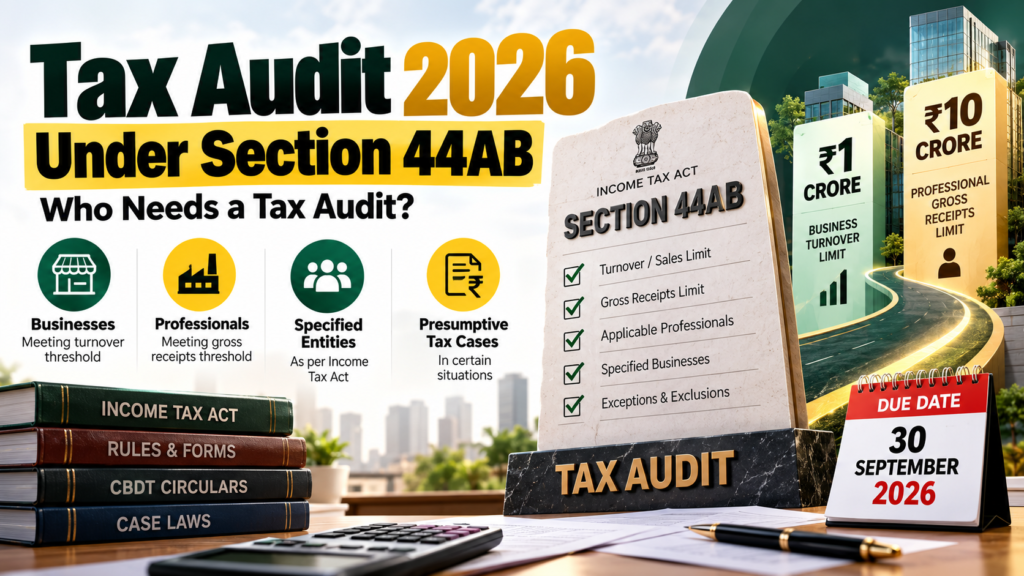
TL;DR Tax audit is mandatory for certain businesses and professionals under Section 44AB of the Income Tax Act, 1961. For FY 2025–26, businesses generally need a tax audit when turnover exceeds ₹1 crore, with the threshold increasing to ₹10 crore where both cash receipts and cash payments do not exceed 5% of the respective totals. For professionals, the general threshold is ₹50 lakh. Certain taxpayers opting out of presumptive taxation may also become liable for audit. For FY 2025–26, the tax audit report is generally due by 30 September 2026. From Tax Year 2026–27, the corresponding provision is Section 63 under the Income Tax Act, 2025. Introduction A tax audit is an important income tax compliance requirement for businesses and professionals whose accounts fall within the specified conditions under the Income Tax Act. The purpose of a tax audit is to ensure that financial records, income, expenses, deductions and other tax-related information are properly maintained and accurately reported. For FY 2025–26, tax audit requirements continue to be governed by Section 44AB of the Income Tax Act, 1961. This means businesses and professionals need to check their turnover, gross receipts, cash transactions and presumptive taxation status to determine whether a tax audit is applicable. The introduction of the Income Tax Act, 2025 also brings a change in section numbering. From Tax Year 2026–27, the corresponding tax-audit provision is Section 63, while the underlying thresholds remain broadly the same. Understanding these rules is important because missing a mandatory tax audit can result in additional compliance issues and potential penalties. What Is a Tax Audit Under Section 44AB? A tax audit is an examination of a taxpayer’s books of accounts by a Chartered Accountant to determine whether the financial information and prescribed particulars are properly maintained and reported. Section 44AB specifies the circumstances in which a person carrying on business or profession must get their accounts audited. The tax audit report contains important information relating to turnover, expenses, deductions, depreciation, tax payments, specified transactions and other financial particulars required under the applicable rules. For FY 2025–26, taxpayers subject to Section 44AB generally use Form 3CA/3CD or Form 3CB/3CD, depending on whether their accounts are already required to be audited under another law. Who Is Required to Get a Tax Audit in 2026? The requirement primarily applies to businesses and professionals crossing the prescribed turnover or gross-receipt thresholds. Certain taxpayers using or opting out of presumptive taxation can also fall under the tax-audit provisions. 1. Businesses With Turnover Above ₹1 Crore A person carrying on business is generally required to get a tax audit if their total sales, turnover or gross receipts exceed ₹1 crore during the relevant previous year. For example, if a business has annual turnover of ₹1.25 crore, it generally falls within the tax-audit requirement. However, there is an important higher threshold for businesses with limited cash transactions. 2. Businesses With Turnover Up to ₹10 Crore and Limited Cash Transactions The tax-audit threshold can increase from ₹1 crore to ₹10 crore if both of the following conditions are satisfied: Cash receipts do not exceed 5% of total receipts Cash payments do not exceed 5% of total payments Therefore, a business with turnover of ₹6 crore may not necessarily require a tax audit solely because its turnover exceeds ₹1 crore, provided the applicable cash-transaction conditions are satisfied. However, if either the cash-receipt or cash-payment condition exceeds the prescribed 5% limit, the enhanced ₹10 crore threshold cannot be relied upon. 3. Professionals With Gross Receipts Above ₹50 Lakh Professionals are subject to a separate threshold. If the gross receipts from a profession exceed ₹50 lakh during the relevant previous year, a tax audit is generally required. This can apply to professionals such as: Chartered Accountants Lawyers Doctors Architects Engineers Consultants Interior designers Technical professionals Other specified professionals The applicable threshold should be evaluated based on the nature of professional activity and the provisions applicable to that taxpayer. 4. Taxpayers Opting Out of Presumptive Taxation Tax audit requirements can also arise when a taxpayer who was eligible for presumptive taxation does not follow the presumptive scheme and declares income below the prescribed level, subject to the conditions of the relevant presumptive-tax provisions. This is particularly important for businesses and professionals using provisions such as presumptive taxation under Sections 44AD and 44ADA of the old Act. The Income Tax Department specifically includes persons opting out of presumptive taxation and declaring income below the prescribed threshold among cases where tax audit requirements can apply. Tax Audit Threshold for Business vs Profession The basic thresholds can be summarized as follows: Category General Tax Audit Threshold Business Turnover/gross receipts exceeding ₹1 crore Business with prescribed low cash transactions Up to ₹10 crore threshold Profession Gross receipts exceeding ₹50 lakh Certain presumptive-tax cases Depends on applicable presumptive-tax conditions The ₹10 crore threshold for businesses is conditional. It is available where both cash receipts and cash payments remain within the prescribed 5% limits. What Happens If Cash Transactions Exceed 5%? The cash transaction condition is important for businesses that want to use the enhanced ₹10 crore threshold. Suppose a business has turnover of ₹5 crore but its cash receipts exceed 5% of total receipts. In that situation, the business cannot automatically rely on the ₹10 crore threshold. Similarly, if cash payments exceed 5% of total payments, the enhanced threshold condition is not satisfied. Therefore, businesses should monitor both: Cash Receipts ÷ Total Receipts and Cash Payments ÷ Total Payments throughout the financial year rather than checking the numbers only at year-end. Does GST Turnover Automatically Decide Tax Audit Applicability? Not always. GST turnover and income-tax turnover are related in many business situations, but tax-audit applicability has to be determined according to the provisions of the Income Tax Act and the nature of receipts. Businesses should therefore reconcile their books, GST records, sales records, credit notes, advances and other relevant transactions before deciding whether a tax audit is required. A business should not simply assume that the turnover shown in