
TL;DR

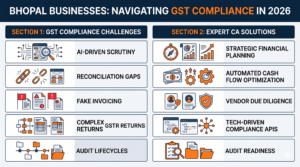
GST compliance in 2026 has become significantly more complex due to:
- Automated scrutiny systems
- Tighter reconciliation requirements
- Real-time invoice validation
- Digital reporting expectations
Businesses in Bhopal commonly face:
- GST mismatches
- Vendor compliance issues
- Filing delays
- GST notices
- Input tax credit problems
Experienced Chartered Accountants help businesses:
- Improve compliance accuracy
- Reduce notice exposure
- Automate reconciliation
- Maintain proper documentation
- Strengthen audit preparedness
Why GST Compliance Has Become More Complex in 2026
GST compliance is no longer limited to monthly return filing.
The GST ecosystem now operates through automated validation systems that continuously compare:
- Invoices
- Tax liabilities
- E-invoices
- E-way bills
- Vendor filings
- GST returns
For businesses in Bhopal, especially SMEs and startups, this shift has increased operational pressure significantly.
Businesses today face:
- Real-time invoice validation
- Automated mismatch detection
- Vendor filing verification
- Data-driven GST scrutiny
- Tight reconciliation timelines
Even minor inconsistencies may trigger:
- GST notices
- Input tax credit reversals
- Delayed refunds
- Departmental scrutiny
- Compliance investigations
This is why businesses increasingly rely on experienced GST consultants and Chartered Accountants instead of depending entirely on internal accounting systems.
Major GST Compliance Challenges Businesses Face
Input Tax Credit (ITC) Mismatches
Input Tax Credit remains one of the most common GST compliance issues.
ITC mismatches usually occur when:
- Vendors fail to file returns correctly
- Invoice details differ across systems
- Incorrect GSTIN information is used
- Purchase entries remain incomplete
Consequences may include:
- Blocked tax credits
- Additional tax liability
- Departmental notices
- Cash flow pressure
Businesses handling large vendor volumes are especially vulnerable.
Incorrect Invoice Reporting
Invoice-level reporting accuracy has become critical in 2026.
Common invoice-related issues include:
- Wrong tax classification
- Incorrect GST rates
- Duplicate invoices
- Missing invoice uploads
- E-invoice inconsistencies
These errors affect:
- GST compliance
- Financial reporting
- Audit preparedness
- Vendor reconciliation
For growing businesses, manual invoice management significantly increases compliance risk.
Delayed GST Filings
Late GST filings continue to create serious operational challenges.
Businesses commonly delay filings because of:
- Poor bookkeeping
- Missing vendor data
- Last-minute reconciliations
- Weak documentation systems
Delayed filings often result in:
- GST notices
- ITC restrictions
- Reporting inconsistencies
- Operational disruption
Maintaining a structured filing calendar has become essential.
Multi-State GST Complexity
Businesses operating across multiple states face additional compliance burdens.
Key challenges include:
- Place-of-supply rules
- Multiple GST registrations
- Interstate transaction classification
- E-way bill compliance
- Branch-wise reconciliation
E-commerce sellers and logistics-focused businesses commonly struggle with multi-state GST management.
Vendor Non-Compliance
Many businesses experience GST problems because vendors fail to:
- File GST returns on time
- Upload invoices correctly
- Maintain reconciliation accuracy
Vendor non-compliance directly impacts:
- ITC availability
- GST reporting accuracy
- Audit readiness
A strong vendor compliance monitoring system is now essential.
GST Notices & Scrutiny
GST notices have increased because authorities now use advanced data analytics and automated discrepancy detection systems.
Common triggers include:
- ITC mismatches
- E-way bill inconsistencies
- Incorrect return filing
- Tax liability mismatches
- High-risk transaction patterns
Businesses without proper documentation often struggle to respond effectively.
How Expert Chartered Accountants Solve GST Challenges
GST Reconciliation Systems
Professional CA firms implement structured reconciliation systems to identify discrepancies early.
This includes:
- Purchase reconciliation
- Vendor matching
- Invoice validation
- ITC verification
- Monthly compliance reviews
Early mismatch detection significantly reduces future notice risk.
Compliance Monitoring & Calendar Management
Experienced GST consultants maintain:
- Filing schedules
- Compliance trackers
- Vendor follow-up systems
- Documentation processes
This ensures businesses avoid last-minute filing stress and operational disruption.
GST Notice Handling Support
When businesses receive GST notices, expert CAs assist with:
- Notice interpretation
- Documentation preparation
- Response drafting
- Reconciliation reporting
- Departmental communication
Professional handling reduces escalation risk and improves compliance response quality.
Technology-Driven GST Management
Modern CA firms use:
- Cloud accounting software
- GST automation tools
- Reconciliation platforms
- Compliance dashboards
Technology improves:
- Reporting accuracy
- Compliance visibility
- Audit preparedness
- Filing efficiency
Digital GST management systems are now essential for growing businesses.
Audit Preparedness & Documentation
Strong documentation is one of the most critical aspects of GST compliance.
Professional CA firms help businesses maintain:
- Invoice records
- Vendor documentation
- GST working papers
- Reconciliation reports
- Filing history
Proper documentation reduces operational risk during audits and departmental scrutiny.
Common GST Mistakes SMEs and Startups Make
Relying Entirely on Manual Accounting
Manual systems increase:
- Human errors
- Reconciliation gaps
- Filing delays
- Data inconsistencies
Businesses should adopt structured digital accounting workflows.
Ignoring Vendor Compliance
Many businesses focus only on their own GST filing while ignoring vendor filing behavior.
This creates major ITC-related risks.
Vendor compliance checks should become a routine monthly process.
Poor Documentation Practices
Missing invoices and weak record management often become serious liabilities during:
- GST audits
- Departmental scrutiny
- Compliance investigations
Businesses should maintain centralized documentation systems.
Reactive Compliance Management
Waiting until filing deadlines creates unnecessary operational pressure.
A proactive compliance system improves:
- Accuracy
- Planning
- Reporting efficiency
- Risk management
GST Compliance Best Practices for 2026
Businesses should implement the following best practices:
Monthly GST Reconciliation
Perform structured reconciliation every month instead of waiting until year-end.
Vendor Compliance Monitoring
Track vendor filing status regularly.
Automated Accounting Systems
Use cloud-based accounting and GST automation tools.
Internal Compliance Reviews
Conduct periodic compliance reviews to identify risks early.
Professional GST Advisory
Work with experienced Chartered Accountants for ongoing compliance monitoring and strategic guidance.
Why Junaid Khan & Co is a Trusted GST Advisory Partner
Junaid Khan & Co helps businesses in Bhopal manage GST compliance challenges through:
- Structured reconciliation systems
- GST filing support
- GST notice handling
- Audit preparedness
- SME-focused compliance advisory
- Startup taxation support
Businesses benefit from working with a CA firm that combines technical GST expertise with practical business understanding.
Final Thoughts
GST compliance in 2026 is significantly more data-driven and operationally demanding than previous years.
Businesses can no longer rely on:
- Reactive filing practices
- Weak accounting systems
- Manual reconciliation processes
The biggest GST challenges today include:
- ITC mismatches
- Vendor non-compliance
- Filing delays
- Invoice inconsistencies
- Automated scrutiny risks
Experienced Chartered Accountants help businesses:
- Build structured compliance systems
- Reduce notice exposure
- Improve reporting accuracy
- Maintain audit readiness
- Strengthen financial discipline
For businesses in Bhopal, proactive GST management is no longer optional — it is essential for operational stability and long-term growth.
6. FAQ SECTION
What are the biggest GST compliance challenges in 2026?
The biggest GST challenges include ITC mismatches, vendor non-compliance, delayed filings, invoice inconsistencies, and automated scrutiny systems.
Why are GST notices increasing?
GST notices are increasing because authorities now use automated data analytics systems to detect mismatches and compliance irregularities.
Can a Chartered Accountant help with GST compliance?
Yes. Chartered Accountants help businesses manage GST filing, reconciliation, notices, audit preparedness, and compliance monitoring.
What causes GST mismatches?
GST mismatches commonly occur because of incorrect invoice reporting, vendor filing errors, incomplete purchase entries, and reconciliation gaps.
How often should GST reconciliation be performed?
Businesses should perform GST reconciliation monthly to identify discrepancies early and reduce compliance risk.
Why do SMEs struggle with GST compliance?
SMEs often struggle because of manual accounting systems, limited internal expertise, and weak compliance processes.
What documents are important for GST audits?
Businesses should maintain invoices, GST returns, reconciliation reports, vendor records, e-way bills, and supporting compliance documentation.
Blog By – CA Junaid Khan
Written by CA Junaid Ahmed Khan, Junaid Khan & Co., Bhopal.