
TL;DR

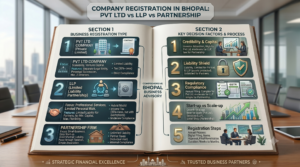
Choosing the right business structure directly affects:
- Legal protection
- Taxation
- Funding opportunities
- Compliance burden
- Business credibility
- Long-term scalability
In 2026, the three most common business structures for entrepreneurs in Bhopal are:
- Private Limited Company
- Limited Liability Partnership (LLP)
- Partnership Firm
Each structure serves a different business objective.
A Private Limited Company is ideal for startups seeking growth and investment opportunities.
An LLP offers flexibility with limited liability and simpler operational management.
A Partnership Firm works primarily for small traditional businesses with minimal operational complexity.
Selecting the wrong structure can create:
- Compliance challenges
- Tax inefficiencies
- Funding limitations
- Ownership disputes
- Scalability issues
Professional guidance from experienced Chartered Accountants helps businesses choose the right structure from the beginning.
Why Choosing the Right Business Structure Matters
Business registration is not just a legal formality.
The structure you choose affects nearly every operational and financial aspect of your business.
This includes:
- Legal liability
- Tax obligations
- Compliance requirements
- Banking relationships
- Investor confidence
- Business continuity
In 2026, businesses operate in a highly regulated and digitally monitored ecosystem. Entrepreneurs require structures that support:
- Scalability
- Compliance
- Operational flexibility
- Long-term sustainability
A poorly chosen structure may appear convenient initially but often creates operational complications as the business grows.
Understanding the Three Major Business Structures
Private Limited Company
A Private Limited Company is one of the most preferred structures for startups and growth-oriented businesses.
Key Characteristics
- Separate legal entity
- Limited liability protection
- Better funding opportunities
- Strong market credibility
- Structured ownership framework
Commonly Chosen By
- Technology startups
- Investor-backed businesses
- Growth-stage companies
- Scalable ventures
Advantages
- Higher market credibility
- Easier equity distribution
- Better investor preference
- Strong legal protection
Challenges
- Higher compliance obligations
- Structured reporting requirements
- Formal governance responsibilities
Limited Liability Partnership (LLP)
An LLP combines partnership flexibility with limited liability protection.
Highly Suitable For
- Professional firms
- Consulting businesses
- Service-based companies
- SMEs with moderate expansion goals
Advantages
- Limited liability protection
- Operational flexibility
- Lower compliance burden than Pvt Ltd companies
- Separate legal identity
Challenges
- Limited external funding opportunities
- Lower investor preference compared to Pvt Ltd companies
LLPs are increasingly preferred by professionals seeking legal protection without highly complex compliance systems.
Partnership Firm
A traditional Partnership Firm remains one of the oldest business structures in India.
Suitable For
- Small local businesses
- Family-owned firms
- Traditional trading operations
Advantages
- Simple operational setup
- Minimal procedural complexity
- Flexible management structure
Challenges
- Unlimited liability exposure
- Lower scalability
- Reduced business credibility
- Partnership dispute risks
In modern business ecosystems, partnerships are becoming less preferred for high-growth businesses.
Pvt Ltd vs LLP vs Partnership — Detailed Comparison
| Factor | Private Limited Company | LLP | Partnership Firm |
|---|---|---|---|
| Legal Status | Separate legal entity | Separate legal entity | Not fully separate |
| Liability Protection | Limited | Limited | Unlimited |
| Investor Preference | High | Moderate | Low |
| Scalability | Excellent | Good | Limited |
| Compliance Level | Higher | Moderate | Lower |
| Ownership Transfer | Easier | Moderate | Difficult |
| Business Credibility | Strong | Strong | Moderate |
| Suitable For | Startups & growth businesses | SMEs & professionals | Traditional small businesses |
Ownership & Liability
Liability protection is one of the primary reasons modern entrepreneurs prefer Pvt Ltd companies and LLPs.
In a Partnership Firm:
- Personal assets may become vulnerable during disputes, liabilities, or financial losses.
In LLPs and Private Limited Companies:
- Liability is generally limited to business involvement.
This distinction becomes extremely important as businesses scale.
Compliance & Regulatory Requirements
Compliance obligations vary significantly between structures.
Private Limited Companies Usually Require
- Structured reporting
- Corporate governance maintenance
- Regulatory compliance monitoring
- Filing discipline
LLPs Require
- Moderate compliance
- Annual filing management
- Regulatory reporting
Partnership Firms Usually Involve
- Lower procedural obligations
- Simpler compliance management
However, choosing a structure solely based on lower compliance is rarely a good long-term strategy.
Funding & Investment Opportunities
Funding capability is a major differentiator.
Private Limited Companies are strongly preferred by:
- Angel investors
- Venture capital firms
- Institutional investors
LLPs can operate efficiently but are generally less attractive for external investment.
Partnership Firms often face the most difficulty in raising structured capital.
If long-term expansion is a priority, investment readiness becomes critical.
Business Credibility
Business structure directly impacts market perception.
Private Limited Companies often enjoy:
- Higher trust levels
- Better vendor relationships
- Stronger corporate branding
- Greater banking confidence
LLPs also maintain strong credibility, especially among professional service firms.
Partnership firms may appear less structured for large-scale operations.
Which Business Structure is Best for Different Entrepreneurs?
Best for Startups
A Private Limited Company is usually the strongest option for startups aiming for:
- Funding
- Rapid scaling
- Equity expansion
- Technology-driven growth
Best for SMEs
LLPs are often suitable for SMEs seeking:
- Limited liability
- Operational flexibility
- Moderate compliance requirements
Best for Consultants & Professionals
Professionals such as:
- Consultants
- Architects
- Agencies
- Advisors
commonly benefit from LLP structures because they balance flexibility and legal protection.
Best for Family Businesses
Traditional family businesses may initially prefer partnerships.
However, as operational scale increases, transitioning toward LLP or Pvt Ltd structures often becomes beneficial.
Common Mistakes Entrepreneurs Make During Registration
Choosing Structure Only Based on Simplicity
Short-term convenience often creates long-term operational and compliance issues.
Ignoring Future Scalability
Many businesses underestimate future growth potential while selecting structures.
Weak Documentation
Improper agreements and registration documentation create future compliance and ownership risks.
Delayed Registrations
Operating informally for extended periods weakens:
- Business credibility
- Banking relationships
- Compliance efficiency
- Taxation clarity
Why Professional CA Assistance Matters
Business registration involves far more than form submission.
Experienced Chartered Accountants help businesses with:
- Structure evaluation
- Tax planning
- Compliance forecasting
- Documentation
- Registration strategy
- Financial structuring
Professional advisory prevents expensive restructuring later.
Why Junaid Khan & Co Helps Businesses Register Correctly
Junaid Khan & Co provides end-to-end registration and advisory support for:
- Startups
- SMEs
- Professionals
- Entrepreneurs
Core services include:
- Private Limited Company registration
- LLP registration
- Partnership registration
- Startup advisory
- MSME registration
- Compliance support
- Taxation advisory
The firm focuses on helping businesses select structures aligned with long-term operational and financial goals.
Suggested Internal Linking Opportunities
- Startup Registration Services
- LLP Registration Services
- GST Registration
- MSME Registration Services
- Income Tax Advisory
Final Verdict
There is no universally “best” business structure.
The ideal structure depends on:
- Business model
- Growth plans
- Funding goals
- Risk exposure
- Operational complexity
Choose:
- Private Limited Company for scalability and funding readiness
- LLP for flexibility with liability protection
- Partnership Firm for small traditional operations
The right registration decision can significantly improve:
- Compliance efficiency
- Operational stability
- Funding readiness
- Financial scalability
For entrepreneurs in Bhopal, professional guidance ensures businesses start with the correct legal and strategic foundation.
6. FAQ SECTION
Which is better: Pvt Ltd or LLP?
A Private Limited Company is generally better for scalability and investment readiness, while an LLP offers flexibility with moderate compliance.
Is LLP suitable for startups?
Yes. LLPs are suitable for service-based startups and professional businesses with limited external funding requirements.
Which business structure provides limited liability?
Both Private Limited Companies and LLPs provide limited liability protection.
Can a Partnership Firm raise investment?
Partnership Firms generally face more challenges in attracting structured investors and institutional funding.
Which structure is best for SMEs?
LLPs are commonly suitable for SMEs because they balance liability protection and operational flexibility.
Is a Private Limited Company mandatory for startups?
No. However, startups seeking investors and scalability commonly choose Pvt Ltd structures.
Why should businesses consult a CA before registration?
A Chartered Accountant helps evaluate taxation, compliance, scalability, legal implications, and registration strategy before business setup.
Blog By –
Written by CA Junaid Ahmed Khan, Junaid Khan & Co., Bhopal.