
TDS Compliance September–October 2026: Due Dates, Returns & Common Errors
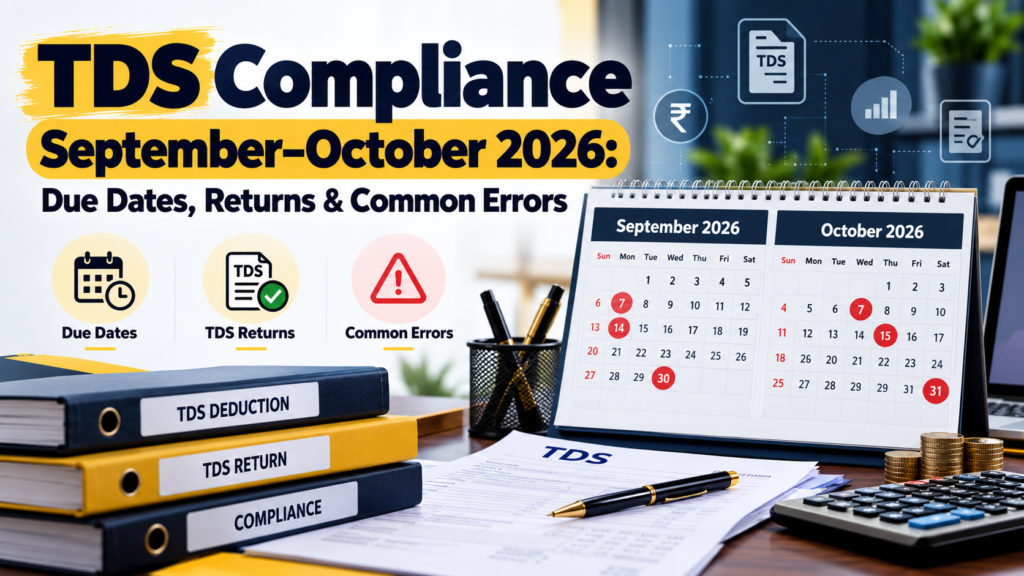
TL;DR September and October 2026 are important months for TDS compliance because deductors need to deposit TDS within the prescribed timelines and prepare for the quarterly TDS statement for July–September 2026. For regular monthly TDS, tax deducted during August is generally deposited by 7 September, while TDS deducted during September is generally payable by 7 October. The Q2 TDS statements covering July–September 2026 are due by 31 October 2026. Under the Income Tax Act, 2025, new forms such as Form 138 for salary TDS and Form 140 for resident non-salary TDS apply for Tax Year 2026–27. Introduction TDS compliance is an important part of the monthly and quarterly tax obligations of businesses, employers, professionals and other deductors. September and October 2026 are particularly important because businesses need to manage regular monthly TDS payments while also preparing the July–September 2026 quarterly TDS statement. The compliance process has also changed in 2026 because the Income Tax Act, 2025 applies to transactions governed by the new tax-year framework from 1 April 2026. The Income Tax Department has introduced revised forms and section numbering for Tax Year 2026–27. For businesses, this means TDS compliance should not be limited to simply depositing tax on time. Deductors should also verify PAN details, deduction sections, amounts, challans, deductee information and quarterly reporting before filing the statement. A small mistake in TDS data can result in interest, late filing consequences, incorrect Form 16A or Form 16 information, mismatches in the deductee’s tax records and unnecessary compliance notices. TDS Due Dates for September and October 2026 Understanding the monthly and quarterly deadlines is the first step toward maintaining proper TDS compliance. TDS Payment Due Date in September 2026 TDS deducted during August 2026 is generally required to be deposited with the government by 7 September 2026. The general rule continues to require monthly TDS deposits by the 7th of the following month, subject to specific exceptions. The Income Tax Department has confirmed that the Income Tax Rules, 2026 retain the same general payment timeline under the new framework. TDS Payment Due Date in October 2026 TDS deducted during September 2026 is generally required to be deposited by 7 October 2026. Businesses should reconcile the TDS payable ledger with the actual deduction records before making the payment. Q2 TDS Return Due Date The second quarter covers: July 2026 to September 2026 The quarterly TDS statements for this period are generally due by: 31 October 2026 For Tax Year 2026–27, the Income Tax Department has introduced new quarterly forms corresponding to the earlier TDS statement framework. Form 138 covers salary TDS reporting, while Form 140 covers TDS on non-salary payments to residents. Form 144 applies to TDS on payments other than salary made to non-residents. September–October 2026 TDS Compliance Calendar Compliance Period Covered Due Date TDS payment August 2026 deductions 7 September 2026 TDS payment September 2026 deductions 7 October 2026 Q2 TDS statement July–September 2026 31 October 2026 Form 138 Salary TDS, Q2 31 October 2026 Form 140 Resident non-salary TDS, Q2 31 October 2026 Form 144 Non-resident non-salary TDS, Q2 31 October 2026 The exact compliance obligation depends on the nature of payment and the deductor. Special challan-cum-statement provisions can have different timelines. What Has Changed for TDS in 2026? The Income Tax Act, 2025 introduced a new framework for Tax Year 2026–27. This means businesses need to understand whether a transaction falls under the old Income Tax Act, 1961 or the new Income Tax Act, 2025. How to Determine the Applicable Act The Income Tax Department states that the applicable Act during the transition depends on the earlier of the event of credit or payment. If that event occurred on or before 31 March 2026, the old Income Tax Act, 1961 generally applies. If the earlier event occurred on or after 1 April 2026, the Income Tax Act, 2025 framework applies. Therefore, businesses should not simply change every TDS section in their accounting software without considering the transaction date. New TDS Forms Under the Income Tax Act, 2025 The new Act has reorganized the TDS reporting framework. Form 138 Form 138 is the new quarterly statement for salary TDS, replacing the earlier Form 24Q framework for applicable Tax Year 2026–27 reporting. The Q2 statement covering July–September 2026 is due by 31 October 2026. Form 140 Form 140 is the quarterly TDS statement for non-salary payments to residents. It covers payments such as applicable professional fees, commission, brokerage, rent and similar payments where TDS is required. The Q2 Form 140 for July–September 2026 is due by 31 October 2026. Form 144 Form 144 is applicable to TDS on payments other than salary made to non-residents under the new framework. The Q2 statement for July–September 2026 is also due by 31 October 2026. Monthly TDS Compliance: What Businesses Should Check Monthly TDS compliance should ideally be completed through a systematic process rather than waiting until the quarterly return. Businesses should verify: Payments subject to TDS Applicable TDS section Applicable rate Deductee PAN Date of credit Date of payment Amount credited or paid TDS amount TDS payable ledger Challan details Deductee classification Lower or nil deduction certificates, where applicable TDS exemptions or thresholds This process helps reduce errors before the quarterly statement is prepared. Common TDS Errors in September–October 2026 1. Using the Wrong TDS Section One of the most common mistakes is applying an incorrect section to a payment. For example, professional fees, contractor payments, commission, rent, interest and payments to non-residents may have different TDS provisions. Under the new Act, section numbering has also changed, making it particularly important to update accounting and payroll systems correctly. 2. Applying the Wrong TDS Rate A business may identify that TDS is applicable but still deduct the wrong amount because the rate was incorrectly configured. Businesses should verify the applicable rate based on: Nature of payment Residential status PAN availability Applicable threshold Certificate for lower deduction, if any Specific statutory provisions 3. Incorrect PAN Details An incorrect PAN can create a
TDS & TCS Compliance Guide 2026: Mistakes That Trigger Notices and How to Avoid Them
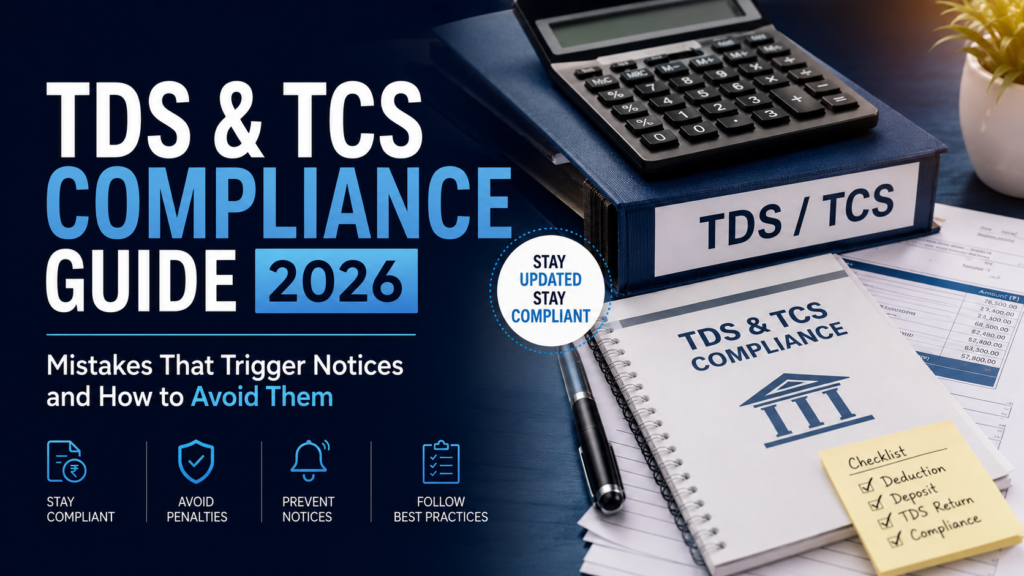
TL;DR TDS and TCS compliance has become heavily data-driven in FY 2026. The Income Tax Department now uses automated reconciliation systems to detect mismatches, delayed deposits, incorrect PAN entries, and return filing errors. Even small compliance gaps can trigger notices, interest liabilities, or scrutiny. This guide explains: Common TDS/TCS mistakes Reasons businesses receive notices Filing and reconciliation best practices Internal compliance controls businesses should adopt Preventive strategies for FY 2026 Understanding TDS & TCS in Simple Terms Tax Deducted at Source (TDS) and Tax Collected at Source (TCS) are mechanisms used by the government to collect taxes during transactions rather than waiting until year-end tax filing. TDS Applies When: A business deducts tax before making payments such as: Salaries Contractor payments Professional fees Rent Interest Commission TCS Applies When: A seller collects tax while selling specified goods or services such as: Scrap Minerals Motor vehicles Overseas tour packages E-commerce transactions under applicable provisions In 2026, tax authorities are increasingly relying on AI-driven data matching between: GST returns Income tax returns TDS returns AIS/TIS data Bank transactions MCA filings This means even minor inconsistencies can now trigger automated notices. Why TDS & TCS Notices Are Increasing in 2026 Businesses today operate in a highly digitized compliance environment. The Income Tax Department cross-verifies multiple data sources automatically. Major Reasons Notices Are Increasing Automated reconciliation systems Higher reporting transparency Real-time PAN validation GST and TDS data integration AI-based anomaly detection Increased compliance scrutiny for MSMEs and startups Many businesses still rely on outdated manual accounting systems, creating frequent mismatches and filing errors. Common TDS Compliance Mistakes Businesses Make 1. Deducting TDS Under the Wrong Section Using the wrong TDS section is one of the most common compliance errors. For example: Professional fees wrongly booked as contractor payments Rent categorized incorrectly Technical services misclassified This can result in: Short deduction notices Interest liability Reassessment risk Prevention Tip Create a vendor classification matrix based on payment nature. 2. Delayed TDS Deduction Many businesses deduct TDS only at the time of payment instead of at the earlier of: Expense booking, or Actual payment This creates compliance gaps and interest exposure. Common Scenario A company records consultancy expenses in March but deducts TDS in May during payment processing. Result: Late deduction liability Interest implications Notice risk 3. Late Deposit of TDS Even when TDS is correctly deducted, delayed deposit remains a major issue. Consequences Interest liability Penalty exposure Disallowance of expenses Increased scrutiny risk Businesses often face delays because: Finance approvals are pending Cash flow planning is weak Compliance calendars are not maintained 4. PAN Errors and Vendor Mismatches Incorrect PAN details create immediate reconciliation failures. Common Problems Invalid PAN Vendor PAN mismatch Name mismatch Inactive PAN status This can: Increase TDS rates automatically Cause Form 26AS mismatches Trigger vendor disputes Prevention Tip Verify PAN details before onboarding vendors. 5. Incorrect TDS Return Filing Errors in quarterly returns are a major source of notices. Common Filing Errors Wrong challan mapping Incorrect deductee details Duplicate entries Missing transactions Invalid section codes Businesses often fail to reconcile: Books of accounts Challans Return data Form 26AS before submission. Common TCS Compliance Errors TCS compliance is becoming increasingly important for: E-commerce sellers Automobile dealers Exporters Traders dealing in notified goods Frequent TCS Mistakes Failure to identify applicable transactions Incorrect collection rates Delayed TCS deposits Missing TCS returns Non-reconciliation with sales records Businesses frequently misunderstand threshold applicability, especially in high-volume sectors. Major TDS & TCS Notice Triggers in FY 2026 1. Mismatch Between GST & TDS Data Authorities compare: Vendor payments GST outward supplies Expense reporting If numbers do not align, scrutiny may begin. 2. High-Value Transactions Without TDS Large payments without applicable TDS deduction create automatic risk flags. 3. Frequent Revised Returns Multiple revisions indicate weak internal controls. This often increases: Compliance scrutiny Audit probability 4. Short Deduction Cases Deducting lower tax than applicable is a common issue in: Professional services Contractual work Technical consultancy 5. Non-Filing or Nil Filing Patterns Businesses with: High turnover Vendor-heavy operations Salary expenses but nil TDS filing often attract notices. TDS & TCS Compliance Checklist for Businesses Compliance Area Action Required Vendor Onboarding Verify PAN & compliance status Expense Booking Apply correct TDS section Monthly Review Reconcile ledgers and challans Return Filing Validate deductee data GST Matching Compare vendor invoices Documentation Maintain agreements and invoices Compliance Calendar Track all due dates Due Dates Businesses Should Never Ignore Critical Compliance Activities TDS deduction TDS deposit Quarterly TDS return filing TCS collection TCS return filing PAN validation Reconciliation reviews Missing timelines significantly increases notice risk. Best Practices to Avoid TDS & TCS Notices Automate Compliance Processes Modern accounting software reduces: Manual entry errors Calculation mismatches Filing delays Conduct Monthly Reconciliation Reconcile: Books Challans GST data Vendor ledgers Form 26AS every month rather than waiting until quarter-end. Maintain Vendor Documentation Keep: PAN copies Agreements Invoices Declarations GST registrations organized and updated. Train Finance Teams Regularly Tax provisions change frequently. Businesses should conduct periodic compliance training for accounting staff. Seek Professional Review Before Filing A professional compliance review helps identify: Section errors Missing deductions Mismatches Reporting gaps before filing returns. How Professional CA Support Reduces Compliance Risks Businesses often focus only on filing returns but ignore preventive compliance systems. Professional CA firms help by: Conducting TDS/TCS health checks Setting internal SOPs Improving reconciliation systems Handling notice responses Monitoring compliance calendars Reducing operational tax risks For growing businesses, startups, and MSMEs, proactive compliance support is often more valuable than reactive notice handling. Conclusion TDS & TCS compliance in FY 2026 is no longer a routine accounting formality. It has become a critical risk-management function for businesses of all sizes. Most notices today are not caused by tax evasion — they result from: Reconciliation failures Incorrect reporting Delayed filings Weak internal systems Businesses that implement structured compliance workflows, conduct periodic reviews, and maintain accurate records can significantly reduce scrutiny and operational stress. Junaid Khan & Co helps businesses streamline tax compliance, strengthen reporting accuracy, and reduce regulatory exposure through practical