
How to Start a Business in India in 2026: Registration, GST, PAN & Compliance Checklist

TL;DR Starting a business in India involves more than developing a great idea. Entrepreneurs must choose an appropriate business structure, complete legal registrations, obtain PAN and GST registration where applicable, maintain proper accounting records, and comply with tax and regulatory requirements. Careful planning from the beginning helps businesses avoid compliance issues and build a strong foundation for long-term growth. Introduction India continues to be one of the world’s fastest-growing startup ecosystems, creating significant opportunities for entrepreneurs across manufacturing, technology, professional services, retail, healthcare, education, and e-commerce. However, starting a business requires much more than securing customers or arranging capital. Every business must satisfy various legal, financial, and tax-related obligations before commencing operations. Choosing the wrong business structure or overlooking mandatory registrations can create avoidable compliance issues later. This guide explains the key steps involved in setting up a business in India and highlights the registrations and compliance requirements every entrepreneur should understand. Step 1: Choose the Right Business Structure Selecting an appropriate legal structure is one of the most important decisions for any entrepreneur because it affects taxation, compliance obligations, ownership, fundraising, and business expansion. Common business structures include: Sole Proprietorship Suitable for individual entrepreneurs operating relatively small businesses with straightforward ownership. Advantages include: Easy to start. Lower compliance requirements. Complete owner control. Simple decision-making. Partnership Firm A partnership involves two or more persons carrying on a business together under a partnership agreement. Suitable for: Family businesses. Professional firms. Trading businesses. Service businesses. Limited Liability Partnership (LLP) LLPs combine operational flexibility with limited liability protection for partners. Suitable for: Professional firms. Consulting businesses. Service providers. Growing startups. Private Limited Company Private Limited Companies are generally preferred by startups planning rapid growth, external investment, or structured corporate governance. Key advantages include: Separate legal identity. Limited liability. Better investor confidence. Easier fundraising opportunities. Greater business credibility. One Person Company (OPC) An OPC allows a single entrepreneur to operate through a corporate structure while retaining limited liability. Step 2: Register Your Business The registration process varies depending on the business structure selected. Generally, registration involves: Selecting a suitable business name. Preparing constitutional documents. Completing required applications. Obtaining registration certificates from the appropriate authorities. Maintaining statutory records after incorporation. Professional assistance helps ensure that documents are prepared correctly and registrations are completed efficiently. Step 3: Apply for PAN & TAN Permanent Account Number (PAN) is an essential tax identification number required for most businesses. Tax Deduction and Collection Account Number (TAN) may also be required where tax deduction obligations apply. These registrations support: Income Tax compliance. Banking requirements. Financial transactions. Return filing. TDS compliance. Step 4: GST Registration GST registration may be mandatory depending on turnover thresholds, business activities, or other criteria prescribed under GST law. Businesses should carefully evaluate whether registration is mandatory or beneficial based on their operations. GST registration enables businesses to: Obtain a GST Identification Number (GSTIN). Issue GST-compliant invoices. Collect GST where applicable. Claim eligible Input Tax Credit, subject to conditions. Meet statutory compliance obligations. Step 5: Open a Business Bank Account Maintaining separate business and personal finances improves accounting accuracy and supports better financial management. A dedicated business account helps with: Recording business transactions. GST compliance. Loan applications. Financial reporting. Audit readiness. Step 6: Obtain Necessary Licenses Depending on the industry and business activities, additional registrations or licenses may be required. Examples include: Shop & Establishment Registration. Professional Tax Registration (where applicable). Trade License. Import Export Code (IEC). FSSAI Registration for food businesses. MSME/Udyam Registration. Industry-specific approvals. Entrepreneurs should identify applicable registrations before commencing operations. Step 7: Business Compliance Checklist After registration, businesses must continue meeting ongoing compliance obligations. Important compliance activities include: Maintaining books of accounts. Filing Income Tax Returns. Filing GST returns (where applicable). Deducting and depositing TDS, if required. Preparing financial statements. Conducting audits where applicable. Preserving statutory records. Complying with labour and other regulatory requirements. Common Mistakes New Businesses Make Many startups face avoidable compliance issues because of poor planning during the initial stages. Common mistakes include: Choosing an unsuitable business structure. Delaying GST registration where required. Mixing personal and business finances. Ignoring bookkeeping. Missing statutory filing deadlines. Poor documentation. Not seeking professional advice. Inadequate tax planning. Why Hiring a Chartered Accountant Is Important for New Businesses Starting a business involves legal registrations, taxation, accounting, and ongoing compliance. While many registration processes can be completed online, choosing the correct structure and ensuring ongoing compliance often requires professional expertise. A Chartered Accountant can help entrepreneurs: Select the most suitable business structure. Complete company, LLP, or proprietorship registration. Obtain PAN, TAN, and GST registration where applicable. Set up accounting and bookkeeping systems. Maintain statutory compliance. File Income Tax and GST returns. Assist with payroll and TDS compliance. Prepare financial statements. Provide business tax planning. Offer financial advisory for business growth. Professional guidance during the initial stages helps reduce compliance risks and allows entrepreneurs to focus on building their business. Startup Compliance Checklist Once your business is operational, maintaining regular compliance is essential to avoid penalties and ensure smooth operations. Business Registration ✔ Complete registration under the appropriate business structure. PAN & TAN ✔ Obtain PAN for the business. ✔ Apply for TAN if tax deduction obligations apply. GST Registration ✔ Register under GST if required under applicable provisions. ✔ Maintain GST-compliant invoices and records. Business Bank Account ✔ Open a dedicated current account for business transactions. Accounting & Bookkeeping ✔ Record all financial transactions accurately. ✔ Maintain purchase, sales, and expense registers. Income Tax Compliance ✔ File Income Tax Returns within the prescribed timelines. ✔ Pay advance tax where applicable. GST Compliance ✔ File GST returns on time. ✔ Reconcile GST records regularly. ✔ Monitor Input Tax Credit eligibility. TDS Compliance ✔ Deduct TDS wherever applicable. ✔ Deposit TDS within prescribed timelines. ✔ File TDS returns accurately. Statutory Records ✔ Preserve invoices, bank statements, contracts, payroll records, and statutory registers. Business Licenses ✔ Renew licenses and registrations before their expiry, wherever required. Annual Financial Statements ✔ Prepare Profit & Loss Account, Balance Sheet, and other
Why Every Startup Needs a Chartered Accountant Before Raising Funds
TL;DR A great business idea alone is rarely enough to secure funding. Investors expect startups to demonstrate financial discipline, legal compliance, accurate reporting, and realistic growth projections. A Chartered Accountant (CA) plays a crucial role in preparing your startup for fundraising by ensuring your financial records are investor-ready, identifying compliance gaps, assisting with valuation, and supporting due diligence. Engaging a CA before approaching investors can significantly improve your chances of raising capital while avoiding costly mistakes. Why Raising Funds Is More Than Just Pitching an Idea Many founders believe that a compelling pitch deck and an innovative product are enough to attract investors. While these elements are important, experienced investors place equal—if not greater—importance on a startup’s financial health and operational readiness. Whether you’re approaching angel investors, venture capital firms, banks, or government funding programs, you’ll be expected to provide accurate financial information and demonstrate that your business is built on a strong financial foundation. Investors are not simply investing in an idea—they are investing in a business that can manage capital responsibly and deliver sustainable returns. This is where the expertise of a Chartered Accountant becomes invaluable. What Investors Expect Before Funding Before committing capital, investors conduct detailed evaluations to assess both the opportunities and risks associated with your startup. 1. Accurate Financial Statements Investors want confidence that your reported numbers reflect the true financial position of your business. Typically requested documents include: Profit & Loss Statement Balance Sheet Cash Flow Statement Revenue reports Expense analysis Bank reconciliations Financial ratios Poorly maintained accounts immediately raise concerns about governance and operational discipline. 2. Complete Regulatory Compliance Investors carefully examine whether the startup complies with applicable legal and tax requirements. Common areas reviewed include: Income Tax filings GST compliance TDS compliance ROC filings (where applicable) Accounting records Payroll compliance Statutory registrations Even minor compliance lapses can delay or jeopardize funding discussions. 3. Reliable Financial Forecasts Funding decisions are based largely on future growth potential rather than past performance. Investors expect realistic projections covering: Revenue growth Operating expenses Cash burn Customer acquisition costs Gross margins Profitability timelines Capital utilization A Chartered Accountant helps develop forecasts based on realistic assumptions rather than optimistic estimates. 4. Transparent Business Operations Transparency builds investor confidence. Founders should be prepared to explain: Revenue model Cost structure Pricing strategy Outstanding liabilities Existing debt Related-party transactions Capital structure Well-organized documentation reflects professionalism and reduces perceived investment risk. How a Chartered Accountant Helps Before Fundraising A Chartered Accountant contributes far beyond tax filing. They act as a strategic financial advisor throughout the fundraising journey. 1. Preparing Investor-Ready Financial Statements One of the first tasks of a CA is organizing the startup’s financial records into professional, accurate reports. This includes: Cleaning bookkeeping records Reconciling bank accounts Verifying assets and liabilities Preparing audited or reviewed statements (where applicable) Standardizing accounting practices Clear financial statements improve credibility during investor meetings. 2. Ensuring Tax Compliance Tax-related issues are among the most common reasons investors request additional clarification during due diligence. A CA ensures: GST returns are filed correctly Income Tax returns are updated TDS obligations are fulfilled Advance tax liabilities are addressed Tax notices are resolved proactively Strong tax compliance demonstrates financial discipline and minimizes legal risks. 3. Assisting with Startup Valuation Valuation determines how much equity founders may need to dilute in exchange for investment. A Chartered Accountant supports valuation by analyzing: Revenue performance Profitability trends Cash flows Comparable businesses Industry benchmarks Asset values Growth projections Accurate valuation helps founders negotiate confidently and avoid unnecessary dilution. 4. Preparing for Financial Due Diligence Due diligence is a detailed examination of every significant financial and legal aspect of the startup. A CA helps organize: Financial statements Tax filings Shareholding records Compliance certificates Loan agreements Vendor contracts Customer agreements Statutory registers Being due diligence-ready shortens fundraising timelines and builds investor trust. 5. Building Realistic Financial Projections One of the biggest mistakes founders make is presenting unrealistic revenue forecasts. A Chartered Accountant prepares evidence-based projections using: Historical financial data Industry growth trends Market assumptions Cost estimates Pricing models Cash flow planning Break-even analysis Credible financial projections reassure investors that management understands the economics of the business. 6. 10 Ways a Chartered Accountant Increases Your Startup’s Funding Success A Chartered Accountant does much more than prepare tax returns. They become a strategic financial partner who helps startups present a strong investment case. 1. Builds Investor Confidence Investors trust startups with organized financial records, transparent accounting practices, and complete statutory compliance. Professionally maintained books indicate that the founders are capable of managing investment responsibly. 2. Improves Financial Reporting A CA ensures your financial reports are accurate, timely, and aligned with accepted accounting standards. This includes: Profit & Loss Statements Balance Sheets Cash Flow Statements Management reports Monthly financial dashboards Clear reporting makes investor discussions smoother. 3. Reduces Compliance Risks Non-compliance with GST, Income Tax, TDS, or ROC requirements can become major red flags during due diligence. A Chartered Accountant helps eliminate these risks before investors discover them. 4. Assists in Business Valuation Incorrect valuation can either discourage investors or cause founders to dilute excessive equity. A CA helps determine a fair valuation using: Financial performance Comparable companies Future revenue projections Industry benchmarks Growth potential 5. Optimizes Cash Flow Management Investors closely evaluate whether startups can efficiently manage cash. A Chartered Accountant helps: Monitor cash burn Improve working capital Control unnecessary expenses Forecast funding requirements Plan future capital allocation 6. Strengthens Internal Controls Good internal controls reduce financial fraud and operational risks. Examples include: Approval systems Expense policies Vendor verification Financial documentation Audit trails 7. Supports Better Tax Planning Effective tax planning improves profitability and investor returns without violating tax regulations. A CA identifies: Eligible deductions Tax-saving opportunities Incentives available for startups Efficient business structures 8. Prepares a Due Diligence Data Room Professional investors expect a well-organized virtual data room containing all essential documents. A Chartered Accountant helps prepare: Financial statements Tax returns Compliance certificates Shareholding records Contracts Licenses Payroll records 9. Helps Negotiate Investor Discussions Financial negotiations
Startup Compliance Checklist for New Businesses in Bhopal: A CA’s Complete Guide
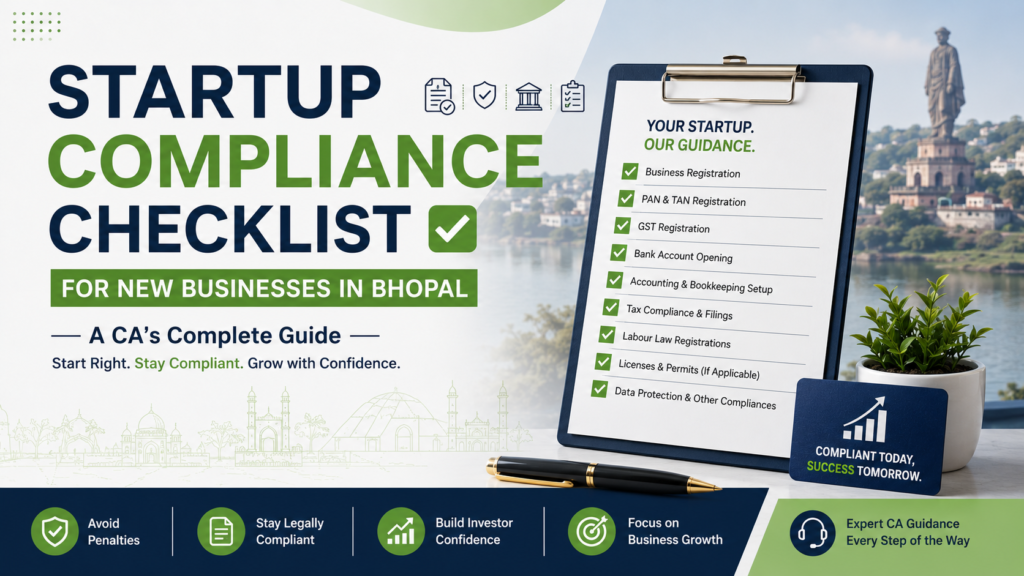
TL;DR Starting a business involves much more than registering a company and opening a bank account. Every startup must comply with multiple legal, tax, accounting, and regulatory requirements to avoid penalties and build a sustainable business. Essential Startup Compliance Checklist ✔ Business Registration ✔ PAN & TAN Registration ✔ GST Registration (if applicable) ✔ MSME/Udyam Registration ✔ Professional Accounting System ✔ Bookkeeping & Record Maintenance ✔ Income Tax Compliance ✔ TDS Compliance ✔ Labour Law Compliance ✔ Annual Filings & Regulatory Reporting Businesses that establish compliance systems from day one are better positioned for growth, funding, and long-term success. Why Startup Compliance Matters Many entrepreneurs focus entirely on product development, customer acquisition, and revenue generation during the initial stages of business. While these activities are important, ignoring compliance can become one of the costliest mistakes a startup makes. Poor compliance can lead to: Government penalties Tax notices GST disputes Loss of input tax credits Regulatory action Difficulty obtaining funding Banking and loan challenges Reputational risks On the other hand, businesses with strong compliance frameworks gain greater credibility with investors, banks, customers, and government agencies. Compliance is not merely a legal obligation—it is a business growth strategy. Startup Compliance Checklist Overview The startup compliance process can be divided into five major categories: Compliance Area Importance Business Registration Legal identity Tax Compliance Avoid penalties Accounting Compliance Financial transparency Labour Compliance Employee protection Annual Filings Regulatory compliance Let’s examine each area in detail. 1. Business Registration Requirements Choosing the right business structure is the first compliance decision every entrepreneur must make. Common business structures include: Sole Proprietorship Suitable for: Small businesses Freelancers Consultants Advantages: Easy setup Lower compliance burden Limitations: Unlimited liability Partnership Firm Suitable for: Family businesses Professional firms Joint ventures Advantages: Shared ownership Flexible management Limitations: Partner liability exposure LLP (Limited Liability Partnership) Suitable for: Professional service firms Growing startups Advantages: Limited liability Simplified compliance Private Limited Company Suitable for: Fundraising startups High-growth businesses Technology ventures Advantages: Investor-friendly structure Limited liability Greater credibility Essential Registration Documents Regardless of business structure, startups generally require: PAN Aadhaar Address proof Bank account Business address documentation Identity proof of promoters Proper documentation ensures smoother registration and future compliance. 2. PAN and TAN Registration PAN (Permanent Account Number) PAN serves as the primary tax identification number for businesses. It is required for: Opening business bank accounts Filing tax returns Financial transactions Regulatory compliance TAN (Tax Deduction and Collection Account Number) Businesses responsible for deducting tax at source must obtain TAN. TAN becomes necessary when: Salaries are paid Contractors are engaged Professional fees are paid Certain specified payments are made Failure to comply with TDS regulations can attract penalties and interest. 3. GST Registration Requirements One of the most important startup compliance requirements involves GST. GST Registration May Be Required For: Businesses crossing prescribed turnover thresholds Interstate suppliers E-commerce sellers Certain service providers Businesses voluntarily opting into GST Benefits of GST Registration Legal compliance Input Tax Credit eligibility Improved credibility Business expansion opportunities Common GST Compliance Requirements GST registration Tax invoice generation Return filing Input tax credit reconciliation Record maintenance Many startups underestimate GST compliance complexity and face avoidable issues later. 4. MSME/Udyam Registration Many entrepreneurs overlook one of the most beneficial registrations available to small businesses. Benefits of Udyam Registration Easier loan approvals Government scheme eligibility Subsidies and incentives Reduced compliance burden in certain areas Protection against delayed payments For eligible businesses, Udyam registration should be completed early. 5. Startup Accounting and Bookkeeping Compliance Accounting is one of the most neglected compliance areas among new businesses. Unfortunately, poor accounting often creates: Tax issues GST mismatches Cash flow problems Funding challenges Essential Accounting Requirements Maintain records of: Sales invoices Purchase invoices Expenses Bank transactions Payroll records GST records Asset registers Best Practice Implement accounting software from day one rather than attempting to reconstruct records later. Why Proper Bookkeeping Matters Accurate bookkeeping helps startups: Monitor profitability Manage cash flow Prepare tax returns Secure investments Support audits Improve decision-making Investors and lenders often review financial records before approving funding. Poor bookkeeping can negatively affect business valuation and credibility. 6. Income Tax Compliance Every business must understand its income tax obligations. Key requirements include: Income Tax Return Filing Businesses must file tax returns within applicable deadlines. Advance Tax Certain businesses may need to pay taxes periodically throughout the year. Tax Planning Proper tax planning helps: Reduce tax liability legally Improve cash flow Avoid year-end surprises Startups that ignore tax planning often pay more tax than necessary. 7. TDS Compliance Many startups are unaware of Tax Deducted at Source (TDS) obligations. TDS may apply when making payments such as: Salaries Contractor payments Professional fees Rent Commission Compliance generally includes: Deduction of tax Deposit of deducted tax Filing TDS returns Issuing certificates TDS defaults can result in penalties and compliance notices. 8. Labour Law Compliance Businesses employing staff must also address labour-related obligations. Depending on employee strength and business activities, requirements may include: Employment contracts Payroll records Employee benefits Statutory registrations Labour law reporting Maintaining proper HR documentation protects both employers and employees. 9. Annual Compliance Requirements Compliance does not end after registration. Businesses must continue meeting ongoing obligations. Common Annual Requirements Income tax return filing Financial statement preparation GST filings TDS filings Regulatory filings Accounting reviews Audit requirements (where applicable) Missing deadlines can result in penalties and legal complications. Common Startup Compliance Mistakes Many startups make avoidable compliance mistakes during their first few years. Mistake 1 Delaying GST registration. Mistake 2 Not maintaining accounting records. Mistake 3 Missing tax filing deadlines. Mistake 4 Mixing personal and business finances. Mistake 5 Ignoring TDS obligations. Mistake 6 Choosing the wrong business structure. Mistake 7 Trying to manage compliance without professional guidance. These mistakes often become expensive as the business grows. How a Chartered Accountant Can Help Startup founders already manage multiple responsibilities. A Chartered Accountant helps ensure compliance remains under control. Professional support typically includes: Business registration guidance GST registration and compliance Tax planning Accounting setup Bookkeeping support Financial reporting Regulatory compliance
Expert Insights: Why Most New Businesses Fail During Registration & Compliance Stage
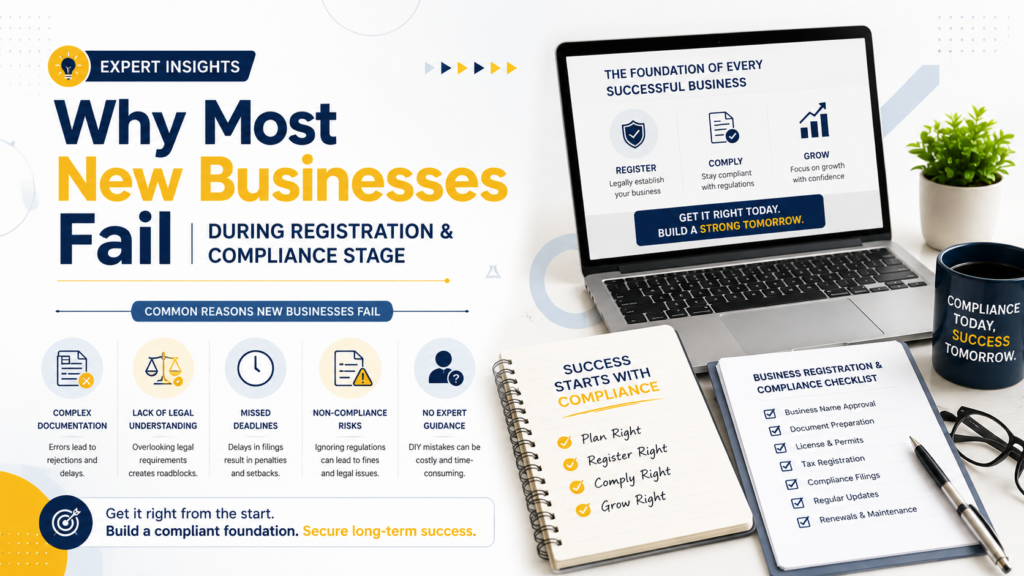
TL;DR Many startups and new businesses fail before scaling because they underestimate the importance of registration, compliance, taxation, and financial structuring. The most common reasons include: Choosing the wrong business structure Missing compliance deadlines GST and tax filing errors Poor bookkeeping systems Inadequate legal documentation Lack of professional advisory support Businesses that establish proper compliance systems early improve operational stability, investor confidence, and long-term scalability. Why the Registration & Compliance Stage Is Critical Most entrepreneurs focus heavily on branding, product development, and customer acquisition during the early stages of business. However, many ignore the legal and compliance foundation that supports sustainable growth. A business may generate revenue initially, but weak compliance systems eventually create operational roadblocks such as: Government notices Banking restrictions Funding difficulties Vendor trust issues Tax penalties Legal complications The registration and compliance stage determines whether a business is structurally prepared for long-term operations. Businesses that neglect this phase often struggle within the first few years. The Hidden Risks New Businesses Ignore New founders frequently assume that registration is simply paperwork. In reality, incorporation is the beginning of ongoing legal, tax, and financial responsibilities. Hidden Risks Include: Incorrect tax classification Improper GST registration Delayed ROC filings Unstructured accounting Lack of statutory records Incomplete shareholder agreements Regulatory non-compliance These issues compound over time and become expensive operational problems later. Most Common Registration Mistakes Founders Make 1. Choosing the Wrong Business Structure One of the earliest and most damaging mistakes is selecting an unsuitable business structure. Many founders register without understanding the long-term impact of: Taxation Compliance obligations Liability protection Funding capability Scalability Common Structures in India Structure Suitable For Sole Proprietorship Freelancers & small local businesses Partnership Firm Small jointly operated businesses LLP Professional services & SMEs Private Limited Company Scalable startups seeking investment Choosing the wrong structure can create: Tax inefficiencies Limited funding opportunities Operational restrictions Compliance confusion 2. Incomplete Documentation During Registration Documentation errors delay approvals and create legal inconsistencies. Common documentation mistakes include: Incorrect address proofs Mismatched PAN details Improper MOA/AOA drafting Missing digital signatures Director KYC issues Poor documentation can delay: Bank account opening GST registration Vendor onboarding Funding processes Founders should maintain organized documentation from day one. 3. Ignoring Industry-Specific Licenses Many businesses assume incorporation alone is sufficient. However, depending on the business type, additional licenses may be required. Examples include: GST registration Shops & Establishment License Import Export Code (IEC) FSSAI registration Professional Tax registration MSME/Udyam registration Operating without required approvals increases compliance risk significantly. 4. Poor Financial Planning Before Launch Many startups begin operations without: Accounting systems Cash flow forecasting Expense categorization Tax planning Compliance budgeting This creates immediate operational instability. According to startup ecosystem reports, cash flow mismanagement remains one of the top reasons early-stage businesses fail. Financial discipline should begin before the first sale. Major Compliance Mistakes That Hurt Startups 1. GST Compliance Errors GST remains one of the biggest compliance challenges for new businesses. Common mistakes include: Delayed GST registration Incorrect invoice formatting ITC mismatches Late filing Vendor reconciliation failures Consequences may include: Interest liabilities Penalties Notice issuance Working capital disruption Businesses should implement structured GST tracking systems early. 2. Ignoring TDS & Payroll Compliance Businesses hiring employees or contractors must understand TDS obligations. Common issues include: Incorrect deductions Delayed deposits Filing errors Missing payroll documentation This creates unnecessary scrutiny and financial exposure. Payroll compliance becomes increasingly important as businesses scale. 3. Delayed ROC Filings Private Limited Companies and LLPs have ongoing filing obligations. Missed ROC deadlines affect: Company status Director compliance records Future fundraising Corporate credibility Founders often ignore ROC obligations until notices arrive. Compliance calendars help avoid this problem. 4. Weak Accounting & Bookkeeping Systems Many startups operate for months without organized accounting. Common issues: Untracked expenses Mixed personal and business transactions No receivable tracking Missing invoices Cash flow confusion Weak bookkeeping creates inaccurate financial reporting. This affects: Tax filings Investor due diligence Loan eligibility Business valuation Why Founders Underestimate Compliance Many entrepreneurs view compliance as a secondary administrative activity. In reality, compliance directly impacts: Business continuity Funding readiness Operational stability Legal protection Financial transparency Startups with poor compliance often appear risky to: Investors Banks Strategic partners Enterprise clients Compliance is not merely about avoiding penalties—it builds business credibility. Registration vs Operational Readiness Registration alone does not make a business operationally ready. A scalable business also requires: Accounting systems Financial controls Vendor contracts Tax tracking Payroll workflows Documentation management Founders should think beyond incorporation certificates. Operational readiness determines whether a company can grow sustainably. Essential Compliance Systems Every Startup Needs 1. Compliance Calendar Track: GST filings ROC filings TDS due dates Payroll compliance Annual returns 2. Cloud Accounting System Use structured accounting platforms for: Invoicing Reconciliation Reporting Expense tracking 3. Document Management System Maintain: Tax filings Registration certificates Agreements Financial records 4. Internal Financial Controls Create approval systems for: Expenses Vendor payments Payroll Reimbursements Startup Compliance Checklist Area Key Requirement Business Registration Proper structure selection GST Timely registration & filing Accounting Organized bookkeeping ROC Filings Annual compliance Payroll TDS & statutory deductions Documentation Digital records management Banking Separate business accounts How Professional Guidance Reduces Risk Professional advisory support helps founders: Choose the right structure Avoid legal mistakes Maintain tax compliance Build scalable accounting systems Improve operational readiness Experienced chartered accountants and compliance advisors can identify risks before they become expensive business problems. For many startups, professional guidance during the initial stage prevents years of compliance complications later. Conclusion Most new businesses do not fail because their ideas are weak. They fail because operational foundations are poorly structured from the beginning. Registration and compliance are not merely formalities—they establish the legal, financial, and operational backbone of a company. Founders who prioritize: Correct registration Strong accounting systems Timely compliance Structured documentation Professional guidance position their businesses for sustainable growth and long-term stability. Businesses seeking structured registration, compliance management, accounting support, and startup advisory can benefit from expert guidance from firms like Junaid Khan & Co to build a stronger operational foundation from the beginning. 6. FAQ SECTION 1.
Startup India + DPIIT Registration: Hidden Benefits Most Startups Still Ignore in 2026

TL;DR Many startups in India still treat Startup India and DPIIT Registration as optional paperwork rather than a strategic business advantage. In reality, DPIIT recognition can help startups: Improve investor confidence Access government schemes Unlock startup ecosystem credibility Apply for tax-related benefits Participate in startup-focused opportunities Reduce regulatory burdens Build long-term compliance structure This guide explains the hidden benefits of Startup India and DPIIT registration in 2026, the eligibility criteria, registration process, common mistakes founders make, and why strategic compliance matters for scaling startups. What is Startup India & DPIIT Registration? Startup India is a flagship initiative launched to promote innovation, entrepreneurship, and startup growth in India. Under this initiative, eligible startups can obtain recognition from DPIIT (Department for Promotion of Industry and Internal Trade). DPIIT recognition acts as an official government acknowledgment that a business qualifies as a startup under applicable criteria. This recognition helps startups access: Regulatory support Startup ecosystem benefits Tax-related opportunities Intellectual property support Networking and incubation access Why DPIIT Recognition Matters in 2026 India’s startup ecosystem has become significantly more competitive. Investors, incubators, accelerators, and enterprise clients increasingly evaluate startups based on: Legal structure Compliance readiness Documentation quality Scalability Regulatory credibility DPIIT recognition strengthens a startup’s positioning in all these areas. In 2026, startups that maintain proper compliance and structured documentation are likely to gain better visibility in: Investor discussions Government initiatives Corporate partnerships Procurement opportunities Eligibility Criteria for Startup India Registration Not every business qualifies as a startup under DPIIT guidelines. Common Eligibility Factors A startup generally must: Be incorporated as: Private Limited Company LLP Registered Partnership Firm Be within prescribed operational timelines Work toward innovation, scalability, or process improvement Avoid being formed through business reconstruction Eligibility assessment is important before filing the application. Step-by-Step DPIIT Registration Process Step 1: Business Incorporation Before DPIIT recognition, the business must be legally incorporated. Common structures include: Private Limited Company LLP Partnership Firm Step 2: Startup India Portal Registration The startup creates a profile on the Startup India platform. Step 3: Document Submission The application generally includes: Incorporation certificate PAN details Business description Innovation details Website or pitch deck information Step 4: DPIIT Application Review Authorities review the startup’s eligibility and business nature. Step 5: Recognition Certificate Issuance Once approved, the startup receives DPIIT recognition. Hidden Benefits Most Startups Ignore Many founders only focus on the “startup certificate” and completely overlook the strategic advantages. 1. Increased Investor Confidence DPIIT recognition signals that: The startup is formally structured Compliance standards are maintained Business legitimacy has been verified This often improves investor perception during: Seed funding discussions Angel investment rounds Accelerator applications 2. Better Access to Startup Ecosystems Recognized startups gain better access to: Incubators Accelerators Startup communities Government startup programs Innovation hubs These networks can significantly influence growth opportunities. 3. Intellectual Property (IP) Advantages Many startups underestimate the importance of: Trademark protection Patent filing Brand ownership DPIIT-recognized startups may receive support in protecting intellectual property assets. This becomes especially important for: SaaS businesses Tech startups D2C brands Product companies 4. Improved Tender Participation Opportunities Government procurement frameworks increasingly encourage startup participation. Recognized startups may receive procedural advantages in: Startup-specific procurement opportunities Innovation-based projects Government-backed startup initiatives 5. Strategic Tax Planning Opportunities Many founders misunderstand startup tax benefits. The actual advantage lies in: Structured tax planning Better documentation Compliance readiness Long-term tax efficiency Improper planning often causes startups to miss legitimate opportunities. 6. Stronger Business Credibility Corporate clients, enterprise partners, and investors often prefer working with: Registered entities Compliance-focused startups Legally structured organizations DPIIT recognition enhances professional positioning. 7. Easier Access to Funding Conversations While DPIIT recognition does not guarantee funding, it improves: Startup profiling Documentation quality Investor preparedness Due diligence readiness This matters significantly during fundraising stages. Tax & Compliance Advantages Many startups delay compliance until they face: Investor due diligence GST notices Tax scrutiny Funding documentation requests DPIIT-recognized startups often become more structured in: Accounting systems Tax filing Record maintenance Corporate governance This improves operational stability. Investor & Funding Benefits Investors increasingly prioritize startups with: Clean legal documentation Financial discipline Compliance consistency Transparent records A startup with proper compliance systems is easier to evaluate and fund. Common Investor Red Flags Missing filings Poor bookkeeping Unstructured founder agreements Tax mismatches Compliance delays Founders should address these issues early. Government Tender and Procurement Advantages Government-backed procurement opportunities increasingly support innovation-driven startups. Recognized startups may receive benefits such as: Startup-focused opportunities Reduced procedural complexity Innovation recognition This can open new revenue channels for early-stage companies. Intellectual Property (IP) Benefits For startups building unique products, technology, or branding, IP protection is critical. Areas Startups Often Ignore Trademark registration Patent strategy Copyright ownership Founder IP agreements Ignoring IP protection can create future disputes and investor concerns. Common Startup Registration Mistakes 1. Choosing the Wrong Business Structure Improper entity selection creates long-term compliance and taxation complications. 2. Filing Incomplete Documentation Poor applications may lead to delays or rejection. 3. Ignoring Compliance After Registration Recognition alone is not enough. Ongoing compliance matters. 4. Weak Financial Documentation Investors expect accurate records and bookkeeping. 5. Delaying Trademark Protection Brand ownership disputes can become expensive later. 6. Confusing Recognition with Automatic Funding DPIIT recognition improves opportunities but does not guarantee investment. Why Founders Need Professional Compliance Guidance Most startup founders focus heavily on: Product development Growth Marketing Fundraising but underestimate compliance planning. Professional guidance helps startups: Structure operations correctly Reduce legal risks Maintain tax compliance Improve investor readiness Avoid future disputes This becomes increasingly important as the startup scales. How Junaid Khan & Co Helps Startups Junaid Khan & Co supports startups with: Startup incorporation DPIIT registration assistance Tax compliance GST advisory Accounting and bookkeeping Startup financial structuring Trademark coordination support Investor documentation readiness The firm works with startups, founders, freelancers, and growing businesses across multiple industries. Suggested Internal Linking Opportunities Startup registration services GST registration support Accounting and bookkeeping Tax planning services Company incorporation consultancy Conclusion Startup India and DPIIT registration are far more than compliance formalities in 2026. For modern startups, proper recognition and