


TL;DR
GST registration is one of the first compliance steps for businesses operating in Bhopal. Whether you run a startup, consultancy, ecommerce business, trading company, or professional service firm, proper GST registration helps maintain legal compliance, improves business credibility, and enables input tax credit benefits.
This guide explains:
- Who needs GST registration
- Required documents
- Registration process
- Approval timeline
- Common rejection mistakes
- Post-registration compliance requirements
Understanding GST Registration
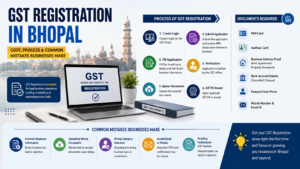
Goods and Services Tax (GST) is India’s unified indirect tax system applicable to most businesses supplying goods or services. Once registered, businesses receive a GSTIN (Goods and Services Tax Identification Number), which is used for invoicing, tax filing, and compliance reporting.
Businesses in Bhopal involved in:
- Trading
- Manufacturing
- Consulting
- Ecommerce
- Professional services
- Freelancing
- Digital services
often require GST registration depending on turnover thresholds and operational structure.
With increasing digital scrutiny and invoice matching systems, GST compliance has become critical for operational continuity and vendor credibility.
Who Needs GST Registration in Bhopal?
GST registration may be mandatory or voluntary depending on business activity and turnover.
Businesses That Commonly Require GST Registration
1. Service Providers
Consultants, agencies, IT professionals, and freelancers crossing prescribed turnover limits generally require GST registration.
2. Goods Suppliers
Retailers, wholesalers, traders, and manufacturers selling taxable goods may require registration.
3. Ecommerce Sellers
Selling through online marketplaces often requires GST registration irrespective of turnover thresholds.
4. Interstate Businesses
Businesses supplying goods or services across state boundaries may require GST registration.
5. Startups Seeking Credibility
Many startups voluntarily register under GST to:
- Work with corporate clients
- Claim input tax credits
- Improve vendor trust
- Participate in tenders
Benefits of GST Registration
Legal Compliance
GST registration helps businesses operate within tax regulations and avoid unnecessary notices or penalties.
Input Tax Credit (ITC)
Registered businesses can claim credits on eligible purchases and operational expenses.
Business Credibility
Corporate clients and vendors often prefer GST-compliant businesses.
Easier Expansion
GST registration simplifies interstate operations and ecommerce participation.
Better Financial Transparency
GST-compliant invoicing improves accounting and audit readiness.
Documents Required for GST Registration
The documentation requirement depends on the constitution of the business.
| Business Type | Common Documents Required |
|---|---|
| Proprietorship | PAN, Aadhaar, address proof, business proof |
| Partnership Firm | PAN, partnership deed, partner IDs |
| LLP | LLP incorporation documents, PAN, address proof |
| Private Limited Company | COI, PAN, MOA, AOA, director KYC |
Common Supporting Documents
- PAN card
- Aadhaar card
- Business address proof
- Electricity bill or rent agreement
- Passport-size photograph
- Bank account proof
- Digital signature (for companies/LLPs)
Step-by-Step GST Registration Process
Step 1: Eligibility Assessment
The first step is determining whether GST registration is mandatory or beneficial voluntarily.
Step 2: Document Collection
Proper documentation significantly reduces rejection chances.
Step 3: Online Application Filing
The GST registration application is submitted through the GST portal.
Step 4: ARN Generation
After submission, an Application Reference Number (ARN) is generated for tracking.
Step 5: Verification by GST Department
The department verifies:
- PAN details
- Address proof
- Business activity
- Contact details
Step 6: Clarification or Notice (If Required)
If discrepancies exist, authorities may issue clarification notices.
Step 7: GSTIN Approval
Once approved, the GSTIN certificate becomes available online.
GST Registration Timeline Explained
The GST registration timeline varies depending on:
- Accuracy of documents
- Type of business entity
- Verification complexity
- Department queries
- Aadhaar authentication status
Applications with incorrect details or mismatched information often face delays.
Factors That Delay GST Registration
- Wrong business address
- Mismatch in PAN details
- Incorrect HSN/SAC selection
- Poor-quality uploaded documents
- Invalid mobile/email verification
- Incomplete business activity details
Common GST Registration Mistakes Businesses Make
Many businesses in Bhopal face registration delays or future compliance issues due to avoidable mistakes.
1. Using Incorrect Business Address Proof
One of the most common reasons for GST rejection is invalid address documentation.
Common Problems
- Expired rent agreement
- Mismatch between electricity bill and application
- Incomplete NOC documentation
- Residential-commercial confusion
2. Wrong Business Classification
Incorrectly selecting:
- Business category
- Constitution type
- Nature of services
- HSN/SAC codes
can create future compliance complications.
3. Applying Without Understanding Compliance Requirements
Many businesses focus only on obtaining the GST number but ignore:
- Return filing requirements
- Invoice formats
- Tax payment obligations
- Record maintenance
This often leads to notices and penalties later.
4. Incorrect Contact Information
GST communications are digitally delivered. Wrong mobile numbers or email IDs can cause missed notices and compliance defaults.
5. Not Maintaining Consistent Business Details
Business name, PAN details, and address must remain consistent across:
- PAN
- Bank account
- Registration documents
- Utility bills
Even minor inconsistencies may trigger verification issues.
6. Ignoring Post-Registration Compliance
Registration is only the beginning.
Businesses must regularly manage:
- GST returns
- Tax invoices
- ITC reconciliation
- Vendor matching
- Compliance records
GST Compliance After Registration
After GST registration approval, businesses must maintain regular compliance.
Important Compliance Areas
GST Return Filing
Monthly or quarterly returns depending on business category.
Proper Invoicing
Invoices must contain mandatory GST details.
Record Keeping
Businesses should maintain:
- Purchase records
- Sales records
- Tax invoices
- E-way bills
Input Tax Credit Reconciliation
Incorrect ITC claims can lead to scrutiny.
Annual Compliance
Some businesses may require annual reconciliations and audit-related compliance.
Why Businesses Prefer Professional GST Consultants
GST law involves continuous amendments, compliance notifications, and procedural changes. Many businesses prefer working with experienced professionals for:
- Error-free registration
- Faster approvals
- Proper classification
- Compliance management
- Notice handling
- Ongoing GST advisory
Professional support reduces compliance risks and allows businesses to focus on operations.
How Junaid Khan & Co Helps Businesses
Junaid Khan & Co assists businesses with:
- GST registration support
- Documentation review
- GST compliance management
- Return filing assistance
- Advisory for startups and MSMEs
- GST notice handling
- Business tax structuring
The firm works with startups, traders, professionals, and growing businesses across Bhopal and surrounding regions.
Conclusion
GST registration is not just a legal formality—it directly affects business credibility, taxation efficiency, vendor relationships, and operational compliance.
Businesses in Bhopal should approach GST registration strategically by:
- Understanding eligibility
- Preparing proper documentation
- Avoiding common application mistakes
- Planning post-registration compliance
A professionally managed registration process minimizes delays, improves approval chances, and helps businesses stay compliant from day one.
If you are planning to register your business under GST or need guidance regarding compliance requirements, professional assistance can help simplify the entire process and reduce future risks.
6. FAQ SECTION
1. Is GST registration mandatory for small businesses in Bhopal?
GST registration depends on turnover limits, business type, and operational structure. Ecommerce sellers and interstate suppliers may require mandatory registration even at lower turnover levels.
2. Can freelancers apply for GST registration?
Yes. Freelancers providing taxable services may require GST registration depending on turnover and client structure.
3. What documents are needed for GST registration?
Common documents include PAN, Aadhaar, address proof, bank proof, and business registration documents.
4. How long does GST registration take?
The timeline depends on verification status, document accuracy, and department queries.
5. Can GST registration be rejected?
Yes. Incorrect documents, address mismatches, or inaccurate business information may lead to rejection or clarification notices.
6. Is GST registration completely online?
Yes. The GST registration process is conducted online through the GST portal.
7. What happens after GST registration?
Businesses must comply with GST return filing, invoicing, record maintenance, and tax payment obligations.
8. Can startups voluntarily register under GST?
Yes. Many startups voluntarily register to improve credibility and claim input tax credit benefits.
Blog By – CA Junaid Khan
Written by CA Junaid Ahmed Khan, Junaid Khan & Co., Bhopal.