

September–October 2026 Business Compliance Checklist for SMEs & Companies
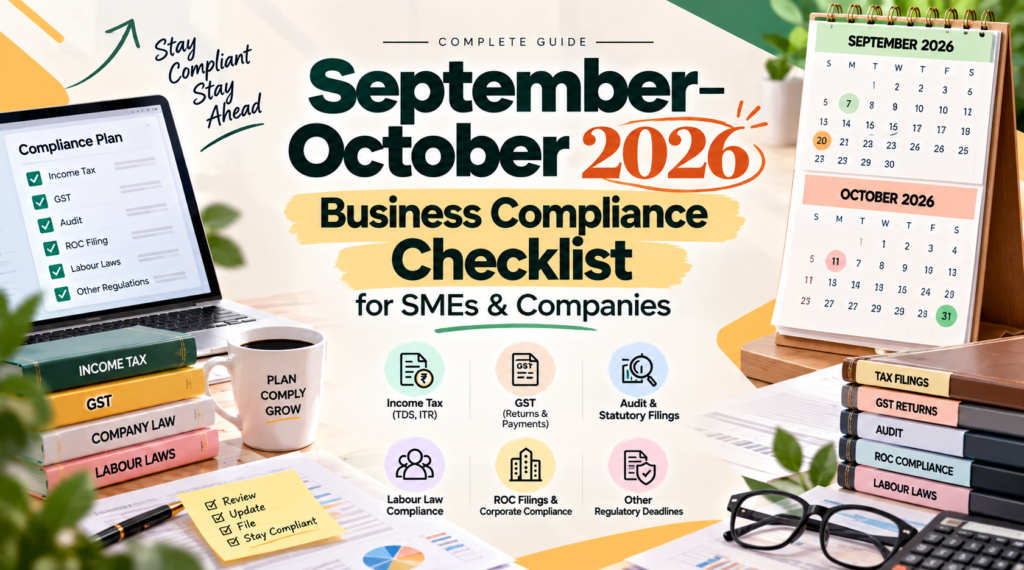
TL;DR September and October 2026 are important compliance months for Indian SMEs and companies. Businesses need to manage GST returns, TDS payments, advance tax, tax-audit requirements, accounting reconciliations and quarterly TDS statements while also preparing for upcoming income-tax and corporate compliance. For September, businesses should particularly track the 15 September advance-tax instalment, monthly GST filings, TDS payments and the 30 September tax-audit deadline applicable to eligible taxpayers for FY 2025–26. October then brings the Q2 TDS statement deadline of 31 October, along with regular GST and TDS compliance. A structured compliance checklist can help SMEs and companies avoid late fees, interest, penalties and last-minute reporting errors. Introduction September and October are among the busiest compliance months for Indian businesses. For SMEs, startups, partnership firms and companies, compliance during this period is not limited to GST return filing. Businesses may also need to manage advance tax, TDS/TCS, tax audit, income-tax reporting, accounting reconciliations and other statutory requirements. The challenge becomes greater when multiple compliance deadlines fall close together. A missed GST filing, incorrect TDS deposit or incomplete tax-audit information can create unnecessary interest, late fees, notices or reconciliation issues. Businesses should therefore maintain a monthly compliance calendar and complete important reconciliations before the actual filing deadlines. Here is a practical September–October 2026 business compliance checklist for SMEs and companies. September 2026 Business Compliance Checklist 1. Review and Pay the Second Advance Tax Instalment One of the most important September tax deadlines is the second instalment of advance tax. For taxpayers following the regular instalment schedule, the cumulative advance-tax requirement reaches 45% of the estimated annual advance-tax liability by 15 September. Before making the payment, businesses should estimate their current-year taxable income and consider: Revenue earned so far Expected profit for the year TDS/TCS credits Capital gains Other taxable income Major business expenses Changes in profitability Tax already paid Businesses should avoid simply repeating the previous instalment without reviewing their latest financial position. 2. File GSTR-1 for August 2026 Monthly GST taxpayers generally need to file GSTR-1 for the previous month’s outward supplies by the applicable due date. GSTR-1 contains important sales and invoice information that subsequently affects GST reporting and recipient-side input tax credit. Before filing, businesses should verify: B2B invoices B2C sales Credit notes Debit notes Export invoices Amendments GSTINs Taxable values Tax rates HSN/SAC information GSTR-1 is required even where there is no business activity for the relevant tax period, subject to the applicable filing framework. 3. Review GSTR-2B and Input Tax Credit Before filing the relevant GSTR-3B, businesses should reconcile purchase records with GSTR-2B. The review should identify: Missing purchase invoices Incorrect GSTINs Duplicate invoices Credit notes Supplier filing delays Ineligible ITC Reverse-charge transactions Differences between books and GSTR-2B Businesses should remember that an invoice appearing in GSTR-2B does not by itself establish that every condition for claiming ITC has been satisfied. 4. File GSTR-3B and Pay GST Liability For monthly filers, GSTR-3B is generally due on the 20th of the following month. The return is used to declare GST liabilities and discharge the applicable tax. Before filing, businesses should reconcile: GSTR-1 GSTR-2B Books of accounts Sales register Purchase register Credit/debit notes Reverse charge liability GST payments GSTN also states that GSTR-3B cannot be amended after filing, making pre-filing verification especially important. 5. Deposit TDS for August 2026 Businesses deducting TDS should generally deposit tax deducted during August by 7 September 2026, subject to the applicable exceptions. The accounting records should be reconciled with: TDS payable ledger Challans Vendor payments Salary records Professional fees Rent Commission Contractor payments The Income Tax Department confirms that the general TDS deposit timeline continues to be the 7th of the following month under the current framework. 6. Complete the Tax Audit for FY 2025–26 For businesses covered by tax-audit requirements, September is particularly important. For FY 2025–26 / AY 2026–27, tax audits continue under the Income Tax Act, 1961. Depending on the circumstances, Form 3CA-3CD or Form 3CB-3CD is applicable. Businesses should ensure that the auditor has received: Final trial balance Profit and loss account Balance sheet Bank statements Fixed-asset register GST records TDS records Loan details Debtor and creditor details Expense ledgers MSME information Related-party transaction details Supporting documents The tax-audit report deadline for standard cases is 30 September 2026. 7. Reconcile Books With GST September is a good time to perform a detailed GST-to-books reconciliation. Businesses should compare: Sales Register → GSTR-1 → GSTR-3B → Books of Accounts Differences may arise because of: Timing differences Credit notes Sales returns Advances Amendments Exempt supplies Export transactions Accounting adjustments Unexplained differences should be investigated before they become a larger compliance problem. October 2026 Business Compliance Checklist 8. File the Q2 TDS Statement The July–September 2026 quarter ends on 30 September. Businesses deducting TDS should prepare their quarterly TDS statement for Q2. Under the Income Tax Act, 2025 framework, Form 140 is the quarterly TDS statement for resident non-salary payments, while Form 138 applies to quarterly salary TDS reporting. The Q2 due date is 31 October. Businesses should reconcile the statement before filing to minimise: PAN errors Incorrect TDS amounts Wrong section reporting Challan mismatches Duplicate entries Incorrect deductee information 9. Reconcile TDS With Books and AIS After completing the quarter, businesses should compare TDS records with their accounting system. Check: TDS deducted TDS deposited Vendor-wise deductions Salary TDS TDS receivable TDS payable Form 26AS/AIS information TDS return data The objective is to ensure that the amount recorded in the books agrees with the tax actually deducted and deposited. 10. Review October GST Compliance October continues the regular GST cycle. Businesses should prepare their sales and purchase data early instead of waiting until the filing deadline. The monthly GST process should include: Finalise sales data Reconcile invoices Review GSTR-1 data Check GSTR-2B Reconcile ITC Calculate GST liability Review reverse charge File GSTR-1 File GSTR-3B Preserve filing records For monthly taxpayers, GSTR-1 is generally due on the 11th and GSTR-3B on the 20th of the following month, subject to applicable rules and extensions.