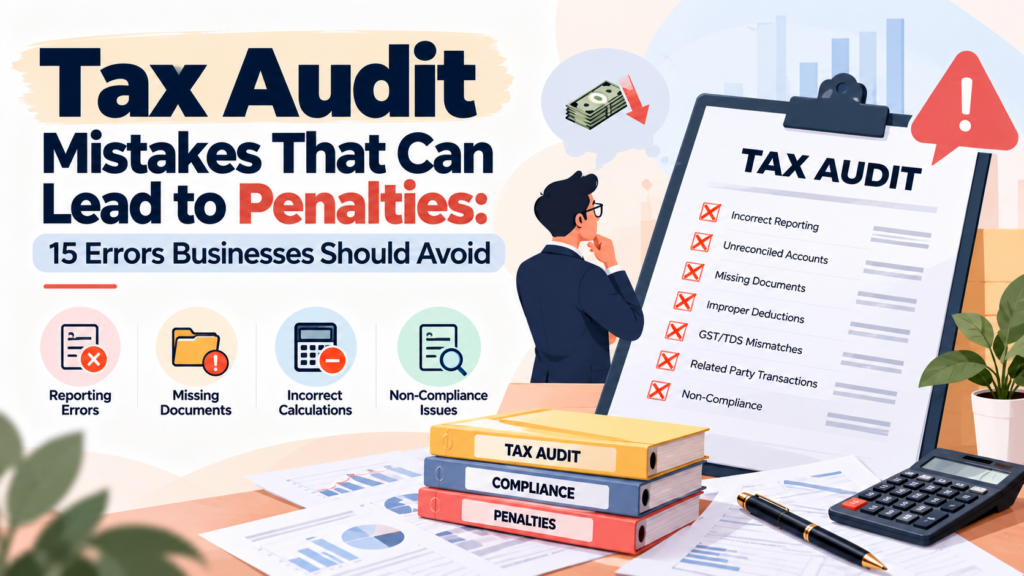
Tax Audit Mistakes That Can Lead to Penalties: 15 Errors Businesses Should Avoid
TL;DR Tax audit is more than submitting Form 3CA/3CB and Form 3CD. Errors in books of accounts, turnover reporting, GST reconciliation, TDS, expenses, depreciation, loans, related-party transactions and tax disclosures can create compliance issues and may expose businesses to penalties where applicable. For FY 2025–26 / AY 2026–27, tax audits continue under Section 44AB of the Income Tax Act, 1961, with Form 3CA/3CD or 3CB/3CD, as applicable. The tax audit report is generally due by 30 September 2026 in standard cases. From Tax Year 2026–27, Section 63 of the Income Tax Act, 2025 applies and the new Form 26 consolidates the earlier audit forms. Businesses should therefore ensure that their accounting records, supporting documents, tax returns and audit disclosures are accurate and properly reconciled before the tax audit report is filed. Introduction A tax audit is an important compliance requirement for businesses and professionals who fall within the prescribed audit provisions. It enables the Income Tax Department to obtain verified information about turnover, expenses, deductions, depreciation, tax compliance and other financial particulars. However, many businesses treat tax audit as simply a form-filing exercise. In reality, the quality of the underlying books and supporting records can significantly affect the accuracy of the audit report. A mismatch between books and GST returns, incorrect turnover, missing expense documents, unreconciled TDS, incorrect depreciation or incomplete Form 3CD disclosures can create unnecessary complications. The Income Tax Department explains that tax audit is intended to help ensure proper maintenance and correctness of books, report discrepancies and provide prescribed information under the Income Tax Act. Here are 15 common tax audit mistakes businesses should avoid. 1. Reporting Incorrect Turnover One of the most important areas during a tax audit is turnover or gross receipts. Businesses sometimes calculate turnover only from their accounting software without reconciling it with bank statements, GST returns, invoices and other records. This can result in: Understatement of business receipts Incorrect tax-audit applicability GST and income-tax mismatches Incorrect profit calculations Incorrect reporting in Form 3CD Businesses should reconcile sales and receipts with their books, GST data, bank statements and other relevant records before finalising the audit. 2. Ignoring the Tax Audit Applicability Threshold Another common mistake is assuming that tax audit is applicable only when turnover crosses a particular limit without checking the complete provisions. For businesses, the general threshold remains ₹1 crore, with the higher ₹10 crore threshold available where cash receipts and cash payments do not exceed the prescribed 5% conditions. For professionals, the general threshold is ₹50 lakh. Certain presumptive-taxation situations can also trigger audit requirements. Therefore, businesses should calculate turnover and review their cash transactions carefully before deciding whether a tax audit is required. 3. Failing to Reconcile GST Turnover With Books GST returns and books of accounts should not be treated as completely separate records. Differences may arise because of: Credit notes Debit notes Advances Export transactions Exempt supplies Year-end adjustments Sales returns Amendments Timing differences An unexplained difference between GST turnover and books can attract questions during tax compliance reviews. Businesses should prepare a proper GST-to-books reconciliation before the tax audit. 4. Incorrect or Incomplete Form 3CD Reporting Form 3CD contains numerous particulars relating to the taxpayer’s business, books, expenses, deductions, depreciation, loans, TDS and other matters. Simply copying information from accounting software without reviewing each applicable clause can result in incorrect disclosures. For FY 2025–26 / AY 2026–27, Form 3CD continues to be used with Form 3CA or Form 3CB under the Income Tax Act, 1961. Businesses should provide complete and accurate information to the tax auditor instead of assuming that every disclosure will automatically be generated from the books. 5. Claiming Expenses Without Proper Supporting Documents An expense recorded in the books does not automatically mean that it is properly supported. Businesses should maintain appropriate documentation such as: Tax invoices Bills Payment records Agreements Purchase orders Bank statements Expense vouchers Supporting correspondence where relevant Missing documentation can make it difficult to establish the nature and business purpose of an expense. 6. Ignoring Cash Expenses and Payment Restrictions Cash transactions require special attention during tax audit. Businesses should review cash payments against the applicable restrictions and maintain proper supporting records. Particular attention should be given to: Large cash payments Payments to related parties Payments to vendors Employee reimbursements Cash purchases Payments that may attract disallowance A proper cash-payment review before the audit can help identify potentially disallowable expenses early. 7. Not Reconciling TDS and TCS TDS and TCS information should be reconciled with the books and relevant tax records. Common mistakes include: TDS deducted but not recorded correctly Incorrect TDS receivable TDS payable not reconciled Wrong deduction classification Differences between books and Form 26AS/AIS TDS returns not matching accounting records The Income Tax Department’s current taxpayer information includes TDS/TCS data through AIS and related systems, making reconciliation increasingly important. 8. Incorrect Depreciation Calculation Depreciation errors are another common tax-audit issue. Businesses may incorrectly calculate depreciation because of: Wrong asset classification Incorrect purchase date Incorrect date of put-to-use Asset additions not recorded Asset disposals not updated Incorrect depreciation rates Failure to reconcile fixed-asset registers with books The fixed-asset register should therefore be reviewed carefully before the audit. 9. Missing MSME Payment Information Payments to micro and small enterprises require careful review because delayed payments can have tax implications. Businesses should identify applicable MSME vendors and verify: Vendor classification Invoice dates Payment dates Outstanding balances Amounts paid after the applicable period Year-end outstanding amounts Maintaining updated vendor records can make this review much easier. 10. Incorrect Reporting of Loans and Deposits Loans, advances and deposits should be carefully reviewed during tax audit. Businesses should maintain documentation for: Loans received Loans given Repayments Advances Security deposits Related-party loans Bank borrowings The mode of receipt and repayment should also be reviewed wherever applicable under the relevant provisions. Large unexplained movements in loan accounts can create unnecessary questions during tax scrutiny. 11. Not Disclosing Related-Party Transactions Properly Transactions with directors, partners, relatives, associated enterprises or other specified persons require additional attention.