

AIS vs Books of Accounts: How to Find and Fix Income & Transaction Mismatches
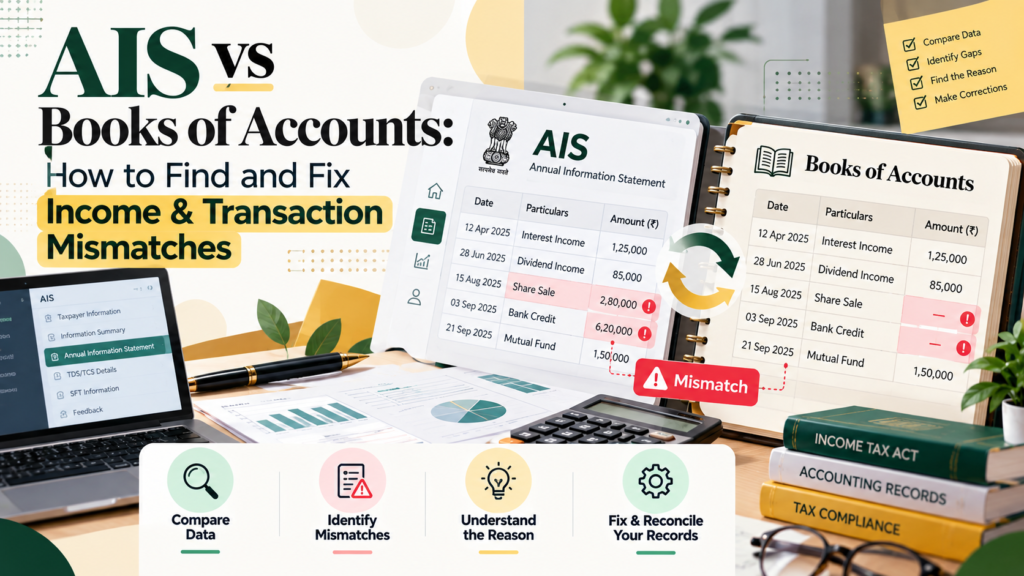
TL;DR AIS and Books of Accounts serve different purposes, so their figures do not always have to match exactly. However, unexplained differences between AIS, books, Form 26AS, bank statements, TDS records and the ITR can create compliance questions. Common mismatches include interest income, TDS, business receipts, property transactions, securities, dividends, foreign transactions and high-value financial activity. The right approach is to identify the source of the mismatch, verify supporting documents, provide AIS feedback where appropriate, correct accounting records if necessary and report the correct tax position in the ITR. Introduction Income tax compliance in 2026 is increasingly data-driven. The Income Tax Department receives financial information from taxpayers, banks, financial institutions, employers, companies, mutual funds, registrars and other reporting entities. Much of this information can appear in the taxpayer’s Annual Information Statement (AIS). At the same time, businesses and professionals maintain their own Books of Accounts, which record income, expenses, assets, liabilities, receivables, payments and other financial transactions. Ideally, the financial information reported through different sources should tell a consistent story. However, mismatches are common. For example, AIS may show interest income that was not recorded in the books, TDS may appear against a receipt that was accounted for in another period, or a property transaction may appear in AIS while the taxpayer’s books contain only the related bank payment. A mismatch does not automatically mean that income has been concealed. The important question is: Why is there a difference, and can it be properly explained with supporting documents? What Is AIS? The Annual Information Statement (AIS) provides a comprehensive view of information available with the Income Tax Department in relation to a taxpayer. According to the Income Tax Department, AIS can contain information relating to: TDS TCS Statement of Financial Transactions (SFT) Tax payments Demand and refund information Certain other information received by the department Taxpayers can also provide feedback where information displayed in AIS is incorrect. (Income Tax Department) AIS is therefore an important source for pre-filing tax reconciliation. However, AIS should not be treated as a complete substitute for the taxpayer’s own books and records. The department itself states that AIS may not contain every transaction relating to a taxpayer. Taxpayers remain responsible for reporting complete and accurate income. (Income Tax Department) What Are Books of Accounts? Books of Accounts are the accounting records maintained by a taxpayer or business. Depending on the nature of the business, these may include: Sales register Purchase register Cash book Bank book General ledger Journal Expense records Debtor ledger Creditor ledger Fixed-asset register Investment records Loan accounts GST records TDS records For businesses, the books ultimately form the basis for preparing financial statements and determining taxable income. Therefore, AIS should be compared with the underlying accounting records rather than being accepted blindly. AIS vs Books of Accounts: Why Can They Differ? AIS and books are generated from different information sources. AIS: Primarily reflects information reported to the Income Tax Department by taxpayers and reporting entities. Books: Reflect transactions recorded by the taxpayer based on accounting documents and business activity. A difference can therefore occur because of: Timing differences Reporting errors by third parties Accounting errors Duplicate reporting Incorrect PAN Transactions recorded under another entity Gross vs net reporting Credit notes Reversals Capital transactions Loans Gifts Non-taxable receipts Exempt income Transactions outside the scope of taxable income The objective of reconciliation is to determine which explanation applies to each difference. Common AIS vs Books Mismatches 1. Interest Income Mismatch Interest income is one of the most common differences. AIS may contain interest information reported by: Banks Financial institutions Companies Bond issuers Other reporting entities The books may show a different figure because of: Accrual accounting Cash accounting Interest credited but not received Interest received from multiple accounts TDS adjustments Wrong reporting by the bank The taxpayer should compare AIS with: Bank statements + interest certificates + ledger + TDS records The correct taxable income should then be determined under the applicable tax provisions. 2. TDS Income Mismatch Another common problem occurs when TDS appears in AIS or Form 26AS but the corresponding income is not visible in the books. For example, a professional may receive ₹1,00,000 from a client and have TDS deducted. The books may record the net bank receipt of ₹90,000 while AIS reflects the gross amount of ₹1,00,000 along with TDS. This is not necessarily a mismatch in taxable income. The reconciliation should consider: Gross income = Net receipt + TDS deducted This is why comparing only the bank credit with AIS can produce misleading conclusions. 3. Business Receipts Mismatch Businesses should compare AIS information with their sales and service-income records. A mismatch can occur when: Customer reports a payment under the wrong PAN Receipt is recorded in a different month Credit note is issued Advance is received Invoice is cancelled Customer reports a transaction incorrectly Receipt belongs to a different entity Businesses should trace the transaction back to: Customer → Invoice → Ledger → Bank statement → TDS → AIS 4. GST Turnover vs AIS and Books Businesses should also examine whether their GST and income-tax records are broadly consistent. A useful reconciliation is: Sales Register → GST Returns → Books → AIS/TDS → ITR Differences can arise due to: Exempt supplies Non-GST income Credit notes Advances Timing differences TDS-reporting differences Capital transactions The objective is not to force every figure to be identical but to explain material differences. 5. Dividend Income Mismatch Dividend information can appear in AIS through reporting by companies and other entities. A taxpayer may fail to record a dividend because: The amount was credited to a demat-linked bank account Multiple investments generated dividends The taxpayer overlooked small dividend amounts TDS was deducted and only the net amount was noticed The correct approach is to reconcile: AIS → Dividend statement → Bank statement → TDS → ITR 6. Mutual Fund Transactions AIS can contain information relating to financial transactions reported by relevant entities. For mutual funds, taxpayers should reconcile: Purchases Redemptions Dividends Capital gains