

Income Tax Scrutiny 2026: Transactions That Can Trigger Questions From the Tax Department
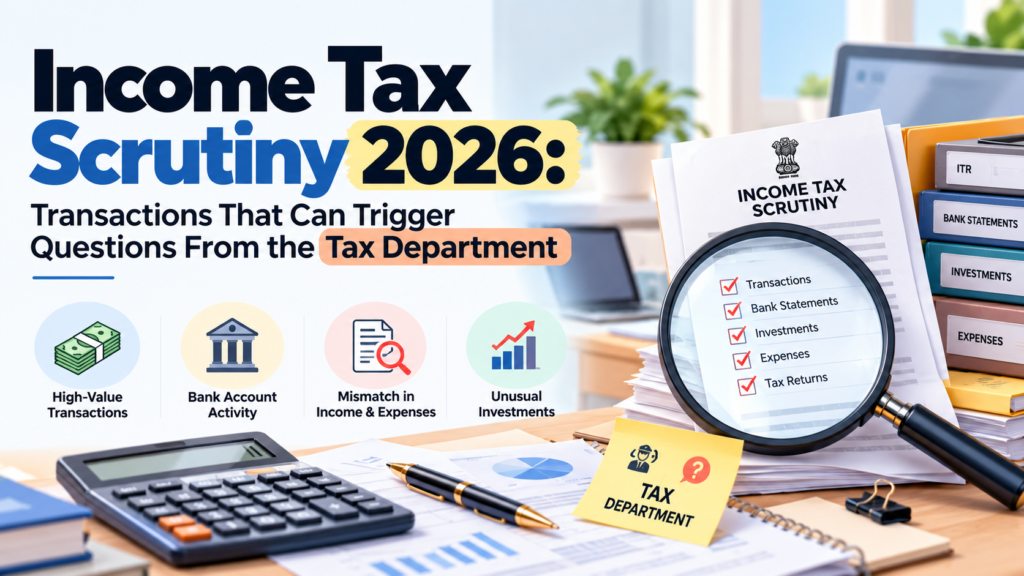
TL;DR Income tax scrutiny does not necessarily mean that a taxpayer has committed an offence. The Income Tax Department uses information available through sources such as AIS, SFT, TDS/TCS records, tax payments and other reported information to identify potential inconsistencies and compliance risks. Transactions that do not match the income declared in the ITR, unexplained investments, significant cash transactions, property purchases, foreign assets, securities transactions, large deductions and differences between GST and income-tax data can attract questions. Taxpayers should therefore review AIS, TIS, Form 26AS, bank statements, investment records and supporting documents before filing and respond carefully if a notice is received. Introduction Income tax scrutiny in 2026 is increasingly data-driven. The Income Tax Department receives financial information from taxpayers, banks, financial institutions, reporting entities and other sources. This information can appear in the taxpayer’s Annual Information Statement (AIS) and may be used for compliance verification and risk analysis. AIS contains information such as TDS/TCS, Statement of Financial Transactions (SFT), tax payments, demand and refund information and certain other information received by the department. Taxpayers can also provide feedback where information displayed in AIS is incorrect. This means that filing an ITR with figures that do not reasonably reconcile with information available to the department can result in questions. Importantly, a transaction appearing in AIS does not automatically mean that it is taxable or that scrutiny will definitely happen. AIS itself states that it contains information presently available to the department and that taxpayers must independently verify all relevant information and report complete and accurate income. The real concern is an unexplained mismatch. What Is Income Tax Scrutiny? Income tax scrutiny is a detailed examination of a taxpayer’s return and supporting information by the Income Tax Department. The objective is to verify whether: Income has been correctly reported Tax has been correctly calculated Deductions and exemptions are genuine Transactions are properly explained Investments are supported by known sources Financial information is consistent Tax compliance requirements have been followed A scrutiny notice does not automatically mean that additional tax is payable. The taxpayer gets an opportunity to provide explanations and supporting documents. For AY 2026–27 and earlier assessment years, assessment proceedings continue under the Income Tax Act, 1961 even though the Income Tax Act, 2025 has come into force from 1 April 2026. The Income Tax Department has specifically clarified that scrutiny assessments for AY 2026–27 or earlier years continue under the old Act. Why Can a Transaction Attract Questions From the Tax Department? The department has access to information from multiple reporting channels. A transaction can attract attention when there is a significant difference between: Transaction reported by a third party → Information available in AIS/SFT → Transaction disclosed in ITR For example, if a financial institution reports a substantial transaction but the taxpayer’s return does not adequately explain the corresponding source or tax treatment, the department may seek clarification. Similarly, a large investment funded from an income level that appears insufficient may require supporting evidence. 1. High-Value Cash Deposits Large cash deposits into bank accounts can attract questions, particularly when they are inconsistent with the taxpayer’s declared income or normal business activity. For example, if an individual reports modest taxable income but deposits substantial cash during the year, the department may seek information regarding: Source of cash Business receipts Cash sales Withdrawals redeposited Loans Gifts Agricultural income Other legitimate sources Cash deposits are not automatically taxable. However, unexplained cash transactions can create significant tax issues. Businesses should therefore maintain proper cash books, sales records, invoices and supporting documents. 2. Large Cash Withdrawals Large cash withdrawals can also require explanation in certain circumstances. A withdrawal itself is not necessarily income. However, if a taxpayer later makes a significant investment or cash deposit and claims that the funds came from earlier withdrawals, proper documentation and a credible transaction trail may be important. The department can examine whether the explanation is consistent with the taxpayer’s financial records. 3. Property Purchases Purchase or sale of immovable property can generate substantial financial information. A property transaction may raise questions where: Purchase value is substantial compared with declared income Payment sources are unclear Loan details do not reconcile Co-owner contributions are unexplained Stamp-duty value and declared consideration require examination Capital gains are incorrectly reported Cash components are alleged or unsupported Taxpayers should retain: Sale deed Purchase agreement Bank statements Loan documents Payment proofs Stamp-duty records Capital-gains computation 4. Sale of Shares and Securities Share-market and securities transactions are increasingly visible through financial reporting systems. Questions can arise when taxpayers fail to correctly report: Sale of listed shares Short-term capital gains Long-term capital gains Securities transactions Dividend income Mutual fund redemptions Other investment income The transaction data should be reconciled with broker statements, contract notes, capital-gains statements and bank records. 5. Mutual Fund Investments and Redemptions Large mutual fund investments or redemptions may also require reconciliation. The taxpayer should be able to explain: Where the investment came from → How much was invested → When it was redeemed → What gain/loss resulted → How it was reported in the ITR A mismatch between investment records and the return can create unnecessary questions. 6. Foreign Assets and Foreign Income Foreign financial information has become increasingly important. The Income Tax Department announced in July 2026 that foreign-assets information received through CRS/FATCA would be made available in AIS. Taxpayers with relevant foreign assets or income should therefore carefully review: Foreign bank accounts Foreign shares Foreign securities Foreign property Foreign dividends Foreign interest Foreign employment income Foreign pension or investment income Where applicable, foreign assets and income should be disclosed correctly in the appropriate ITR schedules. 7. Foreign Remittances Large outward foreign remittances or purchases of foreign currency can form part of the information available to the tax department. AIS specifically includes certain information relating to outward foreign remittance/purchase of foreign currency. A taxpayer should therefore maintain documentation explaining the nature and source of significant remittances. Depending on the transaction, this may involve: Bank statements Form A2 Purpose of