

TDS Compliance September–October 2026: Due Dates, Returns & Common Errors
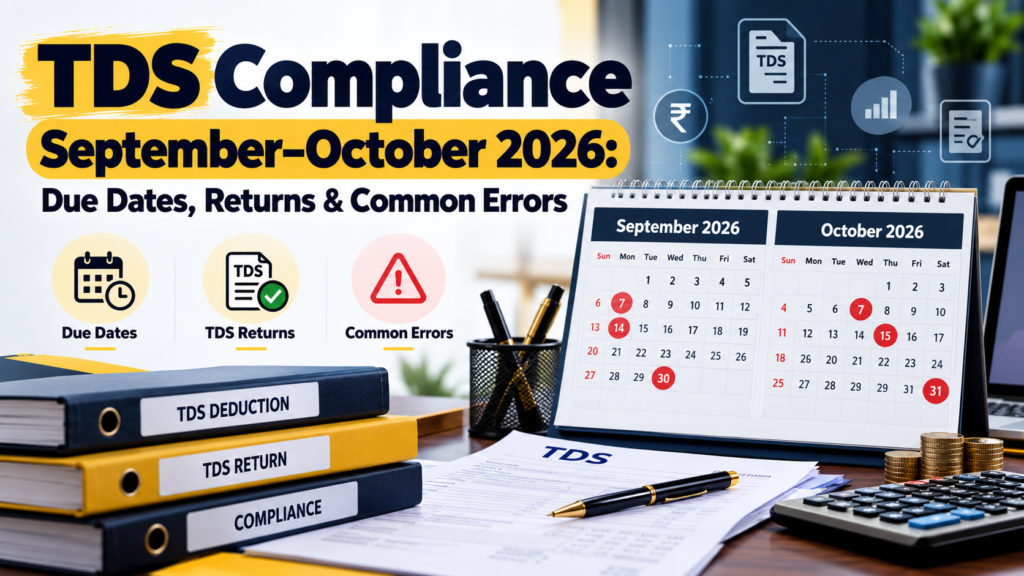
TL;DR September and October 2026 are important months for TDS compliance because deductors need to deposit TDS within the prescribed timelines and prepare for the quarterly TDS statement for July–September 2026. For regular monthly TDS, tax deducted during August is generally deposited by 7 September, while TDS deducted during September is generally payable by 7 October. The Q2 TDS statements covering July–September 2026 are due by 31 October 2026. Under the Income Tax Act, 2025, new forms such as Form 138 for salary TDS and Form 140 for resident non-salary TDS apply for Tax Year 2026–27. Introduction TDS compliance is an important part of the monthly and quarterly tax obligations of businesses, employers, professionals and other deductors. September and October 2026 are particularly important because businesses need to manage regular monthly TDS payments while also preparing the July–September 2026 quarterly TDS statement. The compliance process has also changed in 2026 because the Income Tax Act, 2025 applies to transactions governed by the new tax-year framework from 1 April 2026. The Income Tax Department has introduced revised forms and section numbering for Tax Year 2026–27. For businesses, this means TDS compliance should not be limited to simply depositing tax on time. Deductors should also verify PAN details, deduction sections, amounts, challans, deductee information and quarterly reporting before filing the statement. A small mistake in TDS data can result in interest, late filing consequences, incorrect Form 16A or Form 16 information, mismatches in the deductee’s tax records and unnecessary compliance notices. TDS Due Dates for September and October 2026 Understanding the monthly and quarterly deadlines is the first step toward maintaining proper TDS compliance. TDS Payment Due Date in September 2026 TDS deducted during August 2026 is generally required to be deposited with the government by 7 September 2026. The general rule continues to require monthly TDS deposits by the 7th of the following month, subject to specific exceptions. The Income Tax Department has confirmed that the Income Tax Rules, 2026 retain the same general payment timeline under the new framework. TDS Payment Due Date in October 2026 TDS deducted during September 2026 is generally required to be deposited by 7 October 2026. Businesses should reconcile the TDS payable ledger with the actual deduction records before making the payment. Q2 TDS Return Due Date The second quarter covers: July 2026 to September 2026 The quarterly TDS statements for this period are generally due by: 31 October 2026 For Tax Year 2026–27, the Income Tax Department has introduced new quarterly forms corresponding to the earlier TDS statement framework. Form 138 covers salary TDS reporting, while Form 140 covers TDS on non-salary payments to residents. Form 144 applies to TDS on payments other than salary made to non-residents. September–October 2026 TDS Compliance Calendar Compliance Period Covered Due Date TDS payment August 2026 deductions 7 September 2026 TDS payment September 2026 deductions 7 October 2026 Q2 TDS statement July–September 2026 31 October 2026 Form 138 Salary TDS, Q2 31 October 2026 Form 140 Resident non-salary TDS, Q2 31 October 2026 Form 144 Non-resident non-salary TDS, Q2 31 October 2026 The exact compliance obligation depends on the nature of payment and the deductor. Special challan-cum-statement provisions can have different timelines. What Has Changed for TDS in 2026? The Income Tax Act, 2025 introduced a new framework for Tax Year 2026–27. This means businesses need to understand whether a transaction falls under the old Income Tax Act, 1961 or the new Income Tax Act, 2025. How to Determine the Applicable Act The Income Tax Department states that the applicable Act during the transition depends on the earlier of the event of credit or payment. If that event occurred on or before 31 March 2026, the old Income Tax Act, 1961 generally applies. If the earlier event occurred on or after 1 April 2026, the Income Tax Act, 2025 framework applies. Therefore, businesses should not simply change every TDS section in their accounting software without considering the transaction date. New TDS Forms Under the Income Tax Act, 2025 The new Act has reorganized the TDS reporting framework. Form 138 Form 138 is the new quarterly statement for salary TDS, replacing the earlier Form 24Q framework for applicable Tax Year 2026–27 reporting. The Q2 statement covering July–September 2026 is due by 31 October 2026. Form 140 Form 140 is the quarterly TDS statement for non-salary payments to residents. It covers payments such as applicable professional fees, commission, brokerage, rent and similar payments where TDS is required. The Q2 Form 140 for July–September 2026 is due by 31 October 2026. Form 144 Form 144 is applicable to TDS on payments other than salary made to non-residents under the new framework. The Q2 statement for July–September 2026 is also due by 31 October 2026. Monthly TDS Compliance: What Businesses Should Check Monthly TDS compliance should ideally be completed through a systematic process rather than waiting until the quarterly return. Businesses should verify: Payments subject to TDS Applicable TDS section Applicable rate Deductee PAN Date of credit Date of payment Amount credited or paid TDS amount TDS payable ledger Challan details Deductee classification Lower or nil deduction certificates, where applicable TDS exemptions or thresholds This process helps reduce errors before the quarterly statement is prepared. Common TDS Errors in September–October 2026 1. Using the Wrong TDS Section One of the most common mistakes is applying an incorrect section to a payment. For example, professional fees, contractor payments, commission, rent, interest and payments to non-residents may have different TDS provisions. Under the new Act, section numbering has also changed, making it particularly important to update accounting and payroll systems correctly. 2. Applying the Wrong TDS Rate A business may identify that TDS is applicable but still deduct the wrong amount because the rate was incorrectly configured. Businesses should verify the applicable rate based on: Nature of payment Residential status PAN availability Applicable threshold Certificate for lower deduction, if any Specific statutory provisions 3. Incorrect PAN Details An incorrect PAN can create a