

After Tax Audit: What Businesses Need to Check Before Filing Their ITR
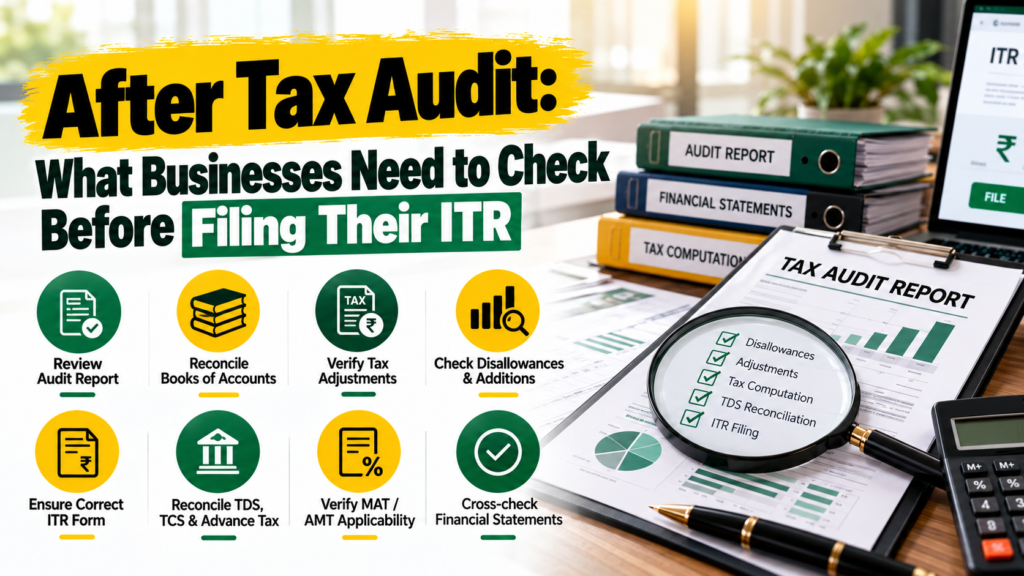
TL;DR Completing a tax audit does not mean the business’s tax compliance work is finished. Before filing the Income Tax Return, businesses should carefully verify the audited financial statements, tax-audit report, Form 3CD, depreciation, GST and TDS data, brought-forward losses, deductions, advance tax and self-assessment tax. Any discrepancy between the ITR and audited information should be resolved before filing. Introduction For businesses subject to tax audit, the completion of the audit is an important milestone—but it is not the final step. After the Chartered Accountant completes the tax audit and the applicable audit report is furnished, the business still needs to ensure that its Income Tax Return is prepared correctly. The figures reported in the ITR should be consistent with the audited financial statements and applicable information reported through the tax-audit process. A mismatch between the ITR, tax-audit report, GST returns, TDS records or other tax information can create unnecessary questions during processing or assessment. This makes the period immediately after the tax audit extremely important. For FY 2025–26 / AY 2026–27, businesses continue to follow the Income-tax Act, 1961 framework. The corresponding tax-audit provision under the Income Tax Act, 2025 applies to Tax Year 2026–27 onward. What Happens After a Tax Audit? Once the tax audit is completed, the business should not immediately file its ITR without reviewing the final numbers. The post-audit process generally involves: Reviewing the final audited financial statements Checking the tax-audit report Reviewing Form 3CD disclosures Calculating taxable income Verifying depreciation Reconciling tax credits Checking brought-forward losses Reviewing deductions and disallowances Calculating final tax liability Adjusting advance tax and TDS/TCS Reviewing the ITR before submission Verifying the filed return The exact process depends on the business structure and applicable ITR form. 1. Check the Final Audited Financial Statements The first step is to make sure the financial statements being used for the ITR are the finalised audited statements. Review: Profit and Loss Account Balance Sheet Cash-flow statement, where applicable Schedules Notes to accounts Debtors Creditors Loans Fixed assets Capital accounts Provisions Outstanding liabilities The profit or loss reported in the ITR should be based on the finalised financial information. Why this matters If financial statements are changed after the tax-audit report has been prepared, the corresponding tax implications and reporting requirements should be reviewed before filing the ITR. Businesses should avoid using an earlier draft of their accounts when preparing the final return. 2. Verify Form 3CD Details For FY 2025–26, where tax audit applies under Section 44AB of the Income-tax Act, 1961, Form 3CD contains various prescribed particulars relating to the taxpayer. The business should review the final tax-audit report and ensure that important information is correctly reflected in the ITR. Check items such as: Business nature Accounting method Turnover Taxable profit Depreciation Disallowable expenses Loans and deposits TDS/TCS compliance GST-related information Statutory liabilities Other prescribed disclosures A CA should review any significant discrepancy between the tax-audit report and the proposed ITR before filing. 3. Reconcile Turnover With GST Returns One of the most important post-audit checks is comparing business turnover with GST records. Businesses should compare their books with relevant GST information, including: GSTR-1 GSTR-3B GSTR-9, where applicable E-invoice records Credit notes Debit notes The turnover appearing in books may not always exactly match GST figures because of timing differences, exempt supplies, non-GST transactions, advances, credit notes or other accounting and GST-treatment differences. However, every material difference should be understood and properly supported. Example Suppose: Turnover as per books: ₹2.50 crore Turnover reported through GST: ₹2.45 crore The ₹5 lakh difference should not simply be ignored. The business should identify whether it relates to: Exempt supplies Credit notes Non-GST transactions Timing differences Accounting errors GST classification differences A proper reconciliation creates a clear audit trail. 4. Check TDS and TCS Credits Before filing the ITR, businesses should verify available tax credits. Compare: Books TDS certificates Form 26AS AIS TCS records Tax-payment challans If TDS appearing in the books is different from the amount reflected in Form 26AS or other tax records, the difference should be investigated. Why TDS reconciliation matters Incorrectly claiming TDS can result in a mismatch during return processing. At the same time, failing to claim legitimate TDS credit can increase the taxpayer’s final tax payable. Therefore, businesses should reconcile tax credits before filing rather than correcting them after the return has already been processed. 5. Verify Advance Tax Payments Businesses that paid advance tax during the year should verify every challan. Check: Challan number Payment date Amount Assessment year PAN Major head/minor head, where relevant The total advance tax reported in the ITR should agree with the available tax records. September advance tax matters For taxpayers following the regular advance-tax instalment system, payments are generally made during the year based on estimated tax liability. Before filing the final ITR, all advance-tax payments should be reconciled with the tax records so that the final tax calculation is accurate. 6. Recalculate Depreciation Depreciation is another area that should be reviewed carefully after the audit. Businesses should check: Fixed assets purchased during the year Date of purchase Date put to use Asset classification Applicable depreciation rate Additions Disposals Written-down value Depreciation claimed The depreciation recorded in the books and depreciation allowed for income-tax purposes can differ. Therefore, businesses should maintain a proper tax depreciation working rather than simply copying the depreciation figure from the Profit and Loss Account. 7. Check Disallowances Identified During the Audit The tax audit may identify expenses that require adjustment while calculating taxable income. These can include applicable disallowances relating to: Certain unpaid statutory liabilities TDS-related non-compliance Cash transactions Personal expenses Capital expenses Certain specified payments Other expenses restricted under the Income-tax Act The business should ensure that all relevant adjustments identified during the audit are correctly incorporated into the tax computation. 8. Verify Outstanding Statutory Liabilities Businesses should review statutory dues appearing in the Balance Sheet. These may include: GST TDS PF/ESI, where applicable Professional tax Other statutory liabilities The tax treatment of unpaid statutory liabilities depends