

GST Registration in 2026: New Bank Account Verification Rules & Common Rejection Reasons
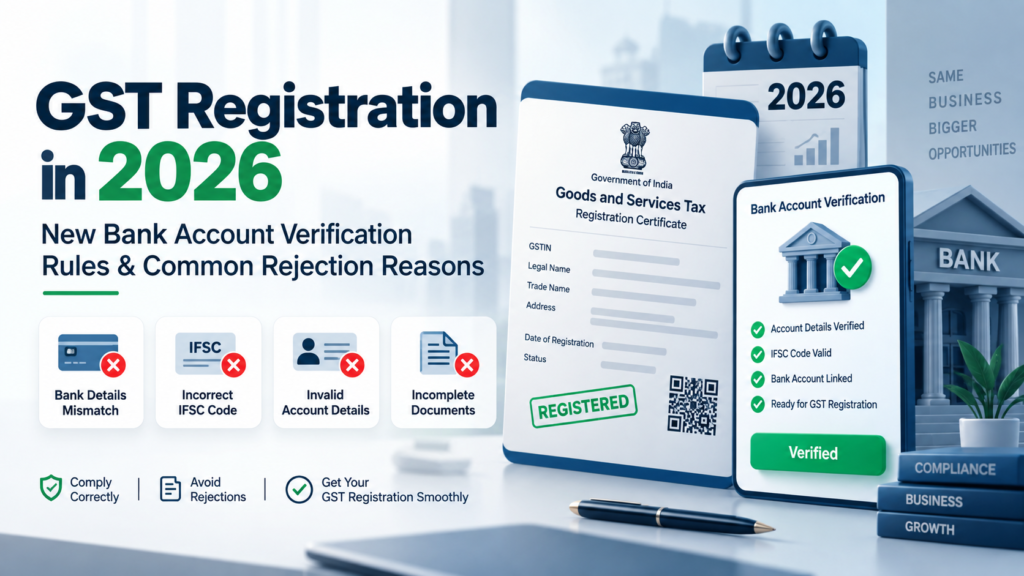
TL;DR GST registration in 2026 involves more than simply submitting PAN, Aadhaar and business documents. The GST system has strengthened verification and compliance checks, particularly around bank account details, Aadhaar authentication, business premises and supporting documents. Under Rule 10A of the CGST Rules, registered taxpayers generally have to furnish valid bank account details within 30 days of registration or before furnishing GSTR-1/IFF, whichever is earlier. GSTN has also operationalised an automated suspension mechanism where required bank details are not furnished within the prescribed period. Applicants can also face queries, clarification notices or rejection when business addresses, ownership/rent documents, PAN details, authorised signatory information or Aadhaar authentication do not match the information submitted. Introduction GST registration is an important compliance step for businesses, freelancers, professionals, traders and service providers crossing the applicable registration threshold or becoming liable under other provisions of GST law. However, obtaining a GSTIN in 2026 requires greater attention to document consistency and verification. The GST Portal uses several checks involving PAN, Aadhaar, business constitution, principal place of business, authorised signatories and bank-account information. One important point often misunderstood is that bank account details are generally furnished after GST registration rather than being a mandatory field for obtaining the GSTIN itself. The GST Portal’s current guidance states that the bank-account tab is optional during the initial registration process and that bank details are added through a non-core amendment after registration. At the same time, failing to provide the required bank information after registration can have serious consequences. So, what exactly has changed, what does bank verification mean in practice, and why are GST registration applications rejected or delayed? GST Registration in 2026: What Applicants Need to Know The GST registration process starts with submission of FORM GST REG-01 on the GST Portal. Depending on the applicant and risk parameters, the process can involve: PAN verification Aadhaar authentication OTP-based verification Biometric authentication Verification of business premises Document scrutiny by the tax officer Clarification through REG-03 Bank-account verification after registration Aadhaar authentication has become an important part of the registration ecosystem. The GST Portal explains that applicants opting for Aadhaar authentication may receive either an OTP-based authentication link or a requirement for biometric verification at a designated GST Suvidha Kendra, depending on applicable risk parameters. New Bank Account Verification Rules in 2026 Is a Bank Account Mandatory for GST Registration? This is one of the most important distinctions. Bank-account details are not generally required to be entered in the initial GST registration application. The GST Portal currently states that the Bank Accounts tab is optional and that taxpayers can furnish the information after GSTIN is granted through a non-core amendment. This does not mean that businesses can permanently operate without providing bank details. Once GST registration has been granted, Rule 10A becomes relevant. What Does Rule 10A Require? Under Rule 10A, a registered person, subject to the applicable exceptions, must furnish bank-account information on the common portal within: 30 days from the date of grant of registration OR before furnishing GSTR-1/IFF, whichever is earlier. Therefore, a newly registered business should not wait until the end of the 30-day period if it is likely to file GSTR-1 or IFF earlier. What Happens If Bank Details Are Not Furnished? GSTN has operationalised an automated mechanism for non-compliance with the bank-account requirement. If the required bank details are not furnished within the prescribed period, the GST registration can be suspended, with the relevant intimation/order available through the GST Portal. The GST Portal also states that failure to furnish bank details can result in the taxpayer being prevented from filing further GSTR-1/IFF. If the details remain unprovided even after suspension, the registration may subsequently be taken up for cancellation proceedings. How Can a Suspended GSTIN Be Restored? The taxpayer should furnish valid bank-account details through the appropriate non-core amendment on the GST Portal. The GST Portal states that once the bank details are updated, suspension arising from this issue can be automatically revoked. If the proceedings do not drop automatically, the taxpayer can use the applicable option to initiate dropping of proceedings. What Documents Can Be Used for Bank Account Verification? The GST Portal’s bank-account guidance allows supporting documentation such as: Monthly bank statement First page of the passbook The portal also allows taxpayers to add multiple bank accounts, with the current guidance permitting up to 10 bank accounts. The most important thing is that the bank information submitted should correspond with the actual account details. Businesses should carefully verify: Account number IFSC Bank name Account-holder details Supporting document Business/entity information Does the Bank Account Have to Be in the Business Name? Not necessarily in every situation. The GST Portal specifically states that where a business bank account has not yet been opened, an applicant can add a personal bank account and update it later when the business account is opened. However, businesses should avoid treating this as a reason to provide arbitrary or unrelated bank information. The account should be genuinely connected with the registered taxpayer and the supporting documentation should be accurate. Common GST Registration Rejection Reasons in 2026 A GST application can be delayed, queried or rejected because of inconsistencies in the application or supporting documents. 1. PAN Details Do Not Match PAN is one of the fundamental identifiers used during GST registration. Common problems include: Incorrect PAN number Name mismatch Incorrect constitution of business PAN belonging to another person/entity Proprietor/company details entered incorrectly Even a small discrepancy can result in validation problems. 2. Aadhaar Authentication Failure Aadhaar authentication is another major verification stage. Problems may arise because of: Incorrect Aadhaar details OTP not received Mobile/email issues linked to Aadhaar Authentication not completed within the permitted period Biometric verification failure Incorrect promoter/partner information The GST Portal states that Aadhaar verification generally needs to be completed within 15 days of submission of Part B of REG-01. If Aadhaar authentication is unsuccessful, the application may be subjected to further verification rather than receiving automatic approval. The current GST Portal guidance says such