

GST Input Tax Credit Rules 2026: Eligibility, Conditions & Common ITC Mistakes
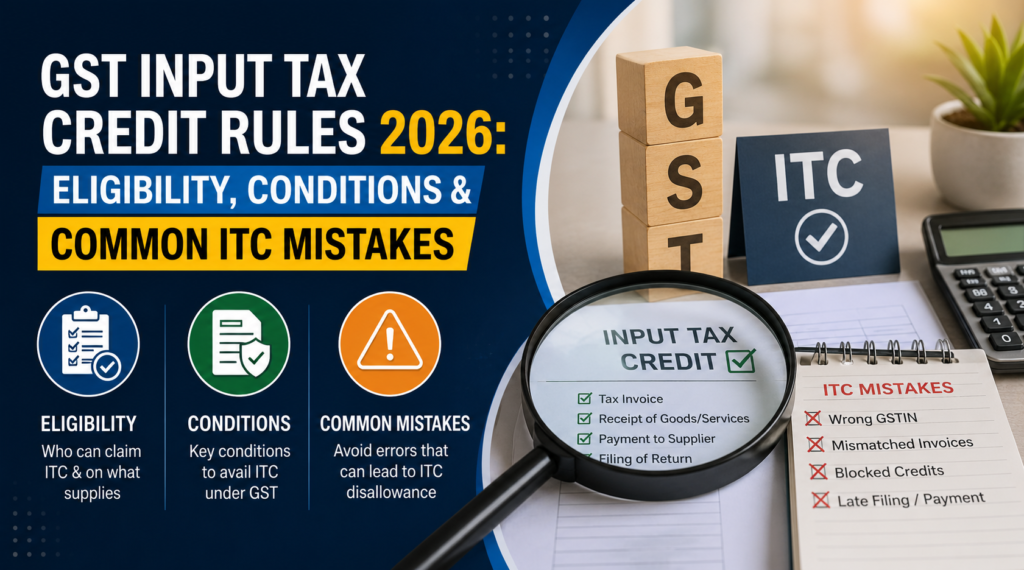
TL;DR Input Tax Credit (ITC) is one of the most important features of GST because it allows eligible registered taxpayers to reduce their output GST liability using qualifying GST paid on business purchases. However, GST paid on an invoice does not automatically mean that the entire amount is eligible for ITC. Businesses must satisfy the applicable conditions under GST law, maintain appropriate documents, confirm receipt of goods or services, reconcile purchase data, identify blocked credits and account for applicable reversals. For 2026, businesses should pay particular attention to: Section 16 ITC eligibility conditions Valid invoices and prescribed documents GSTR-2B reconciliation Supplier compliance ITC time limits Blocked credits under Section 17(5) ITC reversal requirements Correct GSTR-3B reporting Duplicate and unsupported ITC claims The objective should not be to claim the maximum possible ITC, but to claim the maximum eligible ITC supported by proper records. What Is Input Tax Credit Under GST? Input Tax Credit allows an eligible registered person to claim credit for GST paid on qualifying purchases used in the course or furtherance of business. For example, assume a business purchases raw materials worth: ₹5,00,000 + ₹90,000 GST During the same period, it has output GST liability of: ₹1,50,000 If the entire ₹90,000 qualifies as ITC and all applicable conditions are satisfied, the business may use that credit against its output tax liability. Simplified calculation Output GST: ₹1,50,000 Eligible ITC: ₹90,000 Balance GST liability: ₹60,000 This mechanism helps prevent cascading taxation. But the ₹90,000 cannot simply be claimed because GST appears on the purchase invoice. The taxpayer must first establish that the credit is legally eligible. Why GST ITC Compliance Matters in 2026 ITC directly affects a business’s working capital and cash flow. When eligible credit is properly claimed, a business can avoid paying more GST from its own funds than necessary. On the other hand, incorrect ITC claims can create: Additional GST liability Interest exposure ITC reversals Penalties where applicable GST notices Reconciliation problems Cash-flow pressure Example Suppose a company claims: ₹10 lakh ITC After reconciliation, ₹2 lakh is identified as ineligible. That means the business may have to reverse the ₹2 lakh incorrectly claimed, along with any applicable interest or other consequences. For this reason, ITC should be treated as a monthly financial-control process, not something to be checked only at year-end. Who Can Claim Input Tax Credit? Generally, a registered person satisfying the statutory requirements can claim eligible ITC. This can include: Manufacturers Traders Wholesalers Retailers Service providers Consultants Restaurants E-commerce businesses Exporters Startups MSMEs However, GST registration alone does not make every business expense eligible. The relevant question is: Does this particular purchase satisfy the conditions for ITC under GST? A business should therefore assess each category of expense rather than applying a blanket assumption that all GST paid is creditable. Conditions for Claiming ITC Under Section 16 Section 16 of the CGST Act contains important conditions governing ITC. Businesses should evaluate the following before taking credit. 1. The Taxpayer Must Be Eligible to Claim ITC The taxpayer must be a registered person and the transaction must fall within the applicable GST framework. The nature of the supply, registration status and use of the goods or services should be considered before claiming credit. 2. A Valid Tax Document Should Be Available ITC generally needs to be supported by an appropriate prescribed document. Depending on the transaction, this may include: Tax invoice Debit note Bill of entry Other prescribed documents The document should contain the relevant particulars and correspond to a genuine transaction. Maintain a proper audit trail For important purchases, businesses should preserve: Invoice Purchase order Delivery documentation Payment records Goods receipt records Contract or agreement Relevant correspondence Good documentation can become extremely important if a transaction is later questioned. 3. Goods or Services Must Be Received A taxpayer should not claim ITC merely because an invoice has been generated. The goods or services should actually be received in accordance with the applicable provisions. For goods, evidence may include: Delivery challans E-way bills Goods receipt notes Warehouse records Stock records For services, businesses may maintain: Agreements Work orders Service reports Completion certificates Email correspondence Payment records The stronger the documentation, the easier it becomes to establish the commercial substance of the transaction. 4. Supplier Compliance Must Be Monitored GST compliance increasingly requires businesses to look beyond their own accounting systems. Purchase-related information should be reconciled with GST records. This is where GSTR-2B becomes an important compliance tool. Businesses should compare: Purchase Register ↔ GSTR-2B ↔ Books of Accounts ↔ GSTR-3B Differences should be investigated instead of being ignored. 5. Payment-Related Conditions Need Attention GST law contains specific conditions relating to payment to suppliers and corresponding ITC treatment. Businesses should therefore monitor unpaid vendor invoices instead of assuming that ITC remains permanently available regardless of the payment status. A proper vendor ageing report can help identify transactions requiring review. 6. ITC Must Be Appropriately Reported Eligible ITC should be correctly reflected in the relevant GST return. A mismatch between: Books Purchase register GSTR-2B ITC working GSTR-3B can create unnecessary compliance risk. Businesses should maintain a clear reconciliation file supporting the figures reported in their returns. GST Input Tax Credit Time Limit The law prescribes a time limit for claiming ITC relating to invoices and debit notes, subject to applicable provisions. This means businesses should not treat old purchase invoices as permanently claimable. A practical ITC ageing system can help. Invoice Status Recommended Action Current invoice Verify and reconcile Recent unmatched invoice Follow up with supplier Older unmatched invoice Investigate immediately Near statutory deadline Prioritise Potentially time-barred Obtain professional review Businesses handling hundreds or thousands of invoices should automate or systematise this process wherever possible. GSTR-2B and ITC Reconciliation One of the most important GST compliance exercises is reconciling the business’s purchase records with GSTR-2B. A typical monthly reconciliation should identify: Matched invoices Missing invoices Duplicate invoices GSTIN mismatches Tax-value differences Supplier filing delays Credit notes Debit notes Amendments Potentially ineligible ITC Basic reconciliation structure Category Action