

Income Tax Return Filing 2026: Step-by-Step Guide for Salaried Employees, Freelancers & Business Owners
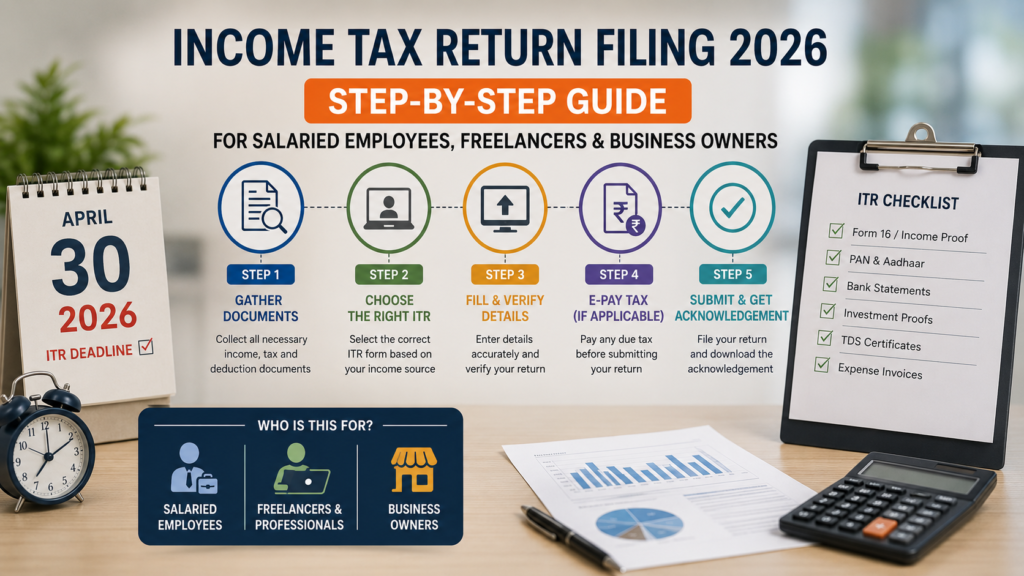
TL;DR Income Tax Return (ITR) filing is an essential annual compliance requirement for eligible taxpayers in India. Whether you’re a salaried employee, freelancer, professional, startup founder, or business owner, filing your return accurately and on time helps avoid penalties, claim refunds, maintain financial credibility, and ensure compliance with tax laws. This guide walks you through the complete ITR filing process for 2026. Understanding Income Tax Return Filing Every financial year, eligible taxpayers are required to report their income, deductions, taxes paid, and other financial details to the Income Tax Department by filing an Income Tax Return (ITR). An ITR is more than just a tax compliance document—it serves as proof of income and financial responsibility. It is often required when applying for loans, visas, government tenders, credit facilities, and various financial transactions. With increasing digital integration through the Income Tax e-Filing Portal, AIS, Form 26AS, and pre-filled returns, accurate filing has become easier—but also demands careful verification of financial information. Who Should File an Income Tax Return? Filing an Income Tax Return may be mandatory or beneficial depending on your income, business activities, and financial transactions. The following categories generally need to file ITR: Salaried Employees Individuals earning salary income above the applicable exemption limits or meeting prescribed filing conditions should file an Income Tax Return. Freelancers & Consultants Professionals providing services independently are required to report their business or professional income and comply with tax provisions applicable to them. Business Owners Proprietorships, partnership firms, LLPs, and companies must comply with applicable income tax filing requirements based on their business structure and legal obligations. Self-Employed Professionals Doctors, architects, lawyers, chartered accountants, designers, and other professionals should report their professional income through the appropriate ITR forms. Investors Individuals earning income from capital gains, dividends, interest, rental income, or foreign assets may also need to file returns depending on applicable provisions. Why Filing Your ITR Is Important Many taxpayers believe ITR filing is necessary only when tax is payable. In reality, timely filing offers several important benefits. Legal Compliance Filing your return helps you comply with the provisions of the Income-tax Act and reduces the likelihood of penalties or notices. Easier Loan Approvals Banks and financial institutions often ask for ITR acknowledgements while processing home loans, personal loans, education loans, or business finance. Faster Refund Processing If excess tax has been deducted through TDS or advance tax, filing your return is essential to claim the refund. Proof of Income ITRs serve as an accepted proof of income for visa applications, government tenders, and financial transactions. Carry Forward of Eligible Losses Timely filing may allow eligible business or capital losses to be carried forward in accordance with tax provisions. Improved Financial Credibility Regular tax compliance demonstrates financial discipline and enhances credibility with lenders, investors, and business partners. Documents Required for Income Tax Return Filing Keeping all documents ready before filing helps avoid delays and errors. Commonly required documents include: PAN Card Aadhaar Card Form 16 (for salaried employees) Form 26AS Annual Information Statement (AIS) Taxpayer Information Summary (TIS) Salary slips Bank statements Interest certificates Investment proofs Home loan certificate Capital gains statements Rental income records Business financial statements GST records (where applicable) TDS certificates Previous year’s ITR Choosing the Correct ITR Form Selecting the right ITR form is one of the most important steps in the filing process. The applicable form depends on factors such as: Nature of income Employment status Business or professional income Capital gains Foreign assets Agricultural income Presumptive taxation eligibility Using an incorrect ITR form may result in defective return notices or processing delays. Step-by-Step Income Tax Return Filing Process Step 1: Collect Financial Documents Gather all income, investment, and tax-related documents before starting the filing process. Step 2: Verify Form 26AS, AIS & TIS Cross-check the tax deducted, financial transactions, and reported income to ensure consistency with your records. Step 3: Calculate Total Income Include income from all applicable sources, such as salary, business or profession, house property, capital gains, and other sources. Step 4: Claim Eligible Deductions Review deductions available under the applicable tax regime and ensure all eligible claims are supported by proper documentation. Step 5: Select the Correct ITR Form Choose the appropriate return form based on your income profile and filing requirements. Step 6: Complete the Return Enter accurate personal details, income information, deductions, taxes paid, and bank account details. Step 7: Verify Tax Liability Check whether any additional tax is payable or whether a refund is due before submitting the return. Step 8: Submit and E-Verify the Return Complete the filing process by electronically verifying your return through the approved verification methods. Common Mistakes During ITR Filing Even small errors can delay processing or trigger notices. Avoid mistakes such as: Selecting the wrong ITR form. Ignoring AIS or Form 26AS mismatches. Omitting income from bank interest or capital gains. Claiming unsupported deductions. Providing incorrect bank account details. Failing to e-verify the return after submission. Waiting until the last date to file. Accurate preparation and careful review help ensure smooth processing. Why Hire a Chartered Accountant for Income Tax Return Filing? Although the Income Tax e-Filing Portal has made online filing more convenient, preparing an accurate Income Tax Return requires much more than simply filling out an online form. Every taxpayer’s financial situation is unique, and even small mistakes can lead to delayed refunds, notices from the Income Tax Department, or additional tax liabilities. A qualified Chartered Accountant helps ensure that your return is accurate, compliant, and optimized within the framework of applicable tax laws. A Chartered Accountant Can Help You: Select the correct ITR form. Verify Form 26AS, AIS, and TIS. Calculate taxable income accurately. Identify eligible deductions and exemptions. Report capital gains correctly. Handle business and professional income. Prepare depreciation schedules. Calculate advance tax liabilities. File revised or updated returns when necessary. Respond to Income Tax notices. Provide tax planning strategies for future financial years. Professional guidance is particularly valuable for freelancers, consultants, startups, companies, and individuals with multiple income