

How to Respond to an Income Tax Notice Without Facing Penalties
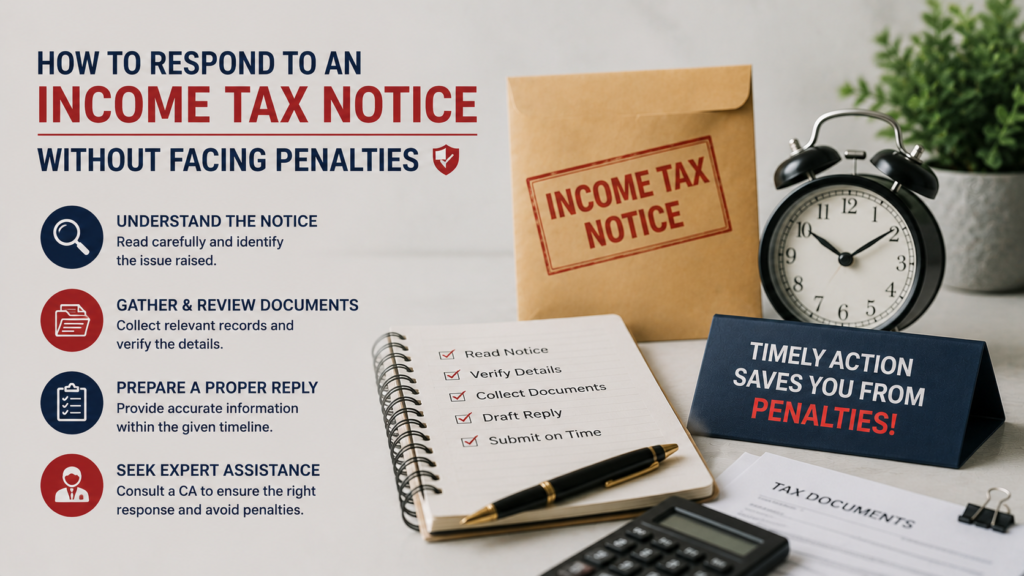
TL;DR Receiving an Income Tax Notice does not necessarily mean you’ve committed tax fraud. Many notices are issued for routine verification, mismatched information, missing documents, or clarification requests. The key is responding accurately and within the prescribed deadline. Working with an experienced Chartered Accountant can significantly reduce the risk of penalties and ensure smooth compliance. Receiving an Income Tax Notice Isn’t the End—But Ignoring It Can Be Few things create panic for taxpayers like opening an email from the Income Tax Department. Whether you’re a salaried employee, freelancer, startup founder, or business owner, receiving an Income Tax Notice can be stressful. However, it’s important to understand that most notices are not punishments—they’re requests for clarification or verification. The Income Tax Department increasingly relies on technology, AI-based data matching, and analytics to identify discrepancies between your Income Tax Return (ITR), GST filings, TDS records, Annual Information Statement (AIS), and financial transactions. If any mismatch is detected, a notice may be issued. Responding correctly—and on time—is the difference between resolving the issue smoothly and facing unnecessary penalties. Why Does the Income Tax Department Send Notices? Common reasons include: Income mismatch High-value transactions Incorrect deductions claimed Missing income disclosure TDS mismatch AIS mismatch Bank transaction discrepancies Capital gains not reported Late filing Defective ITR Tax audit selection Random scrutiny assessments Receiving a notice doesn’t automatically mean you’ve done something wrong. Common Types of Income Tax Notices Notice Type Purpose Defective Return Errors in ITR filing Scrutiny Notice Detailed examination of return Demand Notice Additional tax payable Reassessment Notice Previously undisclosed income Information Request Clarification regarding transactions Notice for Non-Filing Return not filed despite eligibility Each notice has different timelines and documentation requirements. Step 1: Stay Calm and Read the Notice Carefully Avoid reacting emotionally. Instead: Read every page. Check the section under which the notice is issued. Verify the Assessment Year. Note the response deadline. Understand exactly what information is requested. Many taxpayers respond incorrectly simply because they misunderstand the purpose of the notice. Step 2: Verify the Authenticity Before responding: Log into the Income Tax e-Filing Portal. Check whether the notice appears under your account. Match the Document Identification Number (DIN). Confirm the issuing officer’s details. Never respond to suspicious emails without verification. Step 3: Identify the Reason for the Notice The reason determines your response. Examples include: Income mismatch Perhaps your employer reported different salary figures. TDS mismatch Tax deducted may not reflect correctly. AIS mismatch Banks, mutual funds, brokers, or employers may have reported transactions differently. High-value transactions Examples: Property purchase Luxury vehicle purchase Large cash deposits Foreign travel Credit card spending The department simply seeks clarification. Step 4: Gather Supporting Documents Prepare all relevant records before submitting your response. These may include: PAN Aadhaar Income Tax Returns Form 16 Form 26AS Annual Information Statement (AIS) Bank Statements Investment Proofs Capital Gain Statements GST Returns Purchase Invoices Sale Bills Audit Reports Loan Documents Business Books of Accounts Organized documentation leads to faster resolution. Step 5: Draft a Clear and Accurate Response Your response should: Answer every query. Attach supporting documents. Be factual. Avoid assumptions. Avoid emotional explanations. Reference supporting evidence. A professional, structured reply significantly improves credibility. Step 6: Submit Before the Deadline Late responses often lead to: Penalties Interest Best judgment assessment Additional notices Prosecution in severe cases Always submit well before the due date to avoid technical issues. Step 7: Track the Status After submission: Save the acknowledgement. Monitor the Income Tax Portal. Respond quickly if additional clarification is requested. Tax proceedings may involve multiple rounds of communication. Common Mistakes That Can Lead to Penalties Many penalties arise not because of tax evasion, but because of avoidable errors such as: Ignoring the notice. Missing response deadlines. Uploading incomplete documents. Providing inaccurate information. Contradicting previously filed returns. Failing to reconcile AIS or Form 26AS data. Responding without professional review. A careful, evidence-based reply can prevent unnecessary complications and improve the chances of a quick resolution. Step 8: Seek Professional Assistance When Required While some basic notices can be handled independently, complex notices involving scrutiny, reassessment, high-value transactions, or tax demands require expert guidance. A qualified Chartered Accountant can: Interpret the legal provisions mentioned in the notice. Review your Income Tax Return for inconsistencies. Reconcile data with Form 26AS, AIS, and TIS. Prepare a legally sound response. Represent you before the Income Tax Department when required. Help minimize additional tax liabilities, interest, or penalties. Professional assistance not only saves time but also reduces the risk of making errors that could escalate the matter. Can a Chartered Accountant Respond to an Income Tax Notice on Your Behalf? Yes. A Chartered Accountant can represent taxpayers in many tax-related matters, depending on the nature of the notice and the applicable provisions under the Income-tax Act. A CA can assist with: Drafting detailed responses. Preparing supporting documentation. Reconciling tax records. Filing revised or updated returns, where applicable. Representing the taxpayer during assessments. Communicating with the Income Tax Department. For businesses and professionals with complex financial transactions, having expert representation often leads to a smoother resolution. How to Avoid Penalties After Receiving an Income Tax Notice The best way to avoid penalties is to respond proactively and accurately. Follow these best practices: ✔ Reply Before the Deadline Never wait until the last day. Early responses leave time to address any technical issues or additional requests. ✔ Submit Complete Information Incomplete responses often result in follow-up notices and prolonged assessments. ✔ Match All Financial Records Ensure consistency between: Income Tax Return (ITR) Form 26AS Annual Information Statement (AIS) Taxpayer Information Summary (TIS) GST Returns (if applicable) Bank statements Books of accounts ✔ Keep Supporting Documents Ready Maintain organized records for at least the prescribed retention period to respond quickly if questioned. ✔ Be Honest and Transparent If an error was made, acknowledge it and provide the correct information. Intentional concealment can attract more severe consequences than an honest mistake. ✔ Consult a Chartered Accountant Professional review helps identify risks before submitting your reply and ensures