
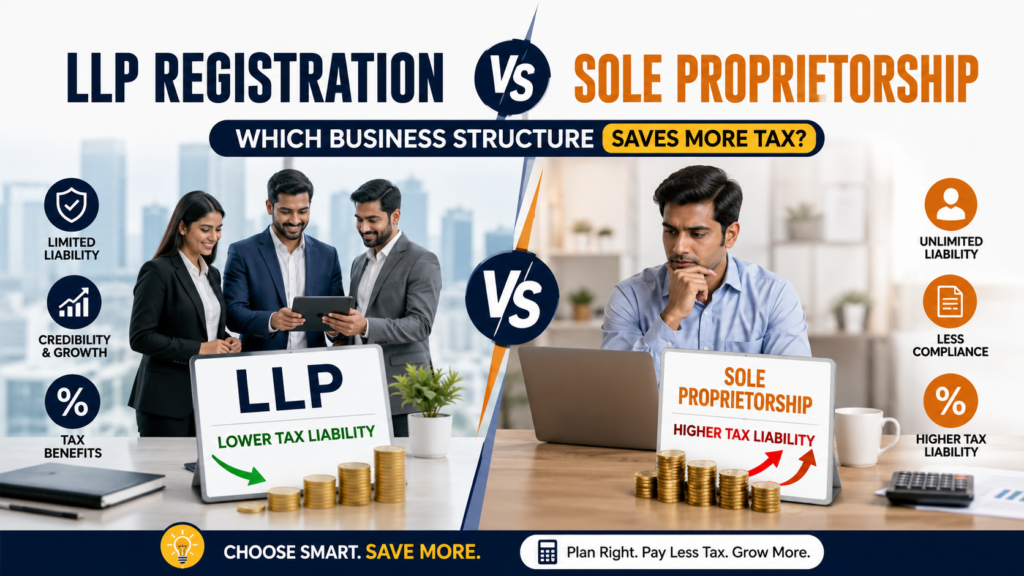
LLP Registration vs Sole Proprietorship: Which Business Structure Saves More Tax?
TL;DR If you’re starting a business in India, choosing between an LLP and a Sole Proprietorship can significantly impact your taxes, legal liability, compliance burden, and future growth. While a Sole Proprietorship offers simplicity and lower compliance, an LLP provides limited liability, greater credibility, and better scalability. The right choice depends on your business goals, expected profits, and expansion plans. Why Choosing the Right Business Structure Matters One of the biggest mistakes new entrepreneurs make is selecting a business structure based solely on registration cost or convenience. However, the legal structure of your business affects nearly every aspect of operations—from taxation and compliance to fundraising and risk management. A business that starts as a small proprietorship may later require conversion into an LLP or company due to growth, increasing compliance requirements, or investor expectations. Making the right decision early can save both money and administrative effort. Before registering your business, evaluate factors such as annual turnover, projected profits, number of owners, funding requirements, liability exposure, and long-term business plans. Understanding Sole Proprietorship A Sole Proprietorship is the simplest and most common business structure in India. It is owned and managed by a single individual, and there is no legal distinction between the owner and the business. Key Features Single owner Easy to start Minimal legal formalities Low compliance burden Complete control over business decisions Advantages Low setup cost Simple tax filing Quick business commencement Full control over profits Minimal regulatory requirements Disadvantages Unlimited personal liability Difficult to raise investment Limited business credibility Business ends with the owner Personal assets remain exposed to business risks Understanding LLP Registration A Limited Liability Partnership (LLP) combines the operational flexibility of a partnership with the legal protection of a corporate entity. Unlike a Sole Proprietorship, an LLP is a separate legal entity, meaning the partners’ personal assets are generally protected from business liabilities. Key Features Separate legal identity Minimum two designated partners Limited liability protection Perpetual succession Recognized under the LLP Act Advantages Better business credibility Easier access to funding Legal protection for partners Structured ownership Suitable for growing businesses Disadvantages Annual compliance requirements Mandatory statutory filings Slightly higher registration costs Requires at least two partners LLP Registration vs Sole Proprietorship: Complete Comparison Feature Sole Proprietorship LLP Legal Status Owner and business are the same Separate legal entity Owners One Minimum two partners Liability Unlimited Limited Registration Relatively simple Mandatory LLP registration Taxation Individual tax slab LLP taxation provisions Compliance Low Moderate Fundraising Difficult Easier Business Continuity Depends on owner Perpetual succession Brand Credibility Moderate High Expansion Limited Excellent Tax Comparison Between LLP and Sole Proprietorship Taxation is one of the most important considerations when choosing a business structure. Sole Proprietorship Business income is treated as the owner’s personal income and taxed according to the applicable individual income tax slab. As profits increase, the effective tax burden may also increase depending on the owner’s total taxable income. Suitable for: Freelancers Small traders Local businesses Consultants with modest profits LLP An LLP is taxed under the Income Tax Act as a separate entity. It offers opportunities for structured financial planning and may be more suitable for businesses with consistent profits, multiple partners, or expansion plans. Suitable for: Professional firms Agencies Manufacturers Service companies Growing startups Compliance Comparison Compliance obligations are another important factor when deciding between an LLP and a Sole Proprietorship. While many entrepreneurs focus on tax savings, ongoing regulatory responsibilities can significantly affect operating costs and administrative workload. Compliance Area Sole Proprietorship LLP Income Tax Return Mandatory Mandatory GST Returns (if applicable) Mandatory Mandatory Annual MCA Filing Not Applicable Mandatory Statutory Records Minimal Mandatory Audit Requirement Based on applicable tax/GST provisions Based on applicable legal provisions Separate PAN Uses proprietor’s PAN Separate PAN for LLP Bank Account In proprietor’s name/business name Separate LLP bank account Sole Proprietorship Compliance Compliance is relatively simple and usually includes: Income Tax Return filing GST return filing (if registered) TDS compliance (if applicable) Maintaining basic books of accounts Renewal of local business registrations, where applicable This makes it suitable for businesses with straightforward operations and limited transactions. LLP Compliance An LLP requires more structured compliance, including: Annual Return filing Statement of Accounts and Solvency Income Tax Return GST compliance (where applicable) TDS compliance Maintenance of statutory books and records Partner-related documentation and resolutions Although compliance costs are higher, they improve transparency, governance, and business credibility. Registration Cost Comparison Registration expenses should not be the only deciding factor. Instead, evaluate the total long-term value offered by each business structure. Expense Sole Proprietorship LLP Registration Cost Lower Moderate Annual Compliance Cost Lower Higher Accounting Cost Lower Moderate Legal Protection Limited High Growth Potential Moderate High Many businesses initially choose a proprietorship because of lower costs but later incur additional expenses when converting to an LLP after business growth. Planning ahead can reduce unnecessary restructuring costs. Which Business Structure Is Best for Different Businesses? Choose a Sole Proprietorship if you are: A freelancer A consultant working independently A small retail shop owner Running a home-based business Testing a new business idea Operating with limited investment Choose an LLP if you are: Starting a business with one or more partners Expecting rapid business growth Providing professional services Planning to apply for larger business loans Looking for better credibility with clients Seeking long-term expansion opportunities When Should You Convert a Sole Proprietorship into an LLP? Many successful businesses begin as proprietorships and later convert into LLPs. Consider conversion when: Business turnover increases significantly You add business partners Personal liability becomes a concern Banks require a more formal business structure Clients prefer working with registered entities You plan to expand into multiple cities You want stronger legal protection for personal assets Early planning with a Chartered Accountant ensures the transition is smooth and compliant. Common Mistakes to Avoid Entrepreneurs often make costly decisions by overlooking the broader implications of business structure selection. Avoid these mistakes: Choosing solely based on registration cost Ignoring future tax implications Underestimating compliance requirements Failing to consider liability protection