GST Registration vs Composition Scheme: Which Is Better for Small Businesses in Bhopal?
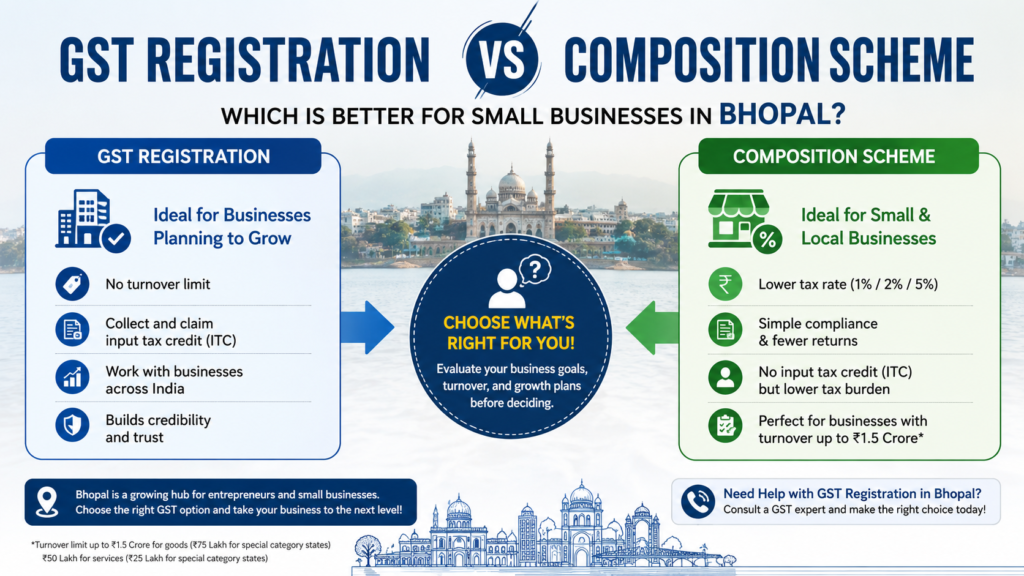
TL;DR If your business has growth ambitions, works with corporate clients, wants Input Tax Credit benefits, or operates across multiple states, Regular GST Registration is usually the better option. If your business is small, locally focused, has limited compliance capacity, and wants simplified taxation, the Composition Scheme may be suitable. The right choice depends on: ✔ Annual turnover ✔ Customer type ✔ Profit margins ✔ Growth plans ✔ Compliance capability ✔ GST Input Tax Credit requirements This guide explains both options in detail to help Bhopal business owners make an informed decision. Why This Decision Matters More Than Ever For many small businesses in Bhopal, GST compliance is no longer just a legal requirement—it directly affects profitability, cash flow, pricing strategy, and business growth. One of the most common questions business owners ask is: “Should I register under the normal GST scheme or opt for the Composition Scheme?” Choosing the wrong option can lead to: Higher tax costs Reduced competitiveness Limited growth opportunities Compliance challenges Cash flow issues On the other hand, selecting the right scheme can simplify operations and improve profitability. Let’s break down both options. Understanding Regular GST Registration Regular GST Registration is the standard GST framework under which businesses collect GST from customers and remit it to the government. Businesses registered under the regular scheme can: Charge GST on invoices Claim Input Tax Credit (ITC) Conduct interstate business Sell through e-commerce platforms Supply goods and services to corporate clients Participate in government tenders This scheme is generally designed for businesses that expect growth and need operational flexibility. Key Features of Regular GST Registration Input Tax Credit Available One of the biggest advantages is the ability to claim GST paid on purchases. For example: If a trader purchases inventory worth ₹10 lakh and pays GST on those purchases, the GST amount can be claimed as Input Tax Credit. This significantly reduces the final tax burden. Interstate Business Allowed Businesses can freely sell products and services across India. This is particularly beneficial for: Online sellers Manufacturers Service providers Export-oriented businesses Better Business Credibility Corporate clients often prefer dealing with GST-registered suppliers who can issue tax invoices and provide Input Tax Credit benefits. This can directly impact business opportunities. Understanding the GST Composition Scheme The Composition Scheme was introduced to reduce the compliance burden for small taxpayers. Instead of following regular GST procedures, eligible businesses can pay tax at a fixed lower rate based on turnover. The scheme is primarily designed for: Small traders Local retailers Small restaurants Certain service providers Key Features of Composition Scheme Simplified Compliance Businesses generally face: Reduced recordkeeping requirements Simpler return filing Less administrative burden This is attractive for small businesses with limited accounting resources. Lower Tax Rates Composition taxpayers typically pay tax at prescribed composition rates rather than normal GST rates. However, lower tax rates do not always mean lower overall tax costs. The impact depends on Input Tax Credit eligibility and business model. No Input Tax Credit This is the biggest limitation. Composition dealers: Cannot claim Input Tax Credit Cannot pass ITC benefits to customers For many businesses, this can significantly affect competitiveness. GST Registration vs Composition Scheme: Detailed Comparison Factor Regular GST Registration Composition Scheme Input Tax Credit Available Not Available Interstate Sales Allowed Restricted in many cases E-commerce Selling Allowed Limited GST Invoice Allowed Not Allowed as Tax Invoice Compliance Higher Lower Growth Flexibility High Limited Corporate Clients Preferred Less Preferred Tax Administration Detailed Simplified Who Should Choose Regular GST Registration? Regular GST registration is usually ideal for businesses that: Plan to Grow Aggressively If you expect turnover growth over the next few years, switching later may create operational disruptions. Starting with regular registration can be more practical. Sell to Businesses B2B customers prefer vendors who can provide Input Tax Credit benefits. Without ITC benefits, customers may prefer competitors. Operate Online Businesses selling through: Amazon Flipkart Meesho Other marketplaces typically require regular GST registration. Have Significant Purchase Costs When businesses purchase inventory, machinery, or raw materials regularly, Input Tax Credit becomes highly valuable. This often outweighs the compliance burden. Who Should Choose the Composition Scheme? The composition scheme may work well for: Local Retail Shops Businesses serving local consumers often find compliance simplicity attractive. Examples: Grocery stores Gift shops Local traders Small retail outlets Businesses with Minimal Input Tax Credit Requirements If purchase-related GST is relatively low, losing ITC may have limited impact. Owners Seeking Simpler Compliance For business owners who prefer a straightforward taxation framework, composition can reduce administrative workload. Real-Life Bhopal Business Examples Example 1: Local Grocery Store Annual Turnover: ₹60 lakh Customer Base: Local consumers Interstate Sales: None ITC Requirement: Low Recommended Option: Composition Scheme Reason: Compliance simplicity may outweigh ITC benefits. Example 2: Manufacturing Unit Annual Turnover: ₹1.2 crore Raw Material Purchases: High B2B Customers: Yes Recommended Option: Regular GST Registration Reason: Input Tax Credit benefits can significantly reduce tax costs. Example 3: Digital Marketing Agency Annual Turnover: ₹45 lakh Clients Across India Growing Business Recommended Option: Regular GST Registration Reason: Interstate services and future growth make regular registration more suitable. Example 4: Restaurant Business Annual Turnover: ₹75 lakh Local Customer Base Limited Expansion Plans Recommended Option: Depends on cost structure and tax planning analysis. Professional evaluation is recommended. Common Mistakes Businesses Make Choosing Based Only on Tax Rate Many business owners focus only on lower composition rates and ignore ITC losses. Ignoring Growth Plans A scheme suitable today may become restrictive within a year. Not Evaluating Customer Type B2B and B2C businesses often require different GST strategies. Poor Record Keeping Regardless of the chosen scheme, proper documentation remains essential. How to Switch Between Schemes Businesses may switch between schemes if eligibility conditions are met. Before switching: Review turnover projections Analyze customer profile Estimate ITC benefits Evaluate compliance costs Consult a GST professional A structured analysis prevents costly mistakes. Expert Recommendation from Chartered Accountants In our experience advising businesses across Bhopal, most growth-oriented businesses benefit more from Regular GST Registration. While the Composition Scheme provides simplicity,