Startup Compliance Checklist for New Businesses in Bhopal: A CA’s Complete Guide
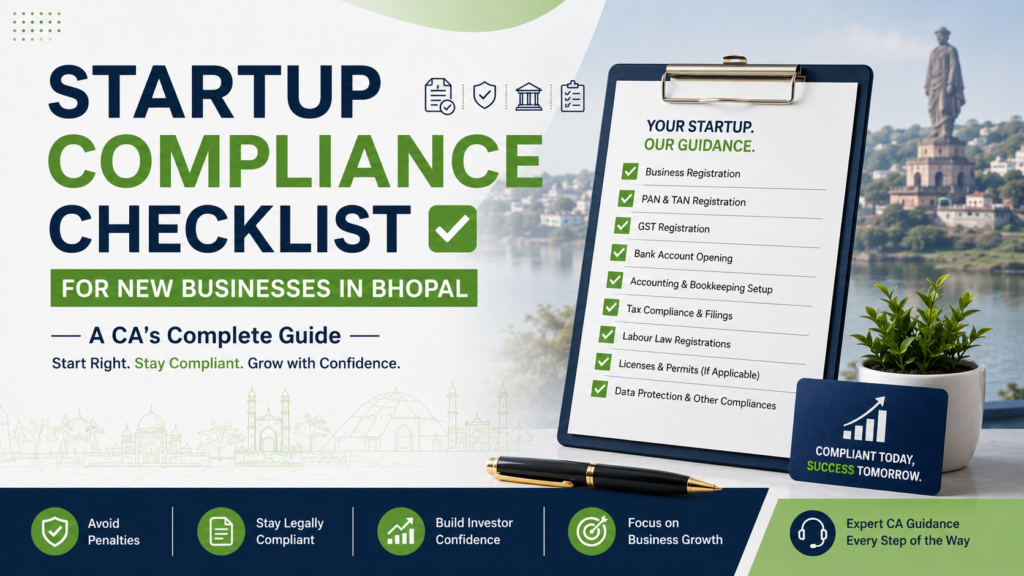
TL;DR Starting a business involves much more than registering a company and opening a bank account. Every startup must comply with multiple legal, tax, accounting, and regulatory requirements to avoid penalties and build a sustainable business. Essential Startup Compliance Checklist ✔ Business Registration ✔ PAN & TAN Registration ✔ GST Registration (if applicable) ✔ MSME/Udyam Registration ✔ Professional Accounting System ✔ Bookkeeping & Record Maintenance ✔ Income Tax Compliance ✔ TDS Compliance ✔ Labour Law Compliance ✔ Annual Filings & Regulatory Reporting Businesses that establish compliance systems from day one are better positioned for growth, funding, and long-term success. Why Startup Compliance Matters Many entrepreneurs focus entirely on product development, customer acquisition, and revenue generation during the initial stages of business. While these activities are important, ignoring compliance can become one of the costliest mistakes a startup makes. Poor compliance can lead to: Government penalties Tax notices GST disputes Loss of input tax credits Regulatory action Difficulty obtaining funding Banking and loan challenges Reputational risks On the other hand, businesses with strong compliance frameworks gain greater credibility with investors, banks, customers, and government agencies. Compliance is not merely a legal obligation—it is a business growth strategy. Startup Compliance Checklist Overview The startup compliance process can be divided into five major categories: Compliance Area Importance Business Registration Legal identity Tax Compliance Avoid penalties Accounting Compliance Financial transparency Labour Compliance Employee protection Annual Filings Regulatory compliance Let’s examine each area in detail. 1. Business Registration Requirements Choosing the right business structure is the first compliance decision every entrepreneur must make. Common business structures include: Sole Proprietorship Suitable for: Small businesses Freelancers Consultants Advantages: Easy setup Lower compliance burden Limitations: Unlimited liability Partnership Firm Suitable for: Family businesses Professional firms Joint ventures Advantages: Shared ownership Flexible management Limitations: Partner liability exposure LLP (Limited Liability Partnership) Suitable for: Professional service firms Growing startups Advantages: Limited liability Simplified compliance Private Limited Company Suitable for: Fundraising startups High-growth businesses Technology ventures Advantages: Investor-friendly structure Limited liability Greater credibility Essential Registration Documents Regardless of business structure, startups generally require: PAN Aadhaar Address proof Bank account Business address documentation Identity proof of promoters Proper documentation ensures smoother registration and future compliance. 2. PAN and TAN Registration PAN (Permanent Account Number) PAN serves as the primary tax identification number for businesses. It is required for: Opening business bank accounts Filing tax returns Financial transactions Regulatory compliance TAN (Tax Deduction and Collection Account Number) Businesses responsible for deducting tax at source must obtain TAN. TAN becomes necessary when: Salaries are paid Contractors are engaged Professional fees are paid Certain specified payments are made Failure to comply with TDS regulations can attract penalties and interest. 3. GST Registration Requirements One of the most important startup compliance requirements involves GST. GST Registration May Be Required For: Businesses crossing prescribed turnover thresholds Interstate suppliers E-commerce sellers Certain service providers Businesses voluntarily opting into GST Benefits of GST Registration Legal compliance Input Tax Credit eligibility Improved credibility Business expansion opportunities Common GST Compliance Requirements GST registration Tax invoice generation Return filing Input tax credit reconciliation Record maintenance Many startups underestimate GST compliance complexity and face avoidable issues later. 4. MSME/Udyam Registration Many entrepreneurs overlook one of the most beneficial registrations available to small businesses. Benefits of Udyam Registration Easier loan approvals Government scheme eligibility Subsidies and incentives Reduced compliance burden in certain areas Protection against delayed payments For eligible businesses, Udyam registration should be completed early. 5. Startup Accounting and Bookkeeping Compliance Accounting is one of the most neglected compliance areas among new businesses. Unfortunately, poor accounting often creates: Tax issues GST mismatches Cash flow problems Funding challenges Essential Accounting Requirements Maintain records of: Sales invoices Purchase invoices Expenses Bank transactions Payroll records GST records Asset registers Best Practice Implement accounting software from day one rather than attempting to reconstruct records later. Why Proper Bookkeeping Matters Accurate bookkeeping helps startups: Monitor profitability Manage cash flow Prepare tax returns Secure investments Support audits Improve decision-making Investors and lenders often review financial records before approving funding. Poor bookkeeping can negatively affect business valuation and credibility. 6. Income Tax Compliance Every business must understand its income tax obligations. Key requirements include: Income Tax Return Filing Businesses must file tax returns within applicable deadlines. Advance Tax Certain businesses may need to pay taxes periodically throughout the year. Tax Planning Proper tax planning helps: Reduce tax liability legally Improve cash flow Avoid year-end surprises Startups that ignore tax planning often pay more tax than necessary. 7. TDS Compliance Many startups are unaware of Tax Deducted at Source (TDS) obligations. TDS may apply when making payments such as: Salaries Contractor payments Professional fees Rent Commission Compliance generally includes: Deduction of tax Deposit of deducted tax Filing TDS returns Issuing certificates TDS defaults can result in penalties and compliance notices. 8. Labour Law Compliance Businesses employing staff must also address labour-related obligations. Depending on employee strength and business activities, requirements may include: Employment contracts Payroll records Employee benefits Statutory registrations Labour law reporting Maintaining proper HR documentation protects both employers and employees. 9. Annual Compliance Requirements Compliance does not end after registration. Businesses must continue meeting ongoing obligations. Common Annual Requirements Income tax return filing Financial statement preparation GST filings TDS filings Regulatory filings Accounting reviews Audit requirements (where applicable) Missing deadlines can result in penalties and legal complications. Common Startup Compliance Mistakes Many startups make avoidable compliance mistakes during their first few years. Mistake 1 Delaying GST registration. Mistake 2 Not maintaining accounting records. Mistake 3 Missing tax filing deadlines. Mistake 4 Mixing personal and business finances. Mistake 5 Ignoring TDS obligations. Mistake 6 Choosing the wrong business structure. Mistake 7 Trying to manage compliance without professional guidance. These mistakes often become expensive as the business grows. How a Chartered Accountant Can Help Startup founders already manage multiple responsibilities. A Chartered Accountant helps ensure compliance remains under control. Professional support typically includes: Business registration guidance GST registration and compliance Tax planning Accounting setup Bookkeeping support Financial reporting Regulatory compliance