

Monthly vs Quarterly GST Filing: Which Option Is Better for Small Businesses in 2026?
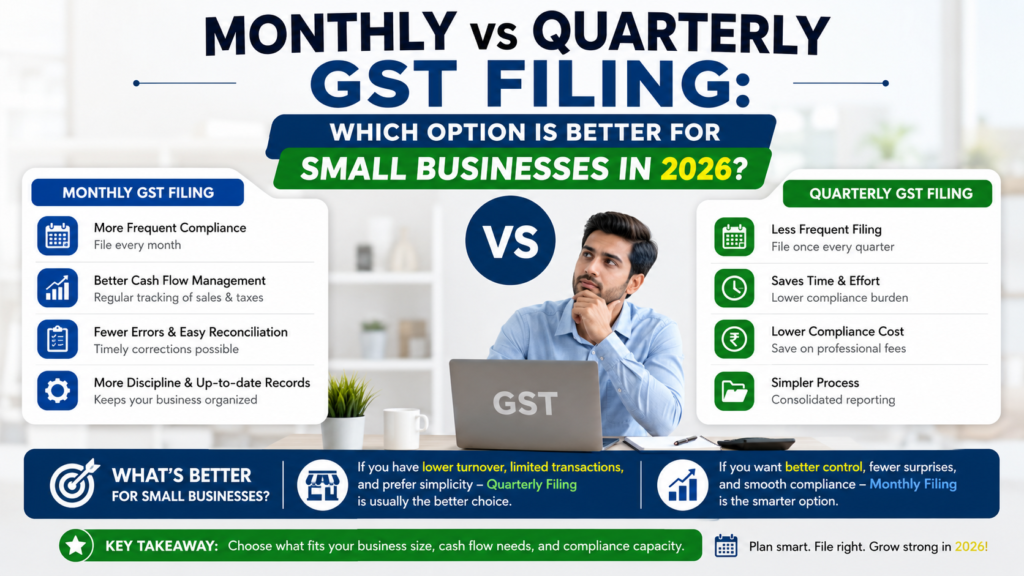
TL;DR GST filing frequency is one of the most important compliance decisions for small businesses in India. Choosing between monthly and quarterly GST filing affects bookkeeping, cash flow visibility, reconciliation, and overall financial management.GST filing frequency directly influences compliance workload, financial visibility, and operational efficiency. Small businesses often struggle to decide between monthly and quarterly GST filing due to unclear rules and operational constraints. The right choice depends on: Business size Transaction volume Cash flow stability Accounting systems Growth stage A structured approach to GST filing reduces compliance errors and improves financial planning. Understanding GST Filing Frequency in India GST return filing is a structured compliance system that requires businesses to report transactions periodically. Two commonly used filing patterns include: Monthly GST filing cycle Quarterly GST filing cycle Each structure affects: Reporting workload Cash flow visibility Tax reconciliation process Operational discipline The selection is not arbitrary; it depends on turnover patterns and compliance eligibility. How GST Filing Cycles Work in Practice GST filing is designed to ensure transparency in: Sales reporting Input tax credit claims Tax liability calculations Vendor reconciliation Businesses must align internal accounting systems with filing cycles to avoid: Mismatch errors Delayed submissions Compliance inconsistencies Monthly GST Filing Explained Monthly GST filing follows a structured reporting cycle where transactions are recorded and submitted every month. This system is generally aligned with: Higher transaction volumes Frequent sales activity Detailed reconciliation requirements Operational Characteristics Continuous bookkeeping required Frequent invoice reconciliation Monthly reporting discipline Real-time financial tracking needed Quarterly GST Filing Explained Quarterly GST filing consolidates transactions into a three-month reporting cycle. This structure is generally suited for: Lower transaction volumes Stable business operations Simplified compliance workflows Operational Characteristics Less frequent reporting Consolidated reconciliation process Reduced administrative workload Delayed financial visibility compared to monthly cycle Key Factors That Influence GST Filing Choice 1. Business Size Smaller businesses with limited transactions often manage quarterly cycles effectively, while high-volume businesses require monthly reporting accuracy. 2. Cash Flow Stability Frequent filing improves financial visibility, which helps in monitoring inflows and outflows more closely. 3. Transaction Volume Higher transaction frequency requires structured monthly reconciliation to maintain accuracy. 4. Compliance Capacity Businesses with limited accounting systems often find quarterly cycles easier to manage initially. Impact of GST Filing Frequency on Business Operations GST filing structure directly impacts: Accounting workload Invoice management systems Tax reconciliation accuracy Financial reporting cycles Decision-making speed Businesses with structured accounting systems handle frequent filings more efficiently due to real-time data availability. Common Mistakes in GST Filing Selection Several operational errors occur when businesses choose filing cycles without evaluating internal systems: Selecting filing frequency without accounting setup Ignoring transaction complexity Missing reconciliation timelines Poor invoice tracking systems Lack of compliance calendar discipline These issues often lead to reporting inconsistencies and financial mismanagement. How Filing Frequency Affects Financial Planning GST filing cycles influence how financial data is interpreted. Monthly systems allow: Faster decision cycles Real-time financial monitoring Improved forecasting accuracy Quarterly systems provide: Consolidated reporting views Reduced administrative load Delayed financial insights Both systems require strong bookkeeping discipline to maintain accuracy. Choosing the Right GST Structure for Growth Stage Business evolution often requires reassessment of filing strategy: Early stage: simplified reporting may suffice Growth stage: structured monthly systems become necessary Scaling stage: automation and integrated accounting become critical The decision should align with operational maturity rather than convenience alone. Transitioning Between Filing Frequencies Businesses often shift between filing structures as operations evolve. Key triggers include: Increase in transaction volume Expansion into new markets Hiring of finance teams Integration of accounting systems Smooth transitions require: Updated bookkeeping systems Clean financial records Consistent invoice management Final Decision Framework A structured decision approach includes evaluating: Transaction volume consistency Internal accounting readiness Cash flow tracking needs Compliance discipline capability Growth trajectory Businesses that align filing frequency with operational structure experience fewer compliance disruptions. Conclusion GST filing frequency is not merely a compliance requirement—it directly impacts financial discipline and operational efficiency. The choice between monthly and quarterly filing depends on business maturity, accounting systems, and transaction behavior. Structured financial systems ensure smoother compliance, accurate reporting, and better decision-making across all stages of business growth. 6. FAQ SECTION 1. Is monthly GST filing mandatory for all businesses? Not all businesses require monthly filing; eligibility depends on turnover and compliance category. 2. Who can file GST quarterly in India? Businesses with specific turnover thresholds and eligible schemes can opt for quarterly filing. 3. Which GST filing method is easier for small businesses? Quarterly filing may reduce administrative frequency, but suitability depends on transaction complexity. 4. Does GST filing frequency affect cash flow? Yes, filing cycles influence financial tracking and reporting visibility. 5. Can businesses switch filing frequency later? Yes, filing structure can be adjusted based on operational requirements and eligibility. 6. What happens if GST returns are delayed? Delays may result in compliance notices and financial penalties. 7. Which filing method is better for growing businesses? Growing businesses often require structured monthly reporting for better financial control. BLOG BY: JUNAID KHAN & CO. Written by CA Junaid Ahmed Khan, Junaid Khan & Co., Bhopal.