
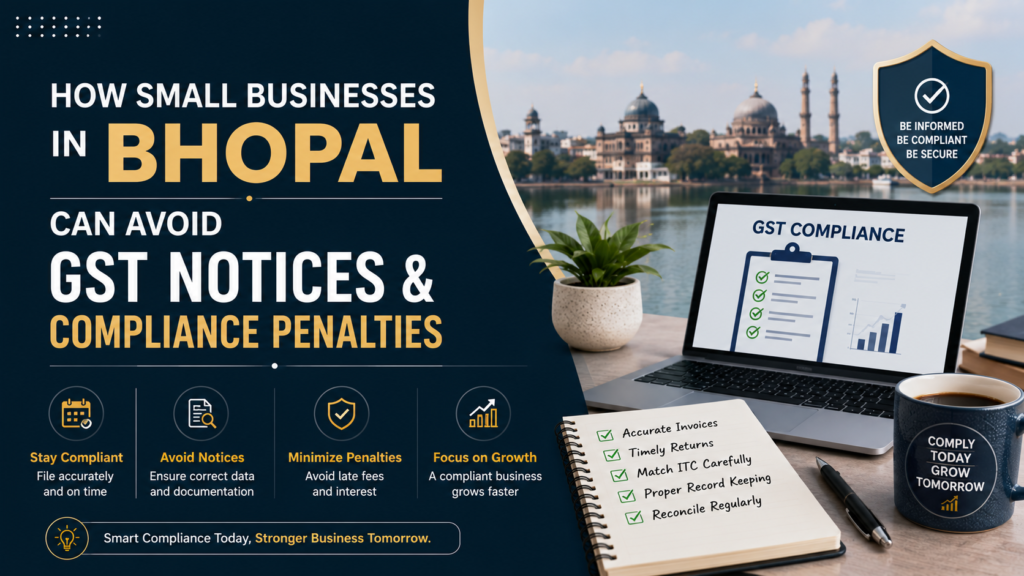
How Small Businesses in Bhopal Can Avoid GST Notices & Compliance Penalties
TL;DR GST notices are becoming increasingly common for small businesses due to: Return mismatches Incorrect invoicing ITC claim errors Vendor non-compliance Late filing Incomplete documentation Many businesses in Bhopal unknowingly trigger compliance risks because they lack: Proper GST monitoring Monthly reconciliation systems Structured accounting practices This guide explains how small businesses can reduce GST risks, maintain compliance, and avoid penalties through practical and proactive GST management strategies in 2026. Why GST Notices Are Increasing for Small Businesses The GST ecosystem has become significantly more data-driven. Authorities now use: Automated return matching AI-based risk analysis E-invoice validations ITC reconciliation systems Vendor compliance tracking As a result, even small inconsistencies can trigger: Notices Scrutiny Penalty proceedings ITC reversals Many small businesses in Bhopal still rely on manual bookkeeping or irregular filing systems, increasing compliance exposure. Common Reasons Businesses Receive GST Notices Understanding the root causes is the first step toward prevention. 1. Late GST Return Filing Delayed filing remains one of the most common reasons businesses receive notices. Frequent delays create: Compliance flags Late fee accumulation Higher scrutiny probability 2. Incorrect GST Invoices Invoice errors often lead to: ITC rejection Mismatches Buyer complaints GST scrutiny Common invoice mistakes include: Wrong GSTIN Incorrect HSN/SAC codes Tax calculation errors Missing invoice details 3. Input Tax Credit (ITC) Mismatches ITC mismatch notices are increasing rapidly. This usually happens when: Vendors fail to upload invoices properly Incorrect GST returns are filed Purchase data does not match GST records 4. Mismatch Between GSTR-1 and GSTR-3B Sales reported in one return but missing in another often trigger automated scrutiny. Even minor inconsistencies can attract: Clarification notices Department inquiries Additional verification requests 5. Non-Compliance by Vendors Your GST compliance is also affected by your suppliers. If vendors: Fail to file returns Use incorrect GST details Become inactive taxpayers your business may face ITC complications. GST Compliance Mistakes That Trigger Penalties Many penalties are avoidable. The problem is not always tax liability. It is often poor compliance discipline. Common Mistakes Ignoring reconciliation Missing filing deadlines Poor documentation Claiming unsupported ITC Using outdated accounting systems Failing to monitor notices Not verifying vendors Importance of Proper GST Record Keeping Documentation is one of the strongest defenses against GST disputes. Businesses should maintain: Purchase invoices Sales invoices E-way bills Payment records Vendor communications GST return copies Reconciliation reports Proper records help businesses: Respond faster to notices Reduce audit risk Improve compliance accuracy How Invoice Errors Create GST Problems Incorrect invoicing is a major compliance risk. Businesses Should Verify: GSTIN accuracy Invoice numbering Tax breakup HSN/SAC codes Reverse charge applicability Place of supply details A small invoice mistake can create: ITC disputes Customer dissatisfaction Department notices Input Tax Credit Mismatch Issues ITC is one of the most sensitive GST areas. Authorities closely monitor: Fake ITC claims Duplicate claims Vendor mismatches Excessive credits Best Practices for ITC Compliance Conduct monthly reconciliation Match invoices with portal data Verify vendor filing status Avoid unsupported claims Maintain digital records GST Return Filing Best Practices Consistent filing discipline significantly reduces notice risks. Recommended Practices File returns before due dates Reconcile books monthly Cross-check sales and purchase data Review tax liability carefully Monitor GST portal communications Maintain filing acknowledgment records Vendor Compliance Monitoring One non-compliant vendor can create major issues. Businesses Should: Verify vendor GST registration Check filing consistency Avoid high-risk suppliers Conduct periodic vendor reviews Vendor due diligence is now an essential GST compliance activity. GST Audit & Scrutiny Preparedness Even compliant businesses may receive notices. The goal is not panic avoidance. It is preparedness. Audit Readiness Checklist Organized financial records Proper invoice management Monthly reconciliation reports GST payment proofs Vendor documentation Accurate books of accounts Businesses with proper systems typically respond faster and reduce escalation risk. Digital Accounting & Automation Benefits Manual accounting increases compliance risk. Modern accounting systems help: Reduce human error Automate reconciliations Generate accurate reports Improve filing accuracy Track GST liabilities Automation improves both: Compliance quality Operational efficiency ]GST Compliance Checklist for Bhopal Businesses Compliance Area Recommended Action GST Return Filing File before deadlines ITC Reconciliation Monthly review Vendor Verification Quarterly checks Invoice Accuracy Pre-submission validation Record Keeping Digital documentation GST Notices Immediate review Accounting System Automation preferred Audit Preparation Maintain organized records How Junaid Khan & Co Helps Businesses Stay Compliant Junaid Khan & Co assists businesses with: GST registration GST return filing GST reconciliation Notice response assistance GST compliance review Vendor compliance analysis Accounting advisory Tax planning support The firm supports startups, traders, retailers, service providers, and MSMEs across Bhopal and other regions. Conclusion GST compliance in 2026 requires more than basic return filing. Businesses in Bhopal must adopt: Accurate documentation Timely filings ITC reconciliation Vendor monitoring Strong accounting systems Most GST notices arise from preventable compliance gaps. Businesses that implement proactive compliance systems can significantly reduce: Penalty exposure Scrutiny risks Operational disruptions A structured GST strategy not only improves compliance but also strengthens long-term business credibility and financial discipline. 6. FAQ SECTION 1. Why do small businesses receive GST notices? Businesses usually receive GST notices due to filing mismatches, late returns, ITC errors, or incorrect invoices. 2. How can businesses avoid GST penalties? Timely filing, monthly reconciliation, proper documentation, and vendor verification help reduce penalty risks. 3. What is the biggest GST compliance mistake? Ignoring reconciliation between GST returns and accounting records is one of the most common mistakes. 4. Can vendor mistakes affect my GST compliance? Yes. Non-compliant vendors can create ITC mismatches and increase scrutiny risk. 5. How often should GST reconciliation be done? Monthly reconciliation is recommended for accurate compliance management. 6. What should businesses do after receiving a GST notice? Businesses should review the notice carefully, verify records, and respond within the prescribed timeline. 7. Is digital accounting necessary for GST compliance? Digital accounting significantly improves accuracy and reduces manual compliance errors. 8. Can incorrect invoices trigger GST notices? Yes. Errors in GSTIN, tax calculation, or HSN codes may trigger scrutiny. BLOG BY: Junaid Khan & Co. Written by CA Junaid Ahmed Khan, Junaid Khan & Co.,