

Income Tax Return Filing 2026: Complete Checklist for Salaried Professionals, Freelancers & Business Owners
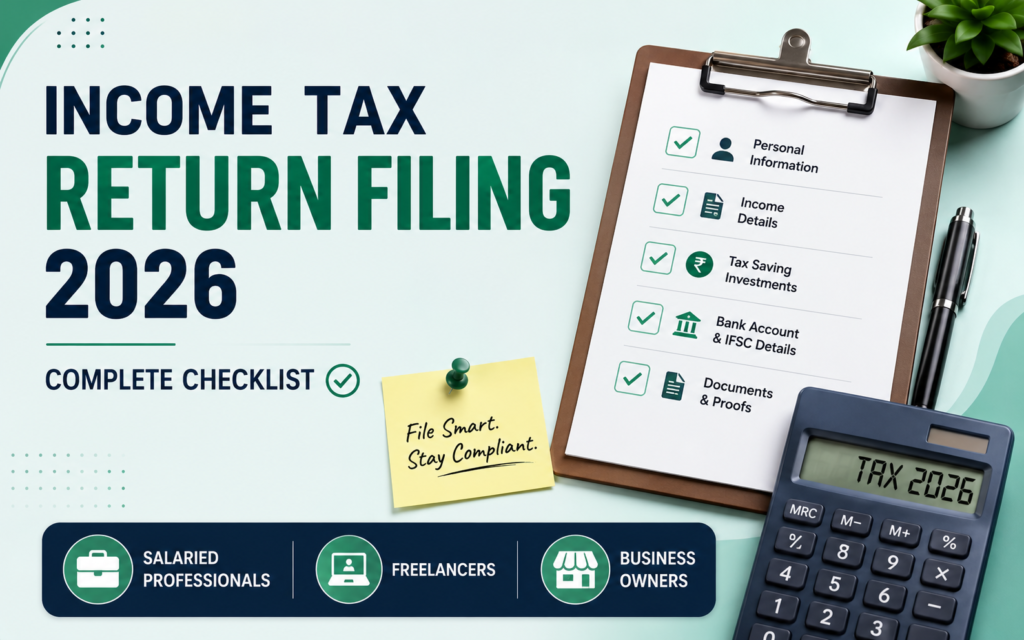
TL;DR Income Tax Return (ITR) filing is no longer just a legal formality. With increasing digital tracking, AIS reporting, PAN-based monitoring, and financial data integration, taxpayers must file accurate returns backed by proper documentation. This complete 2026 ITR filing guide explains: Documents required for tax filing ITR checklist for salaried employees Tax filing tips for freelancers Business owner compliance requirements Common filing mistakes Tax-saving preparation strategies Ways to avoid notices and penalties Why Income Tax Return Filing Matters Income tax filing plays a crucial role in: Legal tax compliance Loan and visa approvals Financial transparency Claiming refunds Carrying forward losses Maintaining clean financial records Today, the Income Tax Department uses advanced data analytics to match : Bank transactions TDS records Mutual fund investments Stock trading activity Credit card usage Property transactions Even small mismatches can trigger scrutiny or notices. For salaried individuals, freelancers, and businesses, timely and accurate filing has become essential. Who Should File an Income Tax Return? Many taxpayers incorrectly assume ITR filing is required only if taxes are payable. However, filing may be important for: Salaried employees Freelancers and consultants Proprietorship businesses Companies and LLPs Startup founders Ecommerce sellers Investors and traders Professionals earning foreign income Even individuals with lower taxable liability often file returns for: Loan eligibility Financial proof Refund claims Visa applications Compliance continuity Important Documents Required for ITR Filing Before starting your return filing, organize all financial documents properly. Document Purpose PAN Card Taxpayer identification Aadhaar Card Verification Form 16 Salary income details Form 26AS TDS verification AIS/TIS Financial transaction summary Bank Statements Income reconciliation Investment Proofs Deduction claims Home Loan Statement Interest deduction Rent Receipts HRA claims Capital Gain Statements Investment taxation Maintaining proper documentation reduces filing errors significantly. ITR Filing Checklist for Salaried Professionals Salaried employees often assume Form 16 alone is enough for filing. In reality, multiple financial disclosures must be verified. 1. Verify Form 16 Carefully Check: Salary breakup TDS deductions Employer PAN Exemptions and deductions Mismatch between Form 16 and Form 26AS can create issues. 2. Review AIS and Form 26AS AIS (Annual Information Statement) may contain: Interest income Dividend income Mutual fund transactions Securities transactions High-value banking activities Ignoring AIS discrepancies is a common reason for tax notices. 3. Declare Additional Income Many salaried individuals forget to disclose: Savings account interest FD interest Freelance side income Rental income Capital gains All taxable income must be reported. 4. Check Deduction Eligibility Review deductions under applicable provisions such as: Insurance premiums Investment-linked deductions Education loan interest Housing loan benefits Medical insurance 5. Choose Correct Tax Regime The old and new tax regimes have different deduction structures. A comparative analysis helps determine the better option. ITR Filing Checklist for Freelancers & Consultants Freelancers face unique compliance challenges because income may come from multiple clients and platforms. 1. Maintain Proper Income Records Track: Client payments Online receipts Foreign remittances Platform commissions Poor record keeping often leads to inaccurate reporting. 2. Separate Personal and Business Expenses Using separate bank accounts improves: Audit readiness Expense tracking Tax computation accuracy 3. Reconcile TDS Entries Clients may deduct TDS under different sections. Verify entries in Form 26AS. 4. Maintain Expense Documentation Freelancers should preserve: Software subscriptions Internet bills Laptop expenses Office rent Travel expenses Professional tools 5. Review Advance Tax Liability Freelancers with significant tax liability may need advance tax compliance. ITR Filing Checklist for Business Owners Business owners require deeper financial reconciliation before filing returns. 1. Finalize Bookkeeping Ensure: Sales records are accurate Expense entries are verified GST reconciliation is complete Debtors and creditors match 2. Verify GST and Income Tax Consistency Mismatch between GST turnover and income tax turnover may trigger scrutiny. 3. Review Cash Transactions Large unexplained cash transactions increase risk exposure. 4. Reconcile Bank Accounts All business bank accounts should align with accounting records. 5. Check Depreciation and Asset Records Incorrect depreciation claims are common filing errors among businesses. Choosing the Correct ITR Form Selecting the wrong ITR form can invalidate returns. Commonly Used ITR Forms ITR Form Suitable For ITR-1 Salaried individuals ITR-2 Capital gains and multiple income sources ITR-3 Business/professional income ITR-4 Presumptive taxation Form selection depends on: Income type Business structure Capital gains Foreign income Tax regime Old Tax Regime vs New Tax Regime Choosing the correct tax regime requires evaluating: Deductions available Investment structure Salary components Housing loan benefits Professional expenses Old Regime Suitable for taxpayers claiming substantial deductions. New Regime Suitable for taxpayers preferring simplified taxation with lower deductions. Tax planning should be personalized rather than generic. Common Income Tax Filing Mistakes 1. Filing Incorrect ITR Form Wrong form selection may invalidate returns. 2. Ignoring AIS Data AIS mismatches are now a major scrutiny trigger. 3. Missing Income Disclosure Undisclosed interest or side income often results in notices. 4. Incorrect Deduction Claims Unsupported deduction claims increase compliance risks. 5. Last-Minute Filing Rushed filings often lead to errors and omissions. 6. Ignoring Foreign Income Reporting Foreign assets and overseas income require proper disclosure. How to Avoid Tax Notices Maintain Accurate Documentation Organized records simplify compliance. Match All Tax Data Cross-check: Form 16 AIS 26AS Bank records Avoid Artificial Deductions Claim only genuine deductions supported by evidence. File Returns Before Deadline Timely filing improves compliance credibility. Seek Professional Review Expert review helps identify risks before submission. Why Professional Tax Assistance Matters Tax laws continue evolving every year. Professional tax assistance helps: Reduce filing errors Optimize deductions Improve compliance Handle notices Select appropriate tax regime Maintain audit-ready records This is especially important for: High-income professionals Freelancers Startups Business owners Investors How Junaid Khan & Co Supports Taxpayers Junaid Khan & Co assists individuals and businesses with: Income tax return filing Tax planning and advisory Business tax compliance Freelance taxation GST and accounting support Tax notice response assistance Financial documentation review The firm works with salaried professionals, startups, consultants, and businesses across multiple sectors. Conclusion Income Tax Return Filing in 2026 requires much more than basic data entry. Taxpayers must carefully reconcile income, deductions, financial disclosures, and compliance